How DSCR Loan Rate Sheets and Pricing Adjusters Work
September 25, 2026
•
10 min read
Table of Contents
How DSCR Loan Rate Sheets and Pricing Adjusters Work
Real estate investors shopping for DSCR loans often encounter the same frustration: one lender's quote comes in noticeably lower than another's, and both claim they're competitive. The truth is, DSCR loan pricing isn't arbitrary. Behind every rate quote lies a structured system of rate sheets and pricing adjusters that respond to your credit profile, loan-to-value ratio, property type, and even the day you lock your rate. Understanding how DSCR loan rate sheets and pricing adjusters work gives you the insight to compare lenders accurately, time your lock strategically, and negotiate from a position of strength.
DSCR loans are underwritten on rental income, not personal income, which makes them invaluable for investors scaling portfolios or holding properties in LLCs. But that flexibility comes with pricing complexity. Lenders layer multiple adjustments onto a base rate, each reflecting a specific risk factor. Credit score, loan-to-value ratio, property type, loan size, and prepayment terms all trigger adjusters that can swing your final rate by half a point or more. Add daily market fluctuations driven by Treasury yields and investor demand, and you've got a pricing landscape that changes faster than most investors realize.
This guide breaks down how wholesale DSCR rate sheets are structured, which pricing adjustments matter most, why rates shift daily, and how to read a rate sheet like a seasoned broker. Whether you're financing your first rental or your fiftieth, knowing the mechanics behind DSCR pricing helps you make smarter financing decisions and squeeze every basis point out of your deal.
What DSCR Rate Sheets Actually Show
A wholesale DSCR rate sheet is the daily pricing menu lenders use to quote loans. It lists base interest rates for various loan programs, then applies a grid of pricing adjustments based on borrower and property characteristics. Rate sheets are updated each business day, typically in the morning, to reflect overnight changes in secondary mortgage markets and Treasury yields.
Base rates by credit tier and LTV: The sheet starts with a matrix showing rates for different FICO score bands and loan-to-value ratios. For example, a borrower with a 740 FICO and 75% LTV typically sees a more favorable base rate than a 680 FICO borrower at the same LTV, often by 50 to 75 basis points. Base rates move with the broader market on a daily basis, so treat any specific number as a snapshot rather than a fixed figure, and confirm current pricing directly with your lender.
Pricing adjustments and hits: Below the base rate grid, you'll find a long list of adjustments, often called hits or add-ons. These cover everything from cash-out refinances and non-owner-occupied status to reserve requirements and prepayment penalties. Each adjuster is expressed in basis points or as a rate increase. A 50-basis-point hit means your rate goes up by 0.50%, or your upfront cost increases if you choose to buy down the rate.
Lock period and product type: Rate sheets also vary by lock period (15-day, 30-day, 45-day, 60-day). Longer locks cost more because they expose the lender to more interest rate risk. You'll see separate tabs or sections for 30-year fixed, adjustable-rate, and interest-only DSCR products, each with its own base pricing and adjusters.
How Credit Score and LTV Adjusters Affect DSCR Pricing
Your credit score and loan-to-value ratio are the two most powerful drivers of DSCR loan pricing. Lenders use them to segment risk and price accordingly, with every 20-point drop in FICO or 5-point increase in LTV potentially triggering a new pricing tier.
Credit score tiers: DSCR lenders typically require a minimum credit score around 620, though some investors find better pricing starting at 660 or 680. The rate difference between a 780 FICO and a 680 FICO can easily reach 75 to 100 basis points. Higher credit scores signal lower default risk, so lenders reward them with tighter spreads. If your score sits near a tier boundary (say, 699 versus 700), even a small boost can unlock meaningfully better pricing.
Loan-to-value bands: DSCR loans typically allow up to 75% to 80% LTV, meaning you'll generally need a down payment of 20% to 25%. Lower LTVs earn better rates because the lender's risk decreases when you have more equity at stake. A 70% LTV loan might price 25 to 50 basis points lower than an 80% LTV loan with the same credit profile. Investors who can stretch their down payment often find the rate savings compound over the life of the loan, more than offsetting the extra cash outlay.
Combined adjustments: Credit and LTV adjustments stack. If you're at the lower end of both scales (say, 640 FICO and 80% LTV), you'll absorb multiple hits that push your rate well above the advertised floor. Conversely, a 760 FICO at 70% LTV can land you near the best-execution rate the lender offers. Understanding this stacking effect helps you prioritize which variable to improve first, whether that's paying down debt to lift your score or putting more cash into the deal to lower LTV.
Have a property in mind?
Tell us about the property and we will find the financing that fits you best.
Understanding Loan Level Price Adjustments on DSCR Loans
Beyond credit and LTV, DSCR lenders apply a suite of loan-level price adjustments that reflect specific loan characteristics and risk factors. These adjustments are where savvy investors can negotiate or restructure their deal to capture savings.
Cash-out versus rate-and-term refinance: Cash-out refinances typically carry a 25 to 50 basis point hit compared to rate-and-term or purchase loans. Lenders view cash-out as higher risk because you're extracting equity rather than simply improving your rate or buying a new asset. If you don't need the cash immediately, consider a rate-and-term refi first, then tap equity later if rates improve.
Property type and occupancy: Single-family rentals generally price better than 2-4 unit properties, which in turn price better than condos or rural properties. Non-owner-occupied status is already baked into DSCR pricing, but unique property types (manufactured homes, properties over a certain acreage, high-rise condos) can trigger additional adjustments. Always confirm the property type adjuster before you make an offer, especially if you're venturing outside standard single-family or duplex rentals.
Loan size and prepayment penalties: Some lenders offer better pricing on larger loan amounts because the fixed costs of underwriting are spread over a bigger balance. Conversely, very small loans (under $75,000 or $100,000) might carry surcharges. Prepayment penalties (typically 3-2-1 step-downs over three years) can buy you a rate discount of 25 to 50 basis points. If you plan to hold the property long-term and won't refinance or sell soon, accepting a prepayment penalty can meaningfully lower your rate.
Why DSCR Pricing Changes Daily
Rate sheets are published every business day because the mortgage market is tightly linked to the broader bond market, particularly Treasury yields and mortgage-backed securities. When those markets move, lenders reprice their rate sheets to protect their margins and manage risk.
Treasury yields serve as the benchmark for mortgage rates. When the 10-year Treasury yield rises, mortgage rates typically follow, and vice versa. DSCR loans are often sold into the secondary market as non-QM mortgage-backed securities, so investor demand for those securities directly influences the rates lenders can offer. Strong demand tightens spreads and lowers rates, while weak demand widens spreads and pushes rates higher.
Economic data releases, Federal Reserve policy statements, inflation reports, and geopolitical events can all trigger intraday swings in Treasury yields. A hotter-than-expected jobs report might send yields spiking, prompting lenders to reprice their rate sheets upward by midday. Conversely, softer inflation data can drive yields down and improve pricing overnight. For investors, this means the rate you see on Monday morning might be 25 basis points different by Friday, even if your credit score and LTV haven't changed.
Lock timing becomes critical in volatile markets. If you expect rates to rise, locking early protects you. If you believe rates will fall, a float strategy (delaying your lock) might pay off, though it carries the risk of rates moving against you. Many brokers offer float-down options or extended locks for a fee, giving you some flexibility to capture improvements while limiting downside risk.
Daily rate monitoring is essential for active investors. Subscribing to rate alerts, checking your broker's rate sheets each morning, or using platforms that aggregate DSCR pricing can give you the edge to lock at the right moment. Even a 10-basis-point improvement on a $500,000 loan saves you real money over 30 years, so staying informed pays dividends.
Reading a Wholesale DSCR Rate Sheet Like a Pro
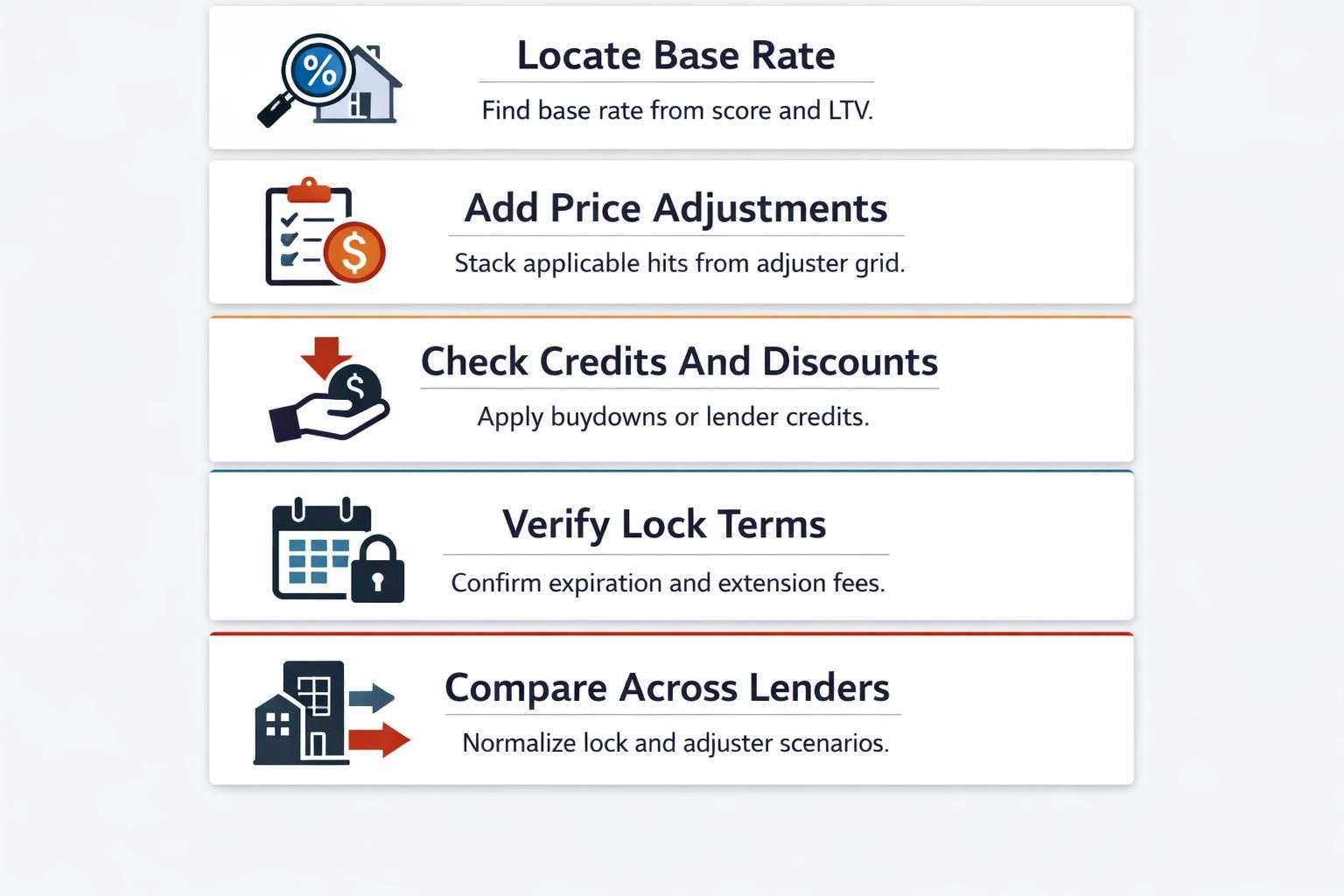
Once you understand the components, reading a DSCR rate sheet becomes straightforward. Here's a step-by-step approach to decode the numbers and calculate your true rate.
Locate your base rate: Find the intersection of your credit score tier and LTV ratio on the rate matrix. This is your starting point. For example, if you have a 720 FICO and 75% LTV, look for the cell where those two variables meet, that's the base rate for a 30-year fixed DSCR loan before any adjustments.
Add loan-level price adjustments: Scan the adjustment grid for any hits that apply to your loan. If you're doing a cash-out refi, add 0.375%. If your property is a 2-unit, add another 0.125%. If you're taking a 60-day lock instead of 30-day, add 0.25%. Stack all applicable adjustments onto your base rate to arrive at your gross rate.
Check for credits or discounts: Some rate sheets offer rate buydowns if you pay points upfront, or discounts for higher DSCR ratios (say, 1.5 or above). If you're willing to pay a point at closing, you might shave 0.25% off the rate. Conversely, if you want zero closing costs, the lender might add 0.50% to the rate and give you a lender credit. Decide whether you want to pay upfront or finance the cost into your rate based on your hold period and cash flow strategy.
Verify rate lock expiration and extension fees: Confirm how long your lock is good for and what it costs to extend if your closing is delayed. A 30-day lock that expires before your title clears can force you into a costly extension or a reprice at current market rates. Build in buffer time, especially if you're buying a property with inspection contingencies or dealing with a slow title company.
Compare apples to apples across lenders: When shopping multiple lenders, make sure you're comparing the same loan structure, lock period, and adjustment scenario. A quote with a longer lock and no prepayment penalty isn't directly comparable to a lower quote that carries a shorter lock and a three-year prepay. Normalize the variables so you can see which lender truly offers the best deal for your situation.
DSCR loan rate sheets and pricing adjusters aren't designed to confuse you, they're a transparent reflection of how lenders price risk in the non-QM space. Once you know how to read the base rate grid, apply the relevant adjustments, and track daily market movements, you can approach DSCR financing with the same clarity you bring to analyzing cap rates and cash-on-cash returns. Credit score and LTV remain the heaviest levers, but loan-level adjustments for property type, loan size, and prepayment terms give you room to optimize.
Daily rate volatility means timing matters. Monitoring rate sheets, understanding Treasury yield trends, and locking strategically can save you thousands over the life of your loan. Whether you're scaling a portfolio or refinancing a single property, the investors who master rate sheet mechanics consistently secure better terms and preserve more cash flow for the next deal.
Keep in mind that the figures and pricing discussed here can change as market conditions evolve. For the most current DSCR loan terms and to confirm how today's adjusters apply to your specific scenario, get a personalized DSCR loan quote directly from Trulo Mortgage. Armed with the knowledge of how rate sheets work, you'll be ready to evaluate every quote with confidence and lock in financing that supports your investment strategy for the long haul.