What Is a Yield Spread Premium in DSCR Loan Pricing
When you're shopping for a DSCR loan, the interest rate quote you receive isn't always as straightforward as it seems. Behind that number sits a layer of lender compensation that can quietly influence your cost of capital. One of those mechanisms is the yield spread premium, a pricing factor that many real estate investors overlook until they dig into the fine print.
Understanding what is a yield spread premium in DSCR loan pricing can help you evaluate loan offers more critically, compare brokers, and ultimately make better financing decisions for your rental portfolio. It's not about gaming the system. It's about knowing where your money goes and what drives the rate you pay.
This article breaks down how yield spread premiums work, how they differ from discount points, how brokers earn on DSCR loan rate spreads, and what it all means for your bottom line as an investor.
What Yield Spread Premium Really Means
A yield spread premium is a form of lender compensation paid to a mortgage broker when the borrower accepts an interest rate higher than the lowest rate the lender is willing to offer. In simpler terms, if the lender could offer you a 7.5% rate but the broker quotes you 8%, that extra half-point generates a rebate from the lender to the broker.
This rebate is the yield spread premium. It's not an additional fee charged to you directly. Instead, it's built into the rate itself. The higher the rate you accept, the larger the premium the lender typically pays the broker.
Rate-based compensation: The premium increases as the rate climbs above par, giving brokers an incentive to present higher rates when possible.
Alternative to upfront fees: Instead of charging you origination points out of pocket, the broker may opt to earn through yield spread premium and advertise a lower-fee or no-fee loan.
Disclosed at closing: Yield spread premiums must be disclosed in loan documents, though the exact labels and line items can vary depending on jurisdiction and lender.
Not inherently deceptive: While the term can sound complex or even shady, yield spread premium is a standard industry practice and legal when properly disclosed.
For DSCR loans, which are investor-focused products not bound by the same consumer mortgage regulations that apply to owner-occupied homes, yield spread premiums are often more flexible. Brokers working in the DSCR space may offer a broader range of rate and fee combinations, giving investors choices between paying upfront costs or accepting a higher rate in exchange for lower closing expenses.
How Yield Spread Premium Affects DSCR Loan Rates
The mechanics are simple. Lenders price loans on a spectrum. At one end, you can pay discount points to buy down your rate. At the other, you accept a higher rate and the lender pays the broker a rebate. That rebate is what makes no-closing-cost loans possible.
When a broker presents you with a DSCR loan quote, the rate reflects their choice of where to land on that spectrum. If they quote you a rate above par, the yield spread premium they receive can cover some or all of the loan origination costs, processing fees, and even third-party charges.
Higher rate, lower fees: Accepting a rate above the lender's base rate allows the broker to use the yield spread premium to offset your upfront costs, sometimes eliminating origination fees entirely.
Longer-term cost: While you save money at closing, you'll pay more interest over the life of the loan, which can add up significantly on a rental property held for years.
Breakeven analysis matters: Investors should calculate how long it takes for the interest cost of a higher rate to exceed the savings from reduced upfront fees, especially if you plan to refinance or sell within a few years.
Rate shopping complications: Because brokers can adjust where they price your loan on the rate spectrum, comparing quotes requires looking at both the rate and the total fees, not just one or the other.
In DSCR loan pricing, this dynamic plays out frequently. Investors often prioritize cash flow and liquidity over long-term interest savings, making higher-rate, lower-fee structures appealing. But it's important to recognize that the convenience comes at a price, and that price is determined in part by how yield spread premium affects DSCR loan rates.
Have a property in mind?
Tell us about the property and we will find the financing that fits you best.
Lenders compensate brokers in two primary ways: borrower-paid compensation and lender-paid compensation. Yield spread premium falls into the latter category. Rather than you writing a check directly to the broker, the lender pays the broker out of the interest rate margin.
This structure creates a potential conflict of interest. A broker earning more when you accept a higher rate might not always present you with the lowest available option. That doesn't mean all brokers act against your interest, but it does mean you need to ask the right questions and understand the trade-offs.
Lender-paid vs. borrower-paid: You can often choose between paying the broker directly via origination points or letting them earn through yield spread premium by accepting a higher rate.
Transparency requirements: Brokers are required to disclose their compensation, though the format and clarity of those disclosures can vary widely across lenders and loan types.
Negotiation leverage: If you understand that the broker's compensation is flexible, you can negotiate for a lower rate in exchange for paying higher upfront fees, or vice versa.
Impact on DSCR underwriting: The compensation structure doesn't change your debt service coverage ratio or loan eligibility, but it does affect your total cost and cash outlay at closing.
Understanding lender compensation in DSCR pricing gives you a clearer picture of the real cost of your loan. It also helps you evaluate whether a broker is working in your best interest or steering you toward a rate that maximizes their payout. Transparency and open communication are key.
Yield Spread Premium vs Discount Points
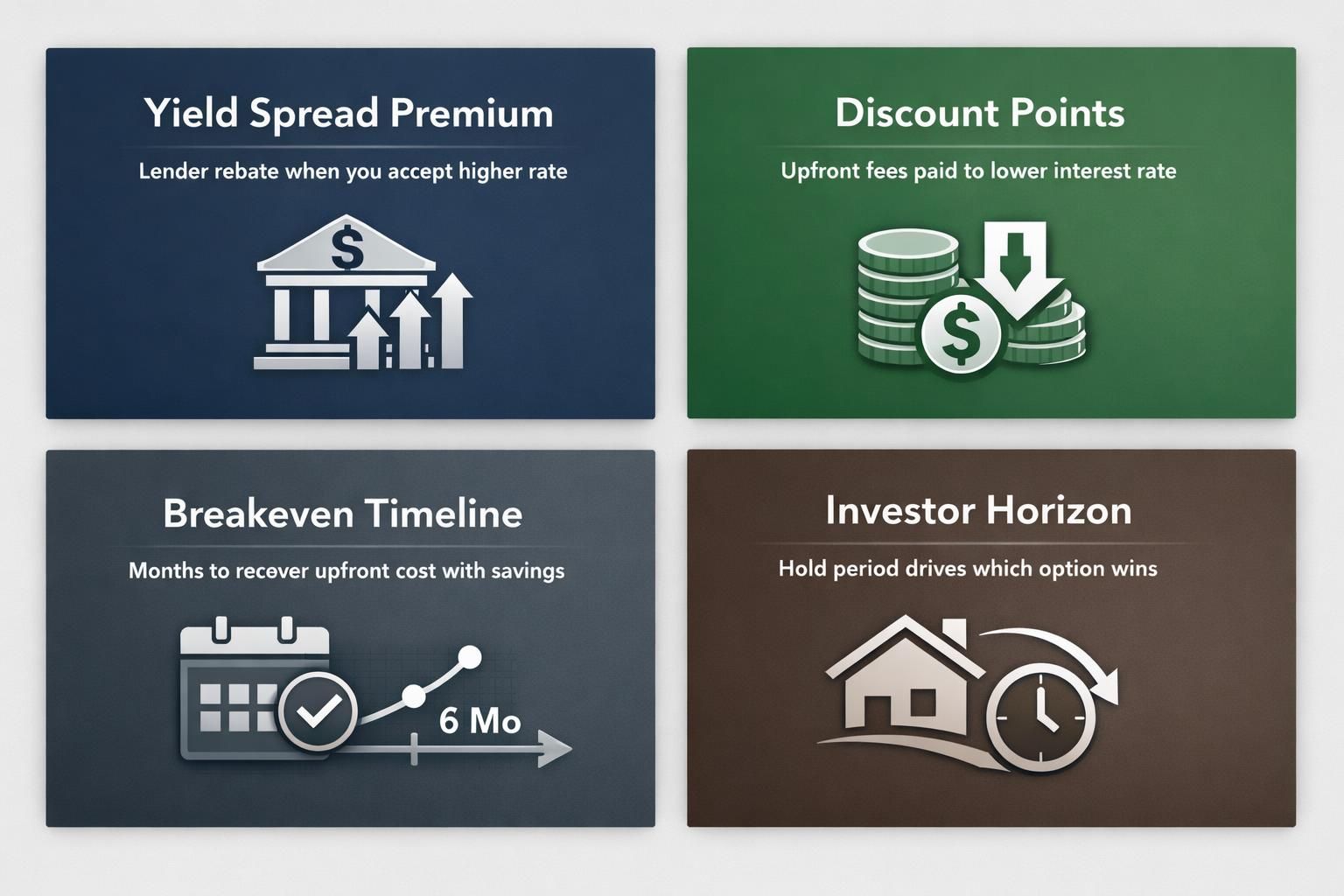
These two concepts sit on opposite ends of the same pricing spectrum. Discount points are fees you pay upfront to lower your interest rate. Yield spread premium is the rebate the lender pays the broker when you accept a higher rate. Both affect your total cost, just in different directions.
Investors often face a choice: pay more now to save later, or save now and pay more over time. The right answer depends on your investment strategy, how long you plan to hold the property, and your current liquidity needs.
Discount points lower your rate: Each point typically costs 1% of the loan amount and may reduce your rate by roughly 0.25%, though the exact reduction varies by lender and market conditions.
Yield spread premium raises your rate: Accepting a rate above par generates a lender rebate that can cover closing costs, effectively trading long-term interest for short-term savings.
Breakeven timeline: Calculate how many months of interest savings it takes to recover the cost of discount points, or how long it takes for a higher rate to exceed the upfront savings from yield spread premium.
Investment horizon drives the decision: If you're flipping or refinancing within two years, paying points rarely makes sense. If you're holding the property long-term, buying down the rate can save substantial money over time.
The key is to model both scenarios using your actual loan amount, projected hold period, and cash flow goals. Many investors default to whichever option a broker presents first, but yield spread premium vs discount points is a decision worth making deliberately, not passively.
How Brokers Earn on DSCR Loan Rate Spreads
Brokers don't work for free, and understanding how they get paid helps you evaluate the fairness and competitiveness of the loan offer in front of you. In DSCR lending, brokers typically earn through a combination of origination fees, processing fees, and yield spread premiums.
The rate spread is the difference between the rate the lender offers at par and the rate the broker quotes you. The wider that spread, the larger the lender's rebate to the broker. This creates a natural tension: brokers can earn more by presenting higher rates, but doing so risks losing your business to a competitor with a better offer.
Par rate baseline: Every lender has a par rate for your profile, the rate at which they neither charge nor rebate the broker. Anything above par generates yield spread premium.
Rebate tiers: Lenders typically pay brokers a percentage of the loan amount based on how far above par the rate sits, often in increments of 0.125% or 0.25%.
Fee transparency: Some brokers disclose their total compensation upfront, while others bury it in closing documents or present it in ways that make comparison difficult.
Competitive pressure: In a transparent market, brokers who overprice loans risk losing deals, which incentivizes fair pricing even when yield spread premium is in play.
Knowing how brokers earn on DSCR loan rate spreads doesn't mean you should distrust your broker. It means you should ask for a rate sheet, request quotes at different rate and fee combinations, and compare offers from multiple brokers to ensure you're getting a competitive deal. Good brokers will walk you through the trade-offs openly and help you choose the structure that best fits your goals.
Understanding what is a yield spread premium in DSCR loan pricing isn't just about knowing the definition. It's about recognizing how lender compensation influences the rate you're quoted, how brokers structure deals, and where you have leverage to negotiate better terms.
Yield spread premium isn't inherently bad. It's a tool that allows brokers to offer low-fee or no-fee loans by accepting a slightly higher rate. But like any tool, it can be used well or poorly. The difference comes down to transparency, disclosure, and whether the broker is presenting options that align with your investment strategy.
As an investor, your job is to ask questions, compare offers, and run the numbers. Model the total cost of each loan structure over your expected hold period. Understand the trade-off between upfront fees and long-term interest. And don't be afraid to push back if a broker can't clearly explain where their compensation comes from or why they're recommending one rate over another.
DSCR loans typically require a down payment of 20% to 25%, up to 75% to 80% LTV, a minimum credit score of 620, and a minimum DSCR ratio of 1.0, though these figures can vary and should be confirmed directly with the lender. The same principle applies to yield spread premium: get the details in writing, confirm current terms, and make sure you're comfortable with the structure before you close.
If you're ready to explore DSCR loan options with transparent pricing and investor-focused service, get a personalized DSCR loan quote today and see how different rate and fee structures stack up for your portfolio.