Understanding DSCR Loan Underwriting Overlays vs Standard Guidelines
Every real estate investor who's shopped for financing knows the frustration: one lender says yes, another says no, and both are offering DSCR loans. You're looking at the same property, the same credit score, the same down payment, yet the outcomes couldn't be more different. Understanding DSCR loan underwriting overlays vs standard guidelines is the key to unlocking why this happens and, more importantly, how to use that knowledge to your advantage.
DSCR loans qualify investors based on a property's rental income rather than personal W-2 income, which opens doors for portfolio-focused investors. But here's the catch: while the fundamental DSCR calculation remains consistent across the industry, each lender applies its own set of overlays on top of baseline guidelines. These overlays can restrict or expand your eligibility in ways that aren't always obvious from a rate sheet.
The DSCR lending market in 2026 is seeing increased competition, which often leads to more favorable terms and broader eligibility for investors who know where to look. With rates typically ranging between 6% and 8.25%, and lenders expanding their geographic reach and product offerings, investors now have more choices than ever. But choice means complexity, and complexity means you need to understand what separates one approval from another.
What Standard DSCR Guidelines Actually Cover
Standard DSCR guidelines establish the baseline framework for how these loans function across the industry. At its core, the debt service coverage ratio is calculated by dividing the property's monthly rental income by its monthly debt obligations, including principal, interest, taxes, insurance, and any HOA fees. A ratio of 1.0 means the property breaks even, while anything above indicates positive cash flow.
Loan-to-Value Ratio: DSCR loans typically allow up to 75% to 80% LTV, meaning investors generally need to provide a down payment of 20% to 25%. This baseline exists across most programs to ensure sufficient borrower equity and reduce lender risk.
Credit Score Minimums: Most DSCR programs establish a minimum credit score threshold, often around 620, though many lenders prefer higher scores to qualify for better pricing tiers. This baseline helps lenders assess borrower reliability without relying on employment verification.
Debt Service Coverage Ratio Floor: The minimum DSCR ratio accepted is typically 1.0, meaning the property must at least break even on its debt obligations. Some programs may price more favorably for ratios above 1.25, rewarding stronger cash flow properties.
Property Type Eligibility: Standard guidelines generally cover 1-4 unit residential investment properties, including single-family homes, condos, and small multifamily buildings. Short-term and long-term rental properties are both commonly accepted under baseline terms.
These standard guidelines create the foundation, but they're just the starting point. Every lender builds its own risk model on top of these baselines, and that's where overlays come into play. Understanding the difference between what's considered standard and what's lender-specific helps you identify which restrictions are negotiable and which are industry-wide.
DSCR loans also typically allow for multiple financed properties without the portfolio loan caps you'd encounter with conventional financing. The calculation method remains consistent: rental income is assessed through current leases, market rent appraisals, or a combination, then measured against total monthly debt to determine eligibility.
What DSCR Lender Overlays Are and Why They Exist
A lender overlay in DSCR underwriting is any additional requirement or restriction imposed by a specific lender beyond the baseline program guidelines. These can range from higher credit score minimums to geographic restrictions, prepayment penalties, or limitations on property condition and type. Overlays are how lenders manage their own risk appetite, capital availability, and competitive positioning.
Overlays exist for several practical reasons. First, each lender has its own liquidity constraints and investor agreements. If a lender sells its loans to institutional investors on the secondary market, those investors might demand stricter criteria than the baseline program allows. Second, regional performance data influences overlay decisions. A lender that's seen higher default rates in certain markets might add overlays restricting loans in those areas, even if the standard guidelines don't prohibit them.
Third, overlays help lenders differentiate themselves in a competitive market. Some lenders tighten overlays to attract only the strongest borrowers, allowing them to offer slightly better rates. Others loosen overlays to capture a broader market share, accepting slightly more risk in exchange for volume. Increased competition in the DSCR lending space may lead to more favorable borrower terms, as lenders adjust overlays to remain attractive.
Common overlay examples include requiring a higher DSCR ratio than the 1.0 minimum, such as 1.10 or 1.25, or mandating larger reserves, often six to twelve months of payments rather than the baseline requirement. Geographic overlays might exclude certain states or counties, while property condition overlays could prohibit properties needing significant rehabilitation or non-warrantable condos, even though some lenders explicitly accept them.
What makes overlays particularly important is that they're not always disclosed upfront. A lender might advertise a 620 minimum credit score but internally require 640 for certain property types or loan amounts. This opacity is why two DSCR lenders can approve the same file differently, even when both claim to follow the same base program.
Have a property in mind?
Tell us about the property and we will find the financing that fits you best.
Why Two DSCR Lenders Approve the Same File Differently
The same investor, same property, same financials, yet one lender issues a clear-to-close and another delivers a decline. This scenario plays out daily in the DSCR space, and overlays are almost always the culprit.
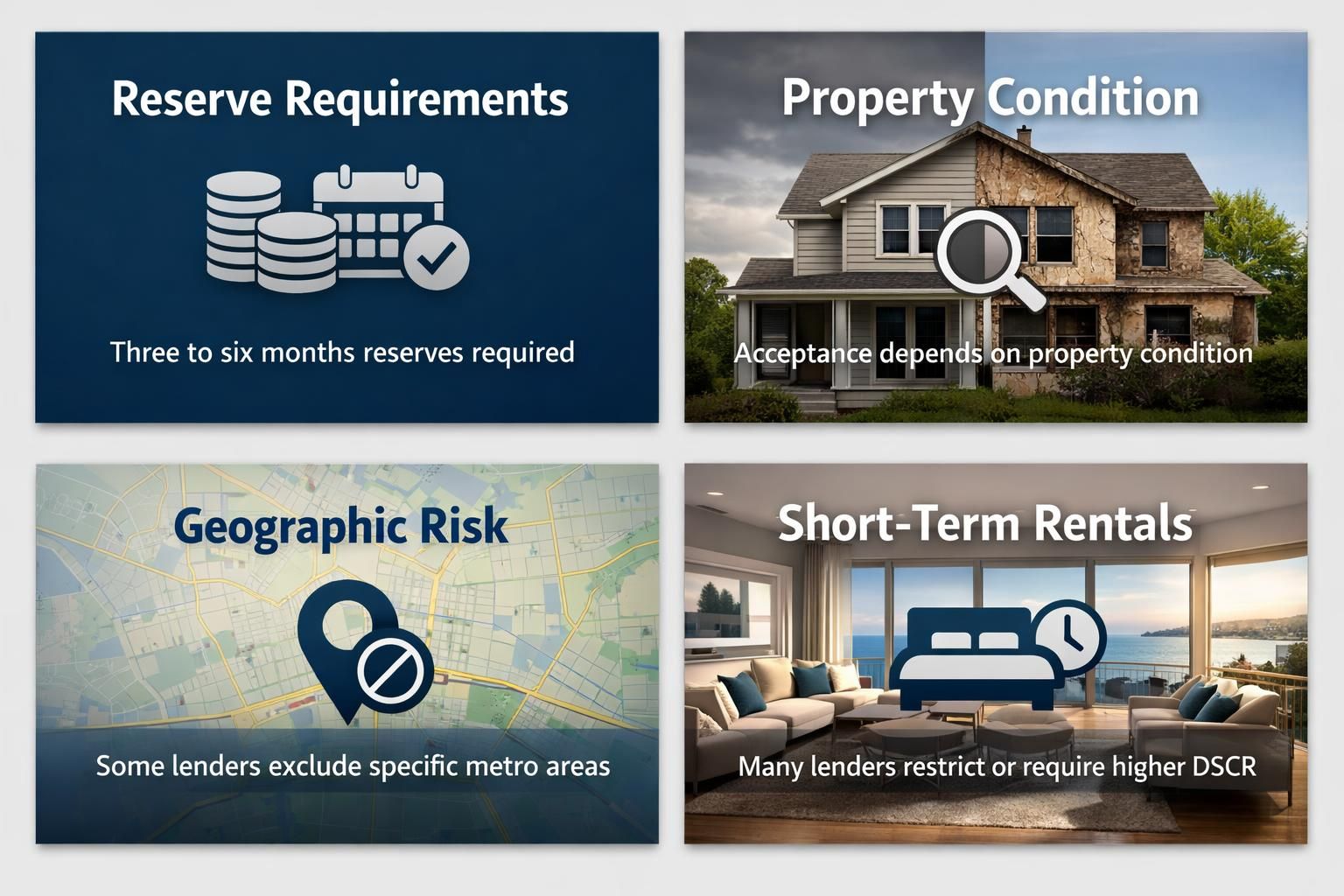
Reserve Requirement Variations: Lender A might require three months of reserves per financed property, while Lender B demands six months. An investor with four properties and moderate liquidity clears the first hurdle but fails the second, despite identical rental income and credit profiles.
Property Condition Standards: One lender's underwriting team accepts properties with deferred maintenance as long as they're habitable and rent-ready, while another flags anything below C+ condition as ineligible. The same duplex that appraises at market value gets approved by the flexible lender and rejected by the conservative one.
Geographic Risk Assessments: Lender overlays often reflect performance data from specific markets. A lender burned by foreclosures in a particular metro area might add that region to its exclusion list, even as competitors continue lending there. Your property in that city becomes a yes or no based entirely on which lender reviews it.
Short-Term Rental Policies: Some lenders embrace short-term rentals and use projected rental income based on market comparables, while others restrict or exclude them entirely due to income volatility concerns. The same Airbnb-ready beach condo gets financed by one lender and declined by another based purely on rental strategy.
Portfolio size also triggers different responses. A lender with aggressive growth targets might welcome an investor with ten financed properties, while another caps eligibility at four or six properties, regardless of cash flow strength. Credit events like past bankruptcies or foreclosures create similar divergence: one lender's overlay requires a seven-year seasoning period, another accepts three years with strong compensating factors.
Even the way rental income is calculated can differ. Some lenders use 75% of market rent to be conservative, while others accept 100% if a lease is in place. This difference alone can push a borderline deal from a 0.95 DSCR to a 1.05, transforming a decline into an approval. Shopping lenders to avoid restrictive DSCR overlays is not just smart strategy, it's often the difference between closing a deal and walking away empty-handed.
Do's When Navigating DSCR Underwriting Overlays
Successfully navigating the landscape of lender overlays requires a proactive, informed approach. Certain strategies consistently help investors secure approvals and favorable terms.
Do shop multiple lenders before committing to one: Because overlays vary so widely, contacting three to five lenders at the application stage gives you a clear picture of which restrictions are universal and which are lender-specific. Increased competition in the DSCR market may improve your leverage when comparing offers.
Do ask direct questions about specific overlays upfront: Before submitting a full application, ask whether the lender has geographic restrictions, property condition requirements, portfolio caps, or reserve minimums beyond standard guidelines. This transparency saves time and prevents surprises during underwriting.
Do prepare strong compensating factors when borderline on ratios: If your DSCR sits just below a lender's preferred threshold, highlight additional liquidity, strong credit history, low leverage across your portfolio, or experience managing similar properties. Many underwriters have discretion to approve borderline files when compensating factors are clearly documented.
Do keep detailed documentation of rental income and lease agreements: Lenders assess rental income differently, and having signed leases, historical rent rolls, or third-party market rent analyses ready demonstrates professionalism and speeds approvals. Clean documentation reduces the chance of overlays being applied due to income uncertainty.
Real estate investors who treat lender selection as carefully as property selection tend to close more deals with better terms. The do's focus on preparation, transparency, and comparison, turning the opacity of overlays into a competitive advantage rather than a frustration.
Don'ts That Cost Investors Approvals and Better Terms
Just as certain strategies improve your odds, common missteps can derail financing or lock you into unnecessarily restrictive terms. Avoiding these pitfalls keeps your options open.
Don't assume advertised minimums apply universally to your scenario: A lender advertising a 620 credit minimum and 1.0 DSCR might apply higher thresholds to certain property types, loan amounts, or borrower profiles. Always confirm the requirements specific to your exact situation rather than relying on marketing materials.
Don't submit to only one lender because of a slightly lower advertised rate: A rate advantage of 0.125% or 0.25% often disappears when overlays force you into higher fees, larger down payments, or prepayment penalties. The best rate means nothing if overlays prevent you from closing at all.
Don't withhold information about property condition or rental strategy: Attempting to hide deferred maintenance, short-term rental plans, or other details that might trigger overlays typically backfires during appraisal or final underwriting. Disclosure upfront lets you find a lender whose overlays accommodate your property rather than facing a last-minute denial.
Don't ignore lender-specific reserve and liquidity requirements when planning deals: Many investors focus exclusively on down payment and overlook post-close reserve mandates. If a lender's overlay requires twelve months of reserves per property and you're acquiring your fifth rental, that's a year of PITI times five, a substantial liquidity drag that can sink the deal if unplanned.
These don'ts share a common theme: assumptions and shortcuts. Overlays thrive in the gaps where investors assume consistency or take shortcuts in due diligence. The investors who close reliably and at favorable terms are the ones who verify every detail and plan for variability.
How Overlays Affect DSCR Loan Eligibility Across Property Types
Different property types encounter different overlay patterns, and understanding these tendencies helps investors anticipate hurdles before they arise.
Single-Family Rentals: These typically face the fewest overlays, as they represent the most liquid and familiar asset class for lenders. Overlays here usually focus on geographic exclusions, reserve requirements, or portfolio caps rather than property-specific restrictions. Single-family homes in stable markets often qualify under the most flexible terms available.
Condos and Non-Warrantable Units: Condos trigger more frequent overlays, especially non-warrantable units in new developments, investor-heavy buildings, or those with litigation or low owner-occupancy. Some lenders exclude them entirely, while others accept them with higher down payment overlays or stricter DSCR minimums. Flexibility on condos varies dramatically by lender.
Small Multifamily (2-4 Units): Duplexes, triplexes, and fourplexes can encounter overlays around property condition and rental income verification. Lenders often require all units to be rent-ready or currently leased, and some apply higher reserve requirements due to the increased complexity of managing multiple tenants. However, strong cash flow often compensates for these overlays.
Short-Term Rentals: Vacation rentals and Airbnb properties face some of the most significant overlay variation. Conservative lenders exclude them outright or require much higher DSCR ratios to account for income volatility. Others embrace them and use market data or historical performance to underwrite income. Shopping lenders is critical for short-term rental investors.
Geographic factors also layer onto property type overlays. A single-family rental in a tertiary market might face tighter scrutiny than a condo in a major metro, depending on lender experience and secondary market demand. Some lenders have expanded offerings to include a broader range of property types, reducing traditional overlay barriers, but this remains inconsistent.
How overlays affect DSCR loan eligibility often depends on matching your specific property profile to a lender whose risk appetite aligns with your investment strategy. The property that's a hard no at one lender might be an easy yes at another simply because their overlays carve out different exclusions.
Strategies to Shop Lenders and Avoid Restrictive Overlays
Shopping lenders effectively requires more than rate comparison. It demands a structured approach to uncovering overlay differences and leveraging competition to your benefit.
Request detailed overlay disclosure before application: Ask each prospective lender for a written summary of their overlays, including geographic restrictions, property type exclusions, reserve minimums, portfolio caps, and any non-standard DSCR or credit requirements. Lenders confident in their competitiveness will provide this transparency, while evasive answers signal potential hidden restrictions.
Compare total cost and flexibility, not just interest rate: A lender offering 6.5% with minimal overlays, no prepayment penalty, and reasonable reserves often beats a 6.25% lender with a three-year prepayment penalty, ten-month reserve requirement, and geographic exclusions. Calculate your true all-in cost and exit flexibility before choosing.
Use broker networks to access multiple lenders simultaneously: Mortgage brokers maintain relationships with numerous DSCR lenders and understand their overlay nuances. A skilled broker can quickly identify which lenders are most likely to approve your specific scenario, saving time and application fees while expanding your options beyond retail lenders.
Time your shopping strategically around market shifts: When competition increases in the DSCR lending market, lenders often relax overlays to capture volume. Monitoring market trends and timing your applications when lenders are actively loosening restrictions can yield better terms than applying during tightening cycles.
Shopping lenders to avoid restrictive DSCR overlays also means building relationships over time. Investors who close multiple deals with a lender often gain access to exceptions, portfolio pricing, or early notice of overlay changes. Loyalty has value, but only after you've confirmed competitive positioning through initial comparison.
Keep in mind that the figures cited here, including LTV, down payment, credit score minimums, and DSCR ratio thresholds, can change based on market conditions and individual lender policies. Always confirm current terms directly with Trulo Mortgage or your chosen lender before making final decisions.
Understanding DSCR loan underwriting overlays vs standard guidelines transforms how you approach investor financing. The baseline framework provides the foundation: ratios calculated from rental income and debt, typical LTV ranges up to 75% to 80%, minimum credit scores around 620, and DSCR ratios starting at 1.0. But overlays are where deals live or die, where one lender's approval becomes another's decline, and where savvy investors gain an edge.
Lender overlays reflect individual risk appetites, secondary market requirements, and competitive strategies. They manifest as geographic exclusions, property type restrictions, higher reserve demands, or stricter ratio minimums. Because these overlays vary so widely and aren't always disclosed upfront, shopping multiple lenders isn't just recommended, it's essential. The same property and borrower profile can receive wildly different treatment depending on which underwriting desk reviews the file.
Increased competition in the DSCR space may continue to drive favorable changes, with lenders relaxing overlays to capture market share and investors benefiting from expanded eligibility. But competition also means complexity, and navigating that complexity requires understanding what separates a lender's marketing from its actual underwriting criteria.
Real estate investors who ask direct questions, prepare strong documentation, compare total costs rather than headline rates, and time their applications strategically consistently close more deals at better terms. They treat overlay discovery as part of their underwriting process, just as important as analyzing cap rates or cash-on-cash returns.
Every DSCR loan approval or denial tells a story about overlays, risk tolerance, and lender positioning. The investors who learn to read that story, who understand why two lenders approve the same file differently, gain a powerful advantage in building and financing their portfolios. Ready to find a DSCR lender whose overlays align with your investment strategy? Get a personalized DSCR loan quote and discover how the right lender fit can open doors you didn't know were available.