Real estate investors are always looking for ways to improve cash flow and expand their portfolios without overextending themselves financially. Traditional mortgage structures require both principal and interest payments from day one, which can strain cash reserves, especially in competitive rental markets. Interest-only DSCR loans offer a different approach, one that prioritizes immediate liquidity over rapid equity building.
These specialized loan products allow investors to pay only the interest portion for an initial period, typically the first 10 years of a 30- or 40-year term. By eliminating principal payments during this phase, investors can significantly reduce their monthly debt service and free up capital for other opportunities. This structure is particularly valuable when rental income is tight or when you're working to qualify a property that sits just below traditional DSCR thresholds.
Of course, no financial product is perfect. While the interest-only DSCR loan payment structure benefits are considerable, there are trade-offs that every investor must understand before committing. From post-interest-only payment increases to delayed equity accumulation, these loans require careful planning and a clear exit strategy. Let's explore how these loans work, who benefits most, and what you need to consider before signing on the dotted line.
How Interest-Only Payment Structures Lower Monthly Obligations
How interest-only payment structures lower monthly obligations is straightforward: by removing the principal component from your monthly payment, you're only servicing the cost of borrowing, not repaying the borrowed amount itself. The mechanics are simple but powerful.
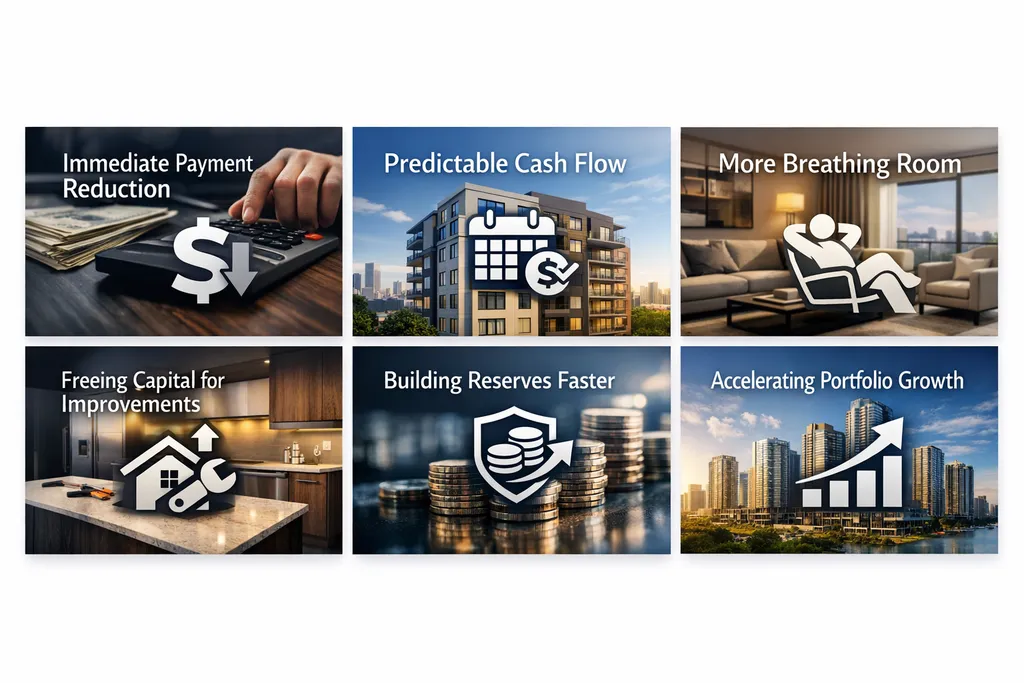
Immediate payment reduction: Research shows that interest-only DSCR loans can reduce monthly payments by 20% to 35% compared to fully amortizing loans. For a property with a $300,000 loan balance, this could translate to monthly savings of several hundred dollars, cash that stays in your operating account instead of going toward principal paydown.
Predictable cash flow during the initial period: Since you're not tackling principal during the interest-only phase, your payment remains stable and predictable. This makes budgeting easier and allows you to model your rental income against expenses with greater confidence, especially helpful when managing multiple properties simultaneously.
More breathing room for operating expenses: Rental properties come with unexpected costs, from HVAC replacements to tenant turnover expenses. Lower monthly debt service creates a cushion that helps you weather these challenges without dipping into reserves or taking on costly emergency financing.
The math is compelling. When you're running tight margins on a rental property, even a few hundred dollars per month can mean the difference between positive and negative cash flow. That breathing room isn't just about comfort, it's about sustainability and the ability to hold properties through market cycles.
For investors who plan to refinance, sell, or substantially increase rents within the interest-only period, this structure can be a strategic tool. The key is understanding that you're trading immediate cash flow for deferred principal repayment, a trade that makes sense in certain market conditions and investment strategies.
Maximizing Rental Property Cash Flow With Interest-Only Mortgages
Maximizing rental property cash flow with interest-only mortgages is about more than just reducing payments. It's about creating financial flexibility that allows you to operate more strategically across your entire portfolio.
Freeing capital for property improvements: The cash you save each month can be redirected into value-add renovations that increase rental income or property value. Instead of sending that money to principal paydown, you might invest in upgraded appliances, fresh landscaping, or unit improvements that justify higher rents and attract better tenants.
Building reserves faster: Many investors struggle to maintain adequate cash reserves while servicing debt on multiple properties. Lower monthly payments mean you can build your emergency fund more quickly, protecting yourself against vacancy periods, major repairs, or economic downturns that affect rental demand.
Accelerating portfolio growth: Perhaps the most compelling benefit is the ability to reinvest savings into additional properties. If you're saving $400 per month on one property, that's $4,800 annually that could go toward the down payment on your next acquisition, compounding your investment returns over time.
Cash flow isn't just a number on a spreadsheet. It's the lifeblood of your real estate business. When cash flow is tight, you're forced into reactive mode, scrambling to cover expenses and unable to capitalize on opportunities. When cash flow is strong, you can operate proactively, choosing the best times to buy, sell, or improve properties.
Interest-only structures are particularly valuable in high-interest rate environments where maintaining positive cash flow becomes more challenging. By reducing your monthly debt service, you create margin that might otherwise disappear when rates climb. This can be the difference between holding a property through a down market and being forced to sell at an inopportune time.
Qualifying More Deals by Improving Your DSCR Ratio
Qualifying more deals by improving your DSCR ratio is one of the most practical applications of interest-only loan structures. The debt service coverage ratio is calculated by dividing the property's net operating income by its annual debt service. Lenders typically require a DSCR of at least 1.0, and often prefer 1.25 or higher.
Turning borderline deals into qualified properties: When a property generates $2,400 in monthly rental income but requires $2,200 in monthly debt service, you're sitting at a DSCR of about 1.09. Many lenders want to see higher ratios. By switching to an interest-only structure that reduces your payment to $1,700, your DSCR jumps to approximately 1.41, well within comfortable lending parameters.
Accessing better loan terms: A stronger DSCR doesn't just help you qualify, it can also unlock more favorable interest rates and loan conditions. Lenders view higher DSCR properties as lower risk, which can translate directly into your cost of capital and overall investment returns.
Expanding your investment criteria: With the ability to improve DSCR through payment structure, you can consider properties that might have been off the table with traditional financing. This expands your opportunity set and allows you to compete in markets or property types where rental yields are tighter.
The DSCR calculation is mechanical and objective. Lenders aren't making subjective judgments about your deal, they're running the numbers. Interest-only structures give you a lever to directly influence those numbers, pushing deals that narrowly miss underwriting standards into the approval zone.
This is especially relevant in today's market, where investors face elevated interest rates and compressed rental yields in many markets. The gap between qualifying and not qualifying can be razor-thin, and interest-only terms can bridge that gap effectively.
Strategic Scenarios Where Interest-Only Structures Excel
Strategic scenarios where interest-only structures excel go beyond simple cash flow management. Certain investment strategies and market conditions make these loans particularly advantageous.
Short-term hold strategies: If you're planning to sell or refinance within five to seven years, paying down principal may not be a priority. Value appreciation and rental income growth matter more than equity buildup through principal reduction. Interest-only structures align perfectly with this timeline, maximizing cash extraction during your ownership period.
Value-add renovation projects: When you're buying a property that needs significant improvements to reach market rents, cash flow can be negative or minimal during the renovation phase. Interest-only payments reduce your carrying costs while you're upgrading the property, making it easier to hold through the improvement period without external capital injections.
Portfolio scaling phases: Investors who are actively growing their portfolios often prioritize acquiring more properties over building equity in existing ones. The cash saved through interest-only payments can accelerate your acquisition pace, allowing you to control more real estate with the same amount of available capital.
Markets with strong appreciation potential: In areas where property values are climbing steadily, your equity growth comes primarily from appreciation rather than principal paydown anyway. Interest-only structures let you capture that appreciation while keeping monthly costs low and cash flow high.
Transitional financing needs: Sometimes you need bridge financing between selling one property and acquiring another, or you're waiting for a property to stabilize before refinancing into permanent financing. Interest-only terms can provide the breathing room you need during these transition periods.
Understanding when and how to deploy interest-only financing is what separates sophisticated investors from those who simply follow conventional wisdom. These tools aren't right for every deal or every investor, but in the right circumstances, they can dramatically improve your investment outcomes.
Understanding the Trade-Offs and Future Payment Changes
Understanding the trade-offs and future payment changes is essential before committing to an interest-only loan structure. The benefits during the initial period are real, but they come with considerations that affect your long-term planning.
Payment increases after the interest-only period: When the interest-only phase ends, typically after 10 years, your payment will increase to cover both principal and interest over the remaining loan term. Research indicates these increases can range from 25% to 55% depending on your loan terms and remaining balance. A $1,500 monthly interest-only payment might jump to $2,000 or more.
No equity buildup through principal reduction: During the interest-only period, you're not paying down the loan balance. Your equity growth comes solely from property appreciation and any additional principal payments you choose to make voluntarily. This means if property values stagnate or decline, you won't have the equity cushion that comes from systematic principal reduction.
Refinancing or sale dependency: Many investors plan to refinance or sell before the interest-only period ends. This strategy works well in favorable markets but can become problematic if credit markets tighten, property values decline, or rental income doesn't increase as anticipated. You need a Plan B if your exit strategy doesn't materialize as expected.
Long-term cost considerations: Over the full loan term, interest-only structures typically result in higher total interest paid compared to fully amortizing loans. You're essentially deferring principal repayment, which means you're paying interest on the full loan balance for a longer period. This is the price of enhanced short-term cash flow.
Market timing risk: If you're counting on refinancing at the end of the interest-only period, you're exposed to interest rate risk. Rates could be higher when it's time to refinance, potentially negating some of the cash flow benefits you enjoyed during the initial period.
These trade-offs aren't deal-breakers, but they do require careful modeling and honest assessment of your investment timeline and goals. The best interest-only borrowers have clear strategies for what happens when the interest-only period ends, whether that's selling, refinancing, or absorbing the higher payment from increased rental income.
Who Benefits Most From Interest-Only DSCR Loans
Who benefits most from interest-only DSCR loans isn't a mystery. Certain investor profiles and situations align particularly well with this financing structure.
Experienced investors with multiple properties often use interest-only structures strategically across their portfolios. They understand the mechanics, have modeled the future payment changes, and can absorb potential risks through diversification and cash reserves. These investors typically aren't relying on a single property's cash flow to survive, they're optimizing across an entire portfolio.
Investors in high-appreciation markets also benefit significantly. When property values are climbing steadily, equity accumulation happens primarily through appreciation rather than principal paydown. In these markets, maximizing cash flow during the ownership period makes more sense than slowly building equity through monthly principal payments that pale in comparison to appreciation gains.
Portfolio builders who are actively acquiring properties find interest-only structures valuable because they free up capital for additional acquisitions. Instead of tying up cash in principal reduction on existing properties, they can redirect that capital toward down payments on new deals, accelerating their growth trajectory and building wealth through property accumulation rather than debt reduction.
Investors dealing with properties that have tight initial cash flow but strong improvement potential also benefit. If you're buying a property below market rents with plans to renovate and increase income, interest-only payments give you the breathing room to execute your value-add strategy without negative cash flow forcing your hand.
Short-term holders who plan to sell or refinance within the interest-only period are perhaps the most natural fit. If you're targeting a three-to-seven-year hold, why pay down principal you'll never fully realize? Interest-only structures align your financing costs with your investment timeline, maximizing the cash you can extract during your ownership period.
Conversely, buy-and-hold investors who plan to keep properties for decades and value the security of a paid-off property in retirement might find less appeal in interest-only structures. For these investors, the long-term equity buildup and eventual elimination of mortgage payments might outweigh short-term cash flow benefits.
Planning for Success With Interest-Only Financing
Planning for success with interest-only financing requires more than just understanding the mechanics. You need a comprehensive strategy that accounts for both the benefits and the eventual transition.
Start by modeling multiple scenarios. Calculate your payments during the interest-only period, then project what happens when it ends. Model different interest rate environments for potential refinancing, different appreciation scenarios, and different rental income growth rates. Understanding your exposure across these variables helps you make informed decisions and avoid surprises down the road.
Build and maintain strong cash reserves. The cash flow benefits of interest-only structures give you an excellent opportunity to accumulate reserves quickly. Resist the temptation to deploy every dollar of savings into new acquisitions. A healthy reserve fund protects you against vacancy, repairs, and market downturns, and gives you options when the interest-only period ends.
Have a clear exit strategy before you sign the loan documents. Will you refinance into a traditional loan? Will you sell the property? Will your rental income have increased enough to comfortably absorb the higher payment? Whatever your plan, put it in writing and review it annually to ensure you're on track.
Use the cash flow strategically. Don't just let the savings accumulate in a checking account or, worse, inflate your lifestyle. Invest the difference in ways that grow your wealth, whether that's additional properties, property improvements that increase income, or other investment vehicles that build your financial foundation.
Stay informed about market conditions and be ready to adjust your timeline if needed. If you're planning to refinance in year eight but market conditions in year seven look favorable, be flexible enough to move earlier. Conversely, if conditions deteriorate, have backup plans that don't depend on perfect market timing.
Consider making voluntary principal payments when cash flow allows. Just because your loan structure doesn't require principal payments doesn't mean you can't make them. In strong cash flow months or years, directing extra payments toward principal gives you the best of both worlds: flexibility when you need it and equity buildup when you can afford it.
Interest-only DSCR loans represent a powerful tool in the real estate investor's financing arsenal, but like any specialized instrument, they require knowledge and planning to use effectively. The interest-only DSCR loan payment structure benefits are substantial: reduced monthly obligations, improved cash flow, better DSCR ratios, and increased financial flexibility during the initial loan period.
For the right investor in the right situation, these benefits can accelerate portfolio growth, make borderline deals viable, and provide the breathing room needed to execute value-add strategies successfully. The ability to reduce monthly payments by 20% to 35% isn't just a marginal improvement, it can fundamentally change the economics of a rental property investment.
Yet these advantages come with responsibilities. Future payment increases, delayed equity accumulation, and the need for sound exit strategies mean interest-only structures aren't set-it-and-forget-it solutions. They work best for investors who understand their portfolios, model various scenarios, and maintain the financial discipline to use the cash flow benefits strategically rather than simply spending the difference.
The decision to use interest-only financing should align with your overall investment strategy, timeline, and risk tolerance. Short-term holders, portfolio builders, and value-add investors often find these structures particularly beneficial. Long-term buy-and-hold investors focused on eventual debt elimination might find traditional amortizing loans more aligned with their goals.
Ultimately, maximizing rental property cash flow with interest-only mortgages is about matching the right financing tool to your specific situation. When used thoughtfully, these loans can provide the financial flexibility that separates good investment outcomes from great ones. When used carelessly, they can create future obligations that strain your finances and limit your options.
If you're considering whether an interest-only structure makes sense for your next rental property acquisition, take the time to model the numbers thoroughly and understand both the immediate benefits and the long-term implications. The investors who succeed with these products are those who go in with eyes wide open, clear strategies in place, and the financial discipline to execute their plans. Ready to explore how this financing structure might work for your portfolio? Get a personalized DSCR loan quote and discover your options today.