What Does Loan-to-Value Actually Mean for Investors
Every real estate investor has heard the term loan-to-value, but few truly understand how it shapes every aspect of a deal. What does loan-to-value actually mean for investors beyond a simple ratio? It determines your leverage, influences your interest rate, affects your cash flow, and can make or break a property acquisition. Whether you're analyzing a rental property or structuring a fix and flip loan, LTV sits at the center of your financing strategy.
Loan-to-value is the percentage of a property's appraised value that a lender is willing to finance. If a property appraises at $500,000 and you're approved for a $400,000 loan, your LTV is 80%. Simple enough on paper, but the implications run deep. A higher LTV means less capital out of pocket, which can free up funds for additional deals or rehab budgets. A lower LTV typically translates to better loan terms and lower rates, but it also requires more cash upfront.
For investors who rely on DSCR loans, bridge financing, or short-term flip funding, understanding how LTV is calculated and why it changes your rate becomes critical. Lenders view LTV as a risk metric. The more equity you bring to the table, the less exposed they are if the market shifts or a deal underperforms. That risk assessment shows up directly in your rate, your loan structure, and even your approval odds.
Why LTV Influences Every Investment Decision
Loan-to-value doesn't just sit in the underwriting file. It drives the economics of your entire investment strategy.
Capital efficiency: Higher LTV deals let you deploy less cash per property, enabling portfolio diversification or faster scaling. Investors weighing how much leverage to take on need to balance that against the higher rate and stricter terms that typically come with it.
Rate and cost structure: Lenders price risk into every deal. A 75% LTV loan might qualify for rates on the lower end of the spectrum, while a higher LTV deal will often carry higher interest costs and potentially stricter terms due to increased lender exposure.
Exit strategy alignment: For fix and flip projects, LTV affects how much capital you need to close and how much room you have for rehab overruns. Some lenders offer a high percentage of the purchase price and rehab budget, but those structures come with higher rates and shorter terms that demand faster turnaround.
Refinance and cash-out potential: When you're ready to pull equity out or refinance into long-term debt, your LTV at that point determines how much cash you can extract and what rate you'll pay. Lower LTV on refinance often unlocks better terms and more favorable loan products.
How LTV Is Calculated and Why It Changes Your Rate
The formula itself is straightforward: divide the loan amount by the appraised value of the property, then multiply by 100. But the variables behind that calculation carry weight.
Appraised value vs. purchase price: Most lenders use the lower of the appraised value or the purchase price. If you negotiate a great deal and buy below market, your LTV is based on that lower purchase price, which may limit your borrowing power even if the appraisal comes in higher.
Property type and condition: Single-family rentals, multi-family buildings, and rehab projects each carry different risk profiles. A stabilized rental with strong cash flow might support a higher LTV than a distressed property requiring extensive renovations.
Credit and DSCR impact: While LTV is independent of your credit score or debt service coverage ratio, lenders layer these metrics together. A borrower with a 750 FICO and a 1.3 DSCR might access more favorable pricing at a given LTV, while a 680 FICO borrower at the same LTV could see meaningfully higher rates.
Rate bands and tiers: Lenders often tier their pricing at set LTV breakpoints. Crossing from just under one breakpoint to just over it can shift you into a higher rate band, even if your credit and property fundamentals remain identical.
Have a property in mind?
Tell us about the property and we will find the financing that fits you best.
Rental property financing hinges on cash flow and long-term value, making LTV a balancing act between leverage and stability.
DSCR loan structures: Debt service coverage ratio loans allow investors to qualify based on rental income rather than personal tax returns. Trulo Mortgage's DSCR program is currently structured around 75% to 80% LTV, meaning a 20% to 25% down payment, with the exact terms depending on the property's DSCR and your credit profile.
Portfolio growth vs. per-deal returns: Lower LTV loans preserve equity and reduce monthly debt service, boosting cash-on-cash return. Higher LTV loans maximize the number of doors you can acquire with available capital. The right choice depends on whether your strategy prioritizes current income or rapid portfolio expansion.
Refinance timing: Many investors use a BRRRR strategy, buying and rehabbing properties, then refinancing once the value has increased and the property is stabilized. Timing that refinance when your LTV drops due to appreciation or forced equity can unlock better long-term rates and pull out tax-free capital for the next deal.
Foreign national and non-traditional borrowers: Investors without U.S. tax returns or traditional income documentation may face stricter LTV caps. Understanding how different lenders tier these borrowers can help you shop strategically and negotiate terms that fit your profile.
Step-by-Step: Optimizing LTV for Your Next Deal
Smart investors don't accept the first LTV offer. They engineer it to fit their goals and capital strategy.
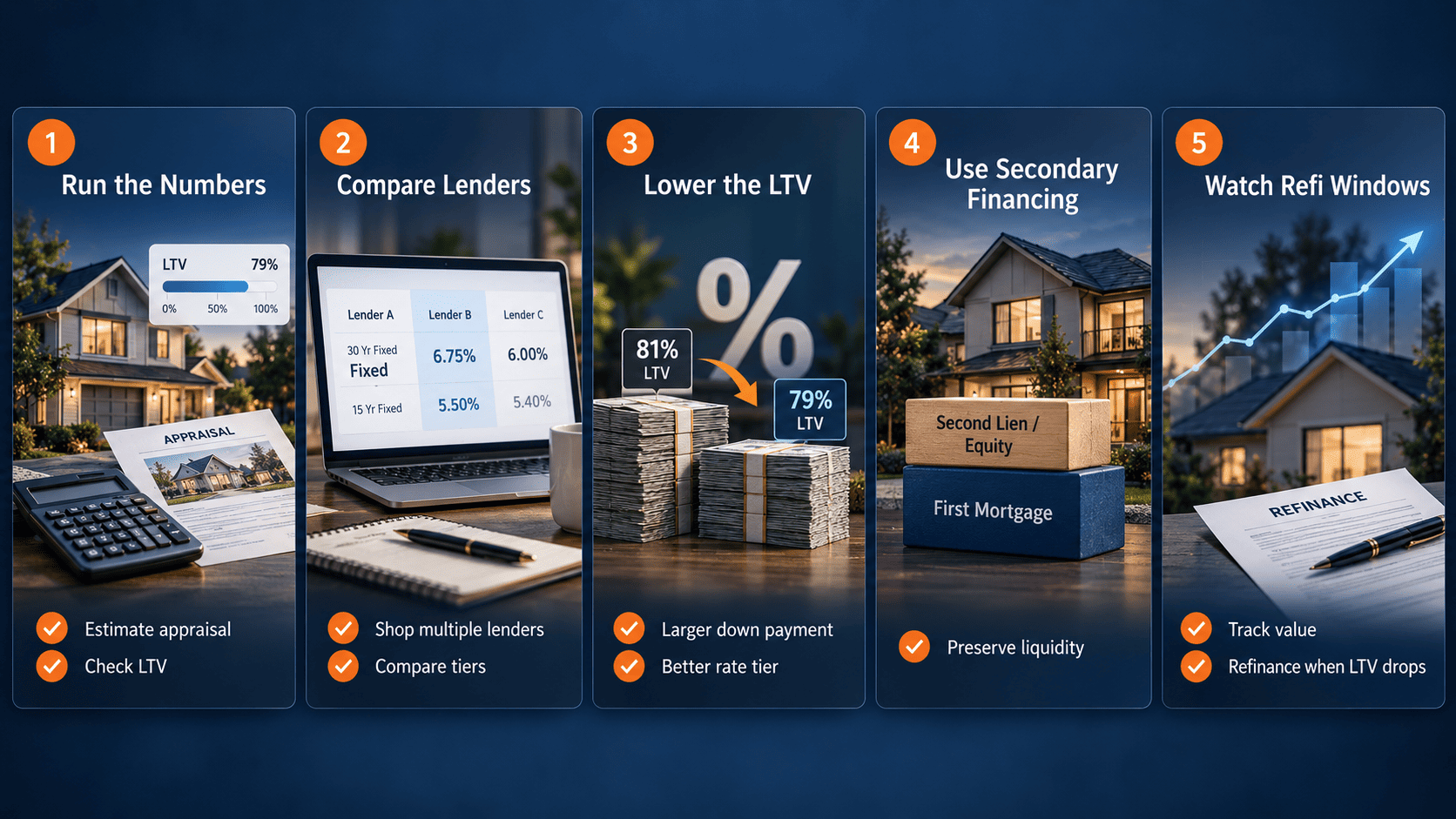
Run the numbers before you make an offer: Estimate the appraisal and calculate the LTV you'll need to close the deal with your available down payment. If you're stretching toward the top of a lender's LTV range, factor in the higher rate and confirm the deal still pencils out with stronger debt service.
Shop multiple lenders and compare rate tiers: One lender's pricing at a given LTV might be another's equivalent at a different breakpoint. Request detailed rate sheets that show how pricing changes at each LTV tier. Even a modest shift in loan amount can move you into a better tier and save thousands over the loan term.
Consider a larger down payment to access a lower tier: If you're facing a rate jump right above a breakpoint, putting down a bit more to drop below it might be worth it. Calculate the interest savings over your expected hold period and compare it to the incremental cash outlay.
Use subordinate financing strategically: Some investors layer a second lien or partner equity to keep the first mortgage LTV in a favorable band. This approach can be complex and must be disclosed to the primary lender, but it allows you to preserve liquidity while maintaining competitive first-lien pricing.
Monitor market value and refinance windows: As property values appreciate or you force equity through improvements, track your effective LTV. When it drops below key thresholds, explore refinancing into a lower rate or pulling cash out while maintaining a strong LTV position.
LTV Dynamics in Fix and Flip Financing
Fix and flip loans operate under different LTV structures because they blend acquisition and construction risk into one short-term product.
Purchase LTV vs. after-repair value: Many flip lenders will finance a percentage of the purchase price and a separate percentage of the rehab budget. The total loan is still capped by the after-repair value, or ARV. If your ARV is $300,000 and the lender caps total LTV at 75% of ARV, your maximum loan is $225,000 regardless of how the purchase and rehab split out.
Shorter terms and higher rates: Because flip loans carry more risk and shorter duration, lenders price them accordingly. Rates reflect both the risk profile and current lending conditions, but investors who move quickly and execute well can still generate strong returns even with a higher cost of capital.
Draw schedules and LTV creep: As you complete rehab milestones, the lender releases funds from the construction reserve. Your loan balance increases, and so does your effective LTV during the project. This is normal, but it underscores the importance of accurate budgeting. If costs overrun and you need additional capital, your LTV might exceed the lender's comfort zone, forcing you to inject personal funds or seek alternative financing.
Exit LTV and sale proceeds: When you sell the completed project, your net proceeds after paying off the loan depend heavily on that final LTV. A lower LTV flip leaves more margin for profit and unexpected holding costs than a higher LTV deal, but it also requires significantly more upfront capital. Balancing those trade-offs is where experienced flippers separate themselves from novices.
Common LTV Mistakes Investors Should Avoid
Even seasoned investors can stumble when they overlook how LTV interacts with the broader deal structure and market conditions.
Ignoring rate tier breakpoints: Requesting an LTV just above a meaningfully cheaper breakpoint is a costly oversight. Always ask your lender where the pricing tiers break and structure your down payment accordingly.
Overestimating appraisal value: Assuming the property will appraise at your purchase price or higher can leave you scrambling for additional down payment at closing. Conservative appraisal assumptions protect you from surprise capital calls and keep your LTV planning realistic.
Neglecting the impact on cash flow: Higher LTV means higher loan balance, which translates to higher monthly debt service. On rental properties, this can squeeze cash flow and reduce your margin for vacancies, maintenance, or rate increases on adjustable products. Run sensitivity analyses to ensure your deal works even if income dips or expenses rise.
Forgetting about subordinate lien restrictions: Some DSCR and investment property lenders restrict or prohibit second mortgages. If your strategy depends on layering debt to manage LTV, confirm your primary lender allows it before you move forward.
Understanding what does loan-to-value actually mean for investors is about more than memorizing a formula. It's about recognizing how LTV shapes your cost of capital, your deal structure, your portfolio velocity, and your long-term equity position. Every percentage point of LTV carries financial consequences, from the rate you pay to the cash you need at closing to the flexibility you have when markets shift.
Smart investors treat LTV as a tool, not a constraint. They run scenarios, compare lender pricing tiers, and structure their capital stack to align leverage with strategy. Whether you're scaling a rental portfolio with DSCR financing or executing a high-velocity flip strategy, mastering LTV gives you a decisive edge in a competitive market.
LTV limits, rates, and program guidelines vary by lender and change with market conditions, so treat the figures in this article as a general framework and confirm current terms directly with Trulo Mortgage.
If you're ready to see how loan-to-value impacts your next investment property deal and want financing tailored to your strategy, explore your DSCR loan options and start building the portfolio you've envisioned.