Condotel properties occupy a unique position in the investment landscape, blending hospitality services with real estate ownership. These hotel-condo hybrids offer nightly rental income potential, but they also come with financing challenges that traditional rental property loans don't address. Most conventional lenders steer clear of condotels due to their resort-like management structures and rental restrictions, leaving investors to seek specialized financing options.
A DSCR loan for condotel properties has emerged as a practical solution for investors targeting this niche market. Unlike conventional mortgages that scrutinize personal income and employment history, DSCR loans focus on the property's rental cash flow. That approach aligns perfectly with condotel investments, where rental management companies handle bookings and revenue flows through established channels. However, not all DSCR programs accept condotels, and those that do typically impose stricter underwriting standards than standard investment property loans.
Understanding condotel financing rules for investors means recognizing the elevated requirements around credit scores, down payments, and debt service coverage ratios. Condotel DSCR loans generally call for a stronger credit profile and a higher DSCR cushion than standard DSCR loans, along with a down payment at the higher end of the typical 20% to 25% range, and rates that carry a premium above Trulo Mortgage's standard DSCR range to reflect the additional risk lenders associate with hospitality-linked real estate. For investors willing to meet these elevated benchmarks, condotel DSCR loans unlock access to a high-yield property category that remains largely off-limits through traditional financing channels.
What Makes Condotel Financing Different
Condotel properties function as hotel units available for owner use and nightly rentals, managed by an on-site hospitality operator. This dual-purpose structure creates complications for lenders who prefer straightforward residential rental arrangements. Traditional mortgage programs often reject condotels outright because the property operates under hotel licensing, rental pooling agreements, and front-desk reservation systems rather than standard lease contracts.
Rental restrictions: Most condotels prohibit long-term leases and mandate participation in a rental management program. Owners can't select their own tenants or set independent rental terms, which eliminates the predictable lease income conventional lenders prefer.
Warrantability concerns: Many condotel projects fail to meet Fannie Mae or Freddie Mac warrantability guidelines due to high investor concentration, limited owner-occupancy, or commercial zoning classifications. Without agency backing, conventional financing options disappear.
Income volatility: Condotel revenue fluctuates with tourism cycles, seasonal demand, and local market conditions. Lenders view this variability as higher risk compared to traditional apartments or single-family rentals with fixed monthly lease payments.
Property management dependencies: The condotel's financial performance hinges on the management company's marketing, maintenance, and operational decisions. Investors hold less direct control over occupancy rates and expense management than they would with a standalone rental property.
These factors explain why can you get a DSCR loan on a condotel isn't a simple yes or no question. DSCR lenders that do work with condotels mitigate their risk by imposing tighter credit, equity, and cash flow requirements than they would for conventional investment properties. Investors must demonstrate stronger financial profiles to compensate for the property's operational complexity and income uncertainty.
DSCR Loan Warrantability Rules for Condotels
Warrantability determines whether a condo project meets the standards necessary for mortgage financing. Agency-backed loans require projects to pass strict tests around owner-occupancy percentages, financial reserves, and legal structure. Condotels typically fail these tests because their hotel-style operations and transient rental models don't align with agency guidelines designed for traditional residential condos.
Owner-occupancy thresholds: Fannie Mae and Freddie Mac generally require that at least 50% of units be owner-occupied or sold to owners intending to occupy. Condotels, which function primarily as investor-owned rental units, rarely meet this benchmark.
Commercial zoning: Many condotels sit on land zoned for hotel or mixed-use development rather than residential purposes. This zoning classification disqualifies the property from conventional condo financing programs that mandate residential zoning.
Rental pool arrangements: Condotel projects often pool rental income among all participating owners and distribute revenue based on unit size or other formulas. This collective income structure conflicts with conventional underwriting, which evaluates each unit's income independently.
Homeowners association requirements: Agency guidelines demand that condo associations maintain specific reserve levels and insurance coverage. Condotels managed by hospitality operators may not structure their finances or governance documents to satisfy these HOA standards.
DSCR lenders operate outside agency guidelines and can finance non-warrantable condos, including condotels. However, they still perform their own due diligence on the project's legal structure, financial health, and rental performance. Condotel rental restrictions and DSCR eligibility standards require lenders to verify that the property generates sufficient cash flow to cover the debt, even when the project wouldn't qualify for conventional financing. Investors benefit from this flexibility but pay for it through higher rates and stricter borrower qualifications.
Have a property in mind?
Tell us about the property and we will find the financing that fits you best.
Lenders view condotels as higher-risk assets, and their underwriting criteria reflect that assessment. Condotel DSCR loans typically call for a notably stronger credit profile than standard programs, along with a down payment at the higher end of the typical range, often close to 25% (roughly 75% LTV). These thresholds sit well above the baseline requirements for standard DSCR investment property loans, which generally require a minimum 620 credit score and typically accept 20% to 25% down (up to 75%-80% LTV).
Elevated credit minimums: Condotel programs set a notably higher credit bar than standard DSCR loans, screening for borrowers with strong credit histories and low default risk. This elevated standard helps lenders offset the property's operational complexity and income variability.
Larger equity contributions: A down payment near the top of the standard range, often around 25% (roughly 75% LTV), ensures that investors have significant skin in the game. Greater equity reduces the lender's exposure in a foreclosure scenario and signals the borrower's financial commitment to the project.
No ratio alternatives: Some lenders offer no-ratio DSCR loans on condo properties for borrowers with strong credit and equity, bypassing traditional rental income assessments. These programs may extend to condotels in certain cases, though availability varies by lender and market conditions.
Rate adjustments: Even when an investor meets the credit and LTV benchmarks, condotel DSCR loans typically carry a rate premium above Trulo Mortgage's standard DSCR range of 6.25% to 8.00%, reflecting the added risk lenders associate with hospitality-linked income.
It's important to note that condotel-specific terms vary by lender and can change, so investors should confirm current credit score, down payment, DSCR, and rate requirements directly with Trulo Mortgage. Market conditions, property specifics, and individual borrower profiles all influence final pricing and eligibility. What remains consistent is that condotel financing demands stronger borrower credentials than traditional rental property loans, reflecting the specialized nature of the asset class.
How to Calculate and Meet the DSCR Minimum
The debt service coverage ratio measures whether a property's rental cash flow can cover its monthly mortgage payment. Lenders calculate DSCR by dividing the property's gross monthly rental income by the total monthly debt obligation, including principal, interest, taxes, insurance, and HOA fees. A DSCR of 1.0 means the income exactly equals the debt payment, while a ratio above 1.0 indicates positive cash flow.
For condotel properties, lenders typically require a higher DSCR minimum than the standard 1.0 floor, building in an extra cushion against the income volatility inherent in short-term rental and hospitality markets. Here's how to approach the calculation and meet the standard:
Document rental income accurately: Condotels generate revenue through nightly bookings rather than monthly leases. Lenders may review historical rental performance reports from the property management company, examining average daily rates, occupancy percentages, and seasonal trends to estimate annualized income.
Account for all debt obligations: Calculate your total monthly payment by adding the principal and interest (based on your loan amount and rate), property taxes, insurance premiums, and any HOA or management fees. Condotel fees can be substantial since they cover front-desk operations, housekeeping, maintenance, and marketing.
Run the math: Divide the gross monthly rental income by the total monthly debt payment. For example, if the property generates ten thousand dollars per month in gross rental income and the debt payment totals eight thousand dollars, the DSCR is 1.25 (ten thousand divided by eight thousand equals 1.25). That's comfortably above the 1.0 baseline and the kind of cushion condotel lenders typically look for.
Adjust your down payment or purchase price: If your initial DSCR falls short, increasing your down payment reduces the loan amount and lowers the monthly debt payment, which improves the ratio. Alternatively, target properties with stronger rental performance to boost the income side of the equation.
Keep in mind that lenders typically use conservative income estimates when underwriting condotels, often applying a vacancy factor or discounting projected income to account for market fluctuations. Building in a healthy margin above the 1.0 baseline gives you a better chance of approval and demonstrates prudent cash flow management to the underwriter.
Steps to Secure Condotel DSCR Financing
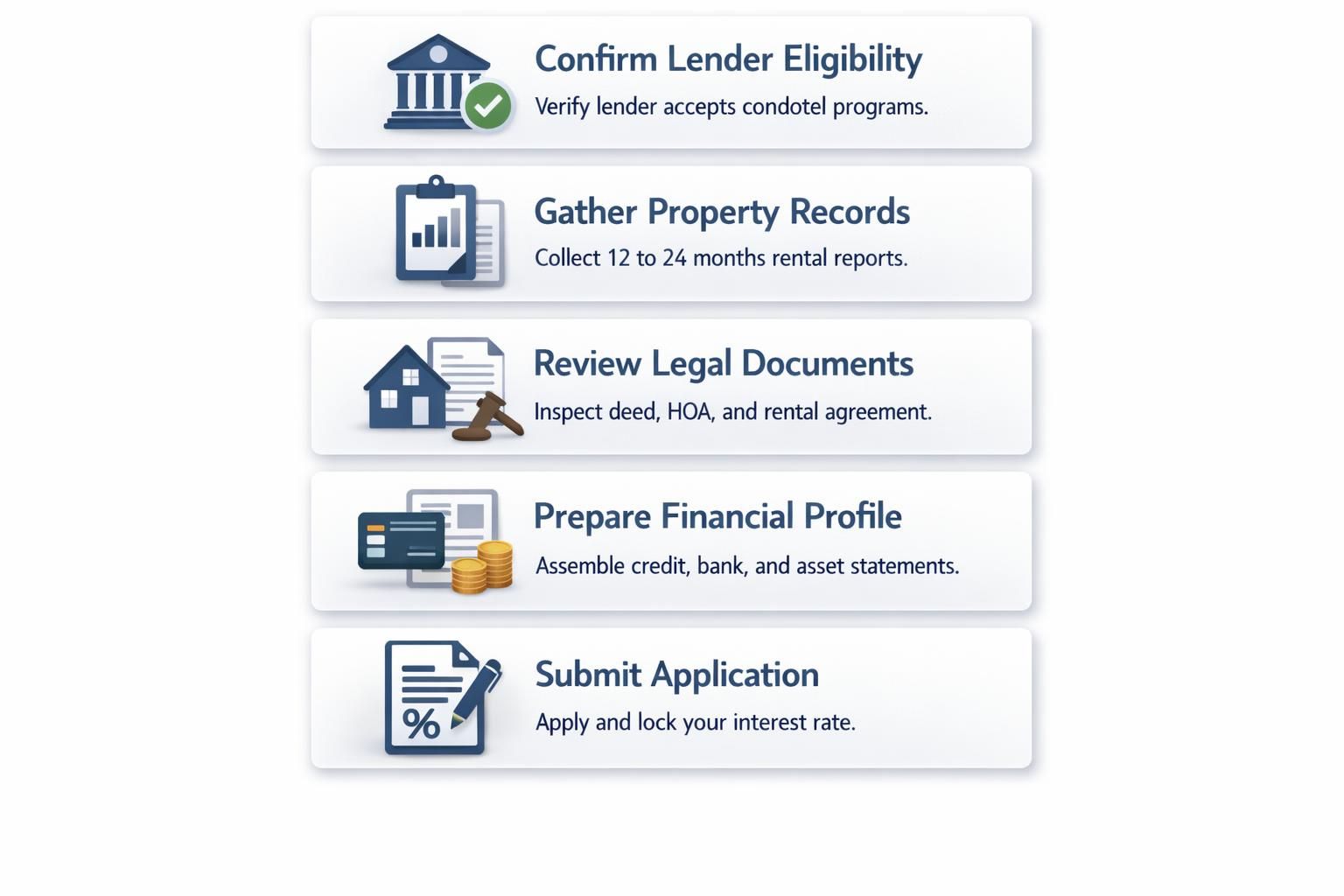
Securing a DSCR loan for a condotel property requires methodical preparation and clear communication with your lender. Because these properties fall outside conventional financing channels, you'll need to assemble documentation that proves both your creditworthiness and the property's income potential. Here's a practical roadmap for the financing process:
Confirm lender eligibility upfront: Not all DSCR lenders accept condotels, so verify that your lender offers condotel-specific programs before investing time in due diligence. Ask about their minimum credit score, LTV limits, DSCR requirements, and rate ranges for condotel properties to ensure your profile aligns with their criteria.
Gather property financial records: Request detailed rental income reports from the condotel's management company, covering at least 12 to 24 months of historical performance. Look for data on occupancy rates, average daily rates, gross revenue, and operating expenses. Lenders use these records to project future cash flow and calculate your DSCR.
Review the condo project's legal documents: Obtain the condotel's master deed, HOA covenants, rental management agreement, and financial statements. Lenders will scrutinize these documents to assess the project's legal structure, reserve levels, insurance coverage, and any pending litigation or special assessments that could affect the property's value or cash flow.
Prepare your financial profile: Compile personal credit reports, bank statements, asset documentation, and any other materials the lender requests. Since condotel loans call for a stronger credit profile than standard DSCR programs, ensure your credit is in excellent standing before applying. Address any errors on your credit report and avoid opening new credit accounts during the application process.
Submit your application and lock your rate: Once you've assembled the required documentation, submit your loan application and work with your lender to lock in your interest rate if market conditions are favorable. Be prepared for a longer underwriting timeline than you'd experience with a standard rental property loan, as condotel due diligence is more complex.
Throughout the process, maintain open communication with both your lender and the condotel management company. Quick responses to underwriter requests and proactive problem-solving help keep your closing on track. Given the specialized nature of condotel financing, working with a lender experienced in this asset class can make a significant difference in your approval odds and final terms.
Condotel properties offer compelling income potential for investors comfortable navigating the complexities of hospitality-linked real estate. While conventional financing options remain largely unavailable, DSCR loans provide a viable pathway to acquire these assets. The key is understanding and preparing for the elevated credit, equity, and cash flow standards lenders impose on condotel financing.
Expect to bring a stronger credit profile, a down payment near the top of the standard range, and a healthier DSCR cushion than a typical rental property loan requires. Rates for condotel DSCR loans also carry a premium above Trulo Mortgage's standard DSCR range, reflecting the property's operational risk and non-warrantable status. These requirements sit above standard DSCR loan benchmarks, but they unlock access to a niche market segment that traditional lenders won't touch.
Thorough due diligence on the property's rental performance, legal structure, and management quality is essential. Review historical income data, assess the condo project's financial health, and confirm that your lender has experience with condotel transactions. Some lenders also offer no-ratio DSCR options for strong borrowers, providing additional flexibility in certain scenarios.
Condotel financing isn't for every investor, but for those targeting short-term rental markets, resort locations, or hospitality-oriented properties, DSCR loans make these deals possible. The combination of property-based underwriting and specialized program structures allows qualified investors to diversify their portfolios beyond traditional apartments and single-family rentals. If you're ready to explore condotel financing options tailored to your investment strategy, get a personalized DSCR loan quote and take the next step toward expanding your real estate holdings.



.png)