Investing in U.S. rental properties from overseas has traditionally been a complicated maze of paperwork, credit requirements, and residency restrictions. For international buyers, the question isn't whether American real estate offers strong returns, it's whether you can actually access the financing to make those deals happen. That's where DSCR loans for foreign national investors have changed the game entirely.
Unlike conventional mortgage products that demand U.S. tax returns, domestic credit scores, and Social Security numbers, DSCR loans focus on one thing: the property's ability to generate rental income. This approach removes many of the traditional barriers that have kept foreign investors on the sidelines. Whether you're based in Asia, Europe, Latin America, or anywhere else in the world, these loan products create a clear pathway into the U.S. rental market.
The core advantage is straightforward. Instead of evaluating your personal financial history in a country where you may have no footprint, lenders assess whether the property's rental cash flow can cover the debt payments. That single shift in underwriting philosophy opens doors for thousands of international investors who previously had limited options for leveraging U.S. real estate opportunities.
What Makes DSCR Loans Accessible for International Buyers
What makes DSCR loans accessible for international buyers is their fundamental departure from traditional lending criteria. These products were designed with one goal in mind: qualifying borrowers based on investment property performance rather than personal income documentation.
No U.S. credit score required: Foreign nationals typically don't have established credit histories with U.S. bureaus. DSCR loan programs bypass this requirement entirely, eliminating one of the biggest obstacles for overseas investors looking to finance American rental properties.
No U.S. tax returns or W-2s needed: Traditional lenders demand multiple years of domestic tax documentation to verify income. DSCR loans for foreign national investors don't ask for any of that paperwork, because the qualification metric is the property's rental income, not your employment or business earnings.
No Social Security number necessary: Many loan products in the U.S. require a Social Security number as part of the application process. DSCR loan non resident programs work around this by using alternative identification methods, making the process far more practical for international applicants.
Property cash flow is the primary qualifier: The debt service coverage ratio measures whether the monthly rental income exceeds the monthly loan payment by a sufficient margin. That calculation becomes the cornerstone of underwriting, allowing lenders to approve loans based on the investment's financial merit rather than the borrower's personal balance sheet.
This structure creates a level playing field. An investor in Singapore evaluating a rental property in Texas faces the same qualification criteria as someone investing across state lines within the U.S. The property's numbers speak for themselves, and that's what matters most in the approval process.
How the DSCR Calculation Works in Practice
How the DSCR calculation works in practice is simpler than many investors expect. The debt service coverage ratio is a straightforward formula that compares a property's gross rental income to its total debt obligation.
Gross rental income is the starting point: Lenders look at either the actual rent currently being collected or the market rent the property could command based on comparable properties in the area. For foreign national investors evaluating a new acquisition, the projected rental income based on market data typically forms the basis of the calculation.
PITIA represents the total monthly debt service: This includes principal, interest, taxes, insurance, and association fees. Every expense tied to carrying the property gets factored into the denominator of the DSCR formula, giving lenders a complete picture of the monthly obligations the rental income must cover.
The ratio determines qualification: Divide the monthly rental income by the monthly PITIA to get your DSCR. A ratio of 1.0 means the rent exactly covers the debt service. Most lenders require a DSCR above 1.0, often between 1.1 and 1.25, to ensure there's a cash flow cushion that protects against vacancies, maintenance costs, and market fluctuations.
Higher ratios improve loan terms: Properties with stronger cash flow relative to their debt service often qualify for better interest rates and lower down payment requirements. A property generating significantly more rent than its monthly obligations represents lower risk, and lenders price that favorably.
For international buyers analyzing potential deals, the DSCR framework provides clarity. You can evaluate whether a property will qualify before you ever submit an application, simply by running the rental income and estimated debt service through the formula. That transparency makes deal evaluation faster and more predictable.
Why Foreign Nationals Choose DSCR Loan Programs
Why foreign nationals choose DSCR loan programs comes down to access, simplicity, and strategic flexibility. These products solve problems that other financing options simply can't address for overseas investors.
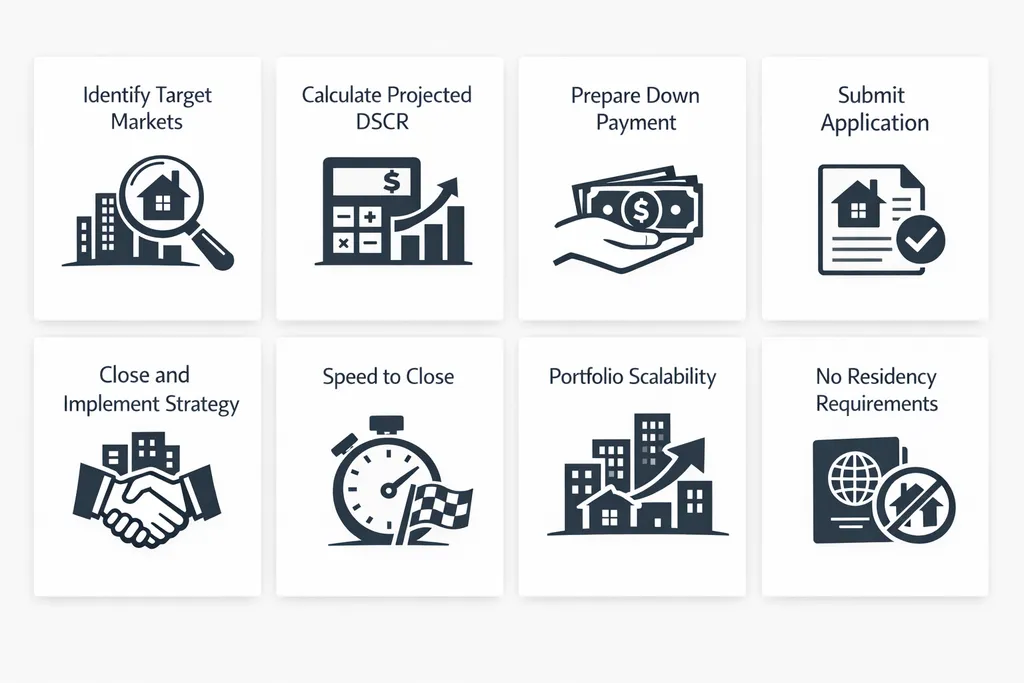
Speed to close on competitive deals: U.S. rental markets move quickly, especially in high-demand areas with strong job growth and population inflows. DSCR loans can close faster than conventional financing because there's less documentation to gather and verify, giving foreign investors the ability to compete with domestic buyers who have financing already lined up.
Portfolio scalability without income limits: Traditional loan programs often cap how much you can borrow based on your personal income, even if you're acquiring cash-flowing properties. DSCR loans for foreign national investors evaluate each property on its own merits, making it possible to scale a rental portfolio without hitting arbitrary debt-to-income ratio ceilings that don't reflect the investment's performance.
Geographic diversification into stable markets: Many international investors view U.S. real estate as a hedge against currency volatility or political instability in their home countries. DSCR loan programs provide the financing mechanism to build that diversification, allowing capital to flow into assets backed by rental income in markets with established property rights and legal protections.
No residency or visa requirements: You don't need to live in the United States or hold any particular immigration status to qualify for a DSCR loan non resident program. Whether you visit the property once a year or manage it entirely through a property management company from abroad, the loan structure remains accessible and practical.
These advantages combine to create a financing solution that aligns with how savvy investors actually operate. You're not trying to fit your international background into a domestic lending box. Instead, you're using a product designed from the ground up for investors who prioritize cash flow and portfolio growth over traditional employment-based qualification metrics.
Step-by-Step: Securing a DSCR Loan as a Foreign National
Securing a DSCR loan as a foreign national follows a clear process once you understand what lenders need and how to present your investment case effectively.
Identify target markets and properties with strong rental fundamentals: Start by analyzing U.S. markets where rental demand is solid, vacancy rates are low, and rent growth trends are favorable. The property you choose needs to generate rental income that comfortably exceeds the projected debt service, so market selection matters as much as the individual property. Look for areas with job growth, population inflows, and diversified economies that support rental housing demand over the long term.
Calculate your projected DSCR before making offers: Once you identify a potential property, pull rental comps from the area to estimate realistic monthly income. Then calculate your likely PITIA based on the purchase price, expected interest rate, property taxes, insurance costs, and any HOA fees. Run the DSCR formula to confirm the property will meet lender requirements, typically a minimum of 1.1 to 1.25. This pre-screening prevents wasted time on deals that won't qualify.
Prepare your down payment and reserves: DSCR loans for foreign national investors typically require larger down payments than domestic borrower programs, often between 20% and 30% depending on the lender and property type. You'll also need to demonstrate cash reserves, usually enough to cover two to six months of debt service. These funds prove you can handle vacancies or unexpected expenses while maintaining loan payments.
Submit your application with alternative documentation: Instead of U.S. tax returns and credit reports, you'll provide a passport or other government-issued identification, proof of assets showing your down payment and reserves, and documentation of the property's rental income potential. Lenders may request additional items depending on their specific program requirements, but the core package is far lighter than conventional loan applications.
Close and implement your property management strategy: Once approved, you'll move through standard closing procedures similar to any real estate transaction. Because you're likely managing the property from overseas, having a reliable property management company in place is crucial. Strong property management protects your cash flow, maintains the asset, and ensures you can scale your portfolio without being physically present in the market.
This process removes much of the complexity that international buyers face with other loan products. The focus stays on the investment itself: does the property generate sufficient income to service the debt and produce positive cash flow? Answer that question affirmatively, and the path to financing becomes straightforward.
Common Questions About DSCR Loan Non Resident Options
Common questions about DSCR loan non resident options typically focus on eligibility, loan terms, and how these products compare to other financing methods available to foreign nationals.
Can I use a DSCR loan for short-term rental properties? Many DSCR loan programs do allow financing for properties operated as short-term rentals, though underwriting may be more conservative. Lenders often require higher reserve requirements and may calculate income differently, using actual rental history or conservative estimates based on market data. The key is demonstrating consistent, verifiable income that meets the DSCR threshold even when accounting for higher vacancy assumptions and operating costs typical in short-term rental models.
How do interest rates compare to conventional loans? DSCR loans for foreign national investors typically carry slightly higher interest rates than conventional mortgage products available to U.S. citizens and permanent residents. The difference reflects the additional risk lenders perceive in working with overseas borrowers and investment properties. That said, the rate premium is often modest, and the ability to actually secure financing without U.S. credit history or income documentation makes the trade-off worthwhile for most international investors.
What property types qualify for DSCR financing? Most DSCR loan programs cover single-family homes, condominiums, townhouses, and multi-unit properties up to four units. Some lenders extend programs to larger multifamily buildings or mixed-use properties, though terms and requirements vary. The unifying factor is that the property must be investment-focused and generate rental income, DSCR loans don't finance owner-occupied homes or second residences for personal use.
How long does the approval process typically take? Because DSCR loans require less documentation than conventional financing, the approval timeline can be shorter in many cases. From application to closing, the process might take anywhere from three to six weeks depending on how quickly you provide required documents, the lender's current volume, and the complexity of the property appraisal. Working with lenders experienced in foreign national transactions tends to speed things up considerably.
Can I refinance a property I purchased with cash using a DSCR loan? Yes, cash-out refinances are possible with DSCR loan products. If you initially purchased a U.S. rental property with cash and it's now generating rental income, you can refinance to pull equity out while still qualifying based on the property's DSCR. This strategy allows foreign investors to recycle capital into additional acquisitions without liquidating performing assets, accelerating portfolio growth while maintaining cash flow from existing properties.
These questions highlight the practical considerations international buyers face when evaluating financing options. DSCR loan for international buyers programs address most of the friction points that make conventional financing inaccessible, creating a viable path to U.S. rental property ownership for non-residents.
Strategic Advantages for Portfolio Growth
Strategic advantages for portfolio growth become especially apparent when foreign national investors use DSCR loans as part of a deliberate acquisition and scaling strategy.
The ability to qualify based on property performance rather than personal income creates unique leverage opportunities. Each rental property you acquire becomes its own qualification engine. A property with strong cash flow can finance itself regardless of how many other properties you already own or what your global income sources look like. This structure is fundamentally different from conventional lending, where your personal debt-to-income ratio becomes a bottleneck that limits how many properties you can finance simultaneously.
Portfolio diversification across multiple U.S. markets becomes more practical with DSCR financing. You might own rental properties in three or four different metropolitan areas, each selected for specific growth characteristics: one market chosen for strong job growth, another for favorable landlord-tenant laws, and a third for below-average property taxes. DSCR loans make it possible to execute that diversification strategy without needing to establish personal financial history in each location or navigate varying documentation requirements across different regional lenders.
The refinance and equity extraction capabilities create a powerful growth flywheel. As properties appreciate and rents increase over time, you can refinance to pull cash out while maintaining positive DSCR ratios. That capital then funds down payments on additional acquisitions, allowing your portfolio to compound without requiring continuous capital inflows from overseas. The rental income from your existing properties effectively finances the expansion of your holdings.
For foreign nationals building serious rental portfolios in the U.S., DSCR loans function as both an entry point and a scaling mechanism. The same qualification criteria that made your first acquisition possible continue working for your fifth, tenth, or twentieth property. The lending framework scales with your ambitions rather than constraining them.
Selecting Markets and Properties That Maximize Your DSCR
Selecting markets and properties that maximize your DSCR requires looking beyond surface-level metrics and understanding what actually drives sustainable rental income.
Markets with strong employment diversity tend to produce more stable rental demand over time. Cities dependent on a single industry or employer face higher risk of economic disruption that can crater rental markets quickly. Look for metropolitan areas with varied economic bases: technology, healthcare, education, government, and professional services all contributing to the employment mix. That diversity protects your rental income during sector-specific downturns.
Population growth trends matter more than current population size. A metro area adding thousands of new residents annually creates ongoing housing demand that supports rent growth and keeps vacancy rates low. Review migration patterns, birth rates, and employment growth projections to identify markets where housing demand is likely to increase rather than stagnate. Growing markets give your DSCR room to improve over time as rents rise faster than your fixed debt service.
Property selection within your target market should prioritize realistic rental income over optimistic projections. Conservative underwriting protects you from surprises and ensures your DSCR holds up even when the market softens. Use multiple data sources to verify rent comps, account for realistic vacancy rates, and factor in property management costs, maintenance, and capital expenditure reserves. Properties that barely meet DSCR minimums leave no margin for error, while those with ratios well above 1.25 provide cushion against unexpected challenges.
Neighborhood-level factors influence both rental income and long-term appreciation potential. School quality, crime rates, walkability, access to employment centers, and local amenities all affect what tenants will pay and how long properties stay occupied. The best DSCR loans for foreign national investors finance properties in neighborhoods where fundamentals support both current cash flow and future value growth, creating a double benefit of immediate income and long-term equity building.
Property condition and age also impact your ability to maintain strong DSCR over time. Newer properties or recently renovated units typically command premium rents and require less capital expenditure in the near term, making cash flow more predictable. Older properties might offer lower purchase prices but can surprise you with expensive systems replacements that eat into cash flow and strain your reserves. Balance acquisition cost against likely maintenance and upgrade expenses when evaluating whether a property will sustain its DSCR.
DSCR loans for foreign national investors have fundamentally changed how international buyers access U.S. rental property markets. By removing the traditional barriers of domestic credit history, tax returns, and residency requirements, these products create opportunity where none existed before. The focus on property cash flow rather than personal financial documentation aligns perfectly with how serious investors actually evaluate deals: does the rental income justify the investment and cover the debt service with room to spare?
For foreign nationals looking to build wealth through American real estate, the path is clearer now than it's ever been. Strong markets are accessible, financing is available, and the structure rewards smart property selection and disciplined underwriting. The investors who succeed are those who treat DSCR requirements not as obstacles to work around but as guardrails that keep them focused on properties with genuine cash flow potential.
Your next step is straightforward. Identify your target market, analyze properties that meet solid DSCR thresholds, and work with lenders experienced in foreign national transactions. The U.S. rental market offers compelling opportunities for international capital, and DSCR loan programs provide the financing mechanism to capture them. If you're ready to explore how these loans can work for your investment strategy, see your DSCR loan options and take the first step toward building your U.S. rental portfolio.