DSCR Cash Out Refinance Guidelines for Scaling Investors
August 24, 2026
•
9 min read
Table of Contents
Real estate investors who have built equity in their rental properties often reach a crossroads: leave that capital locked inside existing assets, or tap it strategically to fuel the next acquisition. Cash-out refinancing on investment properties has become a cornerstone strategy for portfolio scaling, especially when structured through DSCR loans that sidestep traditional income verification. Unlike conventional mortgage refinances that demand W-2s, tax returns, and debt-to-income calculations, DSCR cash-out refinance guidelines for scaling portfolios focus squarely on rental income performance and property cash flow.
Understanding these guidelines is critical because they govern how much equity you can withdraw, which properties qualify, and how quickly you can deploy that capital into new deals. The mechanics differ sharply from owner-occupied refinances, and missteps can delay closings or leave money on the table. This guide unpacks the core underwriting rules, equity withdrawal thresholds, timing restrictions, and strategic considerations that shape cash-out refinancing for real estate investors using DSCR loans.
Core DSCR Cash Out Refinance Requirements
Core DSCR cash out refinance requirements revolve around the property's ability to service debt through rental income, rather than the borrower's personal earnings. These underwriting standards set the foundation for how much cash you can extract and which properties qualify for refinancing.
Debt service coverage ratio threshold: Most lenders require a minimum DSCR of 1.0 to 1.25 for cash-out refinances, meaning monthly rental income must equal or exceed the proposed mortgage payment by that margin. A DSCR below this floor typically disqualifies the property or triggers higher rates.
Loan-to-value caps: Cash-out DSCR refinances generally allow maximum LTV ratios between 70% and 75% of the property's current appraised value. This ceiling protects lenders from market downturns and ensures borrowers retain meaningful skin in the game.
Property type and occupancy: Single-family rentals, multifamily properties up to four units, and certain condos qualify, provided they are non-owner-occupied investment assets. Mixed-use or properties with significant deferred maintenance may face additional scrutiny or reduced leverage.
Credit and liquidity baselines: While DSCR loans don't verify employment income, lenders still review credit scores (often requiring a minimum of 640 to 680) and may ask for proof of cash reserves equal to two to six months of mortgage payments on the subject property.
These requirements act as a filter, separating properties with strong rental fundamentals from those that might strain under higher debt loads. Investors should audit each asset's rent roll and operating expenses before applying, since the DSCR calculation hinges on accurate income documentation. Lease agreements, rent schedules, and trailing twelve-month bank statements often serve as evidence. Properties with vacancies, below-market rents, or inconsistent cash flow may need repositioning before they meet guidelines.
Equity Withdrawal Rules for Rental Property Investors
Equity withdrawal rules for rental property investors define how much capital you can pull from each refinance and how lenders calculate that figure. These rules balance investor liquidity needs against risk management, ensuring the remaining equity cushion can absorb market fluctuations.
Maximum cash-out amount: The cash you receive equals the new loan amount minus the existing mortgage balance and closing costs. With a 75% LTV cap on a property appraised at $400,000, the new loan would be capped at $300,000. If your current mortgage is $200,000 and costs run $5,000, you'd net roughly $95,000 in cash.
Seasoning and waiting periods: Many lenders impose a seasoning requirement, often six to twelve months of ownership, before allowing cash-out refinancing. This rule prevents rapid equity stripping and ensures the property has demonstrated stable rental performance under the investor's management.
Rate and pricing adjustments: Cash-out refinances typically carry higher interest rates than rate-and-term refinances, reflecting the added risk of increased leverage. Investors should compare the cost of capital against expected returns on redeployed funds to confirm the refinance delivers positive arbitrage.
Understanding these withdrawal rules helps investors model their capital stack accurately. For example, an investor with five properties, each holding $100,000 in tappable equity at 75% LTV, could theoretically unlock $500,000 in dry powder for new acquisitions. However, each refinance also resets the mortgage term and payment, so cash flow must remain sufficient to cover the higher debt service across the portfolio. Investors often stagger refinances to avoid simultaneous increases in monthly obligations, spreading the liquidity events over quarters or years as market opportunities arise.
Have a property in mind?
Tell us about the property and we will find the financing that fits you best.
How lenders calculate DSCR for cash out scenarios determines whether a refinance clears underwriting. The calculation is straightforward but precise, and small errors in documenting income or expenses can sink an otherwise viable deal.
DSCR equals monthly rental income divided by the proposed monthly mortgage payment, which includes principal, interest, taxes, insurance, and any homeowner association dues. For example, if a property generates $3,000 per month in rent and the new all-in payment would be $2,400, the DSCR is 1.25. That figure meets most lenders' minimum thresholds and leaves a $600 cushion for vacancies, maintenance, or capital expenditures.
Lenders verify rental income through executed lease agreements and deposit records, typically requiring at least one month of bank statements showing rent receipts. If the property was recently acquired or rents recently increased, some lenders accept an appraisal with a market rent schedule to support higher income figures. Conversely, properties with short-term leases, month-to-month tenants, or seasonal occupancy may face discounts on projected income, lowering the effective DSCR.
Tax, insurance, and HOA expenses are usually drawn from the current bill or estimated by the lender's underwriter. Investors should anticipate these figures and adjust rents or negotiate terms if the DSCR falls short. In some cases, paying down the existing mortgage balance slightly or obtaining a lower interest rate quote can lift the DSCR above the required threshold without changing the property's fundamentals.
Step-by-Step Process for Executing a DSCR Cash Out Refinance
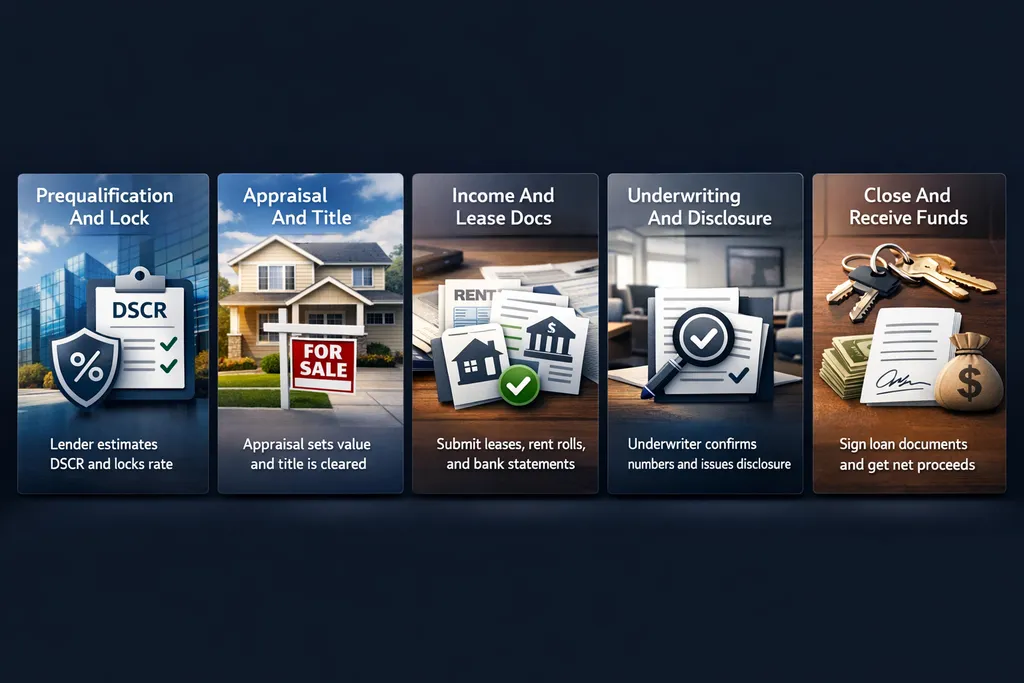
The step-by-step process for executing a DSCR cash out refinance mirrors many conventional refinances but substitutes rental income documentation for employment verification. Knowing the sequence and timeline helps investors coordinate closings with acquisition schedules.
Prequalification and rate lock: Contact a DSCR lender and provide property details, estimated rental income, current mortgage balance, and your credit profile. The lender will issue a prequalification based on preliminary DSCR and LTV calculations, and you may lock an interest rate if comfortable with terms.
Order appraisal and title work: The lender orders a full appraisal to establish current market value and a title search to confirm ownership and lien status. Appraisal turnaround typically takes one to three weeks, and any title issues must be resolved before closing.
Submit income and lease documentation: Provide executed leases, rent rolls, and bank statements showing deposit history. The underwriter calculates DSCR using this documentation and the appraised value to confirm the loan fits within guidelines.
Final underwriting and closing disclosure: Once the appraisal and income documentation clear, the underwriter issues a final approval and the lender sends a closing disclosure detailing the new loan amount, interest rate, monthly payment, and cash-out proceeds. Review this document carefully for accuracy.
Close and receive funds: At closing, you sign the new mortgage note and deed of trust, the existing loan is paid off, and the net cash proceeds are wired to your account, typically within one to three business days.
Timelines for DSCR cash-out refinances generally range from thirty to forty-five days, though delays in appraisal or title work can extend that window. Investors planning to use the proceeds for a time-sensitive acquisition should build buffer into their schedule and communicate deadlines clearly to the lender. Having organized financial records and responsive property managers accelerates underwriting and reduces the risk of last-minute surprises.
Strategic Timing and Portfolio Considerations
Strategic timing and portfolio considerations play a major role in maximizing returns from cash-out refinancing. Pulling equity too early or too late can either leave capital idle or force you to accept unfavorable terms.
Interest rate environment: Refinancing when rates are rising locks you into higher payments for the next decade or more. Conversely, refinancing during rate troughs captures lower costs and improves the spread between borrowing costs and investment returns. Track market trends and consider refinancing when rates dip or stabilize.
Property appreciation cycles: Cash-out refinances deliver maximum proceeds after significant appreciation. If a property has gained 20% to 30% in value since acquisition, a refinance unlocks that equity without selling. Waiting for appreciation peaks can boost cash-out amounts, but waiting too long risks market corrections that reduce appraised values.
Acquisition pipeline and deployment speed: Refinance timing should align with your deal pipeline. If you have a contract pending on a new property and need funds for the down payment, initiate the refinance immediately. If your pipeline is dry, refinancing early increases holding costs without generating returns, since idle cash earns minimal interest.
Portfolio-wide debt service coverage: When scaling through multiple cash-out refinances, monitor aggregate DSCR across all properties. Overleveraging can compress cash flow and leave little margin for vacancies or repairs. Diversifying refinances across properties with varying lease expirations and tenant profiles reduces concentration risk.
Tax and depreciation considerations: Cash-out proceeds are not taxable income, but the refinance resets your loan balance and may affect depreciation schedules. Consult with a tax advisor to understand how increased debt service and interest deductions interact with your overall tax strategy.
Investors who time refinances strategically can compound returns faster, using equity from stabilized assets to acquire value-add properties, then refinancing those assets once stabilized to fund the next round. This cycle, often called the BRRRR method when combined with rehab, relies heavily on disciplined execution of DSCR cash-out refinance guidelines for scaling portfolios. Missing a step or miscalculating DSCR can break the chain and stall growth.
DSCR cash-out refinancing offers real estate investors a powerful lever to scale portfolios without liquidating assets or tapping personal income. By focusing on rental performance and property fundamentals, these loans unlock equity that can be redeployed into new acquisitions, repositioning projects, or reserve building. Success hinges on understanding the underwriting guidelines, accurately calculating debt service coverage, and timing refinances to align with market conditions and deal flow.
Investors who master these mechanics gain a sustainable growth engine, turning paper equity into actionable capital while preserving ownership of cash-flowing properties. As your portfolio expands, each refinance becomes both a funding event and a risk management checkpoint, forcing you to evaluate whether each asset still meets performance benchmarks and deserves continued leverage. If you're ready to explore how much equity you can tap and which properties qualify, get a personalized DSCR loan quote and start building your refinance roadmap today.




.png)