Real estate investors looking to build rental property portfolios need to understand every aspect of their financing, and that includes how DSCR loan amortization schedules work. When you take out a debt service coverage ratio loan, you're entering into a repayment structure that directly impacts your monthly cash flow, long-term equity buildup, and overall return on investment. Unlike conventional mortgages that focus on your W-2 income and tax returns, DSCR loans qualify you based on the rental income your property generates. That flexibility in underwriting doesn't change the fundamental mechanics of loan repayment, though. You still need to know how your monthly payment is divided between principal and interest, how that split changes over time, and what loan term or structure makes the most sense for your investment strategy.
The amortization schedule is essentially a roadmap showing exactly where every dollar of your payment goes each month. In the early years, most of your payment covers interest, with only a small portion reducing the principal balance. As the loan matures, that ratio gradually flips, and by the final years, most of your payment goes toward paying down the loan itself. For investors, this schedule isn't just paperwork. It determines how quickly you build equity, how much interest you'll pay over the life of the loan, and how your property's cash flow evolves. Whether you're comparing a 30-year fully amortizing term, a 40-year option for lower monthly payments, or an interest-only period followed by amortization, each structure creates different financial outcomes. Let's break down how these schedules work, what your options are, and how to choose the right one for your investment goals.
Understanding Principal and Interest Breakdown on a DSCR Loan
Every month you make a payment on a fully amortizing DSCR loan, you're paying two things: interest on the outstanding balance and a portion of the principal itself. The way these two components are calculated doesn't change just because you're using rental income to qualify instead of personal tax returns. The amortization schedule maps out the exact dollar amount going to each category every single month for the entire loan term.
Interest is front-loaded: In the first few years, the majority of your payment covers interest because the principal balance is at its highest. For example, on a $400,000 loan at a typical rate, your first payment might include $2,000 in interest and only $400 toward principal. That doesn't mean you're not making progress, but it does mean equity builds slowly at first.
Principal reduction accelerates over time: As you chip away at the balance, the interest portion shrinks and the principal portion grows. By year fifteen on a 30-year loan, your payment might be split closer to 50-50. By the final years, you could be paying $1,800 toward principal and only $600 in interest each month, even though your total payment stays the same.
Total interest paid depends on the loan term: A shorter amortization means higher monthly payments but dramatically less interest over the life of the loan. Stretching the term lowers your payment but increases the total interest you'll pay. Investors need to weigh cash flow needs today against the cost of capital over the long haul.
This breakdown matters because it affects your property's cash flow and your tax deductions. Mortgage interest is typically deductible as a business expense on rental properties, so those early years when interest dominates can provide significant tax benefits. At the same time, building equity slowly in the beginning means you'll have less cushion if you need to refinance or sell in the short term. DSCR loans typically require a minimum credit score of 620 and down payments of 20% to 25%, which means you start with some equity, but the amortization schedule dictates how that equity grows from there. Understanding this dynamic helps you plan your exit strategy, whether that's a cash-out refinance in five years or holding the property for decades.
How the Amortization Schedule is Calculated
The math behind an amortization schedule is based on a standard formula that ensures your loan is paid off in full by the end of the term, assuming you make every payment on time. DSCR lenders use the same calculation methods as conventional lenders. The schedule starts with your loan amount, interest rate, and term length, then works backward to determine a fixed monthly payment that covers both principal and interest in exactly the right amounts to bring the balance to zero at maturity.
Here's how it works in practice. Your monthly interest is calculated by multiplying the outstanding principal balance by your annual interest rate, then dividing by twelve. That gives you the interest portion for that month. The remainder of your fixed payment goes toward reducing the principal. Next month, because the principal is slightly lower, the interest portion drops a bit and the principal portion increases. This process repeats every month, creating a gradual shift from interest-heavy payments to principal-heavy ones.
The fixed payment amount itself is determined by the loan's interest rate and term. A higher rate or shorter term both lead to higher monthly payments, but for different reasons. The higher rate increases the interest component, while the shorter term compresses the repayment schedule so you're paying down principal faster. DSCR loans typically allow terms up to 30 years, with some lenders offering 40-year amortization for investors who need lower monthly debt service. That flexibility can be valuable when your rental income is strong enough to qualify but you want to maximize cash flow.
One key point for investors: the amortization schedule is fixed at closing based on your original loan terms. If rates drop or your property value increases, the schedule doesn't automatically adjust. You'd need to refinance to lock in a new rate or term and generate a fresh amortization schedule. Given the increased competition in DSCR lending that may lead to better terms and accessibility for real estate investors, staying aware of refinancing opportunities can be part of a smart long-term strategy.
Have a property in mind?
Tell us about the property and we will find the financing that fits you best.
Choosing between a 30-year and a 40-year amortization schedule is one of the most consequential decisions you'll make when structuring a DSCR loan. Both options are fully amortizing, meaning each payment includes principal and interest, and the loan is paid off in full at the end of the term. The difference lies in how much you pay each month and how much interest you'll pay in total.
Lower monthly payments with 40-year terms: Stretching the repayment over an extra ten years reduces your monthly payment, which can be critical for maintaining positive cash flow on properties with tighter rent-to-debt ratios. This can help you meet the minimum DSCR ratio of 1.0 that lenders typically require, especially in markets where rent growth hasn't kept pace with property prices.
Higher total interest cost: The trade-off for that lower payment is significant. Over the life of a 40-year loan, you'll pay tens of thousands more in interest compared to a 30-year term on the same loan amount and rate. That extra decade of payments adds up, even though each individual payment is smaller.
Equity builds more slowly: With a 40-year amortization, a smaller portion of your monthly payment goes toward principal in the early and middle years. That means your equity accumulation lags behind what you'd see with a 30-year loan, which can limit your ability to tap equity for future investments or weather market downturns.
For investors, the choice often comes down to strategy. If you're buying in a high-priced market or targeting properties with modest rent-to-price ratios, the 40-year option might be the only way to keep cash flow positive and still qualify based on the debt service coverage ratio. On the other hand, if your rental income is strong relative to the loan amount and you're planning to hold the property long-term, a 30-year term saves you money and builds equity faster. Some investors even use the 40-year structure initially to maximize cash flow, then refinance into a shorter term once rents increase or property values rise. With DSCR loans now available in more markets, including California, and increased competition potentially leading to better terms, you may find that both options are accessible depending on your portfolio goals. Just remember that these figures can change, and you should confirm current terms directly with Trulo Mortgage before finalizing your decision.
Interest-Only Period vs Fully Amortizing DSCR Loans
Another structure you'll encounter in the DSCR market is the interest-only loan, or a loan with an interest-only period followed by amortization. During the interest-only phase, your monthly payment covers only the interest on the outstanding principal. You're not paying down the loan balance at all, which means your payment is lower but your equity doesn't grow beyond the initial down payment and any property appreciation.
Here's how this structure typically works in practice:
Initial interest-only period: Many DSCR lenders offer an interest-only option for the first five to ten years. During this time, your monthly payment is calculated by taking the loan amount, multiplying by the annual interest rate, and dividing by twelve. There's no principal component, so your payment stays consistent and relatively low as long as the rate is fixed.
Transition to full amortization: Once the interest-only period ends, the loan converts to a fully amortizing structure for the remaining term. Because you haven't reduced the principal at all, the new payment is higher than it would have been under a traditional 30-year amortization from day one. You're essentially compressing the full repayment into a shorter window, which increases the monthly debt service.
Cash flow vs equity trade-off: The main advantage of interest-only payments is maximizing cash flow in the early years, which can be useful if you're acquiring multiple properties quickly, doing value-add renovations, or operating in a market with tight margins. The downside is that you're not building equity through loan paydown, only through appreciation. If property values stagnate or decline, you could find yourself with little cushion if you need to sell or refinance.
Interest-only DSCR loans can make sense for investors with a clear exit strategy. If you're planning to sell the property within the interest-only window, you avoid the higher payment and preserve cash for other deals. If you're confident in strong appreciation or plan to refinance before the loan fully amortizes, the structure can also work. But if you're a buy-and-hold investor who values stability and equity growth, a fully amortizing loan from the start is usually the better choice. The key is matching the loan structure to your investment timeline and risk tolerance, not just picking the lowest payment available.
How Extra Payments Affect a DSCR Loan Amortization Schedule
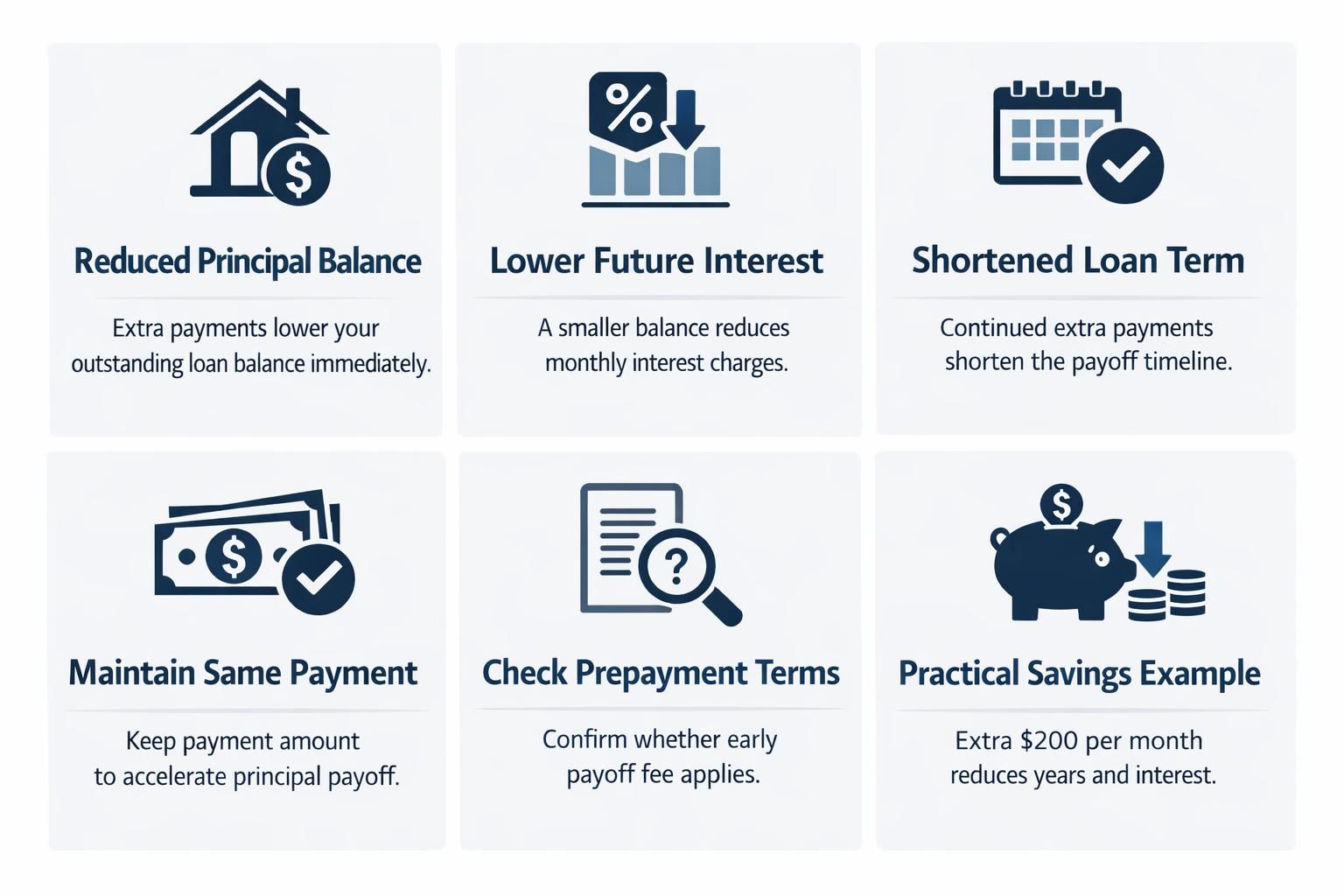
One of the most powerful tools in an investor's financing toolkit is the ability to make extra payments toward principal. Even small additional amounts applied to the loan balance can shorten your amortization schedule by years and save thousands in interest. Because the standard schedule is front-loaded with interest, every dollar you pay above the required amount goes directly toward reducing the principal, which in turn reduces the interest charged in all future months.
Here's a step-by-step look at how extra payments change the math:
Reduced principal balance: When you make an extra payment and specify that it should be applied to principal, your loan balance drops immediately. For example, if your balance is $380,000 and you pay an extra $1,000 toward principal, your new balance is $379,000.
Lower interest in subsequent months: Because interest is calculated on the outstanding balance, a lower balance means lower interest. On that $1,000 reduction, you might save $4 to $5 in interest the very next month, depending on your rate. That savings compounds every month for the rest of the loan.
Shortened loan term or lower total interest: If you keep making the same scheduled payment even after extra principal payments, you'll pay off the loan earlier than the original term. Alternatively, some investors make lump-sum extra payments periodically and enjoy the reduced interest cost over the remaining term without changing the payoff date. Either way, you come out ahead.
For DSCR loan borrowers, the ability to prepay depends on your loan terms. Many DSCR loans have no prepayment penalty, which means you're free to pay extra or pay off the entire balance early without any fees. Some loans, especially those with lower rates or longer terms, may include a penalty for early payoff during the first few years. Always confirm the prepayment terms before closing. If your loan allows it, even modest extra payments like an additional $200 per month can shave years off a 30-year loan and save a significant amount in interest. That's equity you're building faster, and cash you're keeping instead of sending to the lender. For investors who experience rent increases or have surplus cash flow from other properties, redirecting some of that income toward loan principal can be a low-risk way to improve your overall returns.
Understanding how DSCR loan amortization schedules work gives you the insight you need to structure financing that aligns with your investment strategy. Whether you're comparing a 30-year fully amortizing loan, a 40-year option to maximize monthly cash flow, or an interest-only period to preserve capital in the early years, each choice creates a different financial outcome. The way your payment is split between principal and interest, the total cost over the life of the loan, and the speed at which you build equity all depend on the amortization structure you select. Extra payments can accelerate equity buildup and reduce interest costs, while longer terms or interest-only periods offer flexibility when cash flow is tight or you have a short-term exit plan.
As a real estate investor, your financing decisions should support your broader portfolio goals, not just minimize your monthly payment. DSCR loans typically require 20% to 25% down and up to 75% to 80% LTV, with a minimum credit score of 620 and a minimum DSCR ratio of 1.0. These figures can change, so it's important to confirm current terms and explore your options. With increased competition in DSCR lending potentially leading to better terms and more accessibility, now is a smart time to evaluate your loan structure and ensure it's working for you. If you're ready to explore how amortization options can fit your rental property strategy, get a personalized DSCR loan quote and see what terms are available for your next investment.