DSCR Loan Seasoning After Commercial Conversion Explained
August 24, 2026
•
9 min read
Table of Contents
Understanding DSCR Loan Seasoning Period After Commercial to Residential Conversion
Converting a commercial property into a residential rental can unlock new value and income streams. But before you can tap into that equity or refinance with a DSCR loan, you'll need to navigate something called the seasoning period. This waiting period determines when lenders will recognize the property's new use, new value, and your ownership history for refinancing purposes.
For real estate investors, understanding the DSCR loan seasoning period after commercial to residential conversion is critical to timing your next move correctly. Whether you're planning to pull cash out for another deal or simply lock in better loan terms, knowing how long you need to hold the property can make or break your strategy. Let's break down what seasoning really means, why it matters, and how to plan around it when refinancing newly converted rental properties with cash flow loans.
What Seasoning Means in DSCR Loan Refinancing
What seasoning means in DSCR loan refinancing is straightforward once you understand the basic concept. Seasoning refers to the minimum period of ownership or title holding required before a lender will allow you to refinance a property. This isn't unique to DSCR loans, but it plays a particularly important role for investors who've recently converted properties from commercial to residential use.
Ownership verification: Lenders use seasoning periods to confirm you've held the property long enough to establish legitimate ownership and stabilize its operation as a rental.
Appraisal credibility: A seasoning period ensures the new appraised value reflects actual market conditions and rental performance rather than speculative projections immediately following a conversion.
Fraud prevention: Requiring a waiting period helps lenders reduce the risk of property flipping schemes or inflated valuations used to extract unearned equity.
Cash flow stability: For DSCR loans, which rely on rental income to qualify borrowers, seasoning gives the property time to demonstrate consistent cash flow under its new residential use.
When you convert a commercial building into residential rental units, the property undergoes significant changes in use, tenant profile, and income potential. Lenders want to see that the transition is real and sustainable before they extend financing based on the new configuration. That's where the seasoning requirement comes in, acting as a buffer that protects both the lender and you from premature or poorly informed refinancing decisions.
Unlike traditional mortgages that focus heavily on your personal income and credit, DSCR loans evaluate the property's debt service coverage ratio. This ratio compares the rental income the property generates to the debt obligations it carries. Because the calculation depends on actual rental performance, lenders typically want evidence that the property has been operating successfully in its new role for a set period before they'll issue a refinance based on that income stream.
Typical Seasoning Requirements for Cash-Out DSCR Refinances
Typical seasoning requirements for cash-out DSCR refinances often center around a six-month ownership period. This timeframe has become the market standard among many lenders when evaluating properties for cash-out refinancing, particularly those that have undergone recent conversions or improvements.
Six-month standard: The research shows that investors should generally plan for a six-month ownership period before pursuing a cash-out refinance to capitalize on the new appraised value of a converted property.
Lender variation: While six months is common, some lenders may allow seasoning periods as short as three months, depending on the deal structure, borrower experience, and property performance.
Title seasoning vs. loan seasoning: Title seasoning refers to how long you've held the deed, while loan seasoning relates to payment history on an existing mortgage. For conversions, title seasoning is usually the relevant measure.
Rate and refinance timing: Meeting the seasoning requirement allows lenders to apply the property's new appraised value, which can be significantly higher after a successful commercial to residential conversion.
The six-month benchmark serves multiple purposes. It gives you time to lease up the units, establish rental income documentation, and demonstrate that the property can meet or exceed the debt service coverage ratio the lender requires. Most DSCR lenders look for a ratio of at least 1.0, meaning the property's rental income covers the mortgage payment, though many prefer ratios of 1.25 or higher for better loan terms.
If you're planning a cash-out refinance after converting a commercial property to residential use, it's wise to consult with potential lenders early in the process. Understanding their specific seasoning requirements upfront helps you time the conversion work, tenant placement, and refinance application to align with their guidelines. Some lenders might be more flexible if you can show strong cash flow documentation, a solid rental history from other properties, or significant equity in the deal.
Have a property in mind?
Tell us about the property and we will find the financing that fits you best.
Why Commercial to Residential Conversions Trigger Seasoning Rules
Why commercial to residential conversions trigger seasoning rules becomes clear when you consider the nature of the change. When you take a property that was zoned, used, and valued as commercial space and convert it into residential rental units, you're fundamentally altering its risk profile, income structure, and market valuation.
Valuation reset: Commercial properties are often valued based on business income or commercial lease terms, while residential rentals are valued on comparable sales and residential rent rolls. This shift can create significant appraisal changes.
Zoning and permitting: Converting use typically requires new permits, zoning approvals, and sometimes substantial renovations. Lenders want to see that all work is complete and legally compliant before refinancing.
Income type change: Moving from commercial tenants to residential renters changes lease structures, tenant turnover rates, and cash flow predictability. Seasoning periods allow time to prove the new income stream is stable.
Market risk assessment: Lenders need time to evaluate whether the residential rental market in your area can sustain the occupancy and rental rates you're projecting after the conversion.
From a lender's perspective, a newly converted property represents a higher degree of uncertainty than a stabilized rental that's been residential for years. Even if you've done everything right, there's still a settling-in period where the true performance of the property becomes evident. Are the units renting at the rates you expected? Is tenant turnover manageable? Are maintenance costs in line with projections? These questions get answered over time, and the seasoning period provides that time.
For investors, this reality means you can't immediately flip from acquisition and conversion into a cash-out refinance. Instead, you need to plan for a holding period during which you'll stabilize operations, build a rental history, and gather the documentation lenders need to approve refinancing newly converted rental properties with cash flow loans. This might feel like a delay, but it's also an opportunity to optimize operations and maximize the appraised value before you approach lenders.
Steps to Prepare for DSCR Refinancing After Conversion
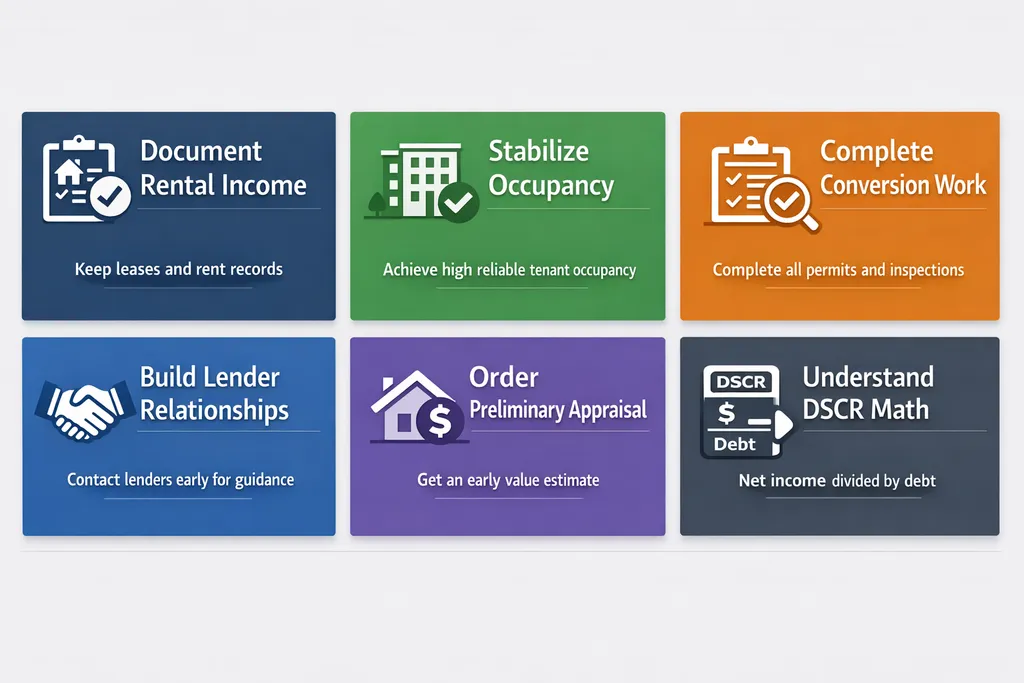
Steps to prepare for DSCR refinancing after conversion start well before you hit the six-month mark. Smart investors use the seasoning period strategically, laying the groundwork for a smooth and successful refinance once the waiting period ends.
Document rental income thoroughly: From day one, keep meticulous records of lease agreements, rent payments, and occupancy rates. DSCR lenders will want to see proof of consistent rental income, so having clean, organized documentation makes the underwriting process faster and more favorable.
Stabilize occupancy and cash flow: Aim to have all or most units leased with reliable tenants before you apply for refinancing. Lenders calculate DSCR based on actual or projected rental income, and a fully occupied property with a track record of on-time payments will qualify for better terms.
Complete all conversion work and inspections: Make sure every permit is closed, every inspection is passed, and the property is 100% compliant with local residential codes. Lenders won't refinance a property with outstanding permits or unfinished construction.
Build a relationship with DSCR lenders early: Don't wait until month six to start shopping for a loan. Reach out to lenders during the conversion process, understand their specific seasoning and underwriting requirements, and position your deal accordingly.
Order a preliminary appraisal if needed: Some investors find it helpful to get an informal sense of the property's post-conversion value before formally applying for a refinance. This can help you set realistic expectations and identify any value gaps you can address before the official appraisal.
One often overlooked aspect of preparation is understanding how the DSCR calculation works. The debt service coverage ratio is calculated by dividing the property's net operating income by its total debt service. Net operating income includes rental income minus operating expenses like property taxes, insurance, maintenance, and property management fees. It does not include mortgage principal and interest, which are part of the debt service side of the equation.
For example, if your converted property generates monthly rental income of six thousand dollars and has operating expenses of two thousand dollars, your net operating income is four thousand dollars per month. If your proposed mortgage payment including principal, interest, taxes, and insurance totals three thousand two hundred dollars, your DSCR is 1.25. That's a solid ratio that many lenders will approve, often with competitive rates and terms.
During the seasoning period, focus on maximizing that ratio. Can you reduce operating costs through better vendor contracts or energy efficiency improvements? Can you increase rental income by adding amenities or adjusting lease terms? Every improvement you make during the waiting period translates into a stronger refinance application and potentially better loan pricing.
How to Navigate Lender Differences in Seasoning Policies
How to navigate lender differences in seasoning policies requires a proactive approach and a willingness to shop around. Not all lenders interpret or enforce seasoning requirements the same way, and understanding these differences can give you a meaningful edge in timing and structuring your refinance.
Ask specific questions upfront: When you contact a lender, don't just ask if they offer DSCR loans. Ask about their exact seasoning requirements for properties converted from commercial to residential use, whether they measure from the deed date or the completion of construction, and if they have any flexibility for experienced investors.
Compare multiple lenders: The research indicates that while many lenders expect six months of seasoning, some may allow as little as three months under certain conditions. Getting quotes from several lenders helps you identify who offers the most investor-friendly terms for your situation.
Understand exceptions and waivers: Some lenders may waive or reduce seasoning requirements if you bring significant equity to the deal, have a strong investment track record, or can demonstrate exceptional cash flow. Always ask if exceptions are possible and what criteria you'd need to meet.
Clarify what counts as seasoning: Does the clock start when you close on the purchase, when you finish the conversion work, or when you place the first tenant? Different lenders may have different interpretations, so get clarity in writing.
Leverage broker relationships: Working with a mortgage broker who specializes in investor loans can save you time and frustration. Brokers often know which lenders are most flexible on seasoning and can match your deal to the right institution without you having to contact dozens of lenders individually.
It's also worth noting that seasoning requirements can vary based on the type of refinance you're pursuing. A standard rate and term refinance, where you're simply replacing your existing loan with a new one at better terms, might have more lenient seasoning rules than a cash-out refinance where you're pulling equity out of the property. Since cash-out transactions carry more risk for lenders, they often come with stricter seasoning and documentation requirements.
Another factor that can influence seasoning policies is the loan-to-value ratio you're targeting. If you're seeking a refinance at a conservative LTV, say sixty or sixty-five percent of the appraised value, a lender might be more willing to work with you on a shorter seasoning period. Conversely, if you're pushing for a higher LTV to maximize your cash-out proceeds, expect the lender to hold firm on the full six-month seasoning requirement.
Common Mistakes Investors Make with Conversion Seasoning
Even experienced investors sometimes trip up when it comes to managing the seasoning period after a commercial to residential conversion. Being aware of these common pitfalls can help you avoid delays, denials, or missed opportunities when refinancing newly converted rental properties with cash flow loans.
Starting the refinance process too early: Some investors assume they can apply for a DSCR loan as soon as the conversion work is done, only to be told they need to wait until they've held title for the required period. This can throw off your financing timeline and tie up capital longer than planned. Always confirm the seasoning requirement before you schedule your refinance application.
Failing to document rental income properly: Lenders need verifiable proof of rental income to calculate your DSCR. If you're accepting cash payments, using informal lease agreements, or not keeping clear records, you'll struggle to qualify even after the seasoning period ends. Set up proper accounting and lease documentation from day one.
Assuming all lenders have the same rules: As we've discussed, seasoning policies vary widely. Don't assume that because one lender quoted you a six-month requirement, that's the industry standard everywhere. Shopping around can uncover more flexible options that fit your timeline better.
Ignoring the appraisal implications: The whole point of waiting through the seasoning period is to refinance based on the property's new, higher value as a residential rental. But if you haven't maintained the property well, if occupancy is low, or if comparable sales have softened, the appraisal might come in lower than expected. Monitor local market conditions and property performance throughout the seasoning period.
Overlooking zoning and permit compliance: A surprisingly common issue is that investors complete the physical conversion but don't finalize all the legal and administrative steps. If your property isn't fully permitted and legally operating as residential when you apply for the refinance, the lender will either delay approval or deny the application outright.
Underestimating the importance of cash flow: DSCR loans are all about the numbers. If your property isn't generating enough income to meet the lender's minimum DSCR threshold, it doesn't matter how long you've owned it. During the seasoning period, focus relentlessly on maximizing rental income and controlling operating expenses to ensure you'll qualify when the time comes.
Another mistake worth mentioning is failing to build relationships with lenders early. Some investors wait until they're ready to refinance to start the conversation, which means they're learning the rules and requirements on the fly. Instead, connect with potential lenders during the acquisition or conversion phase. This gives you time to understand their expectations, prepare the right documentation, and structure your deal in a way that aligns with their underwriting criteria.
Maximizing Your Refinance Outcome After the Seasoning Period
Once you've cleared the DSCR loan seasoning period after commercial to residential conversion, your focus shifts to executing a refinance that delivers the best possible terms and the maximum benefit for your investment strategy. This is where preparation during the seasoning period pays off.
Time your application strategically: Don't just apply on day 181 because you technically meet the six-month requirement. Make sure your property is performing at its best, occupancy is high, and you have several months of solid rental income documentation. Applying when your numbers are strong gives you leverage to negotiate better rates and terms.
Present a complete package: Underwriters appreciate thorough, well-organized applications. Include detailed rent rolls, lease agreements, proof of insurance, property tax records, and a summary of any capital improvements you've made. The easier you make their job, the smoother the approval process will be.
Understand your DSCR and LTV targets: Know what debt service coverage ratio and loan-to-value combination will get you approved and at what rate. If your DSCR is borderline, consider ways to improve it before applying, such as paying down other debts on the property or increasing rents where market conditions allow.
Negotiate terms beyond just the rate: Interest rate matters, but so do prepayment penalties, loan term length, and whether the loan is recourse or non-recourse. DSCR loans often come with favorable terms for investors, but you won't get the best deal unless you ask and compare offers from multiple lenders.
Plan your cash-out use in advance: If you're doing a cash-out refinance, have a clear plan for how you'll deploy that capital. Whether you're funding another acquisition, completing improvements on other properties, or building reserves, knowing your strategy helps you determine the right amount to pull out and ensures the refinance makes financial sense.
Remember that the refinance itself is not the end goal. It's a tool to optimize your portfolio, improve cash flow, reduce your cost of capital, or fund growth. The seasoning period might feel like a frustrating wait, but it's also a valuable window to prove your property's performance, refine your operations, and position yourself for the strongest possible refinance outcome.
For investors who've successfully navigated the conversion from commercial to residential and met the seasoning requirements, the payoff can be substantial. You're not only unlocking equity in a transformed asset, but you're also securing financing based on rental income rather than personal income, which frees you up to scale your portfolio without hitting the debt-to-income limits that constrain traditional mortgage borrowers.
The DSCR loan seasoning period after commercial to residential conversion is more than just a waiting game. It's a strategic phase where you stabilize the property, document its performance, and prepare for a refinance that can unlock significant value and fuel your next investment. While the typical six-month requirement might seem like a hurdle, it's also an opportunity to demonstrate that your conversion was successful and that the property is a reliable income generator.
By understanding how seasoning works, preparing thoroughly during the waiting period, and shopping for lenders who align with your timeline and goals, you can turn a regulatory requirement into a competitive advantage. The key is to stay proactive, keep your financials tight, and use the time wisely to build a case that makes lenders eager to work with you.
If you're ready to explore refinancing options for your converted rental property, see your DSCR loan options and start planning your next move with confidence.




.png)