How Credit Tiers Influence DSCR Loan Interest Rate Adjustments for Lower Credit Tiers
Real estate investors know that every basis point counts when financing rental properties. Unlike conventional mortgages that weigh employment history and personal income heavily, DSCR loans focus on the property's cash flow. That doesn't mean your personal financial profile disappears from the equation, though. Your credit score still plays a powerful role in determining the rate you'll pay, and those differences can translate into thousands of dollars over the life of a loan.
For investors operating in lower credit tiers, understanding how lenders price DSCR loans becomes essential. The gap between a borrower with a 780 FICO and one with a 660 FICO isn't just a rounding error. It's a measurable adjustment that affects monthly payments, cash-on-cash returns, and overall deal viability. This article breaks down exactly how credit scores impact investor mortgage pricing, what rate ranges you might encounter, and how to position yourself for better terms even if your credit history isn't perfect.
How DSCR Loan Interest Rate Adjustments for Lower Credit Tiers Work
DSCR loan interest rate adjustments for lower credit tiers function through a layered pricing model that lenders use to manage risk. When you apply for a DSCR loan, the lender evaluates your credit score alongside other factors like loan-to-value ratio, property type, and the debt service coverage ratio itself. Each of these inputs contributes to the final interest rate you receive.
Credit score adjustments are not arbitrary. Lenders use detailed pricing matrices that assign specific rate increases, often called hits or adjustments, based on where your FICO score falls. A borrower in the mid-600s will typically see a higher rate than someone in the mid-700s, all else being equal. These adjustments reflect the statistical likelihood of default and the lender's cost of capital when extending credit to borrowers with varied credit profiles.
Tiered pricing structures: Most lenders segment credit scores into bands, such as 740 and above, 700 to 739, 660 to 699, and below 660. Each band carries a different base rate.
Cumulative adjustments: If you're also requesting a higher LTV or financing a non-owner-occupied property in a secondary market, those factors stack on top of the credit adjustment.
Rate floors: Some lenders impose minimum rates for lower credit tiers to ensure profitability and risk coverage, meaning even if market rates drop, your rate may not fall below a certain threshold.
Compensation for perceived risk: Lower credit scores may signal past financial challenges, so lenders price in a premium to offset the increased probability of missed payments or foreclosure.
Understanding this framework helps investors anticipate costs and negotiate more effectively. It also highlights the importance of knowing exactly where your credit stands before you start shopping for financing.
Typical Rate Ranges Across Credit Tiers
Typical rate ranges across credit tiers give investors a clearer picture of what to expect when they sit down with a lender. Based on current market observations, DSCR loan rates can range from around 6.375% to 7.875%, with credit score being one of the primary drivers of where you land within that spectrum.
Borrowers with FICO scores above 740 tend to qualify for the lower end of the range, assuming other factors like LTV and property type are favorable. As credit scores decline, the rate adjustments become more pronounced. Someone with a score in the high 600s might see rates closer to the upper end, and in some cases, rates can extend beyond 8% when multiple risk factors align.
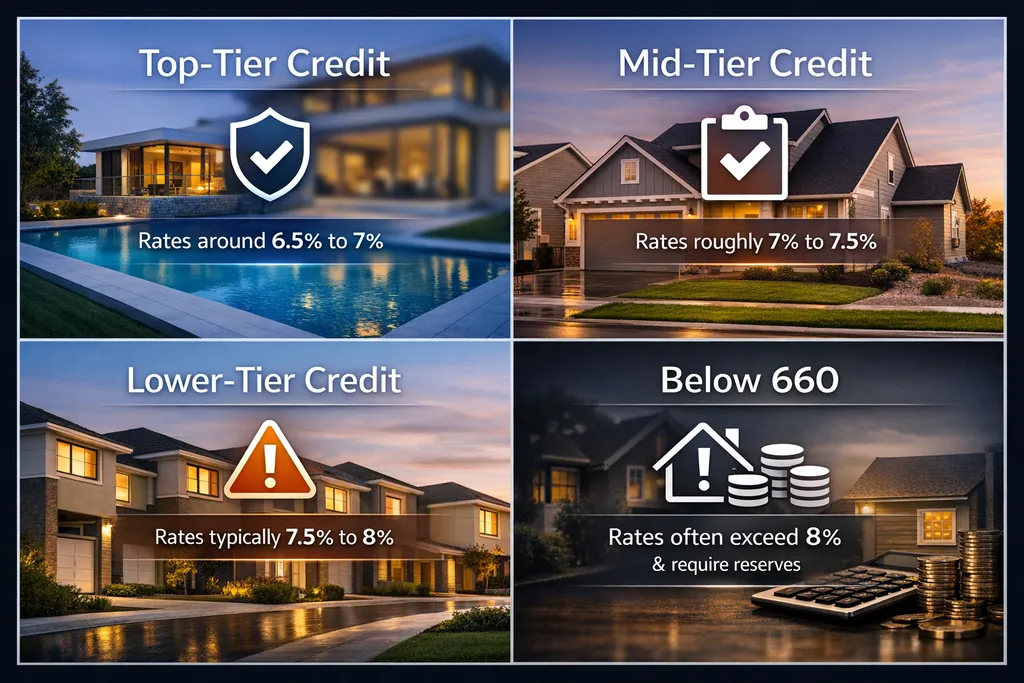
Top-tier credit (740 and above): These borrowers often access rates starting around 6.5% to 7%, depending on other loan characteristics and market conditions.
Mid-tier credit (680 to 739): Investors in this range may encounter rates from approximately 7% to 7.5%, with adjustments varying by lender and loan structure.
Lower-tier credit (660 to 679): Rates for this group typically fall between 7.5% and 8%, reflecting the increased risk lenders perceive.
Below 660: Financing becomes more challenging, and when available, rates often exceed 8%, with some lenders requiring larger down payments or reserves to offset the risk.
These ranges are not set in stone. Market conditions, lender appetite, and individual loan details can shift the numbers up or down. However, the pattern remains consistent: stronger credit opens the door to more favorable pricing, while weaker credit results in measurable rate premiums.
Have a property in mind?
Tell us about the property and we will find the financing that fits you best.
Why credit scores impact investor mortgage pricing comes down to risk assessment and historical performance data. Lenders rely on decades of research showing that borrowers with higher credit scores are statistically less likely to default. Even though DSCR loans prioritize property income over personal income, the borrower's creditworthiness still signals their financial discipline and ability to manage obligations during periods of vacancy or unexpected repairs.
For investment properties, the stakes are different than with primary residences. Investors might choose to walk away from a non-performing asset more readily than they would from their own home. Lenders account for this by layering credit-based pricing on top of property performance metrics. Your credit score becomes a proxy for your track record in handling debt, paying bills on time, and maintaining financial stability.
Default probability: Lower credit scores correlate with higher default rates, prompting lenders to charge more to compensate for potential losses.
Loan servicing costs: Borrowers with weaker credit may require more frequent communication, payment plan adjustments, or collection efforts, increasing the lender's operational expenses.
Secondary market pricing: Many DSCR loans are packaged and sold to investors on the secondary market. Credit quality affects the price those loans can command, influencing the rates lenders offer upfront.
Regulatory capital requirements: Financial institutions must hold more capital against riskier loans, making lower-credit loans more expensive to originate and hold on their books.
This interconnected system means that even a small improvement in your credit score can ripple through the pricing model, potentially saving you money every month. It's not just about qualifying for the loan; it's about qualifying at a rate that keeps your investment penciling out.
Strategies to Reduce Rate Adjustments
Strategies to reduce rate adjustments start with understanding what levers you can actually control. While you can't change market interest rates or lender policies overnight, you can improve your personal financial profile and structure your loan in ways that minimize the impact of credit-based pricing.
First and foremost, focus on your credit score. Even modest improvements can move you into a better pricing tier. Pay down revolving balances, correct errors on your credit report, and avoid opening new lines of credit in the months leading up to your loan application. These actions might seem small, but they can shift your FICO score by 20 or 30 points, which often translates into a meaningful rate reduction.
Increase your down payment: A lower LTV reduces the lender's risk and can offset some of the rate premium associated with a lower credit score. Moving from 80% LTV to 75% LTV, for example, might unlock better pricing.
Choose a property with strong cash flow: A higher DSCR demonstrates that the property generates more than enough income to cover the debt, which can make lenders more comfortable extending favorable terms despite a lower credit score.
Build cash reserves: Showing two to six months of reserves in liquid assets signals to lenders that you can weather vacancies or repairs, reducing their perceived risk and potentially improving your rate.
Work with multiple lenders: Not all lenders price credit adjustments the same way. Shopping around can reveal significant differences in how much your credit score affects the final rate.
These strategies won't eliminate rate adjustments entirely if your credit is below lender thresholds, but they can soften the blow and make your deal more competitive. The key is to approach your financing holistically, addressing multiple risk factors at once rather than focusing on credit alone.
Long-Term Implications of Rate Differences
Long-term implications of rate differences extend far beyond the monthly payment. A difference of even half a percent on a DSCR loan can alter the entire financial profile of your investment, affecting cash flow, equity buildup, and your ability to scale your portfolio.
Consider a scenario where you're financing a rental property with a loan amount of $300,000. At 6.75%, your monthly principal and interest payment is roughly $1,945. At 7.5%, that payment jumps to about $2,098. Over the course of a year, that's an extra $1,836 out of pocket. Over a 30-year loan term, you're looking at tens of thousands of dollars in additional interest expense, assuming you hold the loan that long.
Reduced cash flow: Higher monthly payments mean less money in your pocket each month, which can limit your ability to reinvest in additional properties or cover unexpected expenses.
Lower returns: If your cash-on-cash return drops due to higher debt service, the overall attractiveness of the deal diminishes, and you may miss your target ROI.
Harder to refinance: If your property doesn't appreciate as expected or market rates remain elevated, refinancing out of a high-rate DSCR loan becomes more difficult, locking you into unfavorable terms.
Portfolio growth constraints: Every dollar spent on extra interest is a dollar not available for down payments on future acquisitions, slowing your ability to build wealth through real estate.
These compounding effects underscore why monitoring and improving your credit score is not just a one-time task. It's an ongoing discipline that pays dividends across your entire investment career. Even after you close on a loan, continuing to build your credit can position you for better terms on your next deal.
Real estate investors who understand how credit tiers drive DSCR loan pricing gain a competitive edge in a market where every dollar matters. The research makes it clear that credit scores can influence rates by more than a full percentage point, and that difference compounds over time into significant sums. While DSCR loans evaluate properties based on cash flow rather than personal income, lenders still rely on credit scores to gauge borrower reliability and price their risk accordingly.
Improving your credit score, increasing your down payment, and selecting properties with strong debt service coverage ratios are all actionable steps that can help you secure better terms. The gap between a mid-600s FICO and a mid-700s FICO isn't just cosmetic. It's the difference between a deal that generates steady cash flow and one that barely breaks even after debt service.
If you're ready to explore how your credit profile translates into real numbers, it's worth taking the next step. You can get a personalized DSCR loan quote and see exactly what rate adjustments might apply to your situation. Armed with that information, you'll be better equipped to make smart financing decisions that support your long-term investment goals.




.png)