How DSCR Loans Unlock Financing for Build-to-Rent Single-Family Communities
Build-to-rent developments have reshaped the single-family rental market over the past few years. Investors who once focused exclusively on acquiring existing homes now have the option to develop entire communities purpose-built for long-term renters. Yet financing these projects can be tricky. Traditional mortgage products typically require personal income verification, tax returns, and employment history, none of which align well with the realities of real estate investment at scale.
That's where a DSCR Loan for Build-to-Rent Single-Family Communities becomes a powerful tool. DSCR loans rely on the rental income generated by the property itself, not the borrower's W-2 or 1099. For developers and investors building rental communities from the ground up, this shift in underwriting opens doors that conventional lenders often keep closed. Whether you're purchasing newly built units within a rental development, refinancing out of a construction loan once units are complete and leased, or buying into a stabilized community, understanding how DSCR loans work can change the way you approach your next project.
This article walks through the mechanics of DSCR loans, why they're uniquely suited to build-to-rent communities, and how investors can leverage them to scale their portfolios with confidence.
What Makes DSCR Loans Different for Rental Property Investors
Real estate investors often hit a wall when they try to scale beyond a handful of properties. Traditional lenders want to see personal income, stable employment, and low debt-to-income ratios. But if you've structured your investments to minimize taxable income or you're self-employed with complex returns, you might not qualify even though your rental portfolio is profitable.
DSCR stands for Debt Service Coverage Ratio. It's a metric that compares the monthly rental income a property generates to the monthly debt obligations on that property. Lenders use this ratio to determine whether the property can support its own mortgage payment. If the ratio is 1.0 or higher, the property's income covers the debt. If it's below 1.0, the property operates at a shortfall.
No personal income verification: You don't need to submit tax returns, pay stubs, or employment letters. The property's rental income is the focus.
Faster qualification for portfolio growth: Investors with multiple properties can avoid the personal debt-to-income limitations that traditional loans impose.
Flexible for self-employed and high-net-worth investors: If your income looks low on paper due to write-offs, a DSCR loan sidesteps that obstacle entirely.
Streamlined underwriting process: With fewer documents to gather and verify, closing timelines can be shorter compared to conventional loans.
This structure is especially valuable for build-to-rent communities, where the entire business model revolves around predictable rental income rather than personal earnings. When you're developing or acquiring multiple units at once, qualifying on cash flow instead of personal financials can mean the difference between scaling quickly and being stuck in underwriting limbo.
Why Build-to-Rent Communities Align With Cash-Flow Underwriting
Build-to-rent developments are designed from the start to generate rental income. Unlike traditional homebuilding, where the goal is to sell units to owner-occupants, build-to-rent projects remain under investor ownership and are managed as rental portfolios. This makes them a natural fit for DSCR underwriting once units are complete or near completion.
Predictable income streams: New construction in planned communities often attracts long-term tenants, especially when amenities and property management are built into the model.
Professional management in place: Many build-to-rent developments include on-site or third-party management, which lenders view favorably when evaluating income stability.
Uniform property quality: Newly built homes in a single community tend to have consistent rental rates, lower maintenance costs, and fewer surprises than older, scattered-site acquisitions.
Scalability through bulk financing: Some lenders offer portfolio-level DSCR loans, allowing investors to finance multiple units within the same community under one loan structure.
Cash-flow underwriting evaluates the rental income potential of each unit or the entire project, depending on how the loan is structured. For build-to-rent investors, this means lenders care more about lease terms, market rents, and occupancy rates than about your personal bank statements. That alignment makes DSCR loans one of the most investor-friendly financing options available for this asset class once the ground-up construction phase itself is behind you.
Have a property in mind?
Tell us about the property and we will find the financing that fits you best.
How DSCR Loan Underwriting Works for New Construction Rentals
A DSCR loan is underwritten against a property's actual or projected rental income, so it's built for completed, rent-ready homes rather than the construction phase itself. For a detailed breakdown of financing the construction phase itself and transitioning into permanent financing, see How DSCR Construction Loans Work for Build-to-Rent Properties.
Underwriting a DSCR loan on a completed build-to-rent property involves evaluating the income the property can generate and comparing it to the debt service. The process is straightforward once you understand what lenders are looking for.
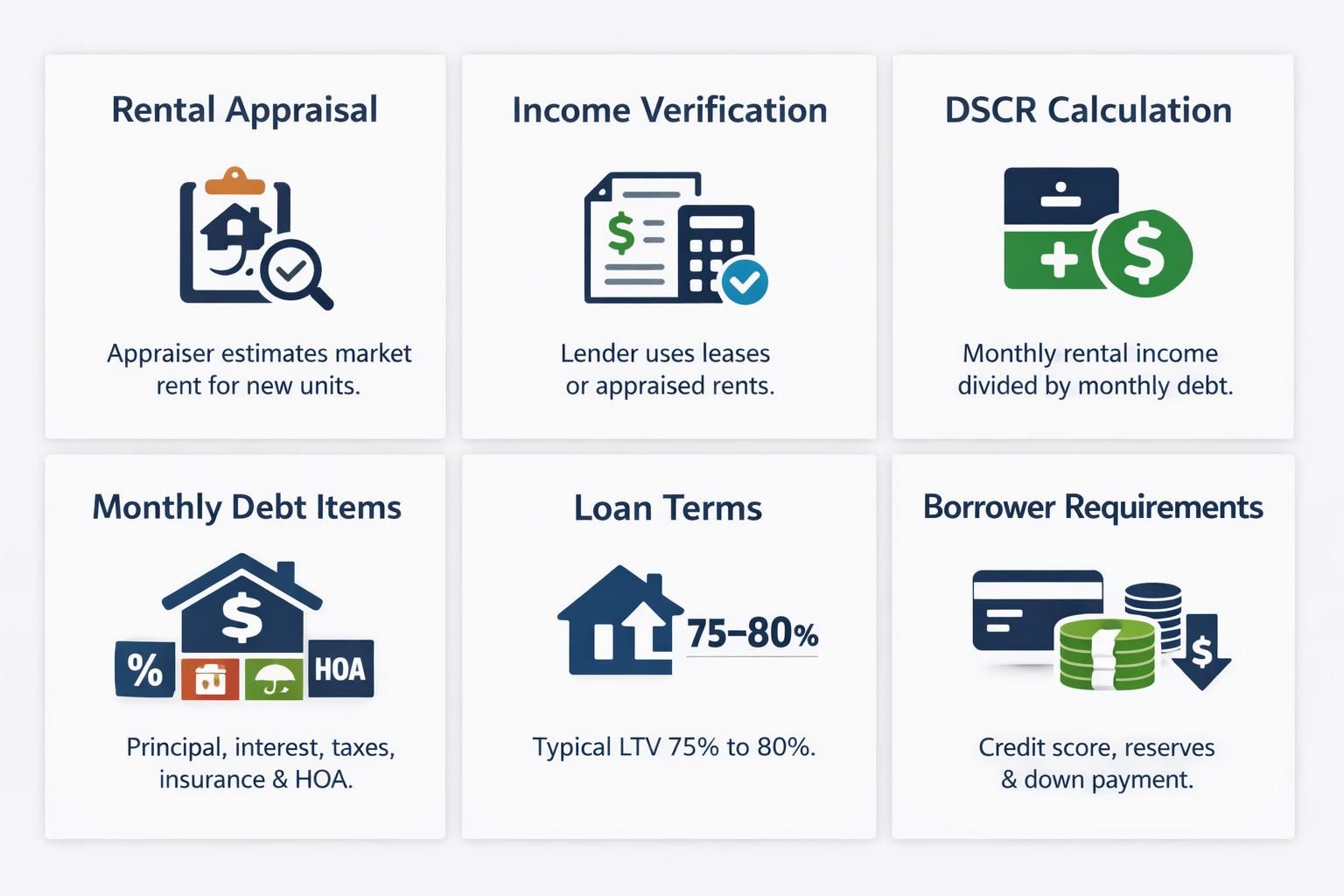
First, the lender orders an appraisal that includes a rental income analysis. For properties that aren't yet occupied, the appraiser estimates market rent based on comparable properties in the area. If the property is already leased, the lender uses the actual lease agreement to confirm income.
Next, the lender calculates the DSCR. The formula is simple:
DSCR = Monthly Rental Income / Monthly Debt Obligation
Monthly debt obligation includes the principal, interest, taxes, insurance, and any HOA fees. If the property generates $2,500 per month in rent and the total monthly debt is $2,000, the DSCR is 1.25. Most lenders prefer a ratio of at least 1.0, though some will finance properties with ratios as low as 0.75 if the borrower compensates with a larger down payment or stronger reserves.
Loan-to-value (LTV) ratios: DSCR loans for build-to-rent properties typically range from 75% to 80% LTV, meaning you'll need a 20% to 25% down payment.
Interest rate considerations: Rates vary based on credit score and loan-to-value. Trulo Mortgage's verified 2026 DSCR loan interest rate range is 6.25% to 8.00%.
Reserve requirements: Lenders may require several months of reserves to cover mortgage payments, especially on new construction where occupancy hasn't been established.
Credit score minimums: Most DSCR lenders require a credit score of 620 or higher, though higher scores unlock better terms.
Rates, LTV limits, and credit score requirements shift with market conditions and are confirmed at the time of application. Treat the figures above as a general guide and reach out to Trulo Mortgage for your current, personalized terms.
Because DSCR loans focus on property performance, the underwriting process is often faster than traditional loans. You won't need to compile years of tax returns or explain employment gaps. Instead, the lender focuses on rent rolls, appraisals, and your ability to manage the property successfully.
Key Benefits of Using a DSCR Loan for Single-Family Rental Communities
No personal income verification required: Your tax returns, pay stubs, and employment history don't factor into the approval process. The property's rental income is the foundation of the loan decision. This is a game-changer for investors who structure their finances to minimize taxable income or who have fluctuating self-employment earnings. Instead of being penalized for smart tax planning, you're rewarded for owning cash-flowing properties.
Faster path to portfolio expansion: Traditional loans count against your personal debt-to-income ratio, which caps how many mortgages you can carry. DSCR loans don't have that limitation. Because each loan is underwritten based on the property's income, you can scale your portfolio without hitting arbitrary borrowing limits. This is especially useful in build-to-rent communities, where you might be acquiring multiple units in a short timeframe.
Flexible terms for stabilized and lease-up properties: Some DSCR lenders offer financing for properties that haven't yet reached full occupancy, using projected rents to underwrite the loan. Others specialize in refinancing stabilized rental communities once they're generating income. This flexibility allows you to align your financing strategy with your project timeline, whether you're buying into a freshly built development or an existing one.
Competitive interest rates tied to property performance: While DSCR loans may carry slightly higher rates than owner-occupied mortgages, they're often more competitive than hard money or short-term construction loans. With rates varying based on credit score and loan-to-value, investors with strong profiles can secure financing that supports healthy cash flow and long-term returns.
Streamlined closing process: With fewer documents to verify and a focus on property income, DSCR loans often close faster than conventional investor loans. This speed can be critical when you're competing for units in a desirable build-to-rent community or trying to line up permanent financing right after construction wraps.
These benefits combine to make DSCR loans one of the most practical financing tools for investors focused on single-family rental communities. The alignment between how the loan is underwritten and how build-to-rent projects generate income creates a natural partnership between lender and borrower.
Common Scenarios Where DSCR Loans Shine in Build-to-Rent Projects
Buying multiple units in a new development: You've identified a build-to-rent community where the developer is selling individual homes to investors. You want to acquire five units at once to diversify your portfolio and benefit from the community's amenities and professional management. A traditional lender might balk at financing multiple properties simultaneously, but a DSCR lender evaluates each property on its own rental income, making bulk acquisitions much easier to finance.
Refinancing after construction is complete: You financed the initial construction with a short-term loan or private capital. Now that the property is built and leased, you want to refinance into a long-term, lower-rate mortgage. A DSCR loan allows you to refinance based on the property's proven rental income, pulling out equity or simply stabilizing your financing without revisiting your personal tax returns.
Purchasing into a stabilized rental community: A build-to-rent development has been operating for a year or two, and the developer is now selling individual units to investors. The properties have established rental histories, professional management, and proven occupancy rates. A DSCR loan lets you buy into this turnkey opportunity without the personal income scrutiny that traditional lenders require.
Scaling beyond personal income limits: You already own several rental properties, and traditional lenders have told you that your debt-to-income ratio is too high to qualify for more financing. But your properties are all cash-flowing and well-managed. A DSCR loan ignores your personal income and focuses on the new property's rental performance, allowing you to continue growing your portfolio.
Investing as a self-employed or high-net-worth individual: Your income looks complicated on paper due to business expenses, depreciation, or investment losses. Traditional lenders struggle to approve you even though your net worth and cash flow are strong. A DSCR loan sidesteps the complexity of your tax returns and underwrites based on the rental property's income, giving you access to financing that matches your real financial strength.
Each of these scenarios reflects a real challenge that investors face when trying to finance build-to-rent properties. DSCR loans offer practical solutions that align with how rental real estate actually works, rather than forcing investors into underwriting frameworks designed for owner-occupants.
Build-to-rent single-family communities represent a growing segment of the rental housing market, and investors who understand how to finance them strategically have a clear advantage. DSCR loans remove the barriers that traditional lenders create by focusing on what matters most: the income the property generates. Whether you're buying into new communities, purchasing stabilized projects, or refinancing out of construction financing, cash-flow underwriting aligns perfectly with the build-to-rent model.
The mechanics are straightforward. The benefits are real. And the opportunity to scale your portfolio without being limited by personal income verification is something every serious rental property investor should explore. As DSCR loan volume continues to grow, the product has become more accessible and competitive, offering terms that support long-term investment strategies. Program terms, rates, and guidelines can change, so always confirm current details directly with your lender.
If you're ready to explore financing a build to rent home with DSCR or want to learn more about how these loans can fit into your investment strategy, get a personalized DSCR loan quote tailored to your portfolio goals.