What Is a Non-QM Loan and How Is DSCR Different from a Mortgage
Most real estate investors hit the same wall eventually. You've built a solid portfolio, your properties cash flow beautifully, but when you approach a conventional lender for your next acquisition, they turn you down. Why? Your personal tax returns don't show enough W-2 income. Never mind that your rental properties generate thousands in monthly revenue. Traditional mortgage rules weren't written for investors like you.
That's where non-QM loans come in, and more specifically, DSCR loans. These investor-focused financing products flip the script entirely. Instead of scrutinizing your personal income documentation, lenders evaluate the property's ability to cover its own debt. For investors scaling portfolios or those with complex tax strategies, understanding what is a non-QM loan and how is DSCR different from a mortgage can unlock doors that conventional lending keeps firmly shut.
The mortgage landscape has shifted considerably in recent years. Non-QM issuance has increased substantially, driven largely by investor demand for flexible financing options that acknowledge the realities of rental property ownership. This isn't fringe financing anymore. It's a mainstream strategy for serious investors who need loan products designed around cash flow, not paystubs.
Why Non-QM Loans Exist Outside Standard Mortgage Guidelines
Conventional mortgages follow strict federal guidelines established after the 2008 financial crisis. These rules were designed to protect consumers buying primary residences, requiring extensive income verification through W-2s, tax returns, and detailed debt-to-income calculations. While this framework works well for salaried homebuyers, it creates significant obstacles for real estate investors.
Non-QM loans, or non-qualified mortgages, operate outside these conventional lending rules entirely. They're not subprime or risky by default. They simply use different underwriting criteria better suited to borrowers who don't fit the traditional employee profile. Think self-employed investors, those with multiple income streams, or anyone who strategically writes off income for tax purposes.
The growth in non-QM products reflects a maturing understanding among lenders that creditworthiness comes in many forms. An investor with strong rental income and substantial equity across a portfolio may represent lower risk than a W-2 employee with unstable employment history, yet conventional guidelines would favor the latter. Non-QM loans correct this imbalance, offering lenders flexibility to assess risk using common sense alongside property performance.
Flexible documentation requirements: Non-QM loans may accept bank statements, rental income history, or asset-based qualification instead of traditional tax returns and W-2s.
Investment property focus: These loans recognize that investment real estate operates differently from owner-occupied homes, with underwriting tailored to rental cash flow dynamics.
Portfolio expansion capability: Investors can often qualify for multiple non-QM loans simultaneously, unlike conventional loans that typically cap at ten financed properties.
Self-employment friendly: Borrowers who write off significant expenses or show reduced taxable income can still qualify based on actual cash flow rather than adjusted gross income.
Why DSCR loans don't fall under conventional lending rules becomes clear when you examine their core philosophy. They prioritize the asset's performance over the borrower's personal financial portrait. This distinction fundamentally changes the qualification process and opens financing opportunities that conventional products simply cannot accommodate.
How DSCR Loans Work for Investment Properties
DSCR stands for Debt Service Coverage Ratio, a straightforward calculation that compares a property's gross rental income to its total debt obligations. The formula divides the property's monthly rental income by the monthly mortgage payment, including principal, interest, taxes, insurance, and any HOA fees. A DSCR of 1.0 means the property's income exactly covers its debt. A DSCR above 1.0 indicates positive cash flow, while below 1.0 signals the property won't fully cover its own expenses.
Most DSCR lenders target ratios between 1.0 and 1.25, though some will finance properties with ratios slightly below 1.0 if other factors compensate. The beauty of this approach lies in its simplicity and property-centric focus. Your personal income, employment status, and tax returns become largely irrelevant. What matters is whether the rental property generates sufficient income to service the loan.
Qualification happens through an appraisal that includes a rental analysis or by providing an existing lease agreement. The lender calculates the DSCR using the documented rental income and the proposed loan terms. If the ratio meets their threshold, you're approved, assuming you meet basic credit and down payment requirements. No pay stubs, no employment verification letters, no tax return analysis.
Income calculation simplicity: Lenders use the property's gross rental income, either from current leases or appraiser market rent estimates, making qualification predictable and straightforward.
No personal income verification: DSCR loans qualify investors based entirely on property cash flow, eliminating the need for W-2s, tax returns, or detailed personal financial statements in most cases.
Fast closing timelines: With reduced documentation requirements, DSCR loans often close more quickly than conventional mortgages, helping investors move faster on time-sensitive deals.
Portfolio scaling advantage: Because qualification doesn't depend on personal debt-to-income ratios, investors can finance multiple properties simultaneously without hitting conventional loan limits.
This structure makes DSCR loans particularly valuable for investors with strong portfolios but complex tax situations. You might show minimal taxable income after deductions yet control properties generating substantial cash flow. Conventional underwriting would disqualify you. DSCR underwriting sees you as an ideal candidate.
Key Differences Between DSCR and Traditional Mortgages
Traditional mortgages and DSCR loans serve fundamentally different purposes and audiences. Understanding these distinctions helps investors choose the right financing tool for each acquisition. Conventional loans excel for owner-occupied properties and investors with straightforward W-2 income. DSCR loans shine when property performance matters more than personal income documentation.
The underwriting process represents the most dramatic difference. Conventional lenders scrutinize your entire financial life: employment history, income stability, existing debts, credit utilization, and detailed tax returns spanning two years or more. They calculate your debt-to-income ratio across all obligations, including the proposed mortgage. This comprehensive review protects the lender but creates barriers for investors whose financial pictures don't fit standard templates.
DSCR lenders take a radically different approach. They examine the property first and the borrower second. Credit scores still matter, as do reserves and down payment capacity. But the approval hinges on whether the rental income covers the mortgage payment with adequate cushion. Your personal income streams, employment status, and tax return complexity become secondary considerations at most.
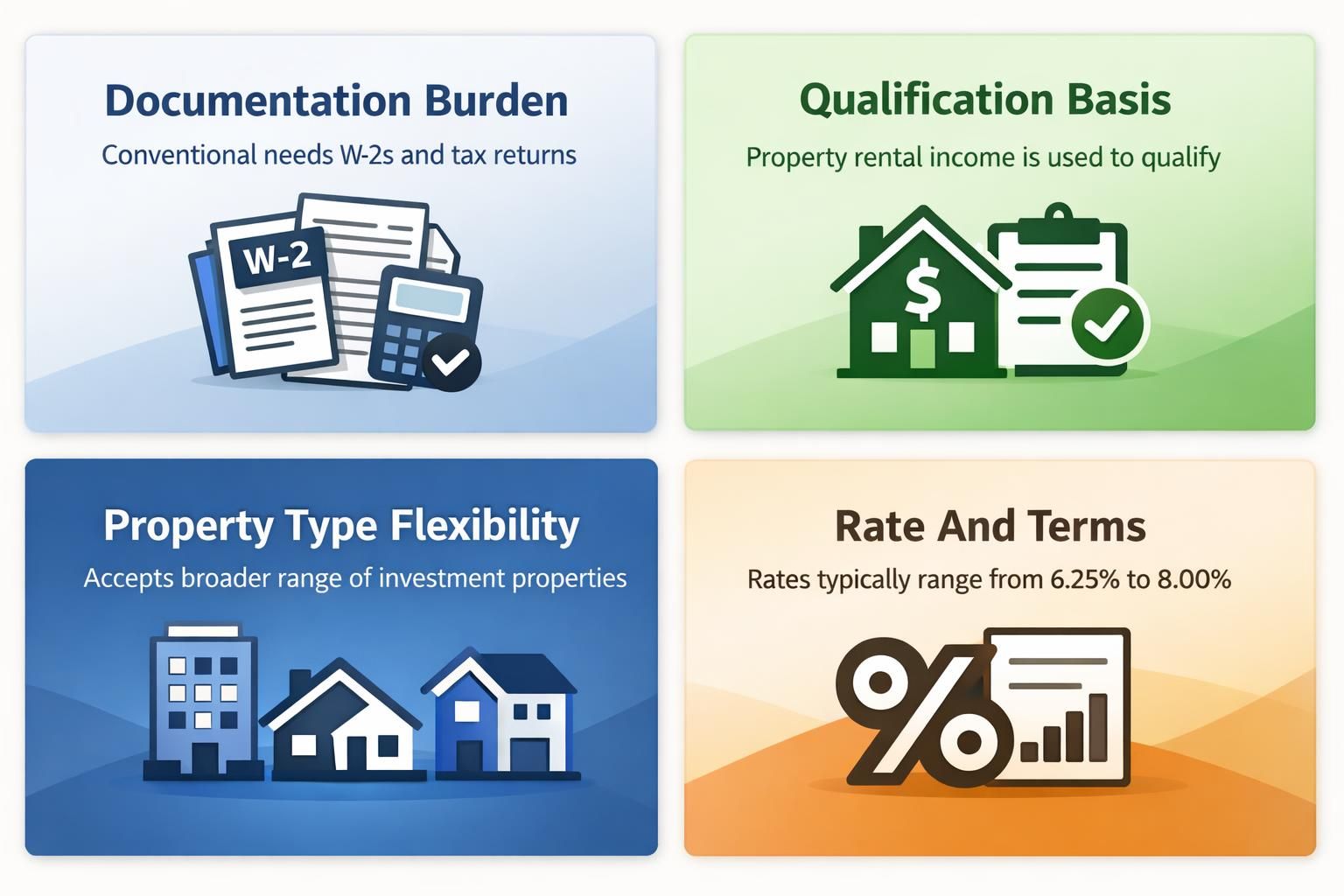
Documentation burden: Traditional mortgages require extensive personal financial documentation, while DSCR loans focus primarily on property income verification through appraisals or lease agreements.
Qualification basis: Conventional loans qualify borrowers on personal debt-to-income ratios and verified employment income; DSCR loans qualify properties based on rental income coverage of debt obligations.
Property type flexibility: DSCR loans often accept a broader range of investment properties, including non-warrantable condos and unique property types that conventional lenders may reject.
Rate and terms: DSCR loan interest rates typically range from 6.25% to 8.00%, reflecting the flexible qualification criteria, while conventional investment property loans may offer different pricing based on traditional underwriting factors.
Another crucial distinction involves portfolio limits. Conventional guidelines typically cap investors at financing ten properties through traditional channels. DSCR loans impose no such restriction. If you can find properties with adequate rental income to support the debt, you can continue expanding indefinitely. This difference alone makes DSCR loans essential for serious portfolio growth.
When Investors Should Choose DSCR Financing
Certain situations make DSCR loans the obvious choice, while others might warrant sticking with conventional financing. Strategic investors recognize when to deploy each tool. If you're salaried with clean tax returns and acquiring your first few rental properties, conventional financing might offer better rates and terms. But once your portfolio grows or your tax strategy becomes more sophisticated, DSCR loans often become not just preferable but necessary.
Self-employed investors typically benefit most from DSCR financing. When you write off business expenses, vehicle costs, home office deductions, and depreciation, your taxable income may appear far lower than your actual cash flow. Conventional lenders see only the adjusted gross income on your tax returns. DSCR lenders see the rental income your properties generate, which tells a completely different story about your financial strength.
Investors scaling beyond ten financed properties hit a hard wall with conventional lending. Federal guidelines limit the number of mortgages most borrowers can carry through traditional channels. DSCR loans impose no such limit. If you're building a substantial portfolio, you'll eventually need non-QM options simply to continue growing. Planning for this transition early helps you maintain momentum as you scale.
Complex tax situations: Investors with substantial write-offs, multiple business entities, or strategic tax planning that reduces reported income benefit from DSCR's focus on property cash flow rather than personal tax returns.
Rapid portfolio expansion: When you're acquiring multiple properties within a short timeframe, DSCR loans enable faster closing and simultaneous financing without hitting conventional loan count limits.
Non-traditional property types: Investment properties that don't fit conventional guidelines, such as certain condos, multi-family buildings, or unique configurations, often find approval through DSCR lenders more readily.
Strong property performance with moderate personal income: When your rental portfolio generates substantial cash flow but your personal income appears modest on paper, DSCR loans recognize your true financial strength.
Timing matters too. The non-QM market has expanded considerably, with issuance increasing as more investors discover these products and more lenders enter the space. This growth has improved terms, increased competition among lenders, and made DSCR loans more accessible than ever. Investors who dismissed these options years ago should revisit them now, as the landscape has matured significantly.
What to Expect from DSCR Loan Terms and Rates
DSCR loan pricing reflects their flexible qualification structure. Because lenders accept higher documentation flexibility and underwrite differently than conventional loans, rates typically fall in the 6.25% to 8.00% range for most investors. Your specific rate within that range depends on several factors: credit score, loan-to-value ratio, DSCR level, property type, and overall loan size.
Higher credit scores naturally command better pricing. An investor with a 740 credit score and strong reserves will secure rates toward the lower end of the range, while someone with a 660 score might land toward the higher end. The spread can be significant, making credit optimization worthwhile before applying. Similarly, lower loan-to-value ratios reduce lender risk and typically earn better rates. Putting 25% or 30% down often yields better pricing than the minimum 20% down payment.
The property's DSCR also influences pricing. A property with a 1.25 DSCR demonstrates strong cash flow cushion and may qualify for better terms than one barely hitting 1.0. Some lenders offer rate improvements at DSCR thresholds of 1.15, 1.25, or higher. This creates an interesting dynamic where stronger performing properties essentially negotiate better financing terms for themselves.
Rate ranges: Current DSCR loan rates span from 6.25% to 8.00%, with individual pricing determined by credit profile, down payment size, property cash flow, and overall risk assessment.
Loan-to-value impact: Lower LTV ratios typically secure better rates, with meaningful pricing improvements often available at 75% LTV or below compared to 80% LTV financing.
Reserve requirements: Most DSCR lenders require cash reserves equivalent to several months of mortgage payments across all financed properties, with exact requirements varying by lender and portfolio size.
Prepayment considerations: Some DSCR loans include prepayment penalties, particularly on fixed-rate products, so investors planning to refinance or sell quickly should review terms carefully before closing.
Term options mirror conventional investment property loans in many ways. Fixed-rate periods of 30 years remain common, along with adjustable-rate products that offer lower initial rates with periodic adjustments. The choice between fixed and adjustable depends on your hold strategy and interest rate outlook, just as with conventional financing. Investors planning long-term holds often prefer fixed rates for payment predictability, while those targeting shorter hold periods or anticipating refinancing may choose adjustable products for lower initial costs.