Real estate investors constantly search for creative ways to minimize upfront capital while maximizing leverage. When you're eyeing a rental property that pencils well but the down payment feels steep, there's a financing structure that can bridge the gap. A DSCR loan with seller financing combines a traditional debt service coverage ratio mortgage with a second lien held by the seller, often called a seller carry or seller second. This layered approach can reduce the cash you bring to closing and open doors to deals that might otherwise sit just out of reach.
The concept is straightforward in principle but requires careful attention to lender guidelines, subordination agreements, and combined loan-to-value limits. Done right, this strategy enhances your buying power without compromising the fundamentals that make DSCR loans attractive in the first place: no personal income verification, rental cash flow underwriting, and speed. Let's walk through how this financing stack works, what lenders typically allow, and how to structure a deal that keeps everyone comfortable.
Why Investors Layer Seller Financing with DSCR Loans
Combining seller financing to reduce down payment requirements makes economic sense when acquisition capital is tight or when you want to preserve liquidity for renovations, reserves, or additional acquisitions. Instead of bringing 25% down in cash, you might fund 10% out of pocket, secure a 75% DSCR loan from a lender, and negotiate a 15% seller-carried second lien. This type of stacked structure is sometimes referred to as a 75/15/10 arrangement.
Lower upfront cash requirement: By using a seller second, you reduce the amount of capital needed at closing, which can free up funds for property improvements, additional properties, or operating reserves that strengthen your position as a landlord.
Preserve leverage across your portfolio: When you're scaling a rental portfolio, each deal competes for the same pool of capital. A seller carry lets you stretch that capital further and potentially close multiple transactions in a shorter timeframe without tying up all your liquidity in a single property.
Faster closing with motivated sellers: Sellers who offer financing are often more flexible on price and terms because they benefit from deferred capital gains, ongoing interest income, and a quicker sale. This can create win-win scenarios where you secure better economics and the seller achieves their exit goals.
The debt service coverage ratio itself remains unchanged in this scenario. Your DSCR is still calculated by dividing the property's net operating income by the total debt service, which now includes both the senior DSCR loan payment and any payment on the seller second. Lenders underwrite the rental income against the combined obligation, so the property still needs to generate enough cash flow to support both layers of debt.
How the 75/15/10 Stack Typically Works
A common structure when using seller financing to reduce down payment involves three components stacked together. The first layer is the senior DSCR loan, usually at 75% loan-to-value. The second layer is the seller-carried note, often around 15% of the purchase price. The third component is your cash equity, which might be as low as 10%. This arrangement is shorthand as a 75/15/10 stack, though the exact percentages can vary based on lender appetite and deal specifics.
Senior DSCR loan in first position: The institutional or private lender providing the DSCR loan holds a first lien on the property. This loan is underwritten based on the rental income and debt service coverage ratio, typically requiring a DSCR of at least 1.0 or higher depending on the lender and property type. Interest rates vary based on credit score and loan-to-value, and the term is usually structured as a 30-year amortization with a balloon or refinance option after a fixed period.
Seller second in subordinate position: The seller agrees to finance a portion of the purchase price and records a second lien behind the senior mortgage. This note is subordinated, meaning the first lender gets paid in full before the seller receives anything in a foreclosure scenario. Because of this added risk, sellers may negotiate a higher interest rate on their note, though terms vary widely based on motivation and negotiation.
Your cash down payment: The remaining equity comes from your own funds. In a 75/15/10 scenario, that's 10% of the purchase price, though some lenders and sellers may accept higher seller seconds and lower cash equity, or vice versa, depending on the deal and the combined loan-to-value limits the senior lender will tolerate.
The senior lender's primary concern is the combined loan-to-value, or CLTV. This figure adds the senior loan balance and the seller second balance together, then divides by the property value. Most DSCR lenders cap CLTV at 80% to 90%, with 85% being a common threshold when a subordinate lien is involved. If the CLTV exceeds the lender's limit, you'll need to bring more cash down or reduce the seller carry amount to make the numbers work.
Subordination and Documentation Requirements
For a lender to approve a DSCR loan second position seller carry arrangement, they need certainty that their lien is protected and that the subordinate debt doesn't compromise the borrower's ability to service the senior loan. This is where subordination agreements and clear documentation become essential.
Signed subordination agreement: The seller must execute a subordination agreement that formally places their lien in second position behind the senior DSCR loan. This document is recorded with the county or jurisdiction where the property is located, creating a public record of lien priority. Without it, the senior lender may refuse to fund the loan or require full payoff of the seller note at closing.
Copy of the seller note and deed of trust: The senior lender will require a copy of the promissory note between you and the seller, along with the deed of trust or mortgage securing that note. They'll review the interest rate, payment terms, maturity date, and any prepayment or balloon provisions to assess whether the combined debt load is sustainable given the property's income.
Payment schedule and amortization: Some lenders prefer or require that the seller second be fully amortizing with regular monthly payments, while others may accept interest-only terms or even deferred payments in certain cases. However, if the seller second has no required payment or a very low payment, the senior lender may still impute a payment when calculating your debt service coverage ratio to ensure the property can support the full debt stack.
Appraisal reflecting true market value: The appraisal underpinning both the senior loan-to-value and the CLTV calculation must reflect an arm's-length transaction. If the property appraises below the contract price, the loan-to-value and CLTV ratios shift, potentially requiring you to bring more cash to closing or renegotiate the seller second amount.
Transparency with your lender from the beginning is critical. Disclose the seller financing arrangement upfront during the application process so the underwriter can structure the deal correctly and gather the necessary documents early. Surprises late in the process can delay closing or derail the transaction entirely.
Setting Up Terms That Work for Everyone
Negotiating the seller-carried note requires balancing your need for favorable terms with the seller's desire for security and return. Unlike a bank, the seller has flexibility to customize the note, but that same flexibility means you need to be thoughtful about how the terms impact your cash flow and future exit strategy.
Interest rate and payment structure: Seller seconds often carry interest rates above the senior loan rate because of the subordinate position and higher perceived risk. Rates might range from the mid-single digits to low double digits, depending on the seller's expectations and local norms. You can negotiate interest-only payments for a period, then switch to amortizing, or even request a balloon payment after several years, giving you time to refinance or sell before the note matures.
Maturity and balloon timing: Many seller seconds are structured with a three- to five-year balloon, meaning the full remaining balance comes due at that point. This aligns with typical DSCR loan refinance windows and gives you time to build equity or increase property value before needing to pay off the seller. Make sure the balloon date doesn't create a liquidity crunch if you plan to hold the property long-term.
Prepayment flexibility: Negotiate the right to prepay the seller note without penalty. This gives you the option to pay down or retire the second lien early if you complete a cash-out refinance or sell the property, improving your returns and simplifying your capital structure.
Cross-default and due-on-sale clauses: Review whether the seller note includes a cross-default provision tied to the senior loan, or a due-on-sale clause that accelerates the note if you transfer the property. These clauses can limit your flexibility, so address them during negotiation if you anticipate a future sale or transfer to an entity.
Remember that the seller's willingness to carry a note often reflects their confidence in you as a borrower and in the property's value. Demonstrating experience, a solid track record, and a clear business plan for the property can help you negotiate better terms and build trust that makes the deal smoother for everyone involved.
Common Pitfalls and How to Avoid Them
Combining a DSCR loan with subordinate financing rules introduces complexity that can trip up even experienced investors if details are overlooked. A few common missteps can delay closing, increase costs, or create unexpected cash flow pressure down the road.
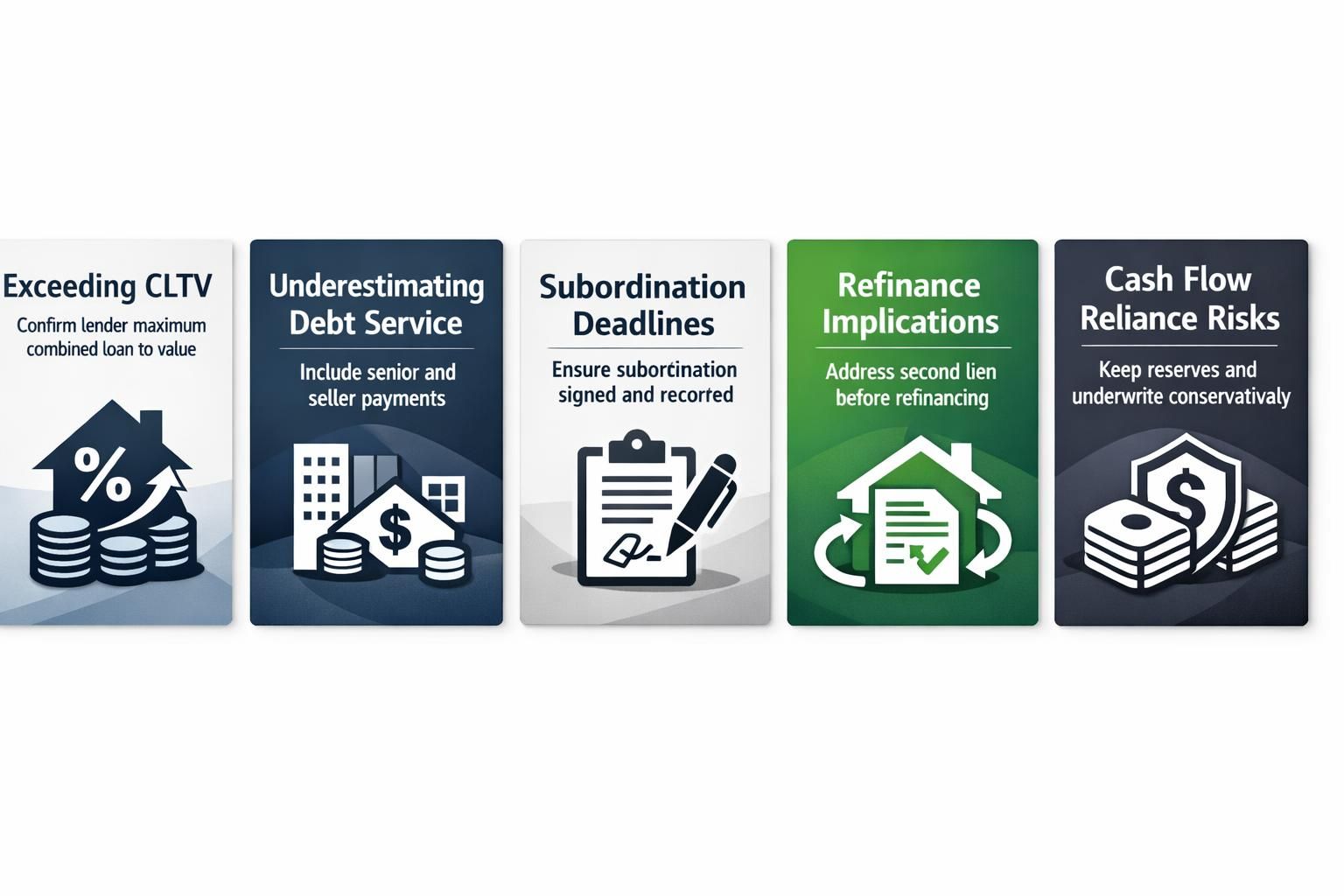
Exceeding the lender's maximum CLTV: Every DSCR lender has a cap on the combined loan-to-value they'll accept when a second lien is present. If you structure an 80% senior loan and a 15% seller second without checking the lender's CLTV limit, you may find out late in underwriting that the deal doesn't fit their guidelines. Always confirm the maximum CLTV upfront and structure your stack accordingly.
Underestimating total debt service: When calculating your expected cash flow, include both the senior mortgage payment and the seller second payment in your debt service figure. Some investors focus only on the first mortgage and are surprised when the combined payment pushes the property into negative cash flow or a DSCR below the lender's minimum threshold.
Missing subordination deadlines: The subordination agreement must be signed and recorded before or at closing. If the seller delays signing or the title company doesn't process the document in time, your closing can be postponed or canceled. Build extra time into your timeline and communicate clearly with all parties about the subordination requirement.
Ignoring future refinance implications: When the seller second matures or you want to refinance the senior loan, you'll need to address the subordinate lien. Some lenders won't refinance a property with a second lien in place unless that lien is paid off or re-subordinated. Plan your exit strategy early so you're not scrambling when the balloon comes due.
Relying on seller financing to cover cash flow gaps: Seller seconds reduce your upfront equity, but they don't eliminate the need for reserves or a cash flow cushion. If the property underperforms or needs unexpected repairs, you're still on the hook for both loan payments. Underwrite conservatively and maintain adequate reserves to weather vacancies or maintenance surprises.
Avoiding these pitfalls comes down to thorough due diligence, clear communication with your lender and seller, and conservative underwriting that accounts for the full debt load and potential contingencies.
A DSCR loan with seller financing unlocks opportunities that might otherwise require tying up more capital or passing on a deal altogether. By layering a senior DSCR mortgage with a seller-carried second, you can reduce your down payment, preserve liquidity for other investments, and structure terms that align with your business plan. The key is understanding the lender's combined loan-to-value limits, securing proper subordination, and underwriting the property to support the full debt stack.
This strategy works best when both you and the seller benefit from creative structuring, when the property's rental income comfortably covers total debt service, and when you have a clear plan for managing or refinancing the subordinate lien before it matures. Transparency with your lender, attention to documentation, and conservative cash flow assumptions will keep the process smooth and set you up for long-term success.
If you're ready to explore how a layered financing structure can work for your next acquisition, see your DSCR loan options and speak with a loan specialist who understands investor financing inside and out.