Understanding the DSCR Loan Underwriting Process for Investment Properties
The DSCR loan underwriting process represents a fundamental shift in how lenders evaluate rental property investments. Unlike traditional mortgage products that focus heavily on personal income verification, this approach prioritizes the property's ability to generate sufficient cash flow to cover its debt obligations.
For real estate investors, understanding this process can mean the difference between a smooth approval and unnecessary delays. The underwriting methodology evaluates your investment based on the debt service coverage ratio, which measures whether rental income can adequately service the mortgage payments.
This streamlined approach has gained significant traction in the current mortgage market, where lenders increasingly recognize that property cash flow often provides a more accurate assessment of loan viability than traditional income documentation.
Common Questions About DSCR Underwriting
Many investors have specific questions about how the DSCR loan underwriting process differs from conventional financing. Here are the most frequently asked questions:
Q: How long does the typical DSCR loan underwriting process take?
The timeline typically ranges from 15 to 30 days, depending on property complexity and documentation completeness. Automated valuation models can expedite the process by providing faster property assessments compared to traditional appraisals.
Q: What DSCR ratio do most lenders require for approval?
Most lenders prefer a DSCR of 1.0 or higher, meaning the property generates enough rental income to cover the mortgage payment. Some lenders may accept ratios as low as 0.75 for strong borrower profiles.
Q: Can I use projected rental income for new acquisitions?
Yes, lenders often accept market rent analysis and comparable property data to establish projected rental income for properties not currently generating cash flow.
Essential Documentation Requirements
The documentation requirements for the DSCR loan underwriting process focus primarily on property performance rather than extensive personal financial records. Understanding what lenders need upfront can significantly accelerate your approval timeline.
Property Financial Records: Rent rolls, lease agreements, and operating statements that demonstrate current or projected rental income from the investment property
Property Information: Purchase agreements, property condition reports, and insurance documentation that verify the asset's value and insurability
Basic Borrower Verification: Credit reports, asset statements, and minimal income documentation to establish overall financial stability
Market Analysis: Comparable rental data or professional rent estimates that support projected cash flow assumptions for the underwriting analysis
Income Review and Cash Flow Analysis
The income review component of the DSCR loan underwriting process centers on evaluating the property's rental income potential rather than the borrower's employment earnings. This analysis forms the foundation of the approval decision.
Current Rental Income: Existing lease agreements and rent rolls provide concrete evidence of the property's cash flow generation capacity
Market Rent Analysis: Comparative market analysis helps establish realistic rental income projections for vacant properties or those with below-market rents
Seasonal Adjustments: For short-term rentals, lenders may analyze seasonal occupancy patterns and average daily rates to calculate annual income projections
Vacancy Allowances: Underwriters typically apply vacancy factors ranging from 5% to 10% to account for periods between tenants and maintenance downtime
Property Expense Analysis Methods
Expense analysis represents a critical component of the DSCR loan underwriting process, as lenders must understand the true net operating income available for debt service. This evaluation goes beyond simple mortgage payments to consider all property-related costs.
Operating Expenses: Property taxes, insurance, maintenance, and management fees that directly impact the property's net cash flow available for debt service
Capital Reserves: Lenders may require evidence of reserves for major repairs and improvements, typically calculated as a percentage of rental income
Utility Responsibilities: Analysis of which utilities the owner versus tenant pays, as this directly affects the property's net operating income calculation
Management Costs: Whether self-managed or professionally managed, lenders account for management expenses in their debt service coverage calculations
Step-by-Step Approval Process
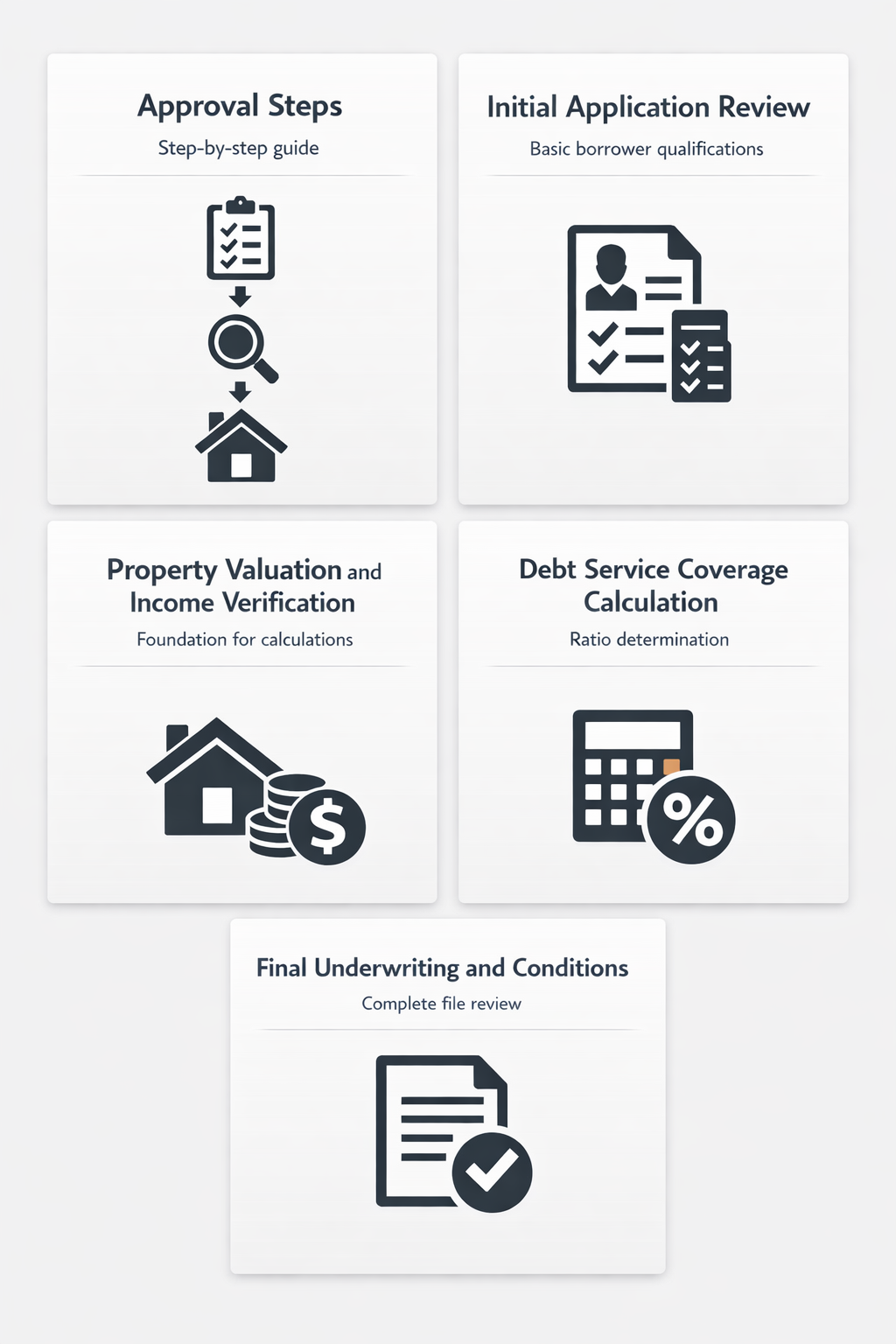
The approval steps in the DSCR loan underwriting process follow a logical sequence that evaluates both property performance and borrower qualifications. Understanding these steps helps investors prepare more effectively.
Initial Application Review: Lenders evaluate basic borrower qualifications including credit score, asset verification, and preliminary property information to determine if the loan meets initial criteria
Property Valuation and Income Verification: Professional appraisal or automated valuation model assessment combined with rental income analysis establishes the foundation for DSCR calculations
Debt Service Coverage Calculation: Underwriters calculate the ratio by dividing net operating income by the proposed mortgage payment to determine if the property meets minimum coverage requirements
Final Underwriting and Conditions: Complete file review addresses any remaining conditions, verifies all documentation, and issues final approval with specific loan terms and closing requirements
Technology Integration in Modern Underwriting
Modern DSCR loan underwriting processes increasingly incorporate technology solutions that expedite evaluation timelines while maintaining accuracy. These technological advances particularly benefit investors seeking to close quickly on time-sensitive opportunities.
Automated Valuation Models: AVM technology provides rapid property valuations that can significantly reduce the time required for traditional appraisals, especially beneficial in fast-moving markets
Rental Income Analytics: Advanced data platforms analyze comparable rental properties and market trends to establish accurate rental income projections for underwriting purposes
Digital Documentation Systems: Electronic document management and verification systems streamline the submission and review process, reducing processing delays
Risk Assessment Algorithms: Sophisticated underwriting engines can quickly evaluate multiple risk factors and provide preliminary approval decisions, allowing faster loan processing
Optimizing Your Application Strategy
Strategic preparation can significantly improve both approval odds and processing speed within the DSCR loan underwriting process. Experienced investors understand that proper preparation often determines success.
Pre-Application Property Analysis: Conduct your own DSCR calculations using conservative rental income estimates and realistic expense projections to ensure the deal meets lender requirements before applying
Documentation Organization: Prepare comprehensive property financial records, lease agreements, and market analysis data in advance to avoid delays during the underwriting review process
Lender Selection Strategy: Research lenders who specialize in DSCR products and understand your specific property type, whether traditional rentals, short-term rentals, or commercial properties
Relationship Building: Establish relationships with experienced loan officers who understand investor needs and can guide you through potential underwriting challenges before they become obstacles
The DSCR loan underwriting process offers real estate investors a streamlined path to financing that aligns with how investment properties actually generate returns. By focusing on property cash flow rather than personal income documentation, this approach recognizes the fundamental economics of rental property investing.
Success in navigating this process requires understanding both the analytical components like income review and expense analysis, as well as the procedural elements that drive approval timelines. The integration of technology solutions continues to make this process more efficient, benefiting investors who need to move quickly in competitive markets.
As the mortgage market continues to evolve toward cash flow-driven lending decisions, mastering the DSCR underwriting process becomes increasingly valuable for building and scaling rental property portfolios. The key lies in thorough preparation, realistic projections, and working with lenders who understand the unique aspects of investment property financing.