Understanding DSCR Loan Credit Score Requirements for Self-Employed Borrowers
If you're a self-employed real estate investor, you've probably hit the same wall countless others have: traditional lenders asking for two years of tax returns, profit and loss statements, and a mountain of documentation that doesn't reflect your true financial capacity. Here's the good news. DSCR loans offer a completely different path to financing investment properties, one that focuses on the property's rental income rather than your personal income documentation.
The dscr loan credit score requirements for self-employed borrowers are generally more straightforward than you'd expect. Instead of digging through your complicated business tax returns or trying to explain variable income streams, lenders evaluate whether the property itself can carry the debt. For investors who've built successful portfolios but show lower taxable income due to legitimate write-offs and deductions, this approach changes everything.
This guide walks you through exactly what credit scores you'll need, how the qualification process works without tax returns, and what factors beyond your FICO score will influence your loan terms. Whether you're acquiring your first rental or your fifteenth, understanding these requirements can help you move faster and close more deals.
What Credit Score Do You Need for a DSCR Loan
What credit score do you need for a DSCR loan as a self-employed investor? The answer might surprise you. Unlike conventional mortgages that often demand scores in the mid-700s, DSCR lenders typically work with borrowers starting at much lower thresholds.
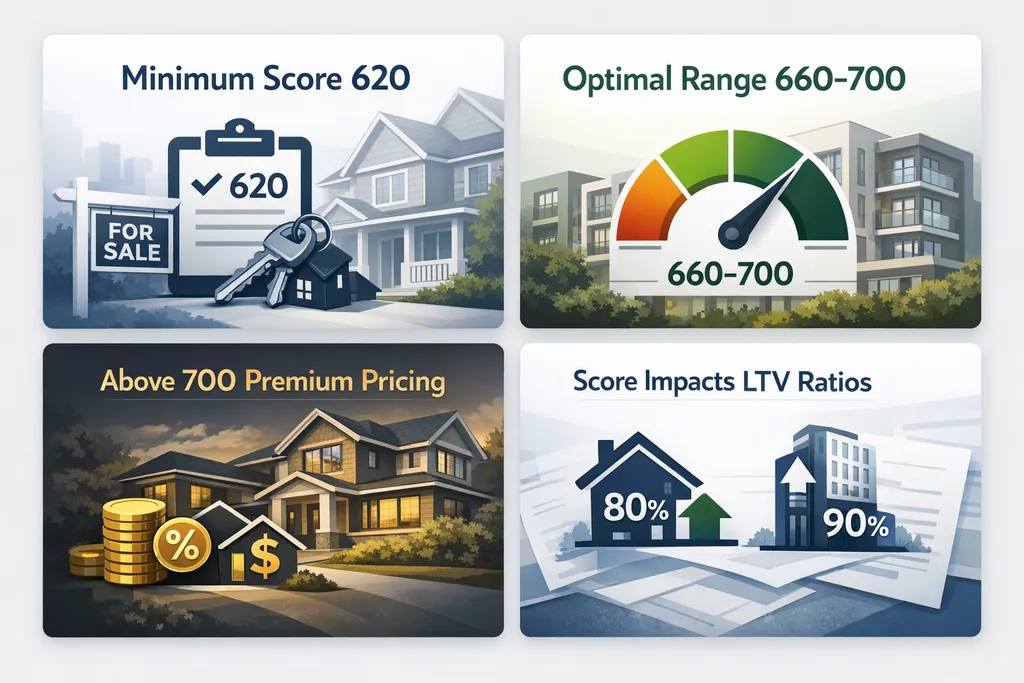
Minimum score of 620: Many DSCR lenders set their floor at 620, which opens the door for investors who may have had past credit challenges but have since rebuilt their financial standing. At this level, you can still qualify, though you'll likely face higher interest rates and may need a larger down payment to offset the lender's risk.
Optimal range of 660 to 700: Most lenders prefer to see scores in this range for standard terms. When your credit sits in the 660-700 band, you'll typically access more competitive rates and have greater flexibility on down payment requirements, making deals pencil out better on your pro formas.
Above 700 brings premium pricing: Once you cross into the 700s, you're in the sweet spot for the best rates and terms DSCR lenders offer. Higher scores signal lower risk, and lenders reward that with pricing that can make the difference between a marginal deal and a strong cash-flowing property.
Score impacts loan-to-value ratios: Your credit score directly affects how much leverage you can get. Borrowers with scores above 680 often qualify for higher LTV ratios, meaning less cash out of pocket at closing, which preserves capital for your next acquisition or necessary property improvements.
It's worth noting that these are general ranges observed across the DSCR lending market. Individual lenders may set their own overlays, and some portfolio lenders might work with scores slightly below 620 if other compensating factors are strong, such as significant liquid reserves or a low loan-to-value request.
The key takeaway here is that dscr loan credit score requirements for self-employed borrowers are typically more accessible than traditional mortgage products. That accessibility stems from the fundamental underwriting difference: the property's income matters more than your personal income documentation.
Why DSCR Loans Don't Require Personal Tax Returns
Why DSCR loans don't require personal tax returns is the question that draws most self-employed investors to this product in the first place. The answer lies in how these loans are underwritten from the ground up.
Property income is the primary metric: DSCR lenders focus exclusively on the rental income the investment property generates or is expected to generate. They calculate the debt service coverage ratio by dividing the property's monthly rental income by the monthly mortgage payment (principal, interest, taxes, insurance, and HOA if applicable). If that ratio meets their threshold, usually 1.0 or higher, the property qualifies.
Simplifies qualification for complex income: Self-employed borrowers often have income that fluctuates month to month or includes multiple revenue streams, partnerships, and legitimate business deductions. Traditional underwriting struggles with this complexity, but DSCR underwriting sidesteps it entirely by not asking for your personal financial picture beyond credit and assets for down payment.
Faster closing timelines: Without waiting for CPAs to produce tax transcripts, without gathering 1099s or K-1s, and without underwriters combing through Schedule C deductions, the qualification process moves significantly faster. Many investors close DSCR loans in three to four weeks, compared to 45-60 days for conventional financing.
Removes personal income volatility from equation: If your taxable income took a dip last year because you reinvested heavily in your business or maximized depreciation on existing rentals, it won't hurt your ability to qualify. The lender simply doesn't look at it. They care whether the property's rent can cover its debt, period.
This structure fundamentally changes the game for qualifying for investment property loans without tax returns. You're no longer penalized for smart tax planning or for having income that doesn't fit neatly into W-2 boxes. Instead, you're rewarded for identifying properties with strong rental fundamentals.
That said, you will still need to provide some documentation. Lenders typically ask for recent bank statements to verify you have funds for the down payment and reserves, along with a credit report and sometimes a rent schedule or appraisal to establish the property's income potential. But the stack of paperwork is a fraction of what traditional lenders demand.
How the DSCR Calculation Works in Loan Approval
How the DSCR calculation works in loan approval is essential knowledge for any investor looking to leverage this financing tool effectively. The ratio itself is straightforward: you take the property's monthly rental income and divide it by the total monthly debt service.
Here's the formula: DSCR equals monthly rental income divided by monthly debt payment (including principal, interest, property taxes, insurance, and any HOA fees). A DSCR of 1.0 means the rental income exactly covers the debt payment. A ratio of 1.25 means the property generates 25 percent more income than needed to service the debt, providing a comfortable cushion.
Most lenders set minimum DSCR requirements between 1.0 and 1.25, depending on the borrower's credit profile, down payment, and the lender's risk appetite. Properties with higher DSCR ratios are viewed as less risky because they generate more income relative to their debt obligations, which can translate to better loan terms.
Let's walk through a quick example. Suppose you're buying a single-family rental that appraises with a market rent of $2,400 per month. Your proposed loan amount, at current rates, would result in a monthly payment of $2,000 (including principal, interest, taxes, and insurance). Your DSCR would be $2,400 divided by $2,000, which equals 1.20. That's a solid ratio that most lenders would approve without hesitation.
Now, if that same property only rented for $1,900 per month, your DSCR would drop to 0.95. That's below the 1.0 threshold, meaning the rent doesn't fully cover the debt service. In that scenario, you'd likely need to make a larger down payment to reduce the loan amount and monthly payment, or the lender might decline the loan altogether.
Understanding this calculation allows you to underwrite deals before you ever submit a loan application. You can quickly assess whether a property will qualify for DSCR financing by running the numbers on rent and estimated debt service. This makes you a faster, more confident buyer who can move decisively when the right opportunity appears.
One nuance worth mentioning: some lenders use actual lease agreements if the property is already occupied, while others use appraised market rent for vacant properties or those you're purchasing. Appraisers determine market rent based on comparable rentals in the area, which can sometimes be conservative. Knowing which method your lender uses helps you set accurate expectations during underwriting.
Key Factors Beyond Credit Score That Affect Approval
Key factors beyond credit score that affect approval for DSCR loans can make or break your deal, even if your FICO number looks great. Lenders evaluate several additional variables to assess overall risk and determine your final terms.
Loan-to-value ratio and down payment: The amount of equity you're putting into the deal directly impacts approval and pricing. Most DSCR lenders require a minimum down payment of 20 to 25 percent, with some allowing as low as 15 percent for borrowers with excellent credit and strong DSCR ratios. Higher down payments reduce the lender's exposure and often unlock better interest rates. If you're willing to put 30 or 35 percent down, you'll typically see noticeably lower rates and smoother approvals.
Cash reserves: Lenders want to see that you have liquid assets available after closing, typically requiring reserves equal to two to six months of the property's debt service (often called PITIA: principal, interest, taxes, insurance, and association dues). These reserves act as a safety net if the property sits vacant or requires unexpected repairs. Investors with deeper reserves demonstrate financial strength and preparedness, which can offset a lower credit score or tighter DSCR ratio.
Property type and condition: Single-family homes and small multifamily properties (two to four units) are easiest to finance with DSCR loans. Condos, especially in non-warrantable projects, can be more challenging and may require higher down payments. The property's condition matters too: lenders generally prefer properties in good, rent-ready condition. If significant rehab is needed, you might need to look at fix and flip financing first, then refinance into a long-term DSCR loan once the work is complete.
Debt service coverage ratio strength: We covered the calculation earlier, but it's worth emphasizing that a higher DSCR gives you more negotiating power. Properties with ratios of 1.30 or above are considered very strong and may qualify for the lender's best execution pricing. Conversely, properties barely hitting the 1.0 minimum may face rate add-ons or require compensating factors like higher credit scores or larger down payments.
Real estate investment experience: While not a hard requirement for most DSCR lenders, your track record as an investor can influence approval, especially in borderline cases. First-time investors are generally welcome, but seasoned landlords with multiple properties may receive more favorable consideration or access to portfolio financing options that streamline acquisitions across multiple deals.
These factors work together in the lender's overall risk assessment. A borrower with a 680 credit score, 25 percent down, strong reserves, and a property with a 1.30 DSCR will likely get better terms than someone with a 720 score but only 20 percent down, minimal reserves, and a 1.05 DSCR. The complete profile matters, not just one isolated number.
Strategies to Strengthen Your DSCR Loan Application
Strategies to strengthen your DSCR loan application can help you secure better terms, faster approvals, and more competitive pricing. Even if you already meet the minimum requirements, these tactics can move you from approval to optimal approval.
Target properties with strong rental comps: Before you make an offer, research comparable rentals in the area to confirm the property can command rents that will deliver a solid DSCR. Pull listings from rental platforms, talk to local property managers, and review the appraiser's rent comparables if you have access. Buying a property with rent potential of $2,600 when similar homes rent for $2,200 might sound great, but if the appraiser pegs market rent at $2,200, that's the number the lender will use in your DSCR calculation.
Improve your credit score before applying: If you're sitting at 640 and you have a few months before you need to close, focus on raising that score. Pay down credit card balances to below 30 percent utilization, dispute any errors on your credit report, and avoid opening new credit accounts. Even a 20-point bump can shift you into a better pricing tier and potentially save you thousands over the life of the loan.
Build deeper reserves: Cash in the bank is one of the simplest ways to de-risk your profile in the lender's eyes. If you're borderline on credit or DSCR, showing six to twelve months of reserves instead of the standard two to six months can tip the scales in your favor. Reserves can include savings accounts, money market accounts, and even a portion of retirement accounts in some cases, though not all lenders count those equally.
Consider a larger down payment: If you're able to stretch your down payment from 20 percent to 25 or 30 percent, you'll reduce the loan amount, lower the monthly debt service, and improve your DSCR in one move. Plus, lower LTV ratios almost always result in better interest rates, which compounds the benefit by further reducing your monthly payment and improving cash flow once you close.
Work with experienced DSCR lenders: Not all lenders are created equal in this space. Some are portfolio lenders who hold their own loans and can be more flexible on guidelines. Others are correspondent lenders who sell to investors and must stick to stricter overlays. Finding a lender who specializes in DSCR products for self-employed investors and who understands the nuances of qualifying for investment property loans without tax returns will make the entire process smoother and often results in better execution.
Taking these steps puts you in the strongest possible position when you submit your application. You're not just hoping to squeak by, you're positioning yourself as a low-risk borrower who gets the best terms available in the market.
Credit Score Exceptions for Portfolio Investors
Investors scaling a portfolio of rental properties may qualify for credit score flexibility that isn't available to first-time buyers, since lenders weigh the performance of the whole portfolio alongside a single FICO number.
Compensating factors: Substantial liquid reserves (two to six months of payments across the portfolio), strong equity in existing properties, or a DSCR ratio above the standard minimum can support approval even when a credit score sits below a lender's advertised floor.
Portfolio performance: A track record of consistent rental income, low vacancy, and on-time mortgage payments across existing rental properties demonstrates operational competence that can offset a lower personal credit score.
Full portfolio review: When financing an additional property, lenders typically request a schedule of real estate owned covering every investment property, its mortgage, income, and expenses, so overall portfolio cash flow and leverage factor into the decision alongside the credit score.
Relationship pricing: Investors financing multiple properties through a single lender may access portfolio-level pricing or flexibility that isn't offered on one-off transactions.
These exceptions typically require documentation such as bank statements showing reserves, a schedule of real estate owned, and lease agreements or rent rolls for existing properties.
Navigating the world of investment property financing as a self-employed borrower doesn't have to be complicated or frustrating. DSCR loans remove the traditional barriers that have kept many capable investors on the sidelines, replacing them with a clear, property-focused underwriting model that rewards strong deals and solid rental fundamentals.
The dscr loan credit score requirements for self-employed borrowers are accessible, with most lenders working with scores as low as 620 and offering optimal terms once you reach the 660 to 700 range. More importantly, the ability to qualify without personal tax returns, W-2s, or complicated income documentation opens the door for investors who've been told no by traditional lenders.
Success with DSCR financing comes down to understanding the key factors: your credit score, the property's debt service coverage ratio, your down payment and reserves, and the overall risk profile you present to the lender. By targeting properties with strong rental income, building your credit, and working with lenders who specialize in investor loans, you can secure financing that supports your portfolio growth without the hassle of conventional mortgage processes.
As you evaluate your next acquisition, remember that the property's numbers matter more than your tax return. Focus on cash flow, run the DSCR calculation before you make an offer, and position yourself as the confident, prepared investor lenders want to work with. If you're ready to explore how DSCR financing can work for your next investment property, get a personalized DSCR loan quote and see what terms you qualify for today.