Choosing between an arm vs fixed rate DSCR loan can make or break your rental property investment strategy. For investors financing properties based on cash flow rather than personal income, understanding how adjustable and fixed-rate structures impact your bottom line is critical. The decision isn't just about today's interest rate, it's about aligning your financing with your investment timeline, risk tolerance, and cash flow projections.
DSCR loans qualify investors based on the property's rental income, not tax returns or W-2s. This structure opens doors for experienced investors with multiple properties or those with complex income situations. Yet the rate structure you choose, whether adjustable or fixed, determines how predictable your monthly payments remain over the life of the loan. With DSCR loan rates in 2026 ranging from 6.25% to 8.00%, investors need clarity on which option delivers the best value.
This guide breaks down the mechanics, costs, and strategic considerations of adjustable versus fixed-rate DSCR financing. You'll learn when each option makes sense, what risks to watch for, and how to match your loan structure to your investment goals. Let's dive into the details that separate profitable rental portfolios from mediocre ones.
Do's When Choosing an ARM vs Fixed Rate DSCR Loan
Making smart decisions about your DSCR loan structure starts with understanding what works in different scenarios. The right approach depends on your specific investment strategy and how long you plan to hold the property.
Do evaluate your holding period carefully. If you're planning to refinance or sell within three to five years, an adjustable-rate mortgage might offer lower initial payments that improve short-term cash flow. Fixed-rate loans make more sense when you're committed to holding a property for the long haul.
Do calculate breakeven points. Compare the monthly payment difference between ARM and fixed options, then determine how long it takes for the cumulative savings from a lower ARM rate to offset potential future rate increases. This math helps you understand your actual cost advantage.
Do review rate adjustment caps and indexes. Adjustable-rate DSCR loans include caps that limit how much your rate can increase at each adjustment period and over the life of the loan. Understanding these protections helps you model worst-case scenarios for your cash flow projections.
Do align your loan choice with market conditions. In environments where rates might decline, an ARM gives you the flexibility to benefit from lower payments without refinancing. When rates appear likely to rise, locking in a fixed rate protects your margins.
These practices help investors make data-driven decisions rather than choosing based on gut feeling or what worked for someone else's portfolio. Your specific circumstances, including property type, location, and investment timeline, should guide your selection between adjustable or fixed rate structures.
Don'ts When Selecting DSCR Loan Rate Structures
Avoiding common mistakes in DSCR loan selection protects your investment from unnecessary risk and cost. Many investors stumble by overlooking key factors that impact long-term profitability.
Don't ignore adjustment frequency and margin details. ARMs adjust based on an index plus a margin, and the adjustment schedule varies. Skipping the fine print on how often your rate can change and by how much leaves you vulnerable to unexpected payment increases that squeeze your cash flow.
Don't assume ARMs are always cheaper. While adjustable-rate loans often start with lower rates, the total cost over time might exceed a fixed-rate loan if rates rise. Investors who only compare initial payments without modeling future scenarios often regret their choice when adjustment periods hit.
Don't choose based solely on payment amount. A lower monthly payment improves cash flow today, but if it comes with rate uncertainty that jeopardizes your ability to maintain reserves or fund capital improvements, you're trading short-term gains for long-term risk.
Don't overlook prepayment penalties. Some DSCR loan structures include penalties for paying off the loan early or refinancing within a certain period. These clauses can trap you in an unfavorable rate structure if your investment strategy changes or better financing becomes available.
Steering clear of these pitfalls requires careful review of loan documents and honest assessment of your ability to handle payment variability. The cheapest option on paper isn't always the best choice for sustainable rental property investing.
Have a property in mind?
Tell us about the property and we will find the financing that fits you best.
DSCR loan rates in 2026 reflect both borrower qualifications and broader market conditions. Knowing how lenders price these products helps investors negotiate better terms and set realistic expectations for financing costs.
Credit score and LTV impact pricing significantly. Borrowers with scores above 720 and loan-to-value ratios of 75% or lower typically qualify for the most competitive rates. According to industry data, top-tier profiles might access rates in the range of 6.25% to 6.75%, while lower credit scores or higher LTV ratios push rates toward the upper end of available ranges.
DSCR ratio affects rate and approval. Properties generating a debt service coverage ratio of 1.25 or higher demonstrate strong cash flow, which lenders reward with better pricing. Lower DSCR ratios, even those above 1.0, might still qualify but often carry higher rates due to increased lender risk.
Property type and location influence terms. Single-family rentals in strong markets typically receive more favorable pricing than multi-unit properties or homes in secondary markets. Lenders view cash flow stability differently across property types, which translates directly into rate differences.
Rate locks and timing matter. Interest rates fluctuate based on economic conditions, and locking your rate at the right moment can save thousands over the loan term. Understanding when to lock your rate versus float requires attention to market trends and your closing timeline.
These factors combine to create your specific rate offer. Two investors applying for DSCR loans on similar properties might receive different rates based on their credit profiles, down payments, and the properties' cash flow characteristics. Comparing offers from multiple lenders ensures you're getting competitive pricing for your situation.
Fixed-Rate DSCR Loans: Stability for Long-Term Investors
Fixed-rate DSCR loans offer predictability that simplifies financial planning and protects investors from interest rate volatility. This structure works best for specific investment scenarios and investor profiles.
Payment consistency improves cash flow modeling. When your mortgage payment remains constant for 15, 20, or 30 years, you can project rental income needs, reserve requirements, and profit margins with confidence. This stability becomes especially valuable when managing multiple properties or planning portfolio expansion.
Protection from rate increases locks in current costs. If you secure a fixed rate when market conditions are favorable, you're insulated from future rate increases that could erode your margins. This hedge against rising rates becomes more valuable the longer you hold the property.
Refinancing flexibility remains available. Even with a fixed-rate loan, you can refinance if rates drop significantly or your financial situation improves. The fixed structure doesn't trap you, it simply provides a known baseline that you can improve upon if opportunities arise.
Long-term wealth building through equity accumulation. Fixed-rate loans with consistent amortization schedules mean you're building equity at a predictable pace. For buy-and-hold investors focused on long-term appreciation and equity growth, this steady progress supports overall wealth-building strategies.
Investors who value certainty over maximum short-term cash flow often prefer fixed-rate structures. The slightly higher initial rate compared to ARMs becomes worthwhile when it eliminates the stress of monitoring rate adjustments and recalculating break-even points every few years. This peace of mind has real value, especially for investors managing full portfolios while working other jobs or businesses.
Adjustable-Rate DSCR Loans: Flexibility for Strategic Investors
Adjustable-rate mortgages for DSCR loans deliver lower initial payments that can boost cash flow in the early years of property ownership. Understanding when this structure makes sense helps investors maximize returns while managing risks appropriately.
Lower initial rates improve cash-on-cash returns. ARM starting rates typically run lower than comparable fixed-rate options. This difference translates directly into higher monthly cash flow during the initial fixed period, which might last three, five, seven, or ten years depending on the ARM structure.
Short-term holding strategies benefit most. Investors planning to sell or refinance within the initial fixed period can capture the lower rate without exposure to future adjustments. Fix-and-flip investors who hold properties longer than initially planned, or value-add investors planning to refinance after improvements, often find ARMs advantageous.
Rate adjustment structures include protective caps. Most ARM products include periodic caps limiting how much the rate can increase at each adjustment, plus lifetime caps that set a ceiling on the total increase. These protections prevent payment shock, though investors must still model scenarios where rates reach these caps.
Market timing opportunities create potential savings. If you secure an ARM when rates are high but expect them to decline, you could benefit from lower payments without refinancing costs. This scenario requires some market forecasting, but the potential savings can be substantial when your timing proves correct.
The key to ARM success lies in honest assessment of your investment timeline and exit strategy. Investors who stretch to buy properties assuming they'll refinance before adjustment periods begin sometimes face challenges if property values don't appreciate as expected or if their financial situation changes. ARMs work brilliantly when used strategically, but they require more active management than fixed-rate alternatives.
Which Rate Structure Is Better for Rental Property Cash Flow
The question of adjustable or fixed rate which is better for rental property doesn't have a universal answer. Your optimal choice depends on multiple factors that are unique to your investment strategy and risk tolerance.
Cash flow investors focused on maximizing monthly income often lean toward adjustable-rate structures during the initial period. The lower starting rate creates a cushion that improves your property's performance metrics and provides breathing room for unexpected expenses or vacancy periods. This approach works well when you're confident in your ability to sell, refinance, or absorb potential rate increases before the first adjustment arrives.
Long-term buy-and-hold investors typically find fixed-rate DSCR loans align better with their goals. The predictability supports portfolio management across multiple properties, and the protection from rate increases becomes more valuable the longer you hold. When you're building a retirement income stream or generational wealth, knowing your exact debt service for decades simplifies planning and reduces stress.
Risk tolerance plays a crucial role in this decision. Conservative investors who prioritize sleep-at-night factor over maximum returns often choose fixed rates even when ARMs offer better initial terms. Aggressive investors comfortable with uncertainty might embrace ARMs to maximize leverage and cash flow, especially when managing larger portfolios where individual property risk is diluted across multiple assets.
Property-specific factors also influence the decision. High-appreciation markets where you expect strong value growth might favor ARMs because you'll have refinancing options before adjustments hit. Stable, cash-flow-focused markets with slower appreciation might favor fixed rates since you're less likely to refinance and more focused on consistent income over time.
Consider running scenarios for both options using your specific property numbers. Calculate monthly payments, total interest costs over different time horizons, and break-even points where cumulative savings from an ARM equal or exceed the fixed-rate alternative. This analysis reveals which structure truly serves your investment goals rather than relying on general rules that might not apply to your situation.
Making Your ARM vs Fixed Rate DSCR Loan Decision
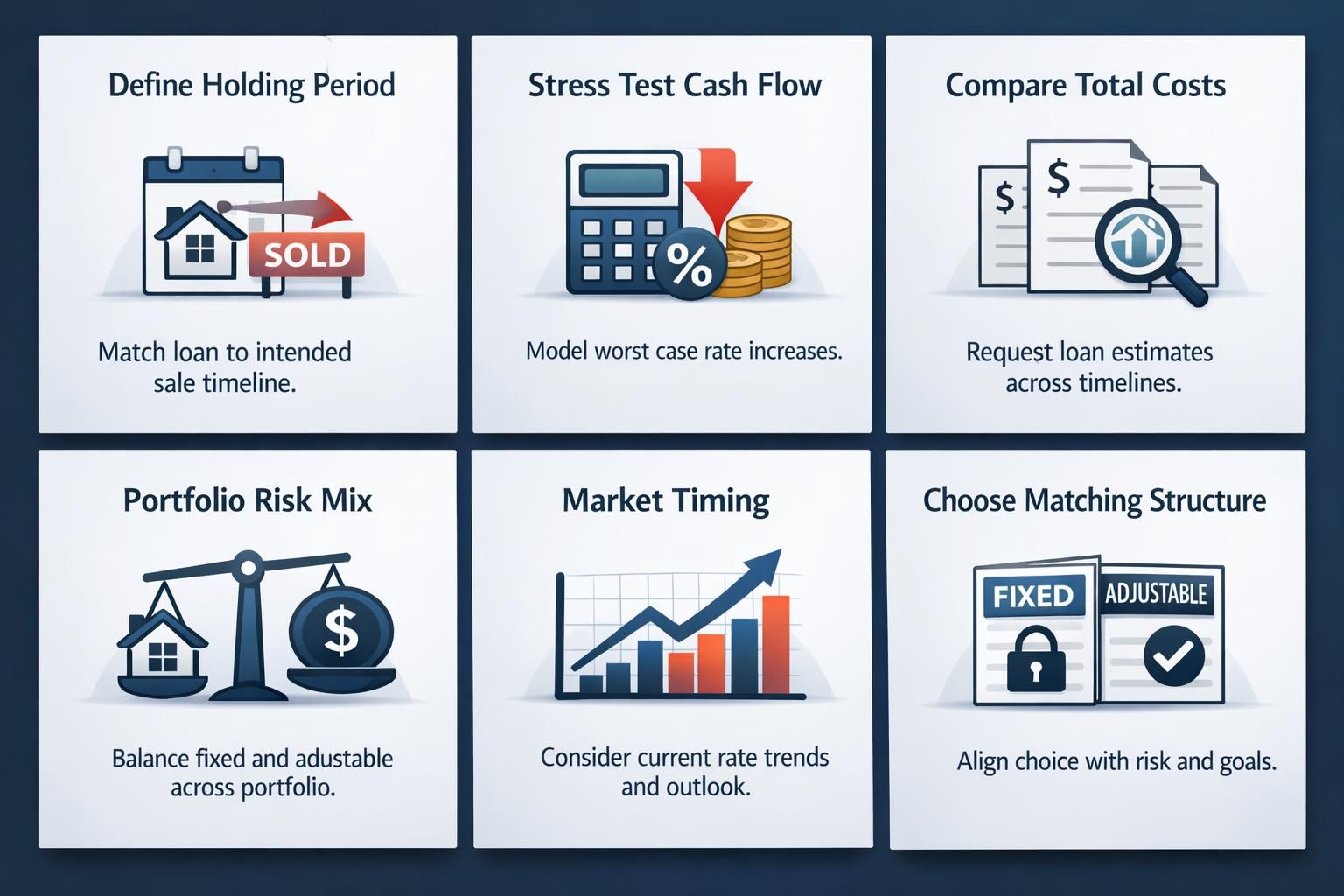
Your final choice between an arm vs fixed rate DSCR loan should emerge from careful analysis of your complete investment picture. Start by defining your holding period with as much precision as possible. If you're genuinely planning to sell or refinance within five years, an ARM with an initial fixed period matching that timeline offers clear advantages. If you're uncertain about your timeline or tend to hold properties longer than initially planned, fixed rates provide valuable insurance against that uncertainty.
Next, stress-test your cash flow assumptions under different scenarios. For ARMs, model what happens if rates increase to the maximum allowed under the cap structure. Can your property still generate acceptable returns? Do you have reserves to cover the higher payments? If worst-case ARM scenarios create financial stress, a fixed rate might be worth the higher initial cost.
Compare total financing costs, not just monthly payments. Request loan estimates showing total interest paid over five, ten, and fifteen-year periods for both ARM and fixed options. Sometimes the difference is smaller than you'd expect, especially when you account for the likelihood that you'll refinance or sell before full loan maturity. Other times, the gap is substantial enough to clearly favor one option.
Factor in your overall portfolio strategy and risk exposure. If you're using ARMs on multiple properties to maximize cash flow, recognize that you're creating correlated risk where all your properties face payment increases simultaneously when rates rise. Mixing fixed and adjustable-rate loans across your portfolio can balance cash flow optimization with risk management.
Consider current market conditions and rate trends. While predicting rate movements is challenging, understanding the broader economic context helps. When rates are historically low, fixed-rate loans lock in favorable terms. When rates are elevated and economic indicators suggest potential declines, ARMs offer a path to benefit from future improvements.
The right DSCR loan structure supports your investment goals while fitting your risk profile and management style. Neither option is inherently superior, they're tools designed for different scenarios. By matching the financing structure to your specific situation, you position your rental property investments for sustainable, long-term success.
Selecting between an arm vs fixed rate DSCR loan ranks among the most important financing decisions rental property investors make. The structure you choose affects your cash flow, risk exposure, and long-term profitability across your entire holding period. Fixed-rate loans deliver stability and predictability that simplifies portfolio management and protects against rising rates. Adjustable-rate mortgages offer lower initial payments that boost short-term returns, especially valuable for investors with clear exit timelines.
Your optimal choice emerges from honest assessment of your investment strategy, holding period, and comfort with payment variability. Investors building long-term wealth through rental income often favor the certainty of fixed rates. Those executing shorter-term value-add strategies or managing larger portfolios frequently benefit from ARM structures that maximize cash flow during critical early years.
The quality of your decision improves dramatically when you model specific scenarios using real numbers from your properties and loan offers. Compare total costs, not just initial payments. Stress-test your assumptions against adverse scenarios. Consider how each option fits within your broader portfolio and risk management approach. With DSCR loan rates in 2026 ranging from 6.25% to 8.00%, understanding the rate structure trade-offs helps you capture the best terms available for your situation.
Ready to explore DSCR financing options tailored to your investment strategy? Get a personalized DSCR loan quote and discover which rate structure maximizes your rental property returns.