What Is a Rent Schedule and Why Lenders Ask for It
Real estate investors know that documentation drives every financing decision. When you apply for a DSCR loan or other rental property financing, lenders need to verify that your properties generate enough cash flow to cover debt obligations. That's where what is a rent schedule and why lenders ask for it becomes critical to understand. This single document acts as a snapshot of your rental income, occupancy rates, and tenant details across your portfolio.
Many investors underestimate how much weight a well-organized rent schedule carries during underwriting. It's not just a formality. Lenders use it to calculate your debt service coverage ratio, assess risk, and determine whether your rental income is stable enough to support the loan. In competitive markets, a clean and accurate rent schedule can be the difference between approval and denial, or between standard terms and premium pricing.
This guide breaks down exactly what a rent schedule is, why mortgage lenders require it, how appraisers use rental income data to estimate property value, and what you can do to prepare a document that strengthens your application from the start.
What a Rent Schedule Actually Includes
A rent schedule is a detailed record of all rental income for one or more investment properties. It lists each unit or property, the monthly rent amount, the lease start and end dates, tenant names, and the current occupancy status. Lenders rely on this document to verify that the income you claim on your loan application is real, recurring, and documented.
Property address and unit number: Every entry on the schedule should correspond to a specific asset in your portfolio, making it easy for underwriters to cross-reference against appraisals and title reports.
Monthly rent and lease terms: The schedule shows the exact rent collected each month and how long the lease runs, which helps lenders assess income stability and tenant turnover risk.
Tenant information and occupancy dates: Including tenant names and move-in dates demonstrates that units are occupied by real people under active leases, not just projected income.
Security deposits and other charges: Some schedules also note security deposits, pet fees, or parking charges, though lenders typically focus on base rent when calculating debt service coverage.
The more organized and transparent your rent schedule, the faster underwriters can move through your file. Incomplete or inconsistent schedules often trigger requests for additional documentation, which delays closing and can raise red flags about how you manage your properties.
Why Lenders Require a Rent Schedule for DSCR Loans
DSCR loans are underwritten based on property cash flow, not your personal income. That means the lender needs ironclad proof that the rental income can cover the mortgage payment, insurance, taxes, and other expenses. A rent schedule provides that proof in a format that's quick to review and easy to verify.
Calculating the debt service coverage ratio: The DSCR is the net operating income divided by the total debt service. Without accurate rent data, underwriters can't calculate this ratio, and your loan won't move forward.
Verifying income consistency: Lenders want to see that rent has been collected reliably over time. A schedule backed by lease agreements and bank deposits shows that your income isn't speculative or inflated.
Assessing tenant quality and turnover: High turnover or frequent vacancies signal risk. A rent schedule with stable, long-term tenants indicates lower default probability and better cash flow management.
Supporting appraisal and market analysis: Appraisers compare your reported rents to comparable properties in the area. If your schedule shows rents well above market norms without explanation, it may trigger additional scrutiny or a lower valuation.
Because DSCR loans don't require W-2s or tax returns, the rent schedule becomes one of the most important documents in your file. It's the bridge between your property's performance and the lender's confidence in your ability to service the debt.
How Appraisers Use Rental Income Data
Understanding how appraisers estimate rental income for DSCR qualification helps you prepare a rent schedule that aligns with their process. Appraisers don't just take your word for it. They analyze market rents, vacancy rates, and comparable properties to determine whether your reported income is realistic and sustainable.
Market rent analysis: Appraisers pull data from recently leased comparable units in the same neighborhood to establish a baseline. If your rent schedule shows figures significantly higher than comps, they may adjust your income downward for underwriting purposes.
Vacancy and collection loss: Even if your properties are fully occupied today, appraisers typically apply a vacancy factor to account for turnover and missed payments. This ensures the lender isn't relying on best-case projections.
Lease verification: Appraisers may request copies of actual lease agreements to confirm that the rents on your schedule match signed contracts. Discrepancies between your schedule and lease terms can delay the appraisal or reduce the final valuation.
Income capitalization approach: For multi-unit or commercial properties, appraisers often use the income approach, which values the property based on its net operating income. Your rent schedule feeds directly into this calculation.
When your rent schedule is consistent with market data and backed by solid leases, appraisers can complete their reports faster and with fewer adjustments. That streamlines underwriting and increases the likelihood that your loan terms remain favorable.
Building a Rent Schedule That Lenders Trust
Lenders see hundreds of rent schedules every month, and they can spot inconsistencies quickly. Taking time upfront to build a clear, accurate, and well-documented schedule pays off during underwriting. Here's how to put together a rent schedule that meets lender expectations and accelerates your approval.
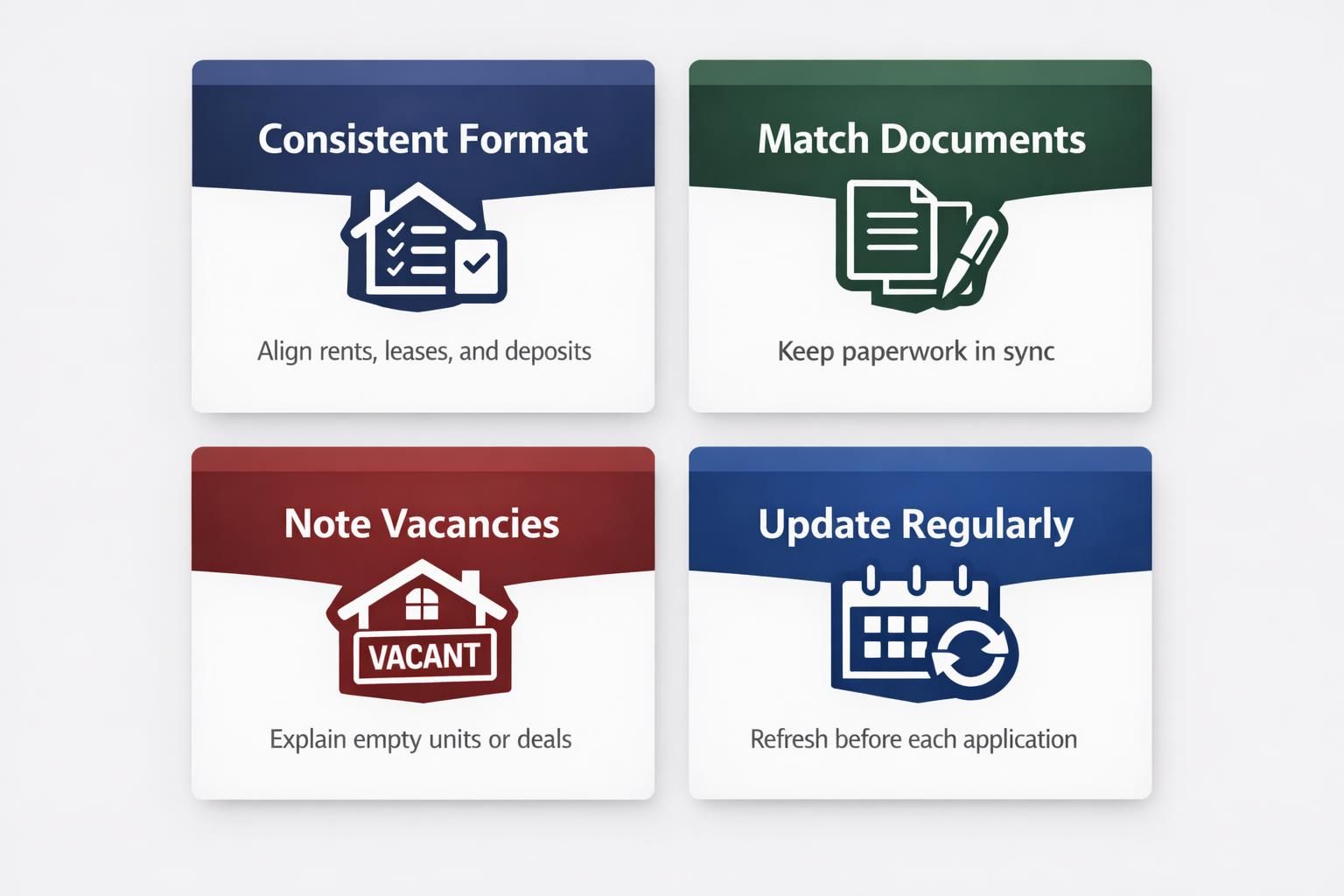
Use a consistent format for every property: Whether you manage two units or twenty, keep the structure uniform. Include columns for property address, unit number, tenant name, monthly rent, lease start and end dates, and occupancy status. Consistency makes it easier for underwriters to scan and verify your data.
Match your schedule to bank statements and lease agreements: Lenders will cross-check your rent schedule against deposit records and signed leases. If the numbers don't align, you'll face follow-up questions or a request to revise the document. Make sure every rent figure on your schedule matches what's documented elsewhere in your file.
Include notes for vacant units or below-market rents: If a unit is temporarily vacant or you're offering a tenant a reduced rate for a specific reason, note that on the schedule. Transparency builds trust and helps underwriters understand the context behind any anomalies.
Update the schedule before every loan application: Don't recycle an old rent schedule from a previous deal. Occupancy and rents change over time, and submitting outdated information can trigger delays or raise concerns about how actively you manage your portfolio.
A rent schedule isn't just a box to check. It's a reflection of how well you track income, manage tenants, and maintain your properties. Lenders interpret a polished, accurate schedule as a sign that you take your investment business seriously.
Common Mistakes Investors Make With Rent Schedules
Even experienced investors can trip up when preparing a rent schedule for a loan application. Small errors or omissions can slow down underwriting, trigger additional document requests, or weaken your overall borrower profile. Avoiding these common pitfalls keeps your application moving smoothly.
Inflating rents to improve the DSCR: Overstating monthly rent might seem like a quick way to boost your debt service coverage ratio, but lenders will catch it during the appraisal or lease verification process. When the appraisal comes in lower than your schedule suggests, underwriters may reduce the loan amount or increase the interest rate.
Omitting vacant units or turnover gaps: Leaving out vacancies makes your portfolio look more stable than it is. Lenders expect to see a complete picture, including units in transition. If they discover vacancies you didn't disclose, it raises questions about your credibility.
Using projected rents instead of actual signed leases: A rent schedule should reflect current, contracted income, not what you hope to charge after a renovation or market shift. Lenders base their underwriting on actual cash flow, not future potential.
Failing to update lease expirations: If a lease expired six months ago but your schedule still shows it as active, underwriters will assume the tenant is month-to-month or that you're behind on renewals. Both scenarios suggest higher risk and weaker cash flow management.
Submitting inconsistent formats across multiple properties: If you own several buildings and each rent schedule uses a different layout or set of terms, it makes the underwriter's job harder and increases the chance of misinterpretation or error.
Taking the time to audit your rent schedule before submission eliminates unnecessary friction and demonstrates attention to detail. Lenders reward clarity and consistency with faster approvals and better loan terms.
A rent schedule is more than a simple list of tenants and payments. It's the foundation of your DSCR loan application and a direct reflection of how you manage your rental portfolio. Lenders use it to calculate cash flow, appraisers rely on it to estimate property value, and underwriters look to it for proof that your investment strategy is sound and sustainable.
Investors who treat the rent schedule as a strategic document, not an afterthought, consistently move through underwriting faster and with fewer complications. By keeping your schedule accurate, current, and aligned with market data, you strengthen every part of your financing application and position yourself as a borrower lenders want to work with.
Whether you're refinancing a single rental or adding a new property to your portfolio, a well-prepared rent schedule gives you a competitive edge. If you're ready to explore financing options that prioritize property performance over personal income, see your DSCR loan options and take the next step toward expanding your real estate investments.