Understanding Rental Income Coverage Requirements for Investment Success
The rental income coverage ratio serves as the foundation for DSCR loan approval and determines whether your investment property generates sufficient cash flow to support mortgage payments. This critical metric typically requires properties to produce enough rental income to cover debt service, with most lenders seeking ratios that demonstrate positive cash flow potential.
Smart investors recognize that understanding coverage requirements isn't just about loan approval. It's about building a sustainable portfolio that generates consistent returns while maintaining adequate cash flow buffers for unexpected expenses and market fluctuations.
Core DSCR Benchmark Levels
DSCR benchmark levels form the backbone of investment property financing decisions. Understanding these core benchmarks helps investors position their properties for optimal loan terms and approval rates.
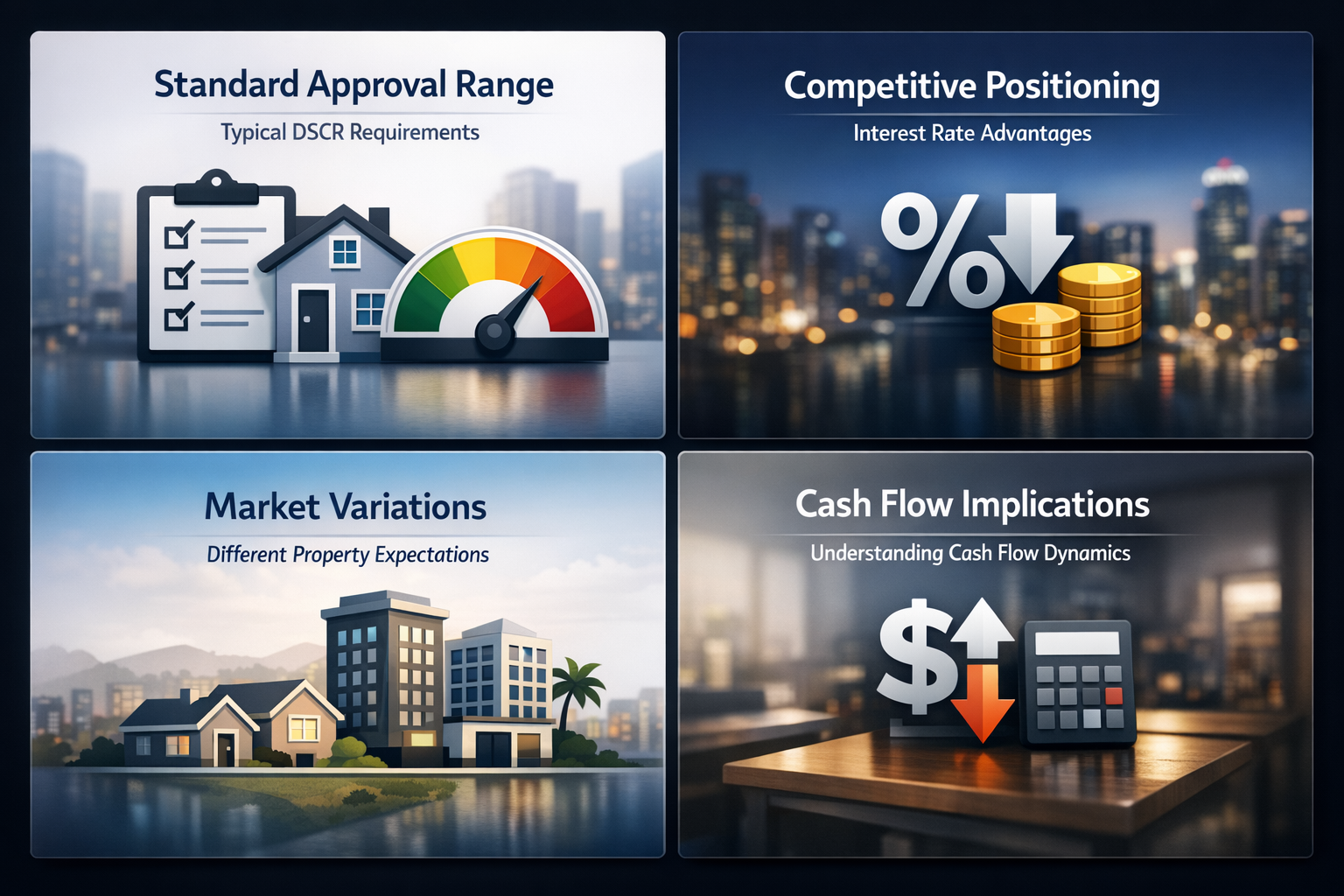
Standard Approval Range: Most lenders typically require DSCR ratios between 1.00 and 1.25, with 1.00 indicating that rental income exactly covers debt service payments
Competitive Positioning: Properties with ratios above 1.25 often qualify for better interest rates, which currently range from 6.25% to 8.00% depending on various factors
Market Variations: Different property types and markets may have varying benchmark expectations, with some lenders accepting lower ratios for high-appreciation areas
Cash Flow Implications: A DSCR of 1.00 means break-even cash flow, while higher ratios indicate positive monthly cash flow that can buffer against vacancy or maintenance costs
Approval Sensitivity Factors
Approval sensitivity in DSCR lending extends beyond the basic ratio calculation. Multiple factors influence how lenders evaluate your rental income coverage ratio and overall loan risk.
Credit Profile Impact: Strong credit scores can sometimes offset lower DSCR ratios, while poor credit may require higher coverage ratios for approval
Property Location Sensitivity: Properties in stable rental markets may receive more favorable treatment than those in volatile or declining areas
Portfolio Consideration: Lenders often evaluate your entire investment portfolio when determining approval sensitivity for additional properties
Market Conditions: Current market trends and interest rate environments can significantly affect lender appetite for various DSCR levels
Cash Flow Buffer Strategies
Building adequate cash flow buffers protects your investment properties from market volatility and unexpected expenses while maintaining strong rental income coverage ratios.
Reserve Requirements: Maintaining 2-6 months of mortgage payments in reserves demonstrates financial stability and may improve loan terms
Conservative Rent Projections: Using 75-85% of market rent in DSCR calculations provides built-in buffers for vacancy and collection losses
Multiple Revenue Streams: Properties with diverse income sources like parking fees or storage rentals typically show stronger coverage ratios
Gradual Rent Increases: Properties in markets supporting regular rent growth offer natural buffer expansion over time
Alternative Coverage Options
Innovative financing products like no-ratio DSCR loans provide coverage alternatives when traditional ratios don't meet standard benchmarks, opening opportunities for strategic investors.
No-Ratio Products: These loans allow approval even when projected DSCR is low, focusing instead on appreciation potential and overall investment strategy
Bridge-to-DSCR Options: Transitioning from hard money to DSCR loan terms can improve coverage ratios while reducing financing costs over time
Asset-Based Evaluation: Some lenders emphasize property value and location over strict income coverage requirements
Portfolio Cross-Collateralization: Strong-performing properties in your portfolio might support weaker coverage ratios on new acquisitions
Optimization Action Steps
Taking specific optimization action steps helps investors maximize their rental income coverage ratios and secure the most favorable financing terms available in today's market.
Calculate Current Ratios: Analyze your existing properties to identify coverage strengths and weaknesses, then prioritize improvements on borderline properties
Research Lender Requirements: Contact multiple DSCR lenders to understand their specific benchmark requirements and identify the most favorable terms for your situation
Monitor Market Conditions: Stay informed about interest rate trends and market factors that influence both rental rates and financing costs
Build Financial Reserves: Establish and maintain adequate cash reserves to demonstrate financial stability and provide operational buffers for your investment properties
Consider Refinancing Opportunities: Evaluate existing high-cost financing for potential refinancing into more favorable DSCR loan products with better coverage requirements
Mastering rental income coverage ratios positions investors for long-term success in building profitable real estate portfolios. While standard benchmarks provide guidance, remember that individual lenders may have varying requirements and innovative products continue to emerge.
The key lies in understanding how coverage ratios affect not just loan approval, but the overall sustainability of your investment strategy. Properties with strong coverage ratios typically generate consistent cash flow while providing buffers against market volatility.
As you evaluate potential investments and financing options, focus on building relationships with lenders who understand investment property dynamics and offer competitive terms for your coverage levels. This approach ensures you're positioned to capitalize on opportunities while maintaining the financial flexibility needed for long-term portfolio growth.