Refinancing Hard Money Into DSCR: Smart Exit Strategy
September 9, 2026
•
9 min read
Table of Contents
How Refinancing a Hard Money Loan Into a DSCR Loan Transforms Your Investment Strategy
When you're moving fast on a rental property acquisition or fix-and-flip project, hard money loans offer the speed and flexibility you need to close deals quickly. But those advantages come at a steep price: interest rates that often climb between 9% and 14%, paired with short terms that create pressure to either sell or refinance within months.
For investors holding cash-flowing rental properties, refinancing a hard money loan into a DSCR loan represents one of the smartest exit strategies available today. This transition can reduce your interest costs significantly, stabilize your monthly payments, and allow you to hold profitable properties long-term without the constant refinancing treadmill.
DSCR loans qualify you based on the property's rental income, not your personal tax returns or W-2s. That makes them ideal for investors with strong rental cash flow but complex personal financials. The shift from short-term bridge financing to long-term rental financing isn't just about saving money. It's about building a sustainable portfolio that works for you, not against you.
Why Hard Money Exit Planning Matters From Day One
Why hard money exit planning matters from day one is a question every investor should answer before signing their first bridge loan. Hard money loans serve a critical purpose: they let you act fast when opportunities appear, whether that's acquiring a distressed property at auction or securing a rental before another buyer can move. But these loans were never designed for the long haul.
High carrying costs: With interest rates in the 9% to 14% range, every month you hold a hard money loan eats into your profit margin and reduces the overall return on your investment project.
Short maturity windows: Most hard money loans mature in 12 to 24 months, forcing you to either sell the property, refinance into permanent financing, or face balloon payment pressure that can derail your strategy.
Limited scalability: Relying exclusively on hard money financing makes it difficult to build a rental portfolio because each property drains cash flow instead of generating it, limiting your ability to reinvest and grow.
Your exit strategy should be part of your underwriting from the very beginning. If the property will generate rental income and you plan to hold it long-term, then planning for a DSCR refinance after seasoning is the logical path. Understanding the timeline and requirements upfront helps you structure the acquisition correctly and avoid costly mistakes down the road.
The Mechanics of DSCR Takeout Financing
The mechanics of DSCR takeout financing revolve around one core principle: the property's income drives approval, not your personal financial documents. DSCR stands for Debt Service Coverage Ratio, and it measures whether the rental income is sufficient to cover the new loan's principal, interest, taxes, insurance, and any applicable HOA fees.
The calculation itself is straightforward. You divide the property's monthly rental income by its total monthly debt obligations. A DSCR of 1.0 means the rent exactly covers the payment. A DSCR of 1.25 means the rent exceeds the payment by 25%, providing a cushion that lenders reward with better rates and terms.
No tax returns required: Unlike conventional loans, DSCR lenders don't ask for your personal income documentation, making this product ideal for self-employed investors, those with multiple LLCs, or anyone with income that doesn't show well on paper.
Property cash flow is king: The underwriting focuses entirely on the rental income the property generates, either actual leases already in place or market rent appraisals for vacant properties being stabilized.
Credit and equity still matter: While DSCR loans are income-light, lenders still evaluate your credit score and the amount of equity you have in the property to ensure you're a qualified borrower with skin in the game.
This structure gives you flexibility that traditional financing simply can't match. If your personal income is tied up in reinvestment, depreciation, or pass-through entities, DSCR loans let the property speak for itself.
Have a property in mind?
Tell us about the property and we will find the financing that fits you best.
Seasoning requirements and timeline expectations are among the most common questions investors ask when planning their hard money exit strategy. Seasoning refers to the period of time you must own and operate a property before refinancing into permanent financing. For DSCR loans, the typical seasoning period ranges from 6 to 12 months, depending on the lender and your specific situation.
Six-month minimum for most lenders: Many DSCR lenders require at least six months of ownership before they'll refinance a recently acquired property, ensuring the property is stabilized and rental income is documented.
Twelve months unlocks more options: If you can hold the hard money loan for a full year, you'll have access to a wider range of lenders and potentially better rates, as the property has a proven track record of cash flow.
Lease documentation accelerates approval: Having signed leases in place with tenants paying rent on time significantly strengthens your refinance application and may allow some lenders to move faster within the seasoning window.
During this seasoning period, your goal is to stabilize the property, document consistent rental income, and ensure the DSCR ratio meets or exceeds lender minimums. Many investors use this time to complete any remaining light rehab work, fill vacancies, and optimize the property's financial performance before applying for the takeout loan.
Steps to Prepare Your Property for DSCR Refinancing
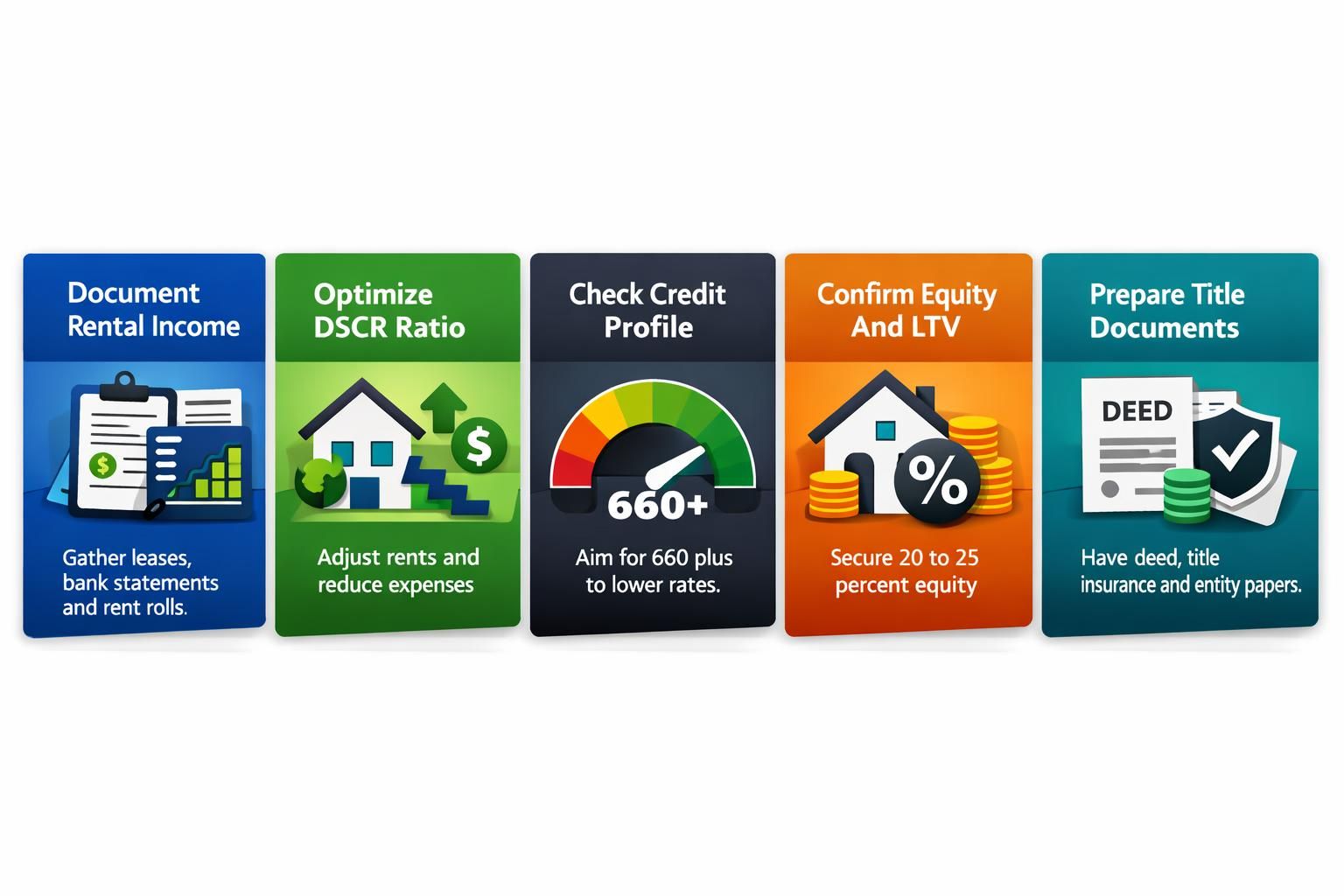
Steps to prepare your property for DSCR refinancing begin well before you submit your application. The stronger your preparation, the smoother the process and the better the terms you'll secure. Lenders want to see a property that's stabilized, cash-flowing, and positioned to perform reliably over the long term.
Document rental income thoroughly: Gather signed lease agreements, bank statements showing rent deposits, and any rent rolls that demonstrate consistent monthly income. If the property is vacant, obtain a formal rent appraisal to establish market rent expectations.
Optimize your DSCR ratio: Run the numbers before you apply. If your current rent doesn't quite hit the 1.0 or 1.25 threshold, consider adjusting the lease terms, reducing unnecessary expenses, or making improvements that justify higher rents to strengthen the ratio.
Review your credit profile: While DSCR loans don't require income documentation, they do consider your credit score. A score of 620 is often the technical minimum, but scores in the 660 to 680 range or higher unlock better pricing and more favorable terms.
Confirm equity and LTV targets: Most DSCR lenders cap loan-to-value ratios between 75% and 80%, meaning you'll need at least 20% to 25% equity in the property. Ensure your current property value supports the loan amount you're requesting.
Organize your legal and title documentation: Have your property deed, title insurance, and any entity documents ready if the property is held in an LLC. Clean title and clear ownership make the underwriting process faster and reduce the chance of last-minute issues.
Preparation isn't just about meeting minimums. It's about positioning yourself as a low-risk borrower with a high-performing asset, which translates directly into lower rates and better loan structures.
Rate and Cost Comparisons: Hard Money vs. DSCR
Rate and cost comparisons between hard money and DSCR loans reveal why this refinance strategy is so compelling for rental property investors. The difference isn't marginal. It's substantial enough to transform a break-even property into a cash-flowing asset.
Interest rate reduction: Hard money loans typically carry rates between 9% and 14%, while DSCR loans in 2026 often range from 6.25% to 8.00% for well-qualified investors with strong property performance and credit profiles, representing a potential savings of 200 to 400 basis points or more.
Term length stability: Hard money loans mature in 12 to 24 months, creating constant refinancing pressure. DSCR loans offer 30-year fixed terms or adjustable-rate options, giving you the stability to hold properties long-term and ride out market cycles without forced sales.
Monthly payment reduction: The combination of lower rates and longer amortization can cut your monthly debt service by hundreds or even thousands of dollars per property, directly boosting cash flow and improving your ability to scale your portfolio.
Origination and closing costs: While DSCR loans do carry standard closing costs, the long-term savings far outweigh the upfront expense, especially when you're refinancing out of a high-rate bridge loan that was bleeding cash flow every month.
When you run the numbers on a typical rental property, the savings from refinancing a hard money loan into a DSCR loan can pay for the closing costs within the first year, and then continue delivering improved cash flow for the life of the loan. That's the kind of math that builds wealth.
Common Pitfalls and How to Avoid Them
Common pitfalls and how to avoid them can make the difference between a smooth refinance and a deal that stalls or costs you more than it should. Investors who plan ahead and understand the process navigate these challenges easily, while those who wait until the last minute often face unnecessary stress and expense.
One frequent mistake is waiting too long to start the refinance process. Hard money loans have fixed maturity dates, and if you're scrambling to refinance in the final weeks before your balloon payment is due, you lose negotiating leverage and may be forced to accept less favorable terms or pay extension fees. Start your DSCR application at least 60 to 90 days before your hard money loan matures to give yourself room to shop lenders and address any issues that arise.
Another pitfall is neglecting the DSCR ratio during the stabilization period. Some investors focus only on occupancy and forget that the rental income must be sufficient to support the new loan. If your rents are too low or your expenses are too high, you may not qualify for the loan amount you need. Monitor your numbers monthly and make adjustments as you go, rather than discovering the problem during underwriting.
Credit surprises also derail refinances. If your credit score has dropped due to high utilization, late payments, or new inquiries, you may not qualify for the best rates or may face higher down payment requirements. Check your credit well in advance and address any issues before you apply, giving yourself time to dispute errors or pay down balances.
Finally, some investors underestimate the importance of documentation. Even though DSCR loans don't require tax returns, they do require proof of rental income, clear title, insurance, and entity paperwork if applicable. Missing or incomplete documents slow down the process and can cause you to miss rate locks or deadlines. Treat the DSCR application with the same level of organization and professionalism you'd bring to any major financial transaction.
Refinancing a hard money loan into a DSCR loan isn't just a financing tactic. It's a strategic pivot that turns short-term acquisition financing into long-term wealth-building infrastructure. By reducing your interest costs, stabilizing your monthly payments, and freeing up cash flow for reinvestment, you position yourself to scale your portfolio with confidence and clarity.
The key is planning your exit from the moment you close on the hard money loan. Understand the seasoning requirements, document your rental income meticulously, and monitor your property's financial performance so you're ready to move when the time is right. The investors who execute this strategy well are the ones who build portfolios that generate consistent returns, weather market cycles, and grow year after year.
If you're ready to explore how DSCR financing can support your rental property goals, get a personalized DSCR loan quote and see what your property qualifies for today.