How to Finance Multi-State Rental Properties with 5 DSCR Strategies
August 7, 2026
•
10 min read
How to Finance Multi-State Rental Properties with DSCR Loans
Expanding a rental portfolio beyond your home state opens doors to better rental yields, stronger tenant markets, and portfolio diversification. Yet many investors hit a wall when traditional lenders demand endless personal income documentation or impose strict limits on how many properties you can finance.
That's where DSCR loans change the game. By focusing on property-level cash flow rather than your W-2 or tax returns, debt service coverage ratio financing lets you scale across state lines without the usual red tape. Whether you're eyeing a duplex in another region or building a coast-to-coast portfolio, understanding how to finance multi-state rental properties with DSCR loans gives you the flexibility to move fast and grow strategically.
In this guide, we'll walk through the mechanics of cross-state DSCR financing, show you how to prepare your portfolio for underwriting, and share practical steps to manage lending relationships in multiple markets. If you're ready to break free from geographic constraints and unlock new investment opportunities, read on.
Why DSCR Loans Work for Cross-State Expansion
Why DSCR loans work for cross-state expansion starts with their unique qualification structure. Unlike conventional residential mortgages, DSCR programs evaluate each property independently based on its rental income and operating cash flow. Your personal income, employment history, and even your home state become secondary factors or don't matter at all.
This property-first approach is a game changer for investors building portfolios in different regions. You don't need to shuttle documents to a lender in every new state or worry about varying income-verification rules. Instead, you present the deal itself: the property's rental income, estimated or actual, and the projected debt service. If the ratio meets the lender's threshold, typically around 1.0 to 1.25, you're in the running.
Another critical advantage is that DSCR lenders often have no cap on the number of loans you can hold simultaneously. Each property stands on its own merits, so whether you own two rentals or twenty, your ability to qualify hinges on each deal's cash flow rather than an arbitrary loan count. That flexibility is essential when you're managing cross-state real estate portfolio financing and want to move quickly on new opportunities without being boxed in by residential lending limits.
Finally, DSCR loans streamline the documentation process. Because underwriters focus on rental agreements, property appraisals, and cash flow projections, you skip the maze of pay stubs, employer letters, and detailed tax returns that slow down traditional applications. For investors operating in multiple states, that means faster closings and less time coordinating paperwork across time zones.
Preparing Your Portfolio Schedule for Multi-State Underwriting
Preparing your portfolio schedule for multi-state underwriting is a foundational step that often determines whether you'll sail through the approval process or get stuck in back-and-forth revisions. Lenders want to see a clear, consolidated snapshot of every property you own, the income each one generates, and how the numbers stack up.
Start by building a comprehensive property schedule in a simple spreadsheet. For each rental, list the street address, state, property type, purchase price or current market value, outstanding loan balance, monthly rental income, and key operating expenses such as property taxes, insurance, and any HOA fees. If you've recently rehabbed or refinanced, note the date and any equity you've pulled out. This schedule becomes your master reference and helps underwriters quickly assess your overall portfolio health.
Next, consolidate your financial metrics. Calculate the debt service coverage ratio for each property individually, then look at your portfolio as a whole. Some lenders may want to see a blended or weighted average DSCR across all holdings, especially if you're applying for portfolio-level financing. Having these numbers ready demonstrates that you understand your cash flow position and can speak confidently about your operations.
Don't forget supporting documents. Attach recent lease agreements, rent rolls if you manage multiple units in one building, and property insurance declarations. If you're working with a property manager, include management agreements and recent statements showing collected rents and disbursements. The more organized and transparent your package, the faster the lender can move.
Finally, keep your schedule current. Markets shift, leases expire, and expenses change. Update your portfolio document quarterly or whenever you acquire or dispose of a property. That discipline not only smooths future financing but also gives you real-time insight into which assets are performing and which might need attention.
Strategies to Maximize DSCR Qualification Across States
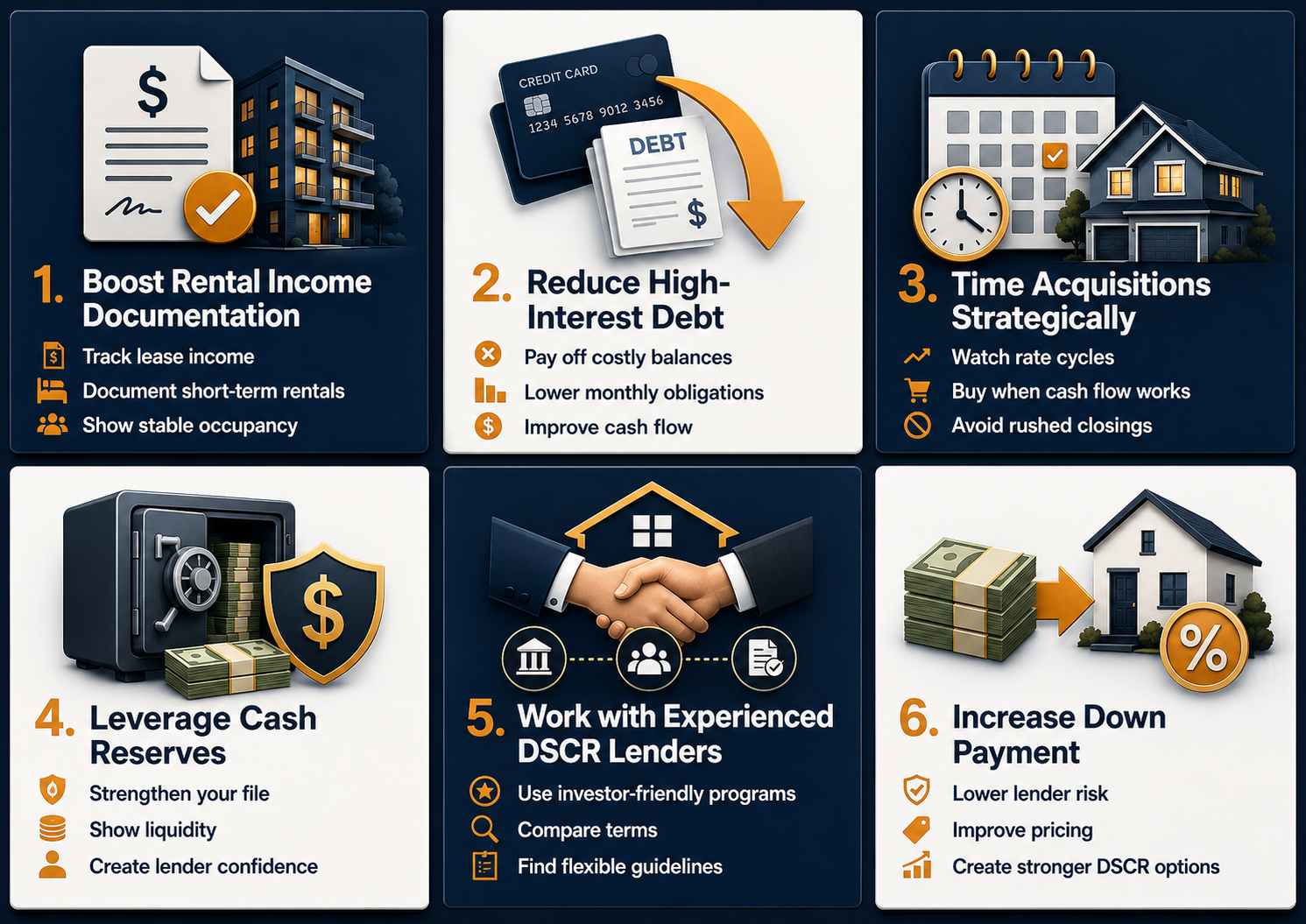
Strategies to maximize DSCR qualification across states revolve around optimizing each property's cash flow profile and presenting underwriters with a compelling, low-risk picture. Here are practical tactics to strengthen your applications:
Boost rental income documentation: Use actual signed leases whenever possible. If a property is vacant or newly renovated, provide market rent analyses or comparable listings to justify projected income. Lenders trust hard data over guesswork.
Reduce or refinance high-interest debt: If an existing loan on one of your properties carries a steep rate, consider refinancing before applying for new DSCR financing. Lowering monthly debt service raises your DSCR and makes the next acquisition easier to qualify for.
Time your acquisitions strategically: Stack closings so you can show stabilized cash flow on earlier purchases before applying for the next loan. A property that's been rented for six months looks stronger on paper than one that just closed last week.
Leverage cash reserves: While DSCR loans focus on property income, having liquid reserves signals financial stability. Some lenders may ask for reserves equivalent to six months of debt service per property, especially when you're managing assets in multiple states.
Work with experienced DSCR lenders: Not all lenders underwrite cross-state portfolios the same way. Partner with institutions that specialize in investor loans and understand regional market nuances, from state-specific landlord laws to local rent trends.
By fine-tuning these elements, you can present each deal as a strong standalone investment and build credibility with lenders who will see you as a serious, scalable investor.
How to Manage Lender Relationships Across Multiple Markets
Centralize communication and documentation: Use a single point of contact or a dedicated email folder for each lender. Keep all correspondence, rate sheets, and underwriting guidelines in one place so you can reference terms quickly when evaluating new deals. This organization saves time and reduces errors.
Build a lender network before you need it: Don't wait until you find the perfect out-of-state property to start shopping for financing. Establish relationships with two or three DSCR lenders in advance, understand their appetites for different markets, and get pre-qualified on general terms. When opportunity knocks, you're ready to move.
Standardize your pitch: Create a master investor profile that includes your portfolio schedule, recent tax returns if required, a summary of your investment strategy, and contact information for your property managers. Send this package to new lenders upfront to streamline introductions and set clear expectations.
Stay transparent about your portfolio size: Lenders appreciate honesty. If you're carrying ten properties and applying for number eleven, say so. Hiding loans or properties can trigger re-underwriting delays or even disqualification. Transparency builds trust and often leads to better terms as lenders see your track record.
Leverage portfolio discounts and repeat-borrower perks: Some lenders offer rate reductions or streamlined processes for investors who bring multiple deals. Once you've closed a loan or two, ask about loyalty programs or portfolio pricing. Those small concessions add up over time.
Managing cross-state real estate portfolio financing means juggling multiple relationships, but with consistent systems and proactive communication, you can turn lender partnerships into a strategic advantage rather than a logistical headache.
Key Underwriting Differences When Financing Properties in Different States
Key underwriting differences when financing properties in different states often catch new multi-state investors off guard. While DSCR loans simplify many aspects of cross-border expansion, lenders still account for regional variations that can affect loan terms and approval criteria.
State-specific regulations and foreclosure timelines: Some states are judicial foreclosure jurisdictions, meaning lenders must go through court to repossess a property. This process can take months or even years, making those markets slightly riskier in a lender's eyes. You may see higher rates or lower loan-to-value ratios in those regions.
Property tax and insurance cost fluctuations: A rental that cash flows beautifully in one state might struggle in another where property taxes are triple or hurricane insurance is mandatory. Underwriters will adjust their calculations based on actual local costs, so always request accurate tax and insurance estimates early in your due diligence.
Market-specific rental income verification: Lenders may have different standards for how they verify market rents. In hot, well-documented metros, a simple rent schedule or comparable listing may suffice. In smaller or more volatile markets, they might require a third-party rent appraisal or additional comps.
Title and closing procedures: Closing practices vary widely. Some states use attorneys, others rely on title companies or escrow agents. Lenders familiar with multi-state portfolios will guide you, but be prepared for different timelines, fee structures, and document requirements.
Understanding these regional nuances helps you set realistic expectations and avoid surprises at the closing table. It also signals to lenders that you've done your homework and are serious about managing cross-state investments responsibly.
Final Takeaway: Scale Smarter with Property-Focused Financing
The real power of DSCR loans lies in their ability to detach your personal financial profile from each deal's approval process. When you're building a multi-state portfolio, that separation means you can evaluate opportunities purely on their investment merit, rental income potential, and cash flow, not on whether your tax returns look perfect this year or whether you've hit some arbitrary loan cap.
By treating each property as an independent business case, you gain the freedom to move quickly, diversify across stronger markets, and scale without the friction that traditional residential financing imposes. Whether you're adding your third rental or your thirtieth, the strategy remains the same: find solid cash-flowing properties, document the numbers clearly, and partner with lenders who understand investor goals. That disciplined approach, combined with the flexibility of DSCR programs, turns geographic expansion from a logistical puzzle into a competitive advantage.
Financing rental properties across multiple states doesn't have to mean endless paperwork, income verification headaches, or artificial caps on how many loans you can carry. DSCR programs flip the script by putting each property's cash flow front and center, letting you scale strategically and invest where the numbers make sense, not just where your personal finances happen to align.
From organizing a detailed portfolio schedule to managing lender relationships and navigating state-by-state underwriting quirks, the tactics we've covered give you a roadmap for confident cross-state expansion. The key is preparation, transparency, and choosing financing partners who specialize in investor loans and understand the realities of managing rental properties in different markets.
If you're ready to explore how debt service coverage ratio financing can unlock your next out-of-state acquisition, take the first step today. Get a personalized DSCR loan quote and see how property-focused financing can power your portfolio growth without the usual constraints.