For real estate investors pursuing rental property financing, few setbacks sting quite like an appraisal that comes in below expectations. When you're counting on a certain property value to secure favorable loan terms, discovering that the appraiser disagrees can feel like watching your carefully structured deal begin to unravel. The impact of a low appraisal extends far beyond just disappointing news: it directly influences your loan-to-value ratio, the amount of cash you'll need to bring to closing, and potentially the interest rate you'll pay on your DSCR loan.
Understanding how a low appraisal affects your DSCR rate requires looking at the mechanics of investor financing and the specific role property valuation plays in underwriting decisions. Unlike conventional mortgages that focus heavily on the borrower's personal income and tax returns, DSCR loans evaluate the income-producing potential of the property itself. This makes the appraisal even more critical, because both the property value and the appraiser's market rent conclusion feed directly into the calculations that determine whether you qualify and at what terms.
This article breaks down exactly what happens when a property appraises below expected value, how lenders adjust loan terms in response, and what strategies savvy investors use to navigate appraisal shortfalls without losing profitable deals.
Why Property Appraisals Matter for DSCR Loans
DSCR loans operate on a fundamentally different qualification model than traditional residential mortgages. Instead of scrutinizing your W-2s, tax returns, and employment history, lenders focus almost exclusively on whether the property generates enough rental income to cover the mortgage payment. This is where the Debt Service Coverage Ratio comes into play: it measures the property's monthly rental income against its monthly debt obligations, including principal, interest, taxes, insurance, and HOA fees.
Property value determines your loan-to-value ratio: The appraisal establishes the maximum loan amount the lender will offer. Most DSCR lenders cap loans at 75% to 80% LTV, meaning a lower appraised value shrinks your available financing and increases the cash you must contribute upfront.
Market rent affects your qualifying DSCR: Appraisers don't just assess property value. They also provide a market rent analysis, often documented on Form 1007, that estimates what the property should rent for in the current market. If that rent figure falls short of your projections, your DSCR ratio drops, potentially disqualifying you from the loan or forcing you into higher-rate tiers.
Both factors influence underwriting decisions: Lenders use the appraised value to calculate LTV and the market rent to calculate DSCR. When either figure disappoints, the lender may reduce the loan amount, increase the interest rate to offset perceived risk, or require additional reserves to cushion against cash flow concerns.
This dual dependency on both value and rent makes the appraisal process uniquely consequential for DSCR borrowers. A conventional borrower might negotiate a lower purchase price to compensate for a low appraisal. For a DSCR investor, however, the appraisal impacts not just the deal price but the very foundation of your qualification.
What Happens When a Property Appraises Below Expected Value
The moment your lender receives an appraisal that falls short of the contract price or your anticipated value, a series of recalculations begins. These adjustments ripple through every aspect of your loan structure, often requiring quick decisions and additional capital to keep the transaction on track.
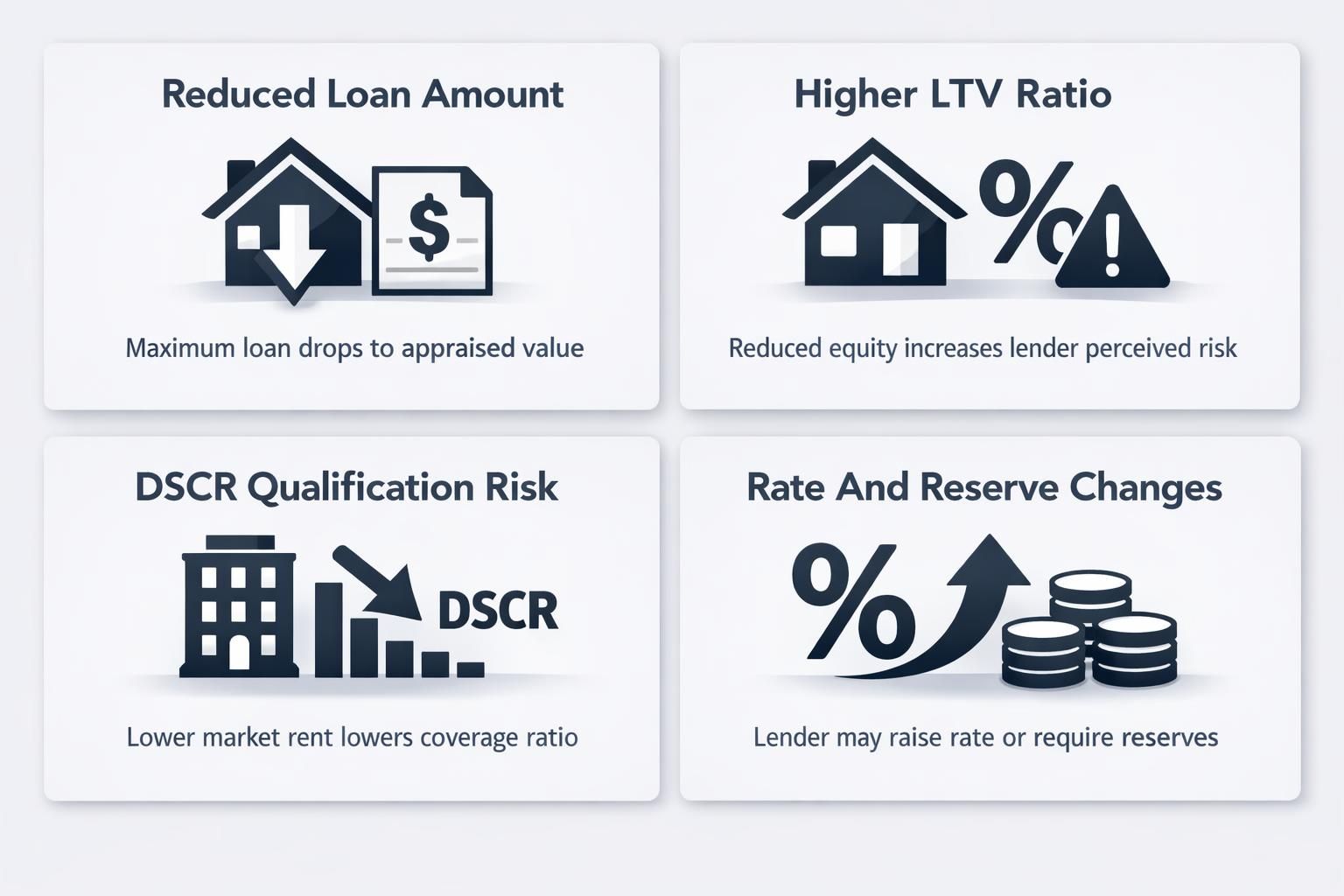
Your loan amount shrinks immediately: If you expected to borrow 80% of a $500,000 property ($400,000 loan) but the appraisal comes in at $475,000, your maximum loan drops to $380,000. That $20,000 gap must now come from your own funds, increasing your down payment requirement without warning.
The loan-to-value ratio climbs: If you proceed with the original loan amount despite the lower appraisal, your effective LTV increases. A lender who was comfortable at 80% LTV might balk at 84% LTV, viewing the loan as riskier. Higher LTV typically means higher interest rates, as lenders price in the reduced equity cushion.
Your DSCR may no longer qualify: When the appraiser's market rent analysis comes in lower than expected, your debt service coverage ratio takes a hit. If you were counting on $3,000 per month in rent to achieve a 1.25 DSCR, but the appraiser concludes the market rent is only $2,700, your ratio drops below the lender's minimum threshold. This can trigger a loan denial or force you to make a larger down payment to reduce the monthly debt service and bring the ratio back into compliance.
Rate adjustments and additional reserves: Even if your DSCR still meets minimum requirements after a low appraisal, lenders may reprice your loan to reflect the increased risk. You might see your rate climb within the allowable range, or the lender may require additional months of reserves, tying up more of your capital.
Understanding these cascading effects helps investors prepare contingency plans before the appraisal report arrives. Waiting until the last minute to address a valuation shortfall can derail your closing timeline and cost you earnest money or a profitable property.
How Low Appraisals Influence DSCR Loan Rates
Interest rate pricing on DSCR loans reflects a complex mix of borrower profile, property characteristics, and market conditions. When an appraisal comes in low, it sends a signal to the lender that the property carries more risk than initially assessed, which can translate directly into higher rates.
Loan-to-value tiers drive rate pricing: Lenders structure rate sheets around LTV bands. A loan at 75% LTV typically earns a better rate than one at 80% LTV, and anything above 80% often faces significant rate premiums or outright denial. A low appraisal that pushes you into a higher LTV tier can cost you a quarter to a half point in interest, translating to thousands of dollars over the loan term.
Lower DSCR ratios increase perceived default risk: When market rent projections fall short and your DSCR ratio tightens, lenders see less margin for error. A property with a 1.50 DSCR offers substantial cash flow buffer, while one at 1.10 DSCR leaves little room for vacancies, repairs, or rent collection issues. Lenders often reserve their best rates for borrowers with strong DSCR ratios and impose rate add-ons for those near the minimum threshold.
Credit score and reserves provide offsetting factors: If a low appraisal weakens your LTV or DSCR position, a strong credit profile and ample cash reserves can help mitigate rate increases. Lenders view borrowers with high credit scores and twelve-plus months of reserves as better positioned to weather temporary cash flow disruptions, which may allow them to maintain cash reserves even when the appraisal disappoints.
Rate ranges reflect combined risk factors: Trulo Mortgage's DSCR loan interest rates range from 6.25% to 8.00%, with specific pricing determined by the interplay of credit score, LTV, DSCR ratio, property type, and loan amount. A low appraisal that worsens your LTV or DSCR typically moves you toward the higher end of that range unless you can offset the impact with additional equity or stronger financials.
Savvy investors monitor these rate-driving variables closely throughout the underwriting process, recognizing that small changes in appraisal outcomes can produce measurable differences in long-term borrowing costs and overall investment returns.
Strategies to Address a Low Appraisal on Your DSCR Loan
When an appraisal falls short, experienced investors don't simply accept the initial valuation and watch their deal collapse. Instead, they deploy a series of tactical responses designed to challenge inaccuracies, adjust deal structure, or find alternative financing paths that preserve profitability.
Review the appraisal report for errors: Appraisals are prepared by professionals, but they're not infallible. Request a copy of the full report and scrutinize the comparable sales used, the property condition notes, and any adjustments made. If the appraiser relied on distressed sales, used properties in inferior neighborhoods, or miscalculated square footage or bedroom count, you have grounds to request a reconsideration of value. Present your lender with better comps, recent sales data, or documentation of property improvements that were overlooked.
Negotiate the purchase price downward: If the seller is motivated and the appraisal genuinely reflects market conditions, renegotiating the contract price to match the appraised value protects your equity position and restores your original LTV ratio. This approach works best in slower markets or when the seller has limited alternative buyers, but it requires swift communication and a willingness to walk away if terms can't be adjusted.
Increase your down payment to maintain LTV: Bringing additional cash to closing allows you to proceed with the original loan structure despite the lower appraisal. While this ties up more capital in a single property, it may preserve your interest rate and avoid underwriting delays. Calculate whether the incremental cash requirement still supports your target cash-on-cash return before committing additional funds.
Request a second appraisal or appeal the valuation: Some lenders allow borrowers to order a second appraisal or submit a formal appeal with supporting documentation. If you believe the first appraisal materially misrepresented the property's value or market rent, this path can produce a more favorable outcome. Be prepared to pay for the second appraisal and recognize that lenders typically average the two values rather than simply adopting the higher one.
Explore alternative loan structures: If the appraisal cannot be corrected and you lack the cash to bridge the gap, consider restructuring the loan. Options might include a higher interest rate in exchange for lower LTV requirements, an interest-only payment period to improve your DSCR ratio, or even a different loan product altogether such as a bridge loan that provides short-term financing while you stabilize the property and refinance later at a better valuation.
Each of these strategies involves trade-offs between capital deployment, time, and financing costs. The right choice depends on your specific situation, the strength of the property's fundamentals, and your broader portfolio strategy. Investors who maintain relationships with responsive lenders often find more flexibility in navigating appraisal challenges than those working with rigid underwriting departments.
Preventing Appraisal Surprises Before You Apply
The best way to handle a low appraisal is to avoid the surprise altogether. Proactive investors conduct their own valuation and rent analysis before submitting a loan application, identifying potential appraisal issues early enough to adjust their offer or financing strategy.
Run your own comparable sales analysis: Before making an offer, pull recent sales of similar properties within a half-mile radius. Focus on properties with comparable square footage, bedroom and bathroom count, lot size, and condition. Pay special attention to sales within the past three to six months, as appraisers prioritize recent transactions. If you struggle to find comps that support your target price, an appraiser will face the same challenge.
Research market rents using multiple sources: Don't rely solely on the seller's rent estimate or your property manager's optimistic projection. Check rental listings on major platforms, review recently leased properties in the area, and consult local property management companies for realistic rent ranges. If your DSCR calculation depends on achieving top-of-market rents, build in a margin for conservative appraisals.
Understand the appraiser's perspective: Appraisers must defend their valuations to lenders and regulators, which makes them inherently conservative. They discount seller concessions, recent renovations without permits, and neighborhood amenities that don't translate into measurable price premiums. If your purchase price sits at the high end of the neighborhood range, expect scrutiny and prepare supporting documentation in advance.
Order a pre-listing appraisal when possible: In competitive situations or when buying from a wholesaler, consider ordering your own appraisal before entering into a binding contract. While this costs money upfront, it gives you accurate valuation and rent data to inform your offer and financing strategy. Some investors include appraisal contingencies in their contracts, allowing them to renegotiate or walk away if the official appraisal falls short.
Work with lenders who understand investor properties: Not all lenders have equal expertise in rental property valuation. Those specializing in DSCR loans and investment financing employ appraisers familiar with income property analysis and market rent methodologies. They're also more likely to work collaboratively when appraisal issues arise, offering solutions rather than simply denying the loan.
By incorporating these due diligence steps into your acquisition process, you shift from reactive problem-solving to proactive risk management. Investors who consistently anticipate appraisal outcomes report fewer financing surprises, smoother closings, and better overall returns on their portfolios.
A low appraisal on a DSCR loan property can feel like a major setback, but it doesn't have to derail your investment strategy. Understanding how property valuation and market rent conclusions influence your loan-to-value ratio, qualifying DSCR, and interest rate empowers you to respond strategically rather than simply accepting unfavorable terms. Whether you choose to challenge the appraisal, renegotiate the purchase price, bring additional cash to closing, or adjust your loan structure, you maintain control over the outcome.
The most successful real estate investors treat appraisals as one variable in a complex equation rather than an immovable obstacle. They conduct thorough due diligence before making offers, maintain cash reserves for unexpected gaps, and cultivate relationships with lenders who offer flexibility when valuation issues arise. They also recognize that sometimes walking away from a deal that no longer pencils out is the smartest financial decision, preserving capital for better opportunities.
As you build your rental property portfolio, factor appraisal risk into every acquisition. Run conservative valuations, stress-test your DSCR calculations with below-market rent assumptions, and structure your financing to accommodate modest shortfalls without destroying your returns. This disciplined approach protects your downside while positioning you to move quickly when attractive properties become available.
If you're ready to explore DSCR financing options that account for real-world appraisal dynamics and provide transparent rate pricing, get a personalized DSCR loan quote tailored to your investment strategy and property profile.