Understanding DSCR Loans for Properties with Rent Escalation Clauses
Real estate investors constantly seek financing tools that align with their portfolio growth strategies. A DSCR loan for properties with rent escalation clauses offers a unique advantage by qualifying borrowers based on property rental income rather than personal income documentation. This approach might be particularly beneficial for investors holding properties with lease agreements that include scheduled rent increases over time.
When your rental property includes escalation clauses that guarantee future rent increases, the underwriting approach can potentially recognize this income trajectory. For self-employed investors or those managing multiple properties, this type of financing removes the burden of proving traditional income sources. Instead, the property's cash flow takes center stage, and future income growth built into lease structures may strengthen your qualification profile.
Throughout this guide, we'll explore how DSCR loans interact with rent escalation provisions, what lenders typically consider during underwriting, and how you can position your properties for optimal financing terms. Let's dive into the specifics that could transform your investment strategy.
Do's for Leveraging Rent Escalation Clauses
When applying for a DSCR loan for properties with rent escalation clauses, certain practices can strengthen your application and improve your chances of securing favorable terms. Understanding what lenders value helps you present your property in the best possible light.
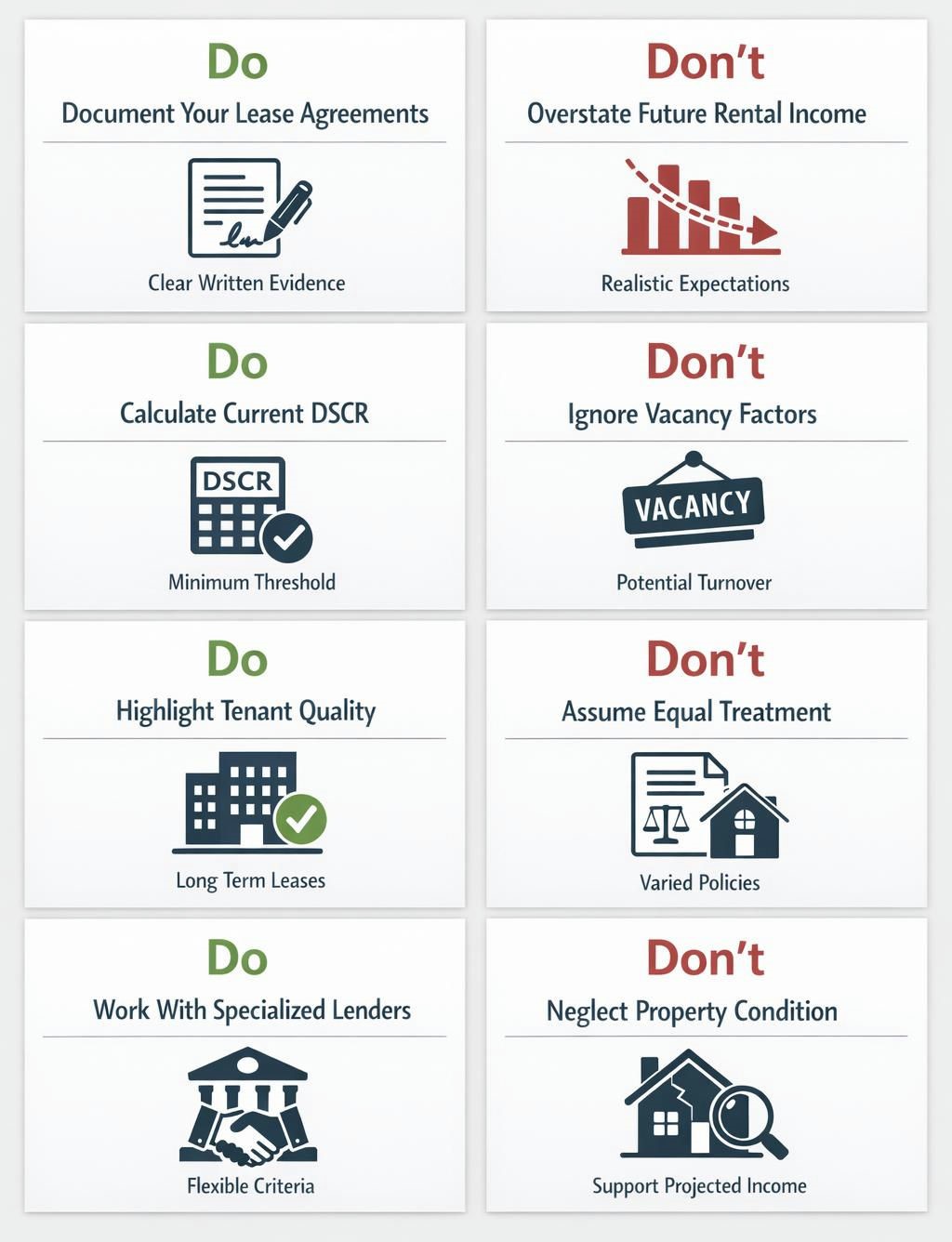
Do document your lease agreements thoroughly: Make sure all rent escalation clauses are clearly written and legally binding. Lenders typically require concrete evidence of scheduled increases, not verbal agreements or informal arrangements.
Do calculate current DSCR accurately: Start with your existing rental income and determine if your property already meets the minimum DSCR threshold, often around 1.25, which indicates the property's income exceeds mortgage obligations by 25%.
Do highlight tenant quality and lease duration: Long-term leases with creditworthy tenants and built-in rent increases may be viewed more favorably during the underwriting approach, as they suggest stable future income growth.
Do work with lenders familiar with investor properties: Not all mortgage providers understand how to evaluate properties with escalation provisions. Specialized lenders who focus on rental property loans often have more flexible underwriting criteria.
Don'ts When Financing Properties with Escalating Rents
Just as important as knowing what to do is understanding what pitfalls to avoid. These common mistakes could derail your financing application or result in less favorable loan terms than you deserve.
Don't overstate future rental income: While escalation clauses promise higher rents, lenders may discount or ignore projected increases if they're not yet realized. Base your initial calculations on current rental income to set realistic expectations.
Don't ignore vacancy factors: Even with escalation clauses, properties experience turnover. Failing to account for potential vacancy periods in your cash flow projections could weaken your application during underwriting.
Don't assume all lenders treat escalations equally: Each financial institution has different policies regarding how they value future income growth. Some might recognize escalation clauses fully, while others may apply conservative discount rates or ignore them entirely.
Don't neglect property condition and market research: Rent escalation clauses mean little if the property or local market can't support those increases. Lenders evaluate whether projected rents align with comparable market rates.
How DSCR Calculation Works with Future Income
The debt service coverage ratio sits at the heart of this financing strategy. Understanding how DSCR calculation works with future income helps you anticipate whether your property qualifies and at what loan amount.
Start with gross monthly rental income: This figure comes from your current lease agreements. If you have multiple units or properties, you'll combine the total monthly rental receipts. This baseline determines your starting DSCR before considering any escalation provisions.
Subtract operating expenses but not mortgage payments: Lenders typically calculate net operating income by deducting property taxes, insurance, HOA fees, and maintenance reserves. The mortgage payment itself isn't included in this calculation, as it's what you're comparing the income against.
Divide net income by proposed debt service: The resulting ratio tells lenders how comfortably the property can cover its mortgage obligations. A DSCR of 1.0 means income exactly equals the payment, while 1.25 indicates a 25% cushion that many lenders prefer.
Assess how escalation clauses may improve future ratios: Some lenders might consider scheduled rent increases when determining loan terms or maximum loan amounts. If your lease structure includes annual 3% increases, for example, that future income growth could strengthen your overall profile, though policies vary widely.
Factor in refinancing opportunities: As rent escalations take effect and your DSCR improves over time, you might qualify for better rates or larger loan amounts through refinancing. This creates a pathway for portfolio expansion using the same property's improved cash flow.
What Lenders Examine During the Underwriting Process
The underwriting approach for DSCR loans differs significantly from traditional mortgage evaluation. When rent escalation clauses enter the picture, lenders apply additional scrutiny to ensure the projected income is realistic and defensible.
Lease agreement terms and enforceability: Underwriters review the actual lease documents to verify that escalation clauses are legally binding and clearly defined. They look for specific percentage increases or dollar amounts tied to dates or events, not vague language about potential adjustments.
Tenant creditworthiness and payment history: Even with strong escalation provisions, a tenant with poor credit or inconsistent payment patterns raises red flags. Lenders may request rent rolls showing payment consistency over time to validate income reliability.
Market rent comparisons and feasibility: Underwriters compare your projected escalated rents against comparable properties in the area. If your escalation clause would push rents significantly above market rates, lenders might discount those future increases or consider them unrealistic.
Property condition and maintenance reserves: A property requiring significant repairs could undermine future income potential, even with escalation clauses in place. Lenders typically require property inspections or appraisals to confirm the asset can support the projected rental income.
Borrower's real estate investment experience: While DSCR loans don't rely on personal income, many lenders still consider your track record managing rental properties. Experienced investors with multiple properties might receive more favorable consideration for loans involving future income growth assumptions.
Strategies to Maximize Your DSCR Loan Approval
Getting approved for a DSCR loan for properties with rent escalation clauses requires more than just having the right lease structure. These strategic approaches can improve your chances of approval and potentially secure better terms.
Build a conservative financial presentation: Rather than emphasizing maximum projected rents from escalation clauses, present a base case using current income and show escalations as upside potential. This demonstrates financial prudence and may actually strengthen your credibility with underwriters.
Maintain higher cash reserves: Lenders feel more comfortable with borrowers who have substantial liquid reserves, typically six to twelve months of mortgage payments. This buffer protects against vacancy periods or unexpected expenses that could interrupt cash flow.
Consider a larger down payment: If your current DSCR sits just below the lender's threshold, increasing your down payment reduces the loan amount and monthly debt service, which could push your ratio into acceptable territory. This approach works well when escalation clauses will improve your position over time.
Structure leases with moderate, predictable escalations: Lease structures featuring modest annual increases like 2-3% may be viewed more favorably than aggressive escalations. Predictable growth patterns align better with conservative underwriting standards and market expectations.
Demonstrate market-rate pricing with documentation: Provide comparable rental data showing that your current rents are at or below market rates, and that your escalation clauses simply bring them in line with market growth. This positions increases as catch-up adjustments rather than speculative projections.
Common Scenarios Where Escalation Clauses Add Value
Not all rent escalation situations are created equal. Certain property types and lease structures particularly benefit from DSCR loan financing that recognizes future income growth potential.
Multi-tenant commercial properties with triple-net leases: These arrangements often include annual escalations tied to inflation indices or fixed percentages. The combination of multiple income streams and predictable increases may strengthen DSCR calculations, particularly when tenants are established businesses.
Long-term residential leases in appreciating markets: Some investors secure two or three-year residential leases with annual rent adjustments. In markets experiencing consistent appreciation, these escalation clauses help maintain income aligned with rising property values and could support higher leverage ratios.
Properties leased below market rate with catch-up provisions: If you've acquired a property with existing below-market leases but negotiated escalation clauses to reach market rates over time, this demonstrates a clear path to improved cash flow that sophisticated lenders might recognize during underwriting.
Newly renovated properties with phased rent increases: After completing value-add renovations, some investors implement graduated rent increases as improvements are completed or as tenants renew. These structured escalations tied to tangible property improvements may be viewed more favorably than arbitrary increases.
Portfolio properties with staggered lease renewals: When you own multiple units with leases expiring at different times, each renewal presents an opportunity to implement escalation clauses. This creates a rolling improvement in overall portfolio DSCR that could support acquisition financing for additional properties.
Planning for Long-Term Portfolio Growth
The true power of combining DSCR loans with rent escalation clauses emerges when you adopt a strategic, long-term perspective on portfolio building. This financing approach can create a self-reinforcing cycle of growth.
Use improving DSCR to access additional capital: As your rent escalations take effect over time, your debt service coverage ratio naturally improves. This improved ratio might enable you to refinance into better terms or access equity for additional property acquisitions without requiring traditional income verification.
Structure lease renewals with growth in mind: When existing leases expire, negotiate new agreements with built-in escalation clauses as a standard practice. This creates a portfolio-wide expectation of growing cash flow that compounds over multiple properties and lease cycles.
Track and document performance metrics: Maintain detailed records showing how your properties perform relative to projections. When escalation clauses deliver the promised income growth, this track record strengthens future financing applications and may open doors to larger loan amounts or better rates.
Diversify escalation strategies across properties: Some properties might work best with fixed percentage increases, others with CPI-tied adjustments, and still others with market-rate reset provisions. This diversification protects your overall portfolio performance if one approach underperforms in certain market conditions.
Build relationships with investor-focused lenders: As you successfully execute this strategy across multiple properties, you become a more attractive borrower to lenders specializing in rental property loans. These relationships can lead to streamlined approvals, better terms, and creative financing solutions as your portfolio scales.
A DSCR loan for properties with rent escalation clauses represents a sophisticated financing tool that aligns well with strategic real estate investment. By qualifying based on property income rather than personal documentation, these loans empower investors to expand portfolios even when traditional income verification proves challenging.
The interaction between DSCR calculations and future income growth creates opportunities that extend beyond simple property acquisition. When structured thoughtfully, lease agreements with escalation provisions can improve your debt service coverage over time, potentially opening doors to refinancing, equity access, and additional acquisitions.
Success with this approach requires understanding how lenders evaluate these properties during the underwriting process. Conservative documentation, realistic projections, and attention to lease structure details typically yield better results than aggressive assumptions about future rent increases. Remember that while escalation clauses offer genuine value, lenders may apply varying degrees of recognition to projected income depending on their specific policies and risk appetite.
As you build your rental property portfolio, consider how rent escalation clauses can work in concert with DSCR financing to create sustainable growth. The combination of income-based qualification and structured rent increases provides a pathway to scale your investments while maintaining financial stability across market cycles.