DSCR Loan Prepayment Penalty Buyout and Reduction Options Explained
Real estate investors using debt service coverage ratio financing often face a critical decision that can impact profitability for years: how to handle prepayment penalties. These charges protect lenders when borrowers refinance or sell properties before the loan term ends, but they can also lock investors into unfavorable positions when market conditions shift or better opportunities emerge.
Understanding investment property loan penalty structures isn't just about reading the fine print. It's about strategic planning that aligns loan terms with your investment timeline, exit strategy, and cash flow goals. Whether you're planning to hold a rental property long term or flip it within a few years, the penalty structure you choose today will determine your flexibility tomorrow.
This guide breaks down the most common DSCR loan prepayment penalty buyout and reduction options available to investors, along with the decision math that helps you choose the right structure for your portfolio. From step-down schedules to no-penalty alternatives, you'll learn how to negotiate terms that protect your returns without sacrificing opportunity.
How Prepayment Penalties Work in DSCR Loans
How prepayment penalties work in DSCR loans is fundamental to making informed financing decisions. Unlike conventional mortgages for primary residences, investment property loans typically include prepayment penalties as a standard feature. These penalties compensate lenders for lost interest income when a loan is paid off early through refinancing, property sale, or large principal payments.
The penalty is calculated as a percentage of the outstanding loan balance at the time of payoff. If you borrowed $400,000 and decide to refinance after two years with a 3% penalty in effect, you would owe $12,000 just to exit the loan. This cost must be factored into any refinance or sale decision to determine whether the move makes financial sense.
DSCR lenders structure these penalties differently than traditional mortgage providers because they're funding non-owner-occupied investment properties. The risk profile differs, and lenders need protection against early payoff in a market where investors frequently refinance to capture equity or take advantage of rate drops.
Step-down structures: Penalties decrease over time, often following a 5-4-3-2-1 pattern where the penalty drops by one percentage point each year.
Flat penalties: A fixed percentage applies for a set period, then drops to zero after the penalty window closes.
Soft prepayment penalties: These apply only to refinances, not to property sales, giving investors more exit flexibility.
Hard prepayment penalties: These apply to any payoff scenario, whether through sale, refinance, or principal paydown.
The structure you accept at closing determines your financial flexibility throughout the loan term. Investors who anticipate refinancing within three years need to approach penalty structures very differently than those planning to hold properties for a decade or more.
Common Step-Down Penalty Structures and Their Impact
Common step-down penalty structures and their impact on investment returns vary considerably based on your holding period and exit strategy. The most prevalent structure in DSCR lending follows a 5-4-3-2-1 step-down pattern, where the penalty starts at 5% of the outstanding balance in year one and decreases by one percentage point each year until it reaches zero in year six.
Here's how this structure plays out in practice. On a $500,000 loan, refinancing in year one would cost you $25,000 in penalties alone. Wait until year three, and that penalty drops to $15,000. By year six, you can refinance or sell penalty-free. This structure encourages investors to either commit to the full penalty period or plan exits carefully to minimize costs.
Front-loaded protection: Lenders receive maximum protection in early years when they've invested the most in loan origination and face the highest risk of immediate payoff.
Declining investor cost: As your loan seasons and you build equity, the penalty becomes less burdensome both as a percentage and as a dollar amount on a declining balance.
Strategic timing opportunities: Investors can plan refinances or sales to coincide with lower penalty years, reducing exit costs significantly.
Rate environment considerations: Step-down structures give you partial flexibility if rates drop dramatically, allowing you to weigh penalty costs against refinance savings.
Some lenders offer alternative step-down schedules like 3-2-1 or 4-3-2-1, which provide faster penalty reduction but may come with slightly higher interest rates upfront. The choice between these structures depends on your confidence in your hold period and your tolerance for rate adjustments.
Investors who've experienced market cycles understand that flexibility has value. A step-down structure provides a middle ground between no-penalty loans (which carry higher rates) and fixed penalties (which may lock you in at the worst possible time). The key is matching the structure to your realistic timeline, not your optimistic one.
Buyout Options: Eliminating Penalties Upfront
Buyout options allow investors to eliminate or reduce prepayment penalties by making trade-offs at loan origination. The most common approach is accepting a higher interest rate in exchange for a no-prepayment-penalty structure. This option provides maximum flexibility but increases your monthly debt service throughout the loan term.
The rate differential typically ranges from 0.25% to 0.75% depending on the lender, loan-to-value ratio, and property type. On a $400,000 loan, a 0.50% rate increase translates to roughly $167 more per month in interest costs, or about $2,000 per year. Over five years, you'd pay an extra $10,000 in interest to maintain the freedom to exit without penalty at any time.
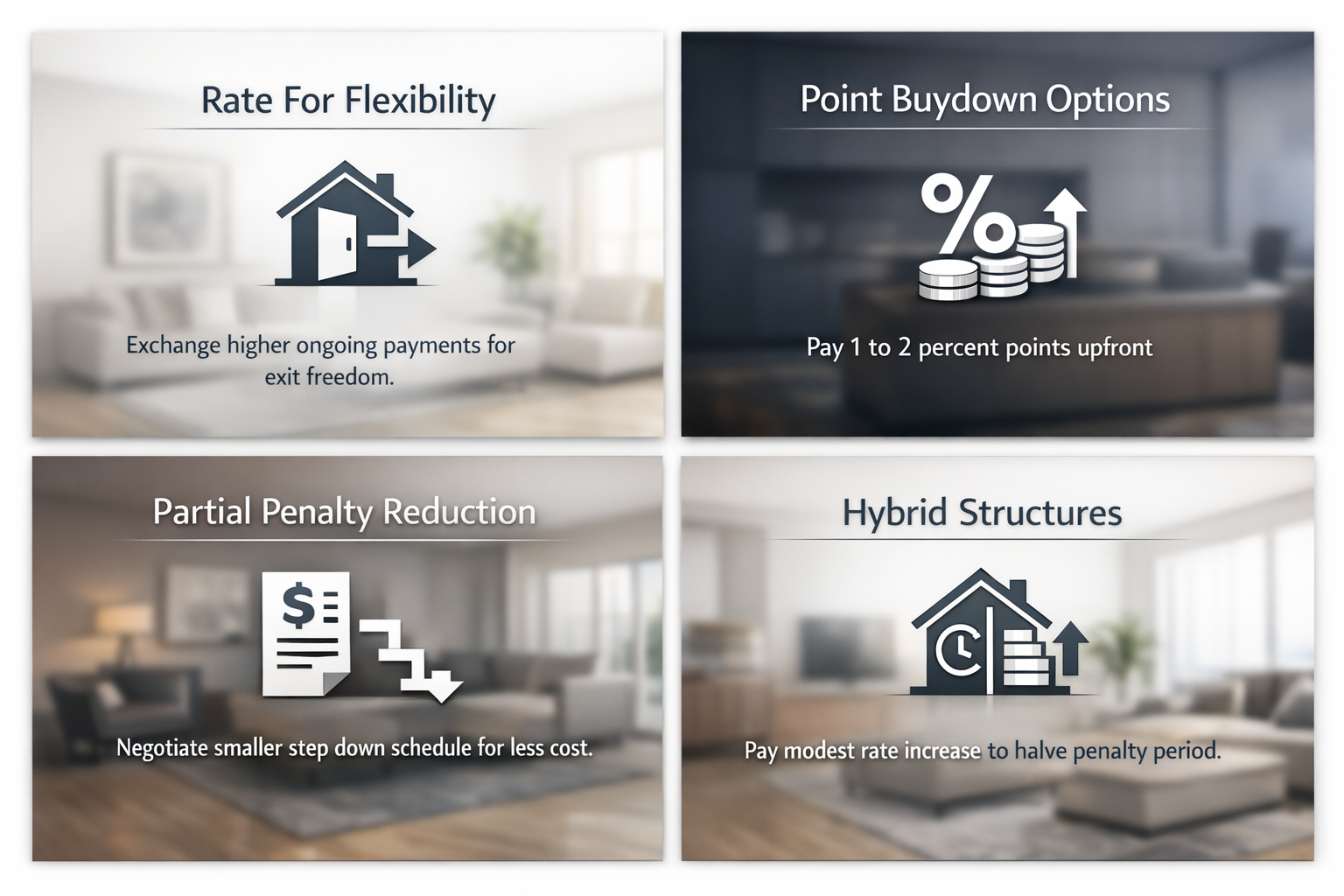
Rate-for-flexibility trade: You exchange ongoing higher payments for the ability to refinance or sell without penalty charges at any point during the loan term.
Point buydown options: Some lenders allow you to pay upfront points at closing (typically 1-2% of the loan amount) to eliminate or reduce the penalty schedule without raising your ongoing rate.
Partial penalty reduction: Instead of eliminating penalties entirely, you might negotiate a lower cap (such as 3-2-1 instead of 5-4-3-2-1) in exchange for a smaller rate increase.
Hybrid structures: A few lenders offer middle-ground options where you pay a modest rate increase to cut the penalty period in half, such as moving from a five-year to a three-year penalty window.
The financial math on buyouts requires honest assessment of your exit probability. If you're highly likely to refinance within three years due to planned property improvements, equity capture strategies, or anticipated rate drops, paying for flexibility upfront often makes sense. If you're committed to a long hold period and rates would need to drop substantially for refinance to make sense, accepting standard penalties and keeping your rate lower may be the better play.
Investors should run break-even calculations comparing the cumulative cost of higher rates against potential penalty charges at different exit points. This analysis reveals the holding period where each option becomes advantageous and helps you make data-driven decisions rather than emotional ones.
Strategic Timing: When to Accept vs. Avoid Penalties
Strategic timing decisions around when to accept versus avoid penalties can significantly impact your investment returns and portfolio growth. The right choice depends on your specific investment strategy, market conditions, and realistic assessment of your hold period.
Accept standard penalties when you're confident in a long hold period: If you're acquiring stable rental properties with strong cash flow and plan to hold them for seven to ten years or longer, accepting a standard step-down penalty structure in exchange for a lower rate makes financial sense. The interest savings over time far outweigh the unlikely scenario of early payoff.
Opt for no-penalty structures when planning aggressive portfolio growth: Investors using a refinance-and-reinvest strategy, where they pull equity from appreciating properties every few years to fund new acquisitions, benefit from no-penalty options despite higher rates. The flexibility to execute this strategy without friction costs enables faster portfolio scaling.
Choose partial buydowns for moderate uncertainty: When you're reasonably confident in your hold period but want some protection against unexpected opportunities or market shifts, negotiating a reduced penalty schedule (such as 3-2-1 instead of 5-4-3-2-1) provides middle-ground protection at a modest rate increase.
Time refinances to penalty step-downs: If you're locked into a penalty structure and market conditions make refinancing attractive, waiting a few months for the penalty to step down can save thousands. Running the math on rate savings versus delay costs helps optimize timing.
Market conditions also influence this decision. In rising rate environments, prepayment penalties matter less because refinancing becomes unlikely anyway. Your focus shifts to locking in the lowest possible rate, and accepting penalties to achieve that goal costs you nothing in practical terms.
Conversely, in declining or volatile rate environments, flexibility gains value. The option to refinance without penalty when rates drop 1% or more can generate substantial savings that dwarf the cost of a slightly higher initial rate. Investors operating in these conditions should weight their decisions toward flexibility.
Negotiating Penalty Terms During Loan Origination
Negotiating penalty terms during loan origination is where savvy investors protect their future flexibility. Unlike rate negotiations, which receive intense focus, penalty structures often get overlooked until they become costly obstacles. Taking control of this conversation early gives you leverage and options.
Start by understanding what's negotiable with your specific lender. Many investors assume penalty structures are fixed, but lenders often have multiple pricing tiers that trade rate for penalty flexibility. Asking directly about all available penalty options reveals choices you might not otherwise see.
Request a full penalty comparison sheet: Ask your lender to provide written comparisons showing rate differences between standard penalty structures, reduced penalties, and no-penalty options. This transparency allows you to make informed decisions based on real numbers rather than assumptions.
Leverage competitive quotes: If you're shopping multiple lenders, use penalty terms as a negotiating point just as you would with rates. A lender offering a slightly higher rate but better penalty terms might deliver superior overall value depending on your strategy.
Negotiate penalty caps: Even if you accept a penalty structure, you can sometimes negotiate a dollar cap that limits your maximum exposure. For example, capping penalties at $15,000 regardless of balance provides downside protection on larger loans.
Request partial portability: Some lenders allow you to port your loan to a new property if you sell and reinvest quickly, avoiding penalties altogether. This feature works well for investors who plan to upgrade properties within their portfolio.
Documentation matters enormously in penalty negotiations. Ensure that any negotiated terms appear explicitly in your loan agreement, not just in email conversations or verbal assurances. Penalty language should clearly specify the percentage, step-down schedule, which events trigger penalties, and any negotiated exceptions or caps.
Your negotiating leverage increases with loan size, portfolio relationships, and creditworthiness. Investors bringing $1 million in loans or multiple properties to a lender carry more weight than those seeking a single small loan. Don't hesitate to use this leverage to request terms that align with your investment strategy.
Calculating Break-Even Points for Penalty Buyouts
Calculating break-even points for penalty buyouts requires comparing the cumulative cost of higher rates against potential penalty charges at various exit points. This analysis removes guesswork and grounds your decision in financial reality rather than optimism or fear.
The basic calculation works like this: determine the monthly payment difference between a standard penalty structure and a no-penalty option, multiply by the number of months you plan to hold the loan, and compare that total to the penalty you would pay if you refinance or sell under the standard structure.
Monthly cost of buyout: A 0.50% rate increase on a $500,000 loan adds approximately $208 to your monthly payment. Over 36 months, that's $7,488 in additional interest costs paid for penalty-free flexibility.
Penalty cost under standard structure: Under a 5-4-3-2-1 step-down, refinancing the same loan in year three would incur a 3% penalty on the remaining balance. If you've paid down to $480,000, the penalty would be $14,400.
Break-even comparison: In this scenario, the buyout saves you $6,912 if you refinance in year three. However, if you hold until year five when the penalty drops to 1%, the penalty would only be $4,600 and the standard structure would have been cheaper.
Probability-weighted analysis: Sophisticated investors assign probability estimates to different exit scenarios and calculate expected value across all possibilities to determine which structure offers better risk-adjusted returns.
This math changes based on loan size, rate differential, and your specific step-down schedule. Larger loans magnify both penalty costs and the expense of rate buyouts, while smaller loans might not justify the complexity of optimization.
Time value of money also matters in this calculation. The additional interest you pay for a no-penalty structure comes out of your cash flow immediately and throughout the loan term, while penalty costs only materialize if and when you exit. Investors with tight cash flow might prefer deferring costs through penalties, while those with strong reserves might value flexibility more highly.
DSCR loan prepayment penalty buyout and reduction options represent one of the most underappreciated leverage points in investment property financing. The right penalty structure aligns your loan terms with your investment strategy, protecting your flexibility without sacrificing returns. The wrong structure can cost you tens of thousands in unnecessary fees or force you to miss lucrative opportunities because exit costs make them financially unviable.
Successful investors treat penalty negotiations as seriously as rate shopping. They run the break-even math, honestly assess their hold period, and choose structures that match their realistic plans rather than their optimistic hopes. They understand that flexibility has value but also recognize that paying for unused flexibility reduces returns.
As you evaluate your next investment property acquisition or refinance, take control of the penalty conversation early. Request full comparisons, negotiate terms that serve your strategy, and document everything clearly. The time you invest in understanding these structures pays dividends throughout your loan term and protects your ability to capitalize on opportunities as they emerge.
Whether you're building a long-term rental portfolio or executing a rapid growth strategy, penalty structures should support your goals rather than constrain them. If you're ready to explore DSCR financing with penalty terms tailored to your investment strategy, see your DSCR loan options and discover how the right structure can enhance your portfolio performance.