Cross Collateral DSCR Loans for Short Term Rentals
September 8, 2026
•
10 min read
Table of Contents
Cross Collateral DSCR Loans for Short Term Rentals
Managing a short term rental portfolio requires smart financing that keeps pace with your growth ambitions. As your Airbnb or vacation rental empire expands, traditional loan structures can slow you down with property-by-property underwriting, multiple closings, and fragmented debt service obligations. That's where a DSCR loan for short term rental portfolio cross collateralization becomes a powerful tool for scaling.
Cross collateralization allows you to bundle multiple investment properties under a single loan, streamlining your financing and often unlocking better terms. When combined with DSCR underwriting, which qualifies you based on rental income rather than personal tax returns, you get a financing strategy built for real estate investors who want to move quickly and efficiently. Whether you're adding your fifth vacation rental or refinancing a scattered portfolio into one blanket structure, understanding this approach can reshape your acquisition strategy.
In this guide, we'll break down exactly how cross collateralization works with DSCR loans, when it makes sense for short term rental investors, and what factors influence your rates and terms. You'll also discover how blanket mortgage structures differ from traditional property-by-property financing and what to watch for as you evaluate lenders.
How Cross Collateralization Works with DSCR Loans
How cross collateralization works with DSCR loans centers on pledging multiple properties as security for a single loan. Instead of taking out separate mortgages for each rental in your portfolio, you group them together under one blanket mortgage. The lender evaluates the combined cash flow from all properties, and each property serves as collateral for the entire loan balance.
Single loan, multiple properties: You close once and manage one monthly payment instead of juggling several loans across different properties. This simplifies bookkeeping and can reduce transaction costs compared to individual property financing.
Portfolio-level DSCR calculation: The lender looks at the total rental income from all properties in the blanket structure and divides it by the total debt obligation. This aggregated debt service coverage ratio determines your qualification, smoothing out any individual property cash flow dips.
Shared collateral risk: Each property in the cross collateralized pool secures the entire loan. If you default, the lender can pursue any or all properties in the package, which means stronger performers cross-subsidize weaker ones in the eyes of the lender.
Release clauses and future flexibility: Many blanket DSCR loans include a release clause that lets you sell one property and remove it from the collateral pool by paying down a portion of the principal. This keeps your exit strategy flexible as your portfolio evolves.
For short term rental investors, this structure is especially useful when you own properties in multiple markets or have a mix of high-season vacation homes and year-round rentals. The portfolio-level DSCR smooths seasonal income fluctuations, making it easier to meet lender thresholds. You're also free to acquire additional properties without the overhead of opening entirely new loan files each time.
DSCR underwriting itself is straightforward. The lender divides your monthly rental income by your monthly debt payment, which includes principal, interest, taxes, insurance, and HOA fees if applicable. A DSCR of 1.0 means your rental income exactly covers your debt service. Most lenders require a minimum DSCR between 1.0 and 1.25, though some may go lower depending on loan-to-value and credit profile. When you cross collateralize, the lender aggregates income and debt across all properties, which can help you qualify even if one or two rentals are break-even or slightly negative on a standalone basis.
Advantages of Blanket Mortgage for Airbnb Rental Portfolio Financing
Advantages of blanket mortgage for Airbnb rental portfolio financing go beyond the convenience of a single closing. This structure is designed for investors who see their portfolio as an integrated business rather than a collection of disconnected properties. Here's why a blanket mortgage paired with DSCR underwriting often makes sense for short term rental operators.
Faster closings and lower transaction costs: Instead of paying appraisal fees, title insurance, and closing costs on every property individually, you consolidate those expenses into one blanket loan. This can save thousands of dollars and weeks of underwriting time when you're adding or refinancing multiple rentals at once.
Improved cash flow management: One monthly payment simplifies your accounting and cash flow projections. You're not tracking multiple due dates, escrow accounts, or lender portals. For Airbnb investors managing dynamic pricing and seasonal bookings, streamlined debt service makes forecasting much cleaner.
Leverage strong performers to support new acquisitions: If you own three high-performing vacation rentals and want to buy a fourth that needs renovation or has lower initial occupancy, the blanket structure lets you use the combined income to qualify. The portfolio-level DSCR absorbs short term weakness in individual properties, giving you runway to stabilize new assets.
Potential rate and term improvements: Lenders may offer better pricing on larger loan amounts or portfolios with diversified income streams. While individual property loans might carry higher rates due to perceived concentration risk, a well-performing portfolio can demonstrate stability and command more competitive terms.
Blanket mortgages are particularly attractive for investors operating in vacation rental hotspots where property values and rental income can be volatile. By bundling properties across different neighborhoods or even different cities, you reduce the lender's exposure to any single market downturn. This diversification can translate into more favorable underwriting decisions and lower interest costs over the life of the loan.
Another benefit is portfolio scalability. Once you've established a blanket loan with a lender, adding properties to the collateral pool is often simpler than starting from scratch with a new lender and loan program. Some lenders will allow you to amend the existing blanket structure to include additional properties, subject to updated appraisals and DSCR calculations. This creates a financing platform that grows with your business, rather than requiring a complete refinance every time you acquire a new rental.
Have a property in mind?
Tell us about the property and we will find the financing that fits you best.
Current DSCR loan rates and what influences them is a question every investor should ask before committing to a blanket structure. DSCR loan rates for well-qualified borrowers generally fall between 6.25% and 8.00% for 30-year fixed products on investment properties. Blanket and portfolio structures may price somewhat differently than single-property loans depending on the lender's overlays, the number of properties involved, and the overall strength of the deal, so this range should be treated as a general starting point rather than a guaranteed quote.
DSCR ratio: The higher your debt service coverage ratio, the lower your rate tends to be. A portfolio with a DSCR of 1.25 or above signals strong cash flow cushion, which lenders reward with better pricing. Conversely, a DSCR closer to 1.0 might push your rate higher or require additional reserves.
Loan-to-value ratio: Lower LTV typically means lower rates. If you're putting down 25% or more, lenders see less default risk and price accordingly. Blanket loans often cap LTV somewhere between 65% and 80%, though this can vary meaningfully by lender, with the most competitive pricing typically landing in the 70% to 75% LTV range.
Credit profile: While DSCR loans don't require tax returns, your credit score still matters. Scores above 700 generally qualify for the best rates, while scores in the mid-600s may face rate premiums or stricter reserve requirements.
Property type and occupancy: Single-family rentals, duplexes, and small multifamily properties tend to receive better rates than larger commercial assets. Short term rentals, especially those managed via platforms like Airbnb, may be viewed as higher risk due to income volatility, which can nudge rates slightly higher compared to long term residential leases.
It's also worth noting that DSCR loan rates can vary significantly between lenders. Some lenders specialize in short term rental financing and understand the seasonal income patterns, while others may apply more conservative overlays. Shopping multiple lenders and comparing rate quotes is essential, particularly for blanket structures where even a quarter-point difference in rate can add up to thousands of dollars annually on a large portfolio loan.
Market conditions play a role too. Broader interest rate trends, investor appetite for mortgage-backed securities, and regional real estate performance all feed into the pricing models lenders use. During periods of economic uncertainty, DSCR loan rates may rise or lenders may tighten qualification criteria. Staying informed about these trends helps you time your refinance or acquisition to capture favorable terms.
When Cross Collateralization Makes Sense for Short Term Rentals
When cross collateralization makes sense for short term rentals depends on your portfolio size, growth plans, and risk tolerance. It's not a one-size-fits-all solution, and understanding the scenarios where it shines will help you decide if it's the right move for your vacation rental business.
You own three or more properties and want to consolidate debt: Managing multiple loans becomes cumbersome as your portfolio grows. If you're juggling different maturity dates, varying interest rates, and multiple lender relationships, a blanket refinance can simplify your life and potentially lower your blended rate.
You're acquiring multiple properties in a short window: If you've identified several deals in a hot vacation market and need to close quickly, a blanket DSCR loan lets you package them into one financing event. This speed can be a competitive advantage when sellers prefer cash-like certainty.
Your portfolio has a mix of strong and emerging performers: Cross collateralization allows you to leverage high-performing rentals to support newer acquisitions or properties you're still optimizing. The aggregated DSCR means you don't need every property to hit 1.25 individually, as long as the portfolio average meets the lender's threshold.
You want to unlock equity for reinvestment: A blanket cash-out refinance can pull equity from multiple properties at once, giving you a capital pool to fund renovations, marketing, or additional acquisitions. This is particularly useful for Airbnb investors who need working capital to upgrade interiors or expand your short term rental into new markets.
On the flip side, cross collateralization may not be ideal if you plan to sell individual properties frequently or if you prefer to isolate risk on a property-by-property basis. Because each property secures the entire loan, a default or foreclosure on one asset can put the entire portfolio at risk. Additionally, if one property needs to be sold, you'll need to negotiate a release with the lender and pay down a portion of the principal, which can complicate exit strategies.
Short term rental investors should also consider the stability of their rental income. If your properties are in highly seasonal markets where occupancy drops to near zero for several months, lenders may scrutinize your DSCR calculation more closely or require larger cash reserves. In these cases, having a diversified portfolio across multiple seasons or geographies can strengthen your loan application and improve your chances of approval at favorable rates.
Key Questions to Ask Before Pursuing a Blanket DSCR Loan
Key questions to ask before pursuing a blanket DSCR loan will help you navigate the complexities of cross collateralization and ensure the structure aligns with your investment strategy. Here are the critical considerations every short term rental investor should address with potential lenders.
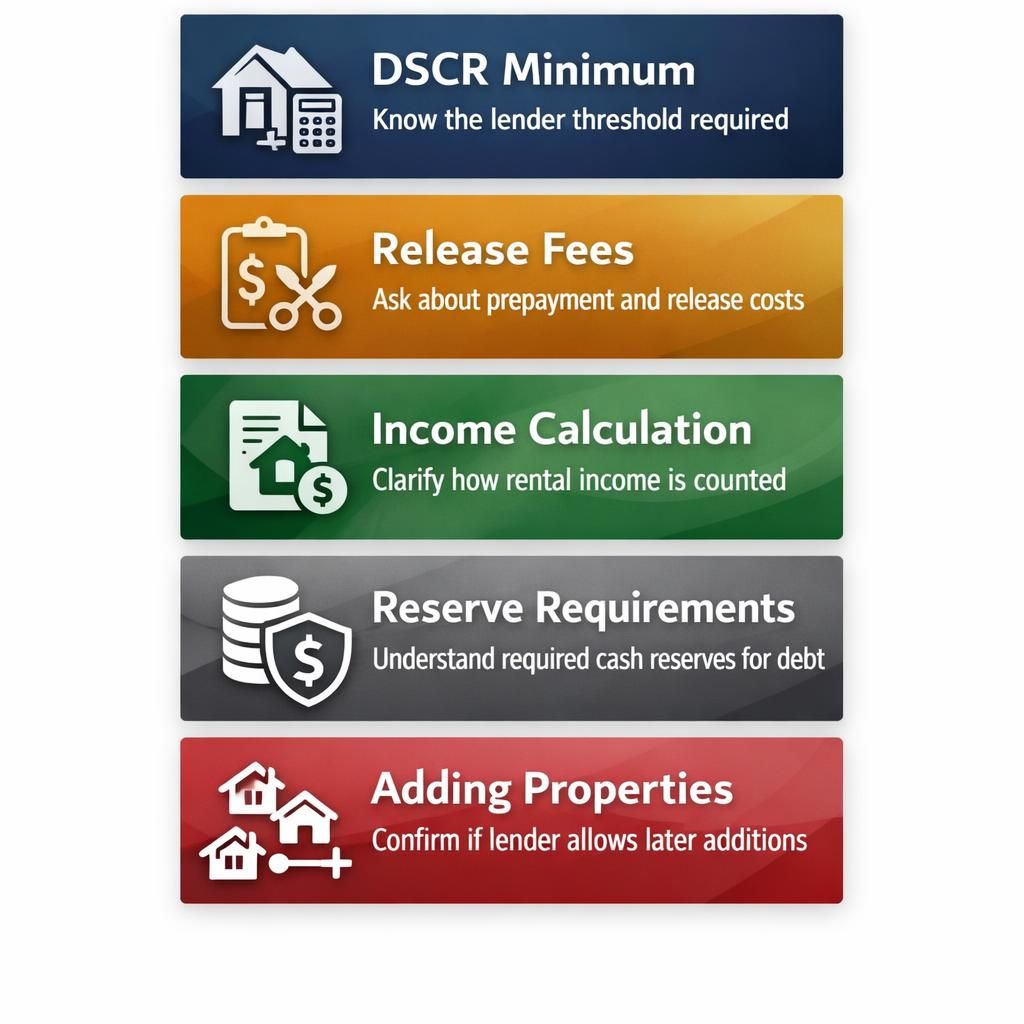
What is the minimum portfolio DSCR required? Lenders vary in their thresholds. Some may accept a portfolio DSCR of 1.0, while others require 1.25 or higher. Knowing this upfront helps you assess whether your current rental income is sufficient or if you need to boost occupancy or rates before applying.
Are there prepayment penalties or release fees? Many blanket loans include prepayment penalties if you pay off the loan early or sell a property within the collateral pool. Ask about the cost and structure of release clauses, so you understand the financial impact of selling one property down the road.
How does the lender calculate rental income for short term rentals? Some lenders use a percentage of gross rental income, others may average the trailing 12 or 24 months of actual bookings, and a few will consider market rents or appraisal-based income projections. Clarifying this ensures you're not surprised during underwriting.
What are the reserve requirements? DSCR lenders typically require cash reserves equal to several months of debt service. For blanket loans covering multiple properties, this can add up quickly. Understanding the reserve calculation helps you plan liquidity before closing.
Can I add properties to the blanket loan later? If you plan to grow your portfolio, ask whether the lender allows amendments to include additional properties without a full refinance. This flexibility can save time and money as you scale your short term rental business.
These questions not only clarify the terms you're agreeing to, but also reveal how experienced the lender is with short term rental financing and cross collateralized structures. A lender who understands vacation rental cash flow dynamics and can articulate clear answers is often a better long-term partner than one offering a slightly lower rate but less portfolio expertise.
A DSCR loan for short term rental portfolio cross collateralization offers investors a streamlined, scalable way to finance and grow vacation rental empires. By bundling multiple properties under one blanket mortgage and qualifying on rental income rather than personal tax returns, you gain speed, simplicity, and often better terms than traditional property-by-property financing. Whether you're consolidating existing debt, acquiring new Airbnb properties, or unlocking equity for reinvestment, this structure can be a game changer for serious portfolio builders.
At the same time, cross collateralization isn't without trade-offs. Shared collateral risk, release clause logistics, and the need for strong portfolio-level cash flow all require careful planning and due diligence. The key is matching the financing structure to your investment strategy, market conditions, and risk appetite. When done right, a blanket DSCR loan becomes a powerful platform that grows with your business and supports your long-term wealth-building goals.
As you evaluate your options, keep an eye on current rate trends, lender specialization in short term rentals, and the specific underwriting criteria for portfolio DSCR loans. Rates generally fall between 6.25% and 8.00% for fixed products, though blanket structures may price somewhat differently than single-property loans, and your actual terms will depend on your DSCR, LTV, credit, and the strength of your rental income. Shopping multiple lenders and asking the right questions will ensure you secure financing that aligns with your portfolio ambitions.
Ready to explore how a blanket DSCR loan can simplify and supercharge your short term rental portfolio? Get a personalized DSCR loan quote and take the next step toward smarter, faster portfolio growth.