DSCR Loan Down Payment Requirements for Real Estate Investors
Understanding DSCR loan down payment requirements is crucial for real estate investors looking to maximize their leverage while securing favorable financing terms. These specialized loans focus on property cash flow rather than personal income, making them attractive for investment properties. However, the down payment requirements can vary significantly based on several factors that directly impact your investment strategy and returns. Let's explore the key elements that determine how much cash you'll need to bring to the table when pursuing DSCR financing for your rental property portfolio.
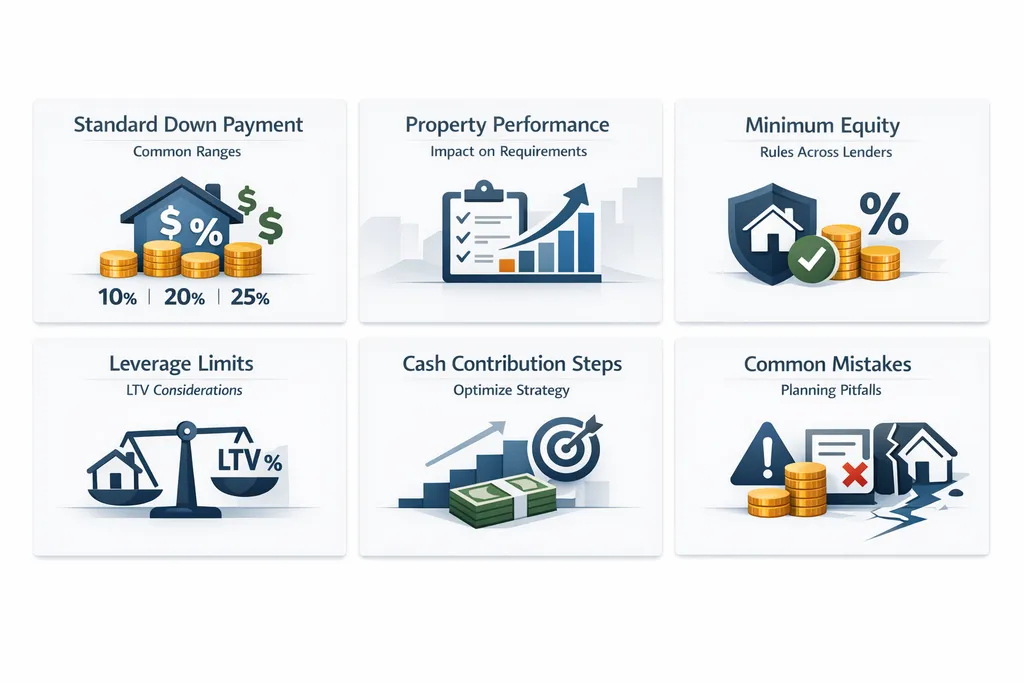
Standard Down Payment Ranges for DSCR Loans
Standard down payment ranges for DSCR loans typically fall between specific percentages that reflect the lender's risk assessment. Most investors can expect to navigate these common requirements when structuring their deals.
Standard scenarios typically require 20-25% down payment with loan-to-value ratios between 75-80%
Single-family rental properties may qualify for down payments as low as 15% in certain cases
Most lenders position their standard offerings in the 20-25% range for competitive investment property financing
These percentages represent the baseline expectations before considering property-specific factors
Property Performance Impact on Down Payment Requirements
Property performance impact on down payment requirements becomes evident when examining how DSCR ratios influence lender decisions. Properties with stronger cash flow metrics often qualify for more favorable terms.
Properties with DSCR ratios below 1.0 may require larger down payments of 30-35% due to higher perceived risk
DSCR minimums generally range between 1.20x and 1.25x for standard approval consideration
Properties generating consistent income above 1.25x DSCR might qualify for lower down payment options
Lenders assess income performance levels as a primary factor in determining cash contribution requirements
Minimum Equity Rules Across Lenders
Minimum equity rules across lenders create a framework that investors must understand to effectively compare financing options. These rules establish the baseline cash investment required for different property types and scenarios.
Most lenders require minimum 20% equity stake regardless of property performance metrics
Higher-risk properties or markets may trigger minimum equity requirements of 25-30%
Some specialized lenders offer flexibility in equity requirements based on borrower experience and portfolio size
Equity rules often correlate with loan-to-value ratios and maximum leverage limits per lender guidelines
Leverage Limits and LTV Considerations
Leverage limits and LTV considerations directly influence how much financing investors can secure against their property value. Understanding these constraints helps in structuring deals effectively.
Maximum LTV ratios typically cap at 75-80% for most DSCR loan programs
Conservative lenders may limit LTV to 70-75% for properties in certain markets or conditions
Higher leverage options might be available for experienced investors with strong portfolios
LTV limits often adjust based on property type, with single-family homes potentially qualifying for higher ratios
Steps to Optimize Your Cash Contribution Strategy
Steps to optimize your cash contribution strategy can help investors maximize their purchasing power while meeting lender requirements effectively.
Calculate your property's projected DSCR ratio before approaching lenders to understand potential down payment requirements
Compare multiple lenders' DSCR criteria and down payment structures to identify the most favorable terms
Prepare for higher cash contributions when targeting properties with DSCR ratios below 1.20x
Structure your investment timeline to allow for varying down payment requirements across different property types
Down Payment Requirements for 2-4 Unit Properties
Small multifamily properties, duplexes, triplexes, and fourplexes, follow the same DSCR framework as single-family rentals, but unit count and property complexity shift the numbers somewhat.
Duplexes: Typically 20% to 25% down, with strong DSCR and credit sometimes qualifying for the lower end of that range.
Triplexes: Generally 25% down, aligning with a standard 75% LTV cap.
Fourplexes: Often 30% down, reflecting the added operational complexity of managing four leases and a higher total loan amount.
Your property's DSCR ratio moves these baselines up or down: a ratio of 1.25 or higher can support a down payment at the low end of the range, a ratio between 1.0 and 1.24 typically lands you at the standard 25%, and a ratio below 1.0 usually pushes the down payment to 25-30% to offset the thinner (or negative) cash flow cushion. A small number of lenders will consider DSCR ratios as low as 0.75 for specific scenarios, such as value-add properties in appreciating markets, but this is a specialty exception that comes with a higher down payment and other tradeoffs, not a general qualification standard.
Beyond the down payment itself, budget for closing costs (2% to 5% of the purchase price) and cash reserves. Reserve requirements for a standard long-term rental in the 2-4 unit range typically run 2 to 6 months of PITIA; if any units are operated as short-term rentals, expect reserve requirements closer to 6 to 12 months given the added income variability.
Down Payment Guidance for First-Time DSCR Investors
If this is your first rental property purchase, the down payment math works the same way it does for experienced investors, but a few points are worth calling out specifically.
Standard range still applies: Expect to put down 20% to 25% on your first DSCR-financed rental; occasionally you'll see programs stretch to the high teens for exceptionally strong deals, but 20-25% is the realistic baseline to plan around.
Credit score matters even without income documentation: DSCR loans skip your tax returns and W-2s, but your credit score still drives your rate and down payment tier. A score of 620 is typically the floor, and scores of 680 or higher generally unlock the best pricing.
Don't forget closing costs and reserves on top of the down payment: Closing costs typically run 2% to 5% of the purchase price, and most lenders want to see 2 to 6 months of PITIA in liquid reserves after closing for a standard long-term rental. First-time investors who budget only for the down payment are often surprised by this additional cash requirement.
A larger down payment can improve a marginal DSCR: If a property's rental income only marginally covers the debt payment, increasing your down payment reduces the loan amount and the monthly debt service, which can lift the DSCR into a more comfortable range and improve your approval odds.
The most common mistake first-time investors make isn't the down payment percentage itself, it's underestimating the total cash needed once closing costs and reserves are added on top. Model your full cash-to-close, not just the down payment, before you make an offer.
Mastering DSCR loan down payment requirements empowers real estate investors to make informed financing decisions that align with their portfolio goals. While standard requirements typically fall between 20-25%, property performance and lender-specific criteria can significantly impact your cash contribution needs. By understanding these variables and planning accordingly, investors can optimize their leverage while securing the financing necessary for continued growth. Remember that each deal may present unique requirements, making it essential to evaluate multiple lenders and prepare for varying scenarios in your investment strategy.