DSCR Loan Down Payment Guide for Multifamily Assets
August 7, 2026
•
9 min read
Understanding Down Payment Requirements for Small Multifamily DSCR Loans
Acquiring 2-4 unit rental properties with DSCR financing offers real estate investors a practical path to scale their portfolios without the documentation hassles of traditional mortgages. Unlike owner-occupied loans that scrutinize personal income statements and tax returns, DSCR products evaluate deals based on rental income performance. That shift in underwriting philosophy changes how lenders approach down payment requirements, especially for duplexes, triplexes, and fourplexes.
The dscr loan down payment requirements for 2-4 unit properties depend on several interconnected factors: the number of units, the debt service coverage ratio itself, your credit profile, and the property's overall condition. Most investors will encounter down payment expectations ranging from 20% to 30%, with the exact figure influenced by how strong the rental income is relative to the mortgage obligation. Getting familiar with these benchmarks helps you plan acquisition budgets more accurately and identify which properties align with your available capital.
This guide walks through the mechanics of small multifamily investment property financing LTV limits, clarifies how lenders assess risk on multi-unit assets, and explains strategies to optimize your down payment position. Whether you're eyeing your first duplex or adding a fourplex to an existing portfolio, understanding these capital requirements will sharpen your deal analysis and improve your negotiation footing with lenders.
Standard Down Payment Benchmarks by Unit Count
Standard down payment benchmarks by unit count provide a foundational reference point when evaluating DSCR financing options. The number of rental units in a property directly influences the level of equity lenders require upfront, reflecting both operational complexity and perceived risk.
Duplexes: Down payments typically fall in the 20-25% range for two-unit properties. Many lenders view duplexes as lower-risk investments given their simpler management profile and broader appeal in secondary markets, which may allow for the lower end of this spectrum when credit and DSCR are strong.
Triplexes: Three-unit buildings often require 25% down, aligning with the standard 75% LTV limit common across DSCR programs. The additional unit introduces slightly more operational variables, prompting lenders to hold firmer equity requirements.
Fourplexes: Four-unit properties may see down payment requirements climb to 30% in some cases. The added complexity of managing four separate leases and tenants, combined with higher total loan amounts, leads lenders to seek more substantial borrower equity.
These benchmarks aren't absolute ceilings. Investors with exceptionally strong DSCR ratios, higher credit scores, or purchasing turnkey properties in stable markets might secure more favorable terms. Conversely, properties with lower coverage ratios or deferred maintenance could push down payment expectations toward the higher end of these ranges. The key takeaway is that unit count serves as a baseline variable, around which other underwriting factors adjust the final equity requirement.
Recognizing these patterns helps you forecast capital needs during the deal screening phase. If you're comparing a duplex at 20% down versus a fourplex at 30%, the difference in required cash can be substantial on higher-priced assets, affecting your ability to deploy capital across multiple deals simultaneously. Always model several scenarios to understand how unit count interacts with your financing strategy.
How DSCR Ratios Influence Your Down Payment
How DSCR ratios influence your down payment is central to understanding the flexibility within these loan products. The debt service coverage ratio measures the property's net operating income against its total debt obligations, and a stronger ratio signals lower lender risk, often translating into reduced equity requirements.
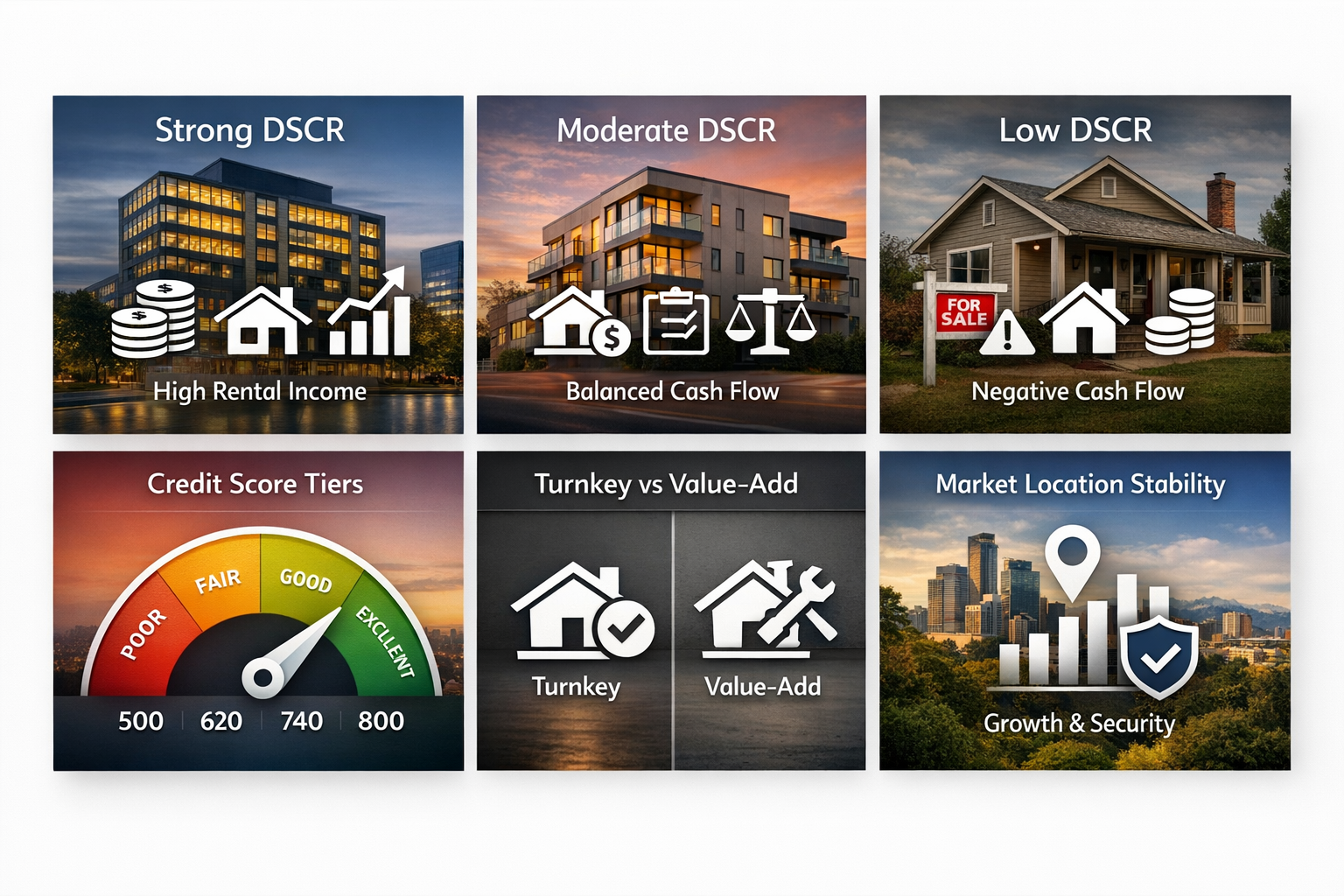
Strong DSCR (1.25 or higher): Properties generating rental income well above the monthly mortgage payment may qualify for down payments at the lower end of the spectrum, sometimes as low as 20%. Lenders gain confidence from the healthy income cushion, which reduces default probability and justifies higher loan-to-value ratios.
Moderate DSCR (1.0 to 1.24): Properties with break-even or slightly positive cash flow typically require 25% down. While the rental income covers the debt, the thinner margin prompts lenders to seek more borrower equity as a risk buffer.
Low DSCR (below 1.0): Some lenders accept DSCR ratios as low as 0.75, particularly in appreciating markets or for value-add projects. However, these scenarios almost always require higher down payments, often 25-30%, to compensate for the negative or marginal cash flow during the initial holding period.
Understanding this relationship allows you to strategically target properties that align with your available capital. If you're working with limited cash reserves, focusing on stabilized assets with strong rental histories can help you access lower down payment thresholds. On the other hand, if you're pursuing a property with upside potential but current underperformance, expect to bring more equity to the table upfront.
The DSCR also interacts with other variables like credit score and property condition. A borrower with a 750 credit score and a property showing a 1.3 DSCR might negotiate terms more favorable than someone with a 680 score and a 1.1 DSCR, even on similar properties. This interconnected web of factors makes it worthwhile to optimize every component of your borrower profile before applying for financing.
Credit Score and Property Condition Effects
Credit score and property condition effects play significant supporting roles in determining final down payment requirements for small multifamily DSCR loans. While the DSCR itself is the headline metric, lenders assess overall risk by looking at borrower creditworthiness and the physical state of the collateral.
Credit score tiers: Borrowers with credit scores above 720 often secure the most favorable terms, including down payments at the lower end of the range. Mid-tier scores in the 680-719 band may face standard requirements, while scores below 680 could trigger higher equity demands or additional reserve stipulations.
Turnkey versus value-add properties: Properties in excellent condition with updated systems, stable tenant rosters, and minimal deferred maintenance tend to support lower down payments. Value-add opportunities requiring rehab or lease-up typically require higher equity, as lenders account for execution risk and the time lag before stabilized cash flow resumes.
Market location stability: Properties in strong, diversified rental markets with low vacancy rates may benefit from slightly more lenient down payment terms compared to assets in economically volatile or oversupplied submarkets, even if the unit count and DSCR are identical.
These factors underscore the importance of presenting a complete, polished loan package. Improving your credit score by even 20-30 points before applying can shift your terms noticeably. Similarly, purchasing a property that's already generating stable income and requires minimal capital expenditure reduces lender concern, often translating into better leverage.
Investors sometimes overlook the property condition angle, focusing exclusively on price and cash flow. Yet a duplex needing a new roof and HVAC replacement will face more conservative underwriting than a comparable unit with recent upgrades. If you're evaluating multiple deals, factoring in these softer variables alongside the headline DSCR can help you choose the acquisition that optimizes both returns and financing terms.
Step-by-Step Capital Planning for Your Next Acquisition
Step-by-step capital planning for your next acquisition ensures you're prepared for the full financial commitment before making an offer. DSCR loans simplify income documentation, but they don't eliminate the need for disciplined upfront capital forecasting.
Estimate your down payment: Start by identifying the unit count and expected purchase price. Apply the appropriate down payment percentage (20-30%) based on the property type and your preliminary DSCR estimate. For example, a $500,000 triplex at 25% down requires $125,000 in equity.
Calculate closing costs: Budget an additional 2-4% of the purchase price for origination fees, title insurance, appraisal, and other closing expenses. On a $500,000 deal, that's $10,000 to $20,000 on top of your down payment.
Set aside cash reserves: Many DSCR lenders require 6-12 months of principal, interest, taxes, and insurance (PITI) held in reserve after closing. On a property with $3,000 monthly PITI, you'd need $18,000 to $36,000 in liquid reserves, separate from your down payment and closing costs.
Plan for immediate capital expenditures: Even turnkey properties sometimes need minor repairs or tenant turnover costs shortly after acquisition. Allocate a contingency fund equal to 5-10% of the purchase price to handle unexpected expenses during the first few months of ownership.
Model multiple scenarios: Run projections with different down payment percentages and DSCR assumptions. Understanding how a 20% versus 25% down payment affects your cash-on-cash return and reserve requirements helps you make informed trade-offs between leverage and liquidity.
This methodical approach prevents capital shortfalls that can derail closings or strain your financial position post-acquisition. Many investors focus solely on the down payment figure without accounting for reserves and closing costs, leading to unpleasant surprises at the closing table. By mapping out every dollar required upfront, you can confidently pursue deals that fit within your liquidity constraints.
Additionally, clear capital planning improves your credibility with lenders. Demonstrating that you've accounted for all cash requirements signals experience and reduces underwriting friction. Lenders appreciate borrowers who arrive with complete financial pictures, and that goodwill can translate into smoother approvals and faster closings.
Maximizing Leverage While Meeting Equity Requirements
Maximizing leverage while meeting equity requirements is the central balancing act in small multifamily investment property financing. Higher leverage amplifies returns when deals perform well, but it also requires navigating LTV limits and down payment floors imposed by lenders.
Optimize your DSCR before applying: Increase rental income or reduce operating expenses to boost the DSCR ratio. Simple improvements like raising below-market rents, reducing vacancy through better marketing, or negotiating lower property insurance premiums can push your ratio higher and unlock better loan terms.
Improve your credit profile: Pay down revolving balances, correct any reporting errors, and avoid new credit inquiries in the months leading up to your loan application. Even modest credit score improvements can shift you into a more favorable pricing tier with lower down payment expectations.
Consider cross-collateralization or portfolio financing: If you own multiple properties, some lenders offer portfolio-level DSCR products that evaluate your overall rental income and debt obligations. Strong performance across your portfolio might offset weaker metrics on a single acquisition, allowing for higher leverage on the new deal.
Negotiate based on property strength: Properties with long-term leases in place, recent capital improvements, or located in high-demand submarkets give you negotiating leverage. Present a thorough rent roll, maintenance records, and market comparables to demonstrate lower risk and justify a lower down payment request.
Evaluate alternative lender programs: Different lenders have varying appetites for risk and different program guidelines. Shopping multiple DSCR lenders can reveal opportunities for 20% down instead of 25%, or 25% instead of 30%, depending on each institution's current portfolio goals and underwriting standards.
These strategies require preparation and sometimes patience, but the payoff is meaningful. Reducing your down payment from 30% to 25% on a $600,000 fourplex frees up $30,000 in capital, enough to fund another down payment on a smaller property or cover unexpected expenses across your portfolio. The compounding effect of better leverage across multiple deals accelerates portfolio growth significantly over time.
Remember that maximizing leverage isn't about taking on excessive risk. It's about efficiently deploying your capital to generate the highest risk-adjusted returns. If a property's fundamentals justify lower equity, pursuing that structure makes financial sense. Conversely, accepting a higher down payment on a marginal deal just to close a transaction can tie up capital that would perform better elsewhere.
Navigating dscr loan down payment requirements for 2-4 unit properties demands a clear grasp of how unit count, DSCR ratios, credit scores, and property conditions intersect to shape lender expectations. While standard benchmarks place most investors in the 20-30% down payment range, the exact figure is rarely fixed. Strong rental performance, solid credit, and well-maintained properties create room to negotiate toward the lower end of that spectrum, freeing up capital for additional acquisitions or reserves.
Effective capital planning goes beyond calculating the down payment itself. Factoring in closing costs, reserve requirements, and immediate capital expenditures ensures you're financially prepared for every phase of the transaction. Investors who model multiple scenarios and optimize their borrower profiles before applying consistently secure better terms and execute deals more smoothly.
The small multifamily space offers compelling opportunities for scaling rental portfolios, and DSCR financing removes many of the documentation barriers that slow traditional mortgage processes. By understanding how down payment requirements work and strategically positioning your deals to meet lender criteria, you can deploy capital more efficiently and build a resilient, cash-flowing portfolio. If you're ready to explore financing options tailored to your next duplex, triplex, or fourplex acquisition, get a personalized DSCR loan quote and see how your property stacks up.