Every real estate investor knows that time is money. When you're competing for rental properties or trying to expand your portfolio, a delayed loan closing can mean losing the deal to a faster competitor. Understanding the dscr loan closing timeline and document checklist helps you move through the approval process efficiently, close deals on schedule, and avoid costly surprises.
Unlike traditional mortgage products designed for owner-occupied homes, DSCR loans focus on the property's cash flow rather than your personal income. This shift in underwriting creates a different documentation path and timeline. Most lenders typically complete DSCR loan closings within 21 to 45 days, though the actual duration depends heavily on how prepared you are from day one.
This guide breaks down each phase of the DSCR loan process, the exact documents you'll need to gather, and practical strategies to accelerate approval. Whether you're buying your first rental or refinancing property number ten, knowing what to expect keeps your investment strategy on track.
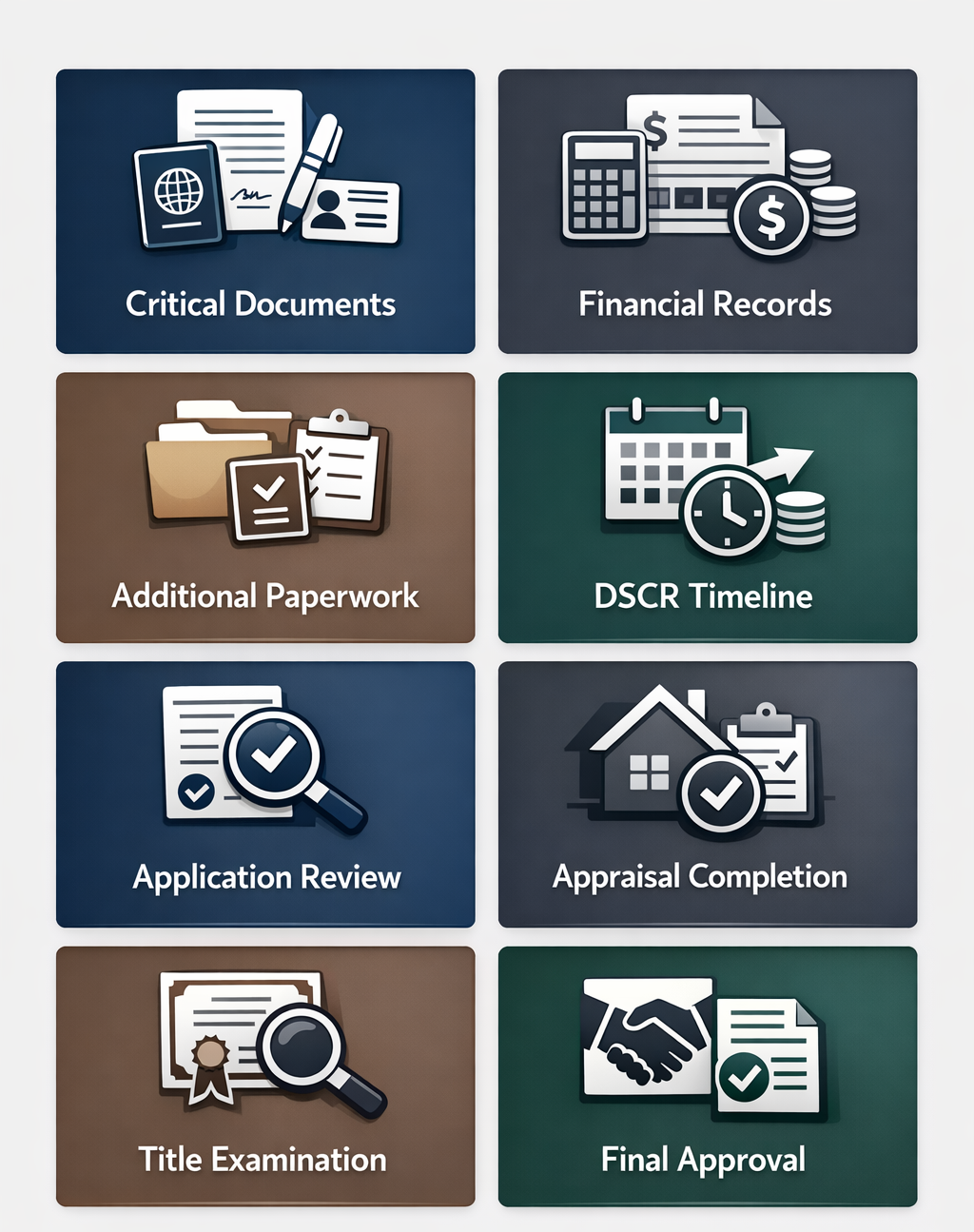
Critical Documents Every Investor Must Prepare
Critical documents every investor must prepare form the foundation of a smooth DSCR loan application. Missing even one item from this checklist can stall your approval and push back your closing date. Lenders need these materials to verify your identity, assess creditworthiness, and confirm you have sufficient reserves to handle the investment.
Government-issued identification: A valid driver's license or passport proves your identity and satisfies federal lending requirements. Make sure the document hasn't expired and matches the name on your application exactly.
Credit authorization form: Signing this document allows the lender to pull your credit report and review your borrowing history. Lenders use this information to determine your rate and loan terms, even though DSCR loans don't rely on income verification.
Bank statements showing cash reserves: You'll typically need to provide statements from the past two to three months that demonstrate you have enough funds to cover the down payment, closing costs, and several months of property reserves. These reserves reassure lenders that you can weather vacancy periods or unexpected repairs.
Proof of entity formation (if applicable): If you're purchasing the property through an LLC or other business entity, provide the articles of organization, operating agreement, and any amendments. This documentation confirms the legal structure holding title to the property.
Having these documents organized and ready at the time of application can shorten the lender's initial review period significantly. Some lenders may issue a term sheet within 24 to 48 hours when they receive a complete package upfront, allowing you to move quickly into the next phases of underwriting and appraisal.
Required Financial Records and Property Information
Required financial records and property information help the lender calculate your debt service coverage ratio and confirm the asset's income potential. Because DSCR loans are underwritten based on the property's performance rather than your W-2 or tax returns, these documents take center stage in the approval process.
Current lease agreements: If the property is already rented, provide signed lease contracts that show the monthly rent amount, lease term, and tenant names. This documentation proves the property generates the income you've claimed.
Rent roll or market rent analysis: For vacant properties or new acquisitions, lenders often accept a market rent analysis or third-party appraisal estimate to determine expected rental income. This figure feeds directly into the DSCR calculation.
Property tax records and insurance quotes: Lenders need to know the full monthly carrying cost, including taxes, insurance, HOA fees, and estimated maintenance. Gathering recent tax bills and insurance quotes ensures accurate DSCR modeling.
Purchase contract or existing mortgage statement: If you're buying, submit the executed purchase agreement. For refinances, provide your current mortgage statement showing the loan balance, interest rate, and monthly payment. This helps the lender structure the new loan appropriately.
Submitting thorough property documentation accelerates underwriting because the analyst can calculate your DSCR without waiting for clarifications or follow-up requests. A DSCR above 1.0 means the rental income exceeds the debt payment, which is the baseline most lenders require, though many prefer ratios closer to 1.25 for better terms.
Additional Paperwork to Expedite the Process
Additional paperwork to expedite the process might not be mandatory at every lender, but submitting these items early can prevent delays and demonstrate your professionalism as an investor. Think of this as the extra layer that separates a 45-day close from a 21-day close.
Detailed deal summary or investment memo: A one-page summary outlining the purchase price, estimated rents, anticipated expenses, and your planned down payment gives the lender immediate context. This proactive approach can help you receive a preliminary term sheet within 24 to 48 hours, especially when working with responsive lenders.
Evidence of prior real estate experience: While not always required, a track record of successful rental property ownership can strengthen your application. Some investors include a portfolio summary or list of properties they manage to show experience and reduce perceived risk.
Pre-approval for homeowners insurance: Securing an insurance quote or even a conditional binder before you apply shows the lender you're serious and helps them finalize the monthly payment calculation faster. This step also protects you from last-minute surprises at closing if coverage is more expensive than expected.
By front-loading these optional documents, you reduce the back-and-forth communication that often stretches out the timeline. Lenders appreciate borrowers who anticipate questions and provide answers before they're asked, which can translate into faster turnaround times and smoother closings.
Phase-by-Phase Breakdown of the DSCR Loan Timeline
Understanding the phase-by-phase breakdown of the DSCR loan timeline helps you plan your acquisition strategy and manage expectations with sellers, especially in competitive markets where closing speed matters. The typical DSCR loan closing window spans 21 to 45 days, divided into distinct stages that each play a critical role.
Application and initial review (1 to 3 days): You submit your loan application along with the core documents outlined earlier. The lender performs a preliminary credit check, reviews your reserves, and evaluates the property details. If everything looks solid, they issue a term sheet outlining the proposed rate, loan-to-value ratio, and estimated closing costs.
Appraisal ordering and completion (7 to 14 days): Once you accept the term sheet, the lender orders an appraisal to confirm the property's market value and rental income potential. Appraisal turnaround times vary by market and season, but ordering this step immediately after the term sheet can shave days off your timeline.
Title examination and insurance (7 to 10 days): Concurrently with the appraisal, the title company searches public records to ensure there are no liens, judgments, or ownership disputes. Any issues discovered here must be resolved before closing, so early identification is crucial.
Underwriting and conditional approval (5 to 10 days): The underwriter reviews the appraisal, title report, and all submitted documents to verify that the loan meets investor guidelines. They may request additional documentation or clarification during this phase, which is why complete upfront submissions speed things up.
Final approval and closing preparation (3 to 7 days): Once all conditions are cleared, the lender issues a clear-to-close, and the closing agent prepares the final settlement statement. You'll review closing figures, wire funds, and schedule a signing appointment. After signing, the deed and mortgage are recorded, and you officially own the property.
Each phase depends on the one before it, so delays early in the process cascade forward. Investors who treat the dscr loan closing timeline as a relay race, where every handoff must be clean, tend to close faster and with fewer headaches.
Fast Approval Steps for Real Estate Investor Financing
Fast approval steps for real estate investor financing revolve around preparation, communication, and choosing the right lending partner. While the DSCR loan process follows a standard sequence, strategic actions on your part can compress the timeline and give you a competitive edge in tight markets.
Pre-assemble your document package before shopping properties: Don't wait until you're under contract to gather bank statements and LLC paperwork. Keep a current file ready so you can submit a complete application within hours of finding a deal.
Submit a comprehensive deal summary with your initial inquiry: Including property details, expected rents, and a brief investment thesis helps lenders issue term sheets faster, sometimes within 24 to 48 hours. This upfront clarity reduces the need for multiple rounds of questions.
Respond immediately to underwriter requests: Underwriting is often the longest phase, but it stretches even further when borrowers take days to reply to conditions. Set aside time to handle lender requests the same day they arrive.
Coordinate with your title company and appraiser: Stay in touch with these third parties to ensure they're moving on schedule. A quick phone call to confirm the appraiser has property access or the title company has received necessary documents can prevent silent delays.
Work with lenders experienced in investor loans: Not all lenders understand DSCR products equally well. Choosing a lender who specializes in rental property financing means fewer surprises, clearer timelines, and staff who know how to move quickly through the process.
Speed matters in real estate investing, but accuracy matters more. Rushing through documentation or skipping steps can lead to last-minute problems that blow up your closing date. The goal is to move fast without cutting corners, and that balance comes from experience and discipline.
Key Takeaway for Investors
The dscr loan closing timeline and document checklist aren't obstacles to overcome but tools to master. When you approach the process with the same diligence you apply to property underwriting, you turn what could be a stressful waiting period into a predictable, manageable sequence of steps. Real estate investors who consistently close deals on time share a common trait: they prepare in advance, communicate proactively, and treat their lender as a partner in the transaction.
Every day you save in the closing process is a day you can start generating rental income or moving on to the next acquisition. By assembling the right documents, understanding each phase of the timeline, and implementing fast approval strategies, you position yourself to act decisively when opportunities arise. In a competitive investment landscape, that speed and reliability can be the difference between building wealth and watching deals slip away.
Mastering the DSCR loan closing process takes practice, but the payoff is substantial. When you know exactly which documents to gather, how long each phase typically takes, and where you can accelerate the timeline, you gain control over one of the most critical variables in real estate investing: timing. The research shows that prepared investors who submit complete applications can move from term sheet to closing in as little as three weeks, while those who scramble for paperwork may stretch the process beyond six weeks.
Your next step is simple. Review your current document files, identify any gaps, and build a master checklist you can reuse for every future acquisition or refinance. If you're ready to explore DSCR financing for your next rental property investment, get a personalized DSCR loan quote and see how quickly you can move from application to closing with the right preparation in place.