Can You Use Airbnb Revenue for DSCR Qualification?
August 18, 2026
•
9 min read
Can You Use Airbnb Revenue for DSCR Qualification?
Real estate investors exploring short-term rental properties often wonder whether platforms like Airbnb and VRBO generate income that qualifies for DSCR financing. The short answer is yes, but the process involves specific documentation and underwriting standards that differ from traditional long-term rental scenarios. Understanding how lenders evaluate short-term rental cash flow can make the difference between securing competitive financing or missing out on lucrative investment opportunities.
DSCR loans are designed specifically for real estate investors who want their properties to qualify based on rental income rather than personal tax returns or W-2 income. For short-term rental investors, this approach opens doors that conventional mortgage products typically keep closed. Yet many investors hesitate because they're unsure whether projected or actual Airbnb revenue will meet lender criteria.
This guide breaks down exactly how you can use Airbnb revenue for DSCR qualification, what documentation lenders require, and how to structure your financing strategy to maximize approval odds and investment returns. Whether you're acquiring your first short-term rental or expanding an existing portfolio, knowing the ins and outs of short-term rental cash flow underwriting criteria will position you ahead of the competition.
How DSCR Loans Evaluate Short-Term Rental Income
How DSCR loans evaluate short-term rental income starts with understanding the fundamental calculation. The debt service coverage ratio compares the property's monthly rental income to its monthly debt obligations, including principal, interest, taxes, insurance, and HOA fees if applicable. A ratio of 1.0 means the property exactly breaks even, while anything above 1.0 indicates positive cash flow. Most lenders prefer to see ratios between 1.0 and 1.25 for approval, though some programs accept ratios as low as 0.75 for strong borrowers willing to cross-collateralize or make larger down payments.
The key difference for Airbnb properties lies in how lenders calculate that monthly rental income figure. Traditional long-term rentals use signed lease agreements showing fixed monthly rent. Short-term rentals generate variable income based on occupancy rates, seasonal demand, nightly rates, and local market conditions. Lenders have adapted their underwriting to accommodate this variability through two primary methods: historical income analysis and projected income models.
When you use actual Airbnb revenue, lenders typically request 12 to 24 months of documented rental history from the platform. This data includes booking calendars, payout statements, and sometimes tax returns if you've owned the property for multiple years. The lender calculates an average monthly income figure, often applying a vacancy factor or discount to account for fluctuations. This method works well for investors refinancing existing short-term rentals or purchasing properties with established rental histories under previous ownership.
Projected income models come into play when you're acquiring a property without prior short-term rental history or converting a long-term rental to Airbnb use. Lenders who accept projected income will use third-party appraisals or rent surveys that analyze comparable short-term rentals in the same market. The appraiser examines similar properties' nightly rates, occupancy percentages, and gross annual income to estimate what your property could reasonably generate. This approach allows investors to move quickly on new acquisitions without waiting years to build rental history.
Documentation Requirements for Airbnb DSCR Qualification
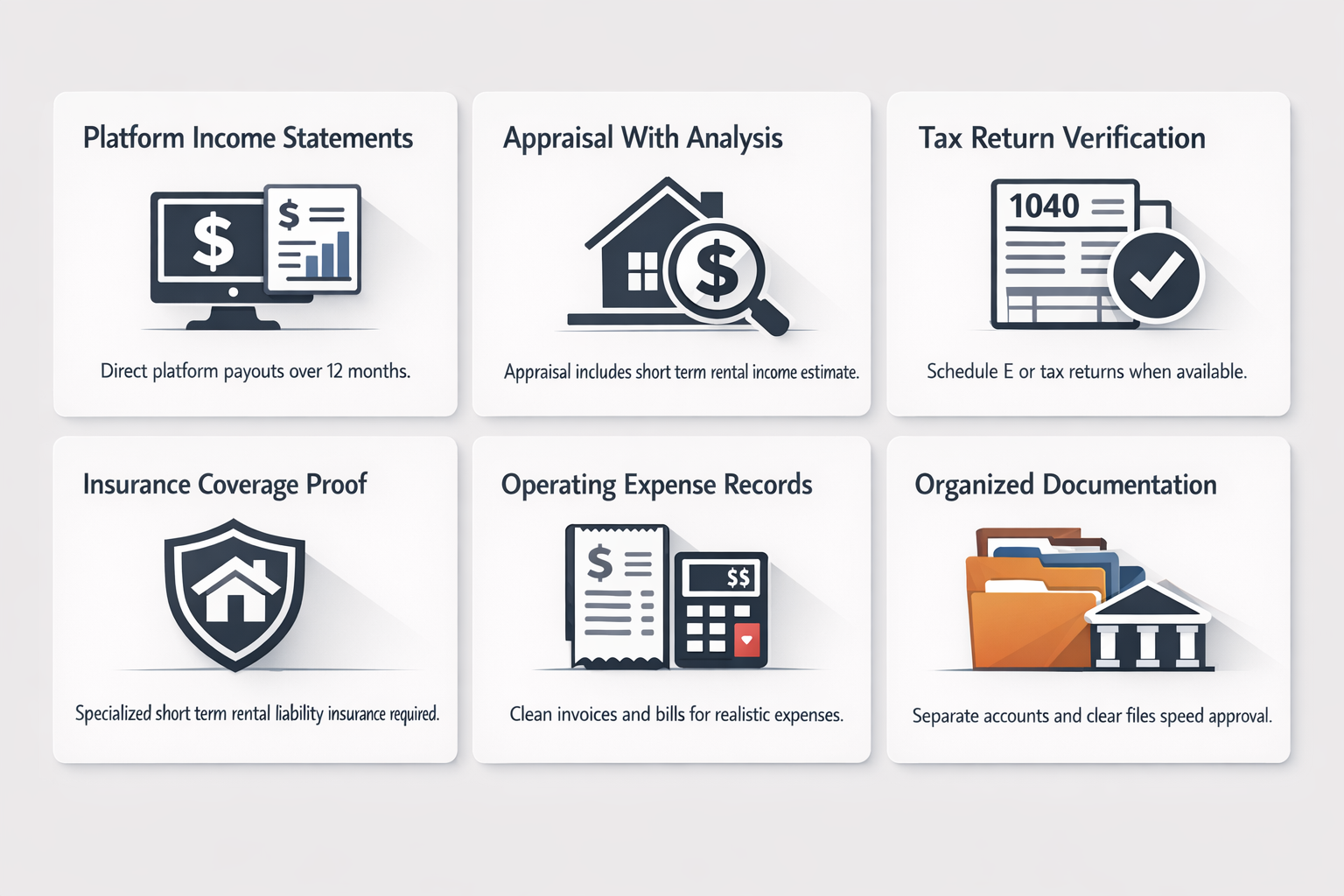
Documentation requirements for Airbnb DSCR qualification vary by lender and whether you're using actual or projected income. Getting your paperwork organized before applying speeds up the process and demonstrates professionalism to underwriters. Here's what lenders typically require when evaluating short-term rental properties:
Platform income statements: Most lenders want direct exports from Airbnb or VRBO showing gross bookings, fees, and net payouts over 12 to 24 months. These statements verify actual performance and help underwriters calculate average monthly income. Some lenders also accept bank statements showing consistent platform deposits, though direct platform reports carry more weight.
Appraisal with rental income analysis: For properties without established history or when using projected income, you'll need an appraisal that includes a short-term rental income analysis. The appraiser researches comparable properties in your market, examines their booking rates and occupancy, then estimates realistic income for your subject property based on location, amenities, and seasonal trends.
Tax returns for established properties: If you've owned and operated the short-term rental for one or more years, lenders may request Schedule E from your tax returns to verify reported rental income. This requirement depends on the lender and loan program, but having clean tax documentation strengthens your application even when it's not mandatory.
Property and casualty insurance: Short-term rentals require specialized insurance coverage that accounts for higher turnover and guest liability. Lenders will verify you have appropriate coverage in place or require proof of coverage at closing. This protects both you and the lender from gaps that standard landlord policies might not cover.
Beyond these core documents, some lenders request operating expense documentation to verify your DSCR calculation accounts for realistic costs. This might include utility bills, cleaning service invoices, property management fees, and maintenance records. Investors who track expenses meticulously through property management software or detailed spreadsheets often move through underwriting faster because they can quickly provide whatever additional documentation underwriters request.
Projected Income vs. Actual Income: Which Path Works Better?
Projected income versus actual income presents different advantages depending on your investment strategy and property situation. Neither approach is universally superior, but understanding when each makes sense helps you structure deals more effectively and choose lenders whose programs align with your needs.
Actual income qualification works best when you're refinancing an existing short-term rental you've operated for at least a year or purchasing a property with documented rental history under the current owner. The income is verifiable through platform statements and tax returns, which gives underwriters confidence and may result in better loan terms. Lenders generally view actual performance as lower risk than projections because there's no guessing about market reception, occupancy rates, or your ability to manage the property effectively.
The challenge with actual income is it requires patience. If you're buying a property that's never been rented short-term or hasn't been on the market long enough to generate meaningful data, you can't use this method. You'd need to operate the property for 12 to 24 months, then refinance using actual income, which delays leveraging your equity and potentially misses market timing opportunities. For investors focused on rapid portfolio growth, waiting that long isn't practical.
Projected income opens the door for immediate financing on new acquisitions, conversions from long-term to short-term use, or properties you're confident will perform well based on market analysis. The flexibility to finance based on projected performance means you can move on deals quickly, capitalize on market opportunities, and start generating returns without the waiting period. This method particularly benefits experienced investors who understand their markets deeply and can identify properties likely to exceed projected income once operational.
The trade-off with projected income is that lenders might apply more conservative estimates than your optimistic projections, especially in markets where they lack experience or during uncertain economic conditions. Interest rates on projected income deals might also run slightly higher to compensate for increased perceived risk. However, the ability to acquire properties immediately and begin building actual income history often outweighs these costs for active investors building portfolios.
Interest Rates and Terms for Airbnb DSCR Loans
Interest rates and terms for Airbnb DSCR loans reflect current market conditions and lender risk assessment. Here's what investors should expect when financing short-term rental properties in the current environment:
Understand current rate ranges: Based on recent market data, DSCR loans for Airbnb properties typically range from 7.75% to 9.25% depending on credit profile, down payment, property location, and whether you're using actual or projected income. These rates reflect the non-QM nature of DSCR products and the specialized underwriting required for short-term rentals. Investors with stronger credit scores, larger down payments, and properties in established short-term rental markets tend to secure rates at the lower end of this range.
Consider loan terms and structure: Most DSCR loans for short-term rentals come with 30-year amortization schedules, though the loan itself might have a fixed rate period of five, seven, or ten years before adjusting. Some lenders offer interest-only payment options for the first few years, which can improve cash flow during the critical early period when you're establishing the rental and building reserves. Understanding whether you want fixed-rate stability or interest-only flexibility helps you compare programs effectively.
Evaluate prepayment penalties: Many DSCR loan programs include prepayment penalties, especially during the first three to five years. These penalties protect lenders who've priced loans expecting to hold them for a certain period. If you plan to refinance quickly once you've established actual income history or if you flip properties frequently, understanding prepayment structures is critical. Some lenders offer step-down penalties that decrease each year, while others charge flat percentages of the outstanding balance.
Beyond interest rates, investors should compare total loan costs including origination fees, discount points, and third-party expenses like appraisals and title insurance. A loan with a slightly higher rate but lower upfront costs might pencil out better than a low-rate option with significant points, especially if you plan to refinance within a few years once you've built actual income history.
Strategic Considerations When Using Airbnb Revenue for DSCR Qualification
Strategic considerations when using Airbnb revenue for DSCR qualification go beyond simply meeting minimum lender requirements. Smart investors structure their financing to maximize flexibility, preserve capital, and position themselves for long-term portfolio growth. Here are the key strategic factors to evaluate:
Optimize your DSCR ratio: While many lenders accept DSCR ratios as low as 0.75 or 1.0, shooting for ratios between 1.15 and 1.30 gives you breathing room for market fluctuations, unexpected expenses, and seasonal slowdowns. Higher ratios also qualify you for better interest rates and terms on future deals. When analyzing potential acquisitions, run scenarios with conservative occupancy estimates rather than peak season projections to ensure the property can sustain debt service year-round.
Build relationships with specialized lenders: Not all mortgage lenders understand short-term rental markets or feel comfortable with projected income models. Working with lenders who specialize in DSCR products for investors and have specific Airbnb loan programs streamlines approvals and often results in more flexible underwriting. These lenders understand seasonal fluctuations, market-specific occupancy trends, and how to evaluate short-term rental potential, which means they're more likely to approve deals that conventional lenders would decline.
Plan your documentation strategy early: If you're operating short-term rentals now or planning to start, implement systems that generate clean documentation from day one. Use dedicated bank accounts for each property, maintain detailed expense records through property management software, and keep platform statements organized by year. When you're ready to refinance or acquire additional properties, having professional documentation ready accelerates approvals and demonstrates operational competence to underwriters.
Consider market timing and regulatory risk: Short-term rental regulations vary significantly by market and can change quickly as local governments respond to housing concerns. Before financing a property primarily for Airbnb use, research local regulations, licensing requirements, and any pending legislation that might restrict short-term rentals. Lenders in markets with clear, established short-term rental frameworks often offer better terms than those in jurisdictions where regulations are uncertain or hostile to short-term rentals.
These strategic considerations work together to create a financing approach that supports your broader investment goals rather than simply securing one-off deals. Investors who think several moves ahead tend to build portfolios faster and weather market cycles better than those who approach each property in isolation.
Can you use Airbnb revenue for DSCR qualification? Absolutely, and many real estate investors have built substantial short-term rental portfolios using exactly this approach. The key is understanding how lenders evaluate short-term rental income, whether through documented historical performance or projected income models based on market comparables. Both paths offer viable routes to financing, and the right choice depends on your specific property, market conditions, and investment timeline.
Short-term rental cash flow underwriting criteria continue to evolve as more lenders recognize the income potential of well-managed Airbnb properties. Investors who stay informed about documentation requirements, current interest rate ranges, and strategic financing considerations position themselves to move quickly on opportunities while avoiding common pitfalls that slow down or derail less-prepared buyers.
Success with DSCR financing for short-term rentals comes down to preparation, realistic projections, and working with lenders who understand investor needs. Whether you're acquiring your first property or expanding an existing portfolio, taking time to structure your financing strategically pays dividends through better terms, faster closings, and the flexibility to scale your investments as markets shift. If you're ready to explore financing options for your next short-term rental investment, get a personalized DSCR loan quote and discover how investor-focused financing can accelerate your portfolio growth.