Real estate investors face a constant balancing act between growth and risk. Every new rental property adds potential cash flow, but it also introduces exposure. When financing investment properties, one of the most critical questions revolves around liability: if a deal goes south, how much of your personal wealth is on the line?
That's where non-recourse DSCR loans come into play. Unlike traditional mortgages that tie your personal credit and assets to the loan, a non-recourse DSCR loan limits the lender's recovery to the collateral property itself. For investors building portfolios across multiple properties, this structure can be a game changer. It separates personal finances from business ventures, shields other assets from default fallout, and allows for more aggressive scaling without exposing everything you own.
Understanding what is a non-recourse DSCR loan, how it works, and when it makes sense is essential for any serious investor. This guide breaks down the mechanics, benefits, and trade-offs so you can make informed decisions about your next rental property acquisition.
How Non-Recourse DSCR Loans Protect Your Personal Assets
Non-recourse financing fundamentally changes the risk equation for real estate investors. With traditional recourse loans, if the property value drops and foreclosure doesn't cover the outstanding balance, the lender can pursue your personal bank accounts, other properties, wages, and assets to recover the shortfall. That means your primary residence, business holdings, and savings could all be at risk.
A non-recourse DSCR loan eliminates that personal exposure. The lender's sole remedy in the event of default is to foreclose on the collateral property itself. Once the property is sold, the lender has no legal claim against your other assets, regardless of whether the sale price covers the full loan amount.
Here's what non-recourse protection typically includes:
No personal guarantee required: You don't pledge your individual creditworthiness or sign a personal guarantee, so your Social Security number and personal credit history aren't directly tied to the loan performance.
Liability limited to the property: If the rental property fails to generate sufficient income or the market declines, the lender can only take back the property, not your other investments or personal accounts.
Portfolio insulation: When you own multiple rental properties, a default on one non-recourse loan won't automatically trigger claims against your other holdings, helping you compartmentalize risk across your portfolio.
Bankruptcy protection considerations: In many cases, non-recourse debt is treated differently in bankruptcy proceedings, potentially offering additional strategic advantages if your broader financial situation becomes challenging.
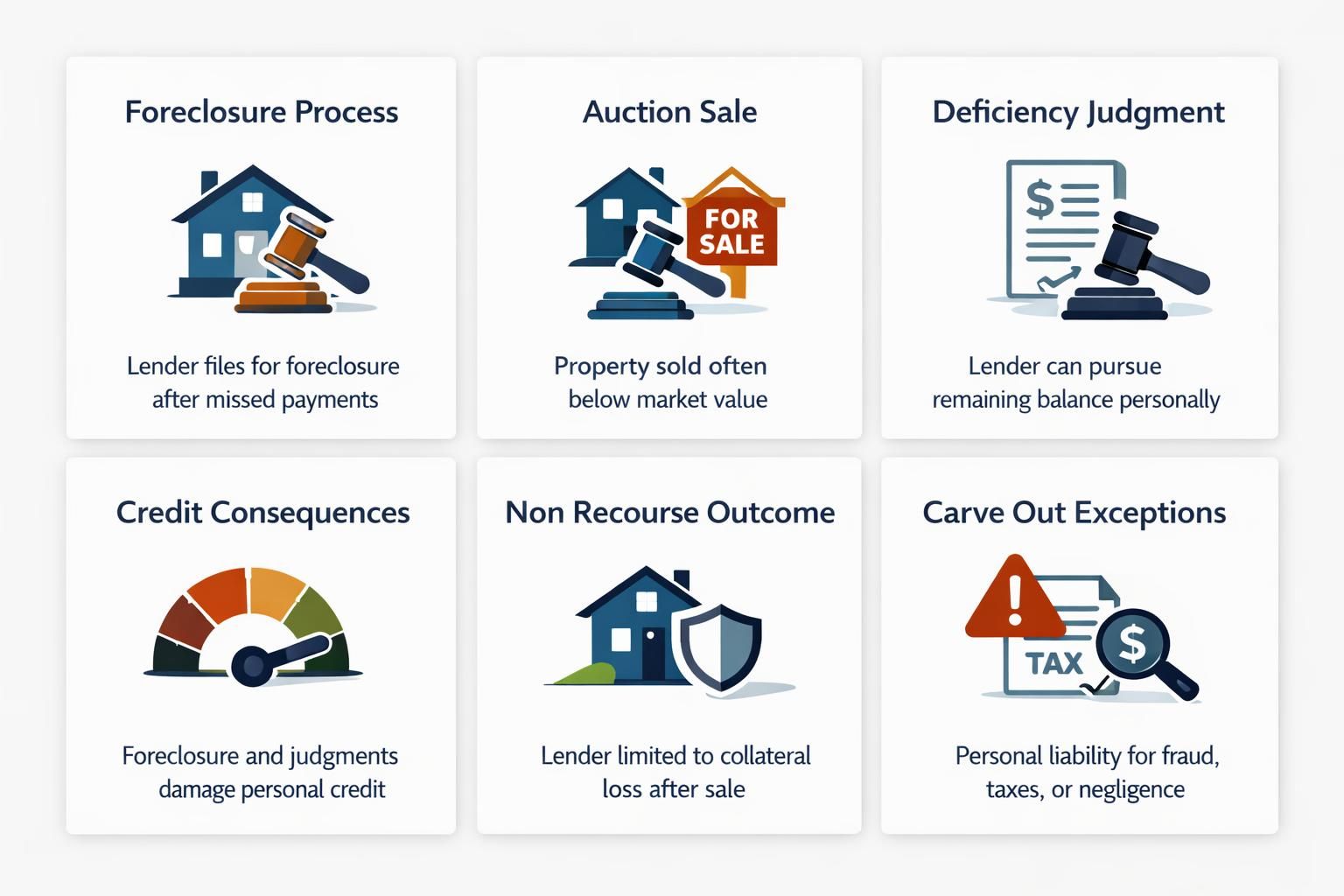
It's important to note that non-recourse protections usually come with carve-outs. Lenders typically reserve the right to pursue personal liability in cases of fraud, environmental violations, unpaid property taxes, or gross negligence. These exceptions are designed to prevent borrowers from intentionally mismanaging properties or committing wrongdoing while hiding behind non-recourse status.
For investors who plan to scale quickly, non-recourse DSCR loans offer a critical layer of protection. They allow you to take calculated risks on individual properties without betting your entire net worth on every deal.
Understanding DSCR Underwriting and Loan Structure
DSCR stands for Debt Service Coverage Ratio, a metric that measures a rental property's ability to cover its own mortgage payments from rental income alone. This ratio is the cornerstone of DSCR loan underwriting and replaces the traditional focus on personal income, tax returns, and employment verification.
The calculation itself is straightforward: divide the property's monthly rental income by its monthly debt obligations. For example, if a rental property generates four thousand dollars per month in rent and the mortgage payment is three thousand dollars, the DSCR is 1.33. Most lenders require a minimum DSCR of 1.0 to 1.25, meaning the property must generate enough income to cover its debt service with some margin for vacancy, maintenance, and unexpected costs.
DSCR loans differ from conventional mortgages in several key ways:
Income documentation is simplified: Instead of W-2s, pay stubs, and tax returns, lenders rely on a lease agreement or market rent analysis to determine the property's income potential.
No personal income verification: Your salary, business income, or other personal earnings are generally not part of the underwriting equation, making DSCR loans ideal for self-employed investors or those with complex tax situations.
Property performance drives approval: The focus shifts entirely to the asset itself, meaning strong rental markets and cash-flowing properties are more important than your debt-to-income ratio.
Flexible borrower profiles: Investors who might struggle to qualify for traditional loans due to multiple mortgages, high personal debt, or non-traditional income sources often find DSCR underwriting more accessible.
When combined with non-recourse terms, DSCR loans become even more attractive. The underwriting is based on the property's performance, and your liability is limited to that same property. This alignment creates a clean risk profile where the investment stands or falls on its own merits, not on your personal financial situation.
Interest rates for DSCR loans typically fall within a range that reflects the property-based risk model. Trulo Mortgage's DSCR loan rates currently range from 6.25% to 8.00%, depending on factors like credit score, loan-to-value ratio, property type, and overall borrower profile. Investors with strong credit and lower leverage can often secure rates at the lower end of that spectrum.
What Is a Non-Recourse DSCR Loan and When It Makes Sense
At its core, a non-recourse DSCR loan is a financing tool designed specifically for real estate investors who want to grow their rental portfolios without putting their personal assets at risk. It combines two powerful features: underwriting based on property cash flow rather than personal income, and liability limited to the collateral property itself.
This dual structure makes non-recourse DSCR loans particularly well-suited for certain investor profiles and scenarios:
Experienced investors scaling portfolios: If you already own multiple rental properties and want to continue acquiring without cross-collateralizing or exposing your existing assets, non-recourse terms provide critical insulation between deals.
High-net-worth individuals protecting wealth: Investors with substantial personal assets often prefer non-recourse financing to keep their rental property ventures separate from their broader financial picture, reducing the risk of a single bad deal affecting their overall net worth.
Out-of-state or remote investors: When you're buying rental properties in markets far from where you live, non-recourse loans can reduce the downside risk of unfamiliar locations or management challenges you can't oversee personally.
Investors with complex income structures: Self-employed individuals, business owners with fluctuating income, or retirees who don't have traditional W-2 income often struggle with conventional mortgage qualification but can easily access DSCR loans based on rental income alone.
Non-recourse DSCR loans might not be the best fit for every situation. They typically require larger down payments than conventional loans, often 20% to 25% or more, because lenders need stronger equity cushions when they can't pursue personal assets. Investors who have limited capital or are just starting out may find the upfront costs challenging.
Additionally, interest rates on non-recourse loans may be slightly higher than recourse alternatives, reflecting the lender's increased risk. However, many investors consider the rate difference a worthwhile cost for the liability protection and underwriting flexibility these loans provide.
The decision ultimately comes down to your investment strategy, risk tolerance, and portfolio goals. If you're focused on aggressive growth, asset protection, and simplifying your financing process, non-recourse DSCR loans offer a compelling combination of benefits that traditional mortgages simply can't match.
How Personal Liability Works If a Rental Property Loan Defaults
Default scenarios reveal the true value of non-recourse protection. When a rental property fails to perform, whether due to extended vacancies, unexpected repairs, market downturns, or tenant issues, the lender has the right to take action. How personal liability works if a rental property loan defaults depends entirely on whether the loan is structured as recourse or non-recourse.
With a recourse loan, the process typically unfolds like this:
Foreclosure initiates: After several missed payments, the lender files for foreclosure and takes legal ownership of the property through a court process or trustee sale, depending on state law.
Property is sold at auction: The foreclosed property is sold, often at a discount to market value, to recover as much of the outstanding loan balance as possible.
Deficiency judgment pursued: If the sale proceeds don't cover the full loan amount plus foreclosure costs, the lender can seek a deficiency judgment against you personally, allowing them to garnish wages, freeze bank accounts, place liens on other properties, or pursue other collection actions.
Credit and financial damage: Beyond the immediate financial loss, the foreclosure and deficiency judgment severely damage your personal credit score, making future financing difficult and potentially affecting other areas of your financial life.
Non-recourse loans change the equation significantly. When a non-recourse DSCR loan defaults, the lender still forecloses on the property and sells it to recover their investment. However, once the foreclosure sale is complete, the lender's claim ends. If the sale doesn't cover the outstanding balance, the lender absorbs that loss. They cannot pursue you for the shortfall, and your other assets remain protected.
This protection does come with exceptions. Lenders typically include carve-out provisions that restore personal liability in specific circumstances, such as fraud in the loan application, intentional property damage, failure to pay property taxes or insurance, environmental law violations, or waste that diminishes the property's value. These carve-outs are designed to prevent borrowers from intentionally harming the lender's collateral position.
Understanding how personal liability works if a rental property loan defaults is essential for risk management. Non-recourse protection allows you to approach each investment as a standalone business decision, where the worst-case scenario is losing your equity in that specific property rather than jeopardizing your entire financial foundation.
Key Considerations Before Choosing Non-Recourse Financing
While non-recourse DSCR loans offer substantial benefits, they're not a one-size-fits-all solution. Before committing to this financing structure, investors should carefully weigh several important factors to ensure it aligns with their investment strategy and financial situation.
Here are the critical considerations to evaluate:
Down payment requirements: Non-recourse loans typically require 20% to 25% equity or more, which means you'll need substantial capital upfront. This higher equity requirement protects the lender when they can't pursue your other assets, but it also ties up more of your cash in each deal and may limit how many properties you can acquire simultaneously.
Interest rate premium: The rates for non-recourse DSCR loans may be slightly higher than comparable recourse products, reflecting the additional risk the lender assumes. For Trulo Mortgage, DSCR rates range from 6.25% to 8.00%, and where you fall in that range depends on your credit profile, loan-to-value ratio, and property characteristics. Calculate whether the liability protection justifies the potential rate difference over your expected holding period.
Property and market selection: Because DSCR underwriting focuses on rental income, choosing properties in strong rental markets with stable demand becomes even more critical. Properties that can consistently generate sufficient cash flow to meet the DSCR threshold will qualify more easily and perform better throughout the loan term.
Exit strategy alignment: Consider how long you plan to hold the property and whether non-recourse terms support your exit strategy. If you're planning to refinance in a few years, ensure the property's income potential will remain strong enough to qualify for future financing. If you're planning a sale, factor in the equity requirements and holding costs.
Portfolio diversification impact: Non-recourse loans allow you to isolate risk across multiple properties, but they also require more capital per deal. Evaluate whether concentrating your resources in fewer non-recourse deals or spreading capital across more recourse loans better serves your diversification and growth goals.
Investors should also consider the administrative and management implications. Non-recourse DSCR loans place greater emphasis on property performance, which means maintaining consistent rental income, keeping properties in good condition, and managing vacancies effectively become even more important. Strong property management, whether you handle it yourself or hire professionals, directly affects your ability to service the debt and protect your investment.
Finally, review the specific carve-out provisions in your loan agreement carefully. Understanding exactly which actions could restore personal liability helps you avoid unintentional violations and ensures you maintain the full benefit of non-recourse protection throughout the loan term.
Non-recourse DSCR loans represent a powerful financing tool for real estate investors who prioritize asset protection and portfolio scalability. By limiting personal liability to the collateral property and underwriting based on rental income rather than personal finances, these loans allow investors to pursue growth opportunities without exposing their entire net worth to the risks of individual deals.
Understanding what is a non-recourse DSCR loan and how it fits into your broader investment strategy is essential for making informed financing decisions. The combination of simplified underwriting, liability protection, and portfolio insulation makes non-recourse DSCR loans particularly attractive for experienced investors, high-net-worth individuals, and anyone managing multiple rental properties across different markets.
While these loans typically require larger down payments and may carry slightly higher interest rates, many investors find the trade-off worthwhile for the peace of mind and strategic flexibility they provide. Each property stands on its own financial foundation, and a single underperforming asset won't threaten your other investments or personal wealth.
If you're ready to explore how non-recourse DSCR financing can support your rental property goals, get a personalized DSCR loan quote and discover what options are available for your next investment.
Successful real estate investing requires balancing opportunity with risk management. Non-recourse DSCR loans give you the tools to do both, allowing you to scale your portfolio confidently while keeping your personal assets protected. As you evaluate your next acquisition, consider whether the combination of property-based underwriting and limited liability could be the key to unlocking your next phase of growth.