When you're evaluating rental property financing, understanding what does PITIA mean in a DSCR loan can make or break your investment strategy. PITIA stands for Principal, Interest, Taxes, Insurance, and Association dues, and it represents the total monthly housing expense used to calculate your debt service coverage ratio. Unlike traditional mortgages that focus on your personal income, DSCR loans qualify you based on whether the property's rental income covers these combined costs. For investors building portfolios without relying on W-2s or tax returns, grasping how PITIA works is essential to securing favorable terms and maximizing cash flow. Each component of PITIA directly affects your loan approval, interest rate, and long-term profitability, so knowing how lenders analyze this figure gives you a competitive edge in today's market.
Breaking Down Principal, Interest, Taxes, Insurance, and HOA
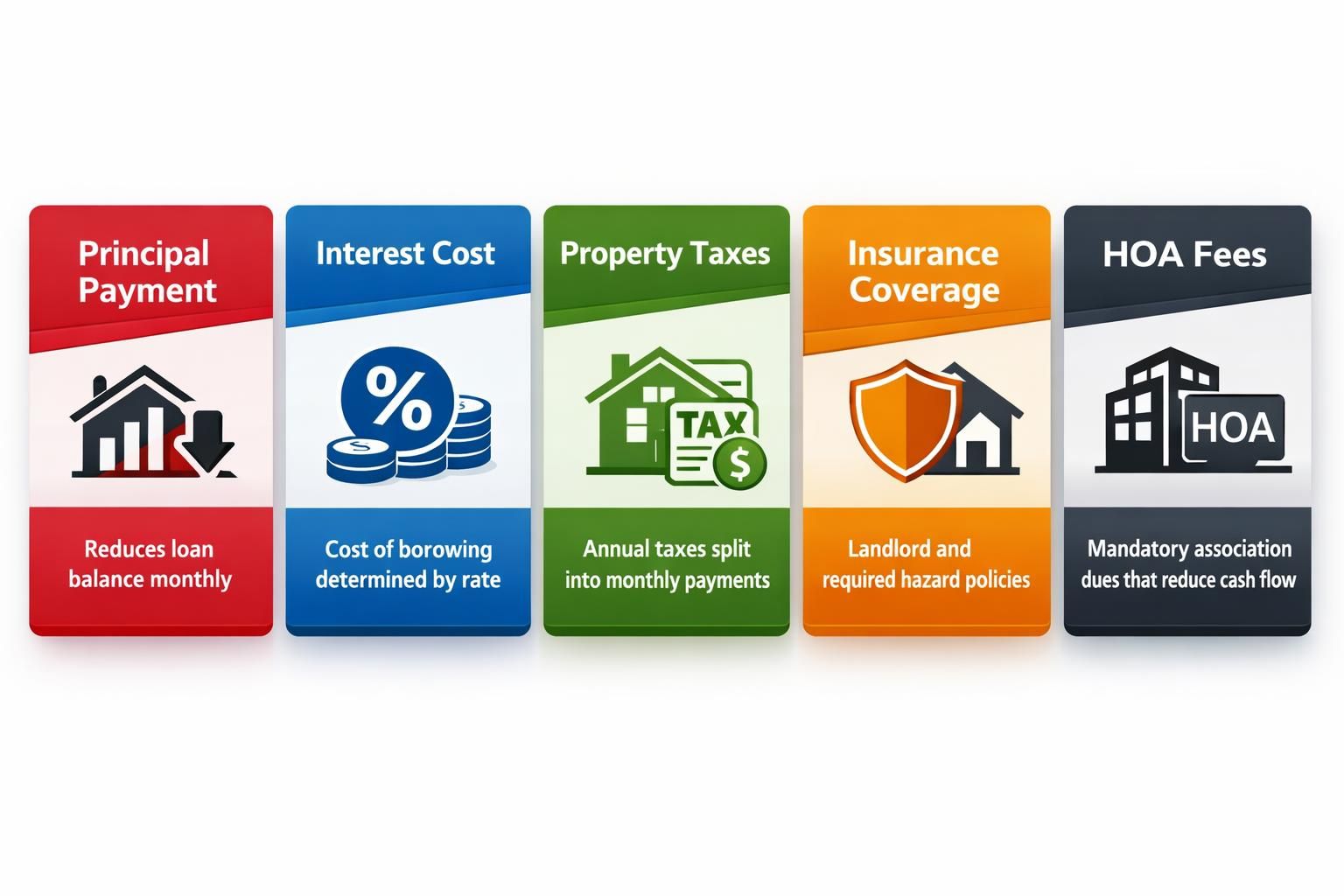
PITIA encompasses every recurring cost tied to your rental property's monthly debt obligation, and lenders scrutinize this total when determining whether your investment qualifies. Here's how each element factors into your DSCR calculation:
Principal: The portion of your monthly payment that reduces the loan balance. This is the amount you're actually paying down on the property's purchase price, building equity over time as you make payments.
Interest: The cost of borrowing, determined by your loan's interest rate. Rates vary based on credit score and loan-to-value, and this component typically represents the largest share of your early payments on a new loan.
Taxes: Annual property taxes divided into monthly installments. Lenders include this figure because it's a non-negotiable expense that must be paid regardless of rental income fluctuations, and it varies significantly by location and assessed property value.
Insurance: Homeowners or landlord insurance premiums, plus any additional coverage like flood or wind policies required by the lender. This protects both you and the lender from property damage and liability claims.
Association (HOA): Homeowners association or condo fees, if applicable. Many investors overlook this component, but in properties with mandatory HOA dues, these monthly costs can significantly impact your DSCR and overall profitability.
Together, these five components create your total monthly obligation. Lenders divide your expected rental income by this PITIA figure to arrive at your debt service coverage ratio. A higher PITIA means you need stronger rental income to achieve a qualifying DSCR, which is why understanding each piece helps you negotiate better terms and select properties that pencil out financially.
How PITIA Drives Your Debt Service Coverage Ratio
The debt service coverage ratio measures whether a property generates enough income to cover its monthly debt obligations. Lenders calculate DSCR by dividing the property's gross monthly rental income by the total PITIA payment.
DSCR Formula: Monthly rental income divided by PITIA equals your debt service coverage ratio. For example, if a property brings in $3,000 per month in rent and the PITIA totals $2,400, your DSCR is 1.25, indicating the income exceeds expenses by 25 percent.
Minimum Ratios: Most lenders require a DSCR of at least 1.0 to 1.25 for approval. A ratio below 1.0 signals negative cash flow, meaning the property doesn't generate sufficient income to cover debt service, while ratios above 1.25 typically unlock better interest rates and terms.
Rate Impact: Stronger DSCR ratios often translate to lower interest rates. Investors with solid rental income relative to PITIA may secure financing in the lower end of available rate ranges, improving overall returns and reducing monthly cash outlay.
Portfolio Strategy: By focusing on properties with favorable rent-to-PITIA relationships, you can build a portfolio that qualifies for multiple DSCR loans without exhausting your borrowing capacity. This allows you to scale faster than traditional financing methods permit.
Understanding this relationship empowers you to run the numbers before making an offer. If a property's projected rent won't achieve the minimum DSCR once you factor in all PITIA components, you'll know immediately whether to negotiate a lower purchase price, increase the down payment to reduce principal and interest, or walk away entirely. This analytical approach separates successful investors from those who chase deals without crunching the fundamentals.
Why DSCR Loans Focus on Property Performance, Not Personal Income
Traditional mortgage underwriting revolves around your W-2s, tax returns, and debt-to-income ratio, but DSCR loans flip that script entirely. Instead of proving personal income, you demonstrate that the rental property itself can sustain its own debt service.
No Income Documentation: DSCR loans typically require no pay stubs, no tax returns, and no employment verification. This structure benefits self-employed investors, those with complex tax strategies, or anyone whose personal income fluctuates but whose rental properties produce steady cash flow.
Qualification on Rental Income: Lenders evaluate the property's current or projected rent using appraisals, lease agreements, or market rent schedules. As long as the rental income divided by PITIA meets the minimum DSCR threshold, you can qualify regardless of your personal financial profile.
Faster Closings: Without the need to gather extensive personal financial documents, DSCR loan applications often move through underwriting more quickly. This speed can be critical in competitive markets where delayed financing costs you the deal.
Portfolio Scalability: Because each property is evaluated on its own merit, you can finance multiple rentals simultaneously without hitting the income limitations that cap conventional loan approvals. Your borrowing power grows with your portfolio's performance, not your salary.
This shift from borrower income to property income opens doors for investors who might not qualify under traditional guidelines. If you've written off significant business expenses, taken depreciation deductions, or simply prefer privacy around personal finances, DSCR loans let the numbers on the property do the talking. The PITIA figure becomes the focal point, and your job is to find deals where rental income comfortably exceeds that monthly obligation.
Current DSCR Loan Rates and How PITIA Affects Your Terms
Interest rates on DSCR loans vary based on several factors, and your property's PITIA-to-income relationship plays a central role in determining where you land within the available range. Trulo Mortgage's DSCR loan interest rates for 2026 range from 6.25% to 8.00%, and here's how PITIA influences your specific rate:
Credit Score: Higher credit scores typically unlock lower rates within the range. If your credit is strong and your DSCR is solid, you're more likely to qualify near the lower end, reducing your interest component of PITIA and improving overall cash flow.
Loan-to-Value Ratio: Larger down payments reduce LTV and often result in better rates. A lower loan amount means smaller principal and interest payments, which in turn lowers your total PITIA and makes it easier to achieve a qualifying DSCR.
DSCR Strength: Properties with DSCR ratios well above 1.0 may command more favorable pricing. When rental income significantly exceeds PITIA, lenders view the loan as lower risk and may offer rates toward the bottom of the spectrum.
Property Type and Location: Single-family rentals in stable markets might receive better terms than multi-units or properties in economically volatile areas. Lenders assess how reliably the property can generate income to cover PITIA over the life of the loan.
Because interest is a major piece of your PITIA calculation, even a small rate difference can meaningfully impact your debt service coverage ratio. For instance, a rate near 6.25% on a $300,000 loan produces a lower monthly interest payment than a rate near 8.00%, leaving more room for other PITIA components while still hitting your target DSCR. Shopping around and comparing offers from multiple lenders helps you identify the best combination of rate, terms, and PITIA structure for your investment goals.
Strategies to Optimize PITIA and Improve Your DSCR
Smart investors don't just accept whatever PITIA number emerges from their initial loan estimate. Instead, they actively work to reduce or manage these costs to strengthen their DSCR and unlock better financing terms. Here are practical ways to optimize each component:
Increase Your Down Payment: Putting more money down reduces the loan amount, which lowers both your principal and interest payments. This directly decreases your PITIA and can push your DSCR above key thresholds that trigger better rates or easier approval.
Shop Insurance Policies: Landlord insurance premiums vary widely between carriers. Obtain quotes from multiple providers and consider bundling policies or adjusting coverage limits to reduce this portion of PITIA without sacrificing essential protection.
Challenge Property Tax Assessments: If you believe your property's assessed value is too high, file an appeal with your local tax authority. A successful reduction lowers your annual tax bill and the monthly taxes included in PITIA.
Evaluate HOA Costs: Before purchasing a property with association fees, analyze whether the amenities and services justify the expense. High HOA dues can inflate PITIA to the point where rental income can't support a qualifying DSCR, making the property a poor investment regardless of other factors.
Boost Rental Income: While not a direct PITIA reduction, increasing rent through property improvements, better tenant screening, or market rate adjustments raises your DSCR by growing the numerator in the income-to-PITIA ratio. Even modest rent increases can make a marginal deal work.
Taking these steps before applying for a DSCR loan positions you to present a stronger application and negotiate from a place of confidence. Lenders reward borrowers who understand the mechanics and demonstrate financial discipline, often translating that into lower rates and more flexible terms. The goal is to create a rental property where income comfortably exceeds PITIA, building a cushion that protects you during vacancies or unexpected expenses while satisfying lender requirements.
Knowing what does PITIA mean in a DSCR loan transforms how you evaluate rental property investments and approach financing. By understanding that Principal, Interest, Taxes, Insurance, and Association dues form the total monthly obligation lenders use to calculate your debt service coverage ratio, you can make smarter acquisition decisions and structure deals that qualify for competitive terms. DSCR loans remove the burden of proving personal income, instead letting the property's rental performance speak for itself. With rates varying based on credit, LTV, and DSCR strength, optimizing each component of PITIA directly impacts your borrowing costs and long-term profitability. Whether you're financing your first rental or scaling a multi-property portfolio, mastering the PITIA breakdown gives you the analytical edge needed to succeed. Ready to see how your rental income stacks up? Get a personalized DSCR loan quote and discover your financing options today.