Top Rental Property Financing Challenges in 2026 (+ Fixes)
August 25, 2026
•
6 min read
Navigating the Top Challenges in Rental Property Financing Today
Real estate investors know that securing the right financing can make or break a deal. In 2026, the landscape for rental property financing has become increasingly complex, presenting hurdles that require careful navigation and strategic planning. From fluctuating interest rates to soaring insurance premiums, the top challenges in rental property financing today demand attention from every serious investor looking to scale their portfolio.
The investment property market has shifted dramatically over the past few years. What once seemed like straightforward financing decisions now require deeper analysis and preparation. Lenders have tightened their underwriting criteria, treasury yields continue to create uncertainty, and property-specific costs have climbed to levels that impact cash flow projections in ways many investors didn't anticipate.
Understanding these challenges isn't just about awareness. It's about developing actionable strategies that position your investments for long-term profitability despite market headwinds. Whether you're refinancing an existing rental or acquiring your next property, the obstacles you face today require a different approach than they did even a year ago.
How Rate Volatility Reshapes Investment Decisions
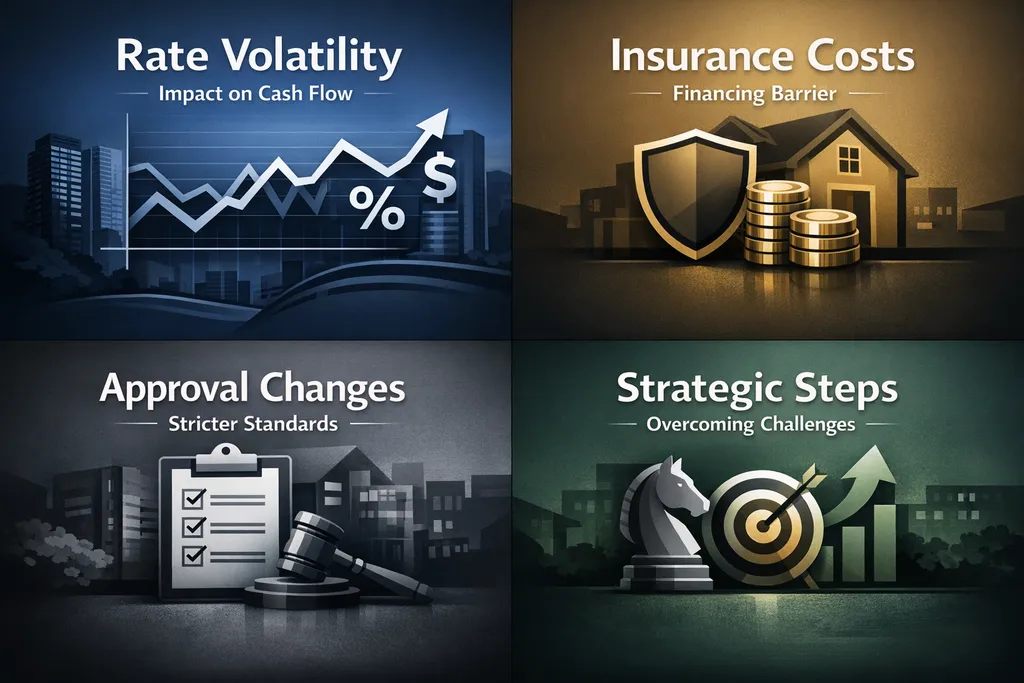
How rate volatility reshapes investment decisions has become one of the most pressing concerns for rental property investors. Interest rate fluctuations directly affect borrowing costs, which in turn influence your ability to generate positive cash flow and achieve target returns on investment.
Monitor treasury yield trends regularly. Interest rates for rental property loans typically track movements in treasury yields. When these yields rise, borrowing costs increase, potentially reducing the profitability of new acquisitions. Staying informed helps you time your financing decisions more strategically.
Evaluate how rate changes impact your debt service coverage ratio. DSCR loans are particularly sensitive to rate movements because higher rates mean higher monthly payments. This can affect whether a property meets the minimum coverage requirements lenders demand, which is often around 1.0 to 1.25 times the debt service.
Consider fixed-rate options during periods of uncertainty. While adjustable-rate products might offer lower initial costs, locking in a fixed rate can provide stability for your cash flow projections. This becomes especially valuable when rate volatility makes it difficult to forecast future conditions accurately.
Commercial real estate financing feels the impact of rate volatility through changes in cap rates as well. As borrowing costs rise, investors may demand higher returns to compensate for increased debt expense, which can put downward pressure on property values. Understanding this relationship helps you make informed decisions about when to enter or exit investments.
The challenge isn't just about higher rates. It's the unpredictability that makes planning difficult. One quarter rates might stabilize, giving investors confidence to move forward. The next quarter could bring unexpected shifts that alter the economics of deals already in progress. This environment requires flexibility in your investment strategy and a willingness to adapt quickly when market conditions change.
Why Insurance Costs Are Becoming a Financing Obstacle
Why insurance costs are becoming a financing obstacle is a question more investors are asking as premiums skyrocket across many markets. Property insurance has always been a factor in rental property economics, but recent increases have transformed it from a manageable expense into a significant barrier that affects both acquisition and refinancing.
Factor insurance into your purchase analysis from day one. Many investors focus heavily on principal, interest, taxes, and routine maintenance when evaluating deals. However, insurance premiums in certain regions have doubled or even tripled, dramatically affecting net operating income. Failing to account for these costs accurately can turn a seemingly profitable investment into a cash flow drain.
Understand how insurance impacts lender decisions. When you refinance a rental property, lenders recalculate your debt service coverage based on current expenses. If insurance costs have increased substantially since your original purchase, you might not qualify for the refinancing terms you expected, or you may not qualify at all.
Explore options to mitigate insurance expense. While you can't control market-wide insurance trends, you can take steps to manage costs. This might include improving property resilience through upgrades, shopping multiple carriers annually, or adjusting coverage levels where appropriate. Some investors are also factoring insurance costs more heavily into property selection, avoiding markets with the most severe premium increases.
The impact of rising insurance costs extends beyond monthly expenses. Lenders typically require proof of adequate coverage before closing any loan, and in some high-risk areas, coverage itself is becoming harder to obtain. This creates a scenario where you might find the perfect property and secure financing approval, only to have the deal fall apart because insurance isn't available at a reasonable cost.
For refinancing specifically, insurance presents a particularly acute challenge. Your original loan might have been based on insurance costs that no longer reflect reality. When you seek to refinance to take advantage of equity or adjust your loan terms, the new underwriting will incorporate current insurance premiums, which could significantly reduce the loan amount you qualify for or eliminate refinancing as an option altogether.
Managing Stricter Approval Changes and Underwriting Standards
Managing stricter approval changes and underwriting standards has become essential as lenders respond to market uncertainty with more conservative lending practices. The days of relatively easy qualification for investment property loans have given way to a more rigorous evaluation process that examines every aspect of your financial position and the property's performance.
Prepare comprehensive documentation before you apply. Lenders now require more detailed financial records, including tax returns, bank statements, and property performance data. Having this documentation organized and ready demonstrates professionalism and can speed up the approval process, reducing the risk of deals falling through due to delays.
Strengthen your debt service coverage ratio proactively. With lenders requiring higher DSCR thresholds, you may need to bring more cash to closing as a down payment or select properties with stronger income potential. Understanding lender requirements before you start shopping helps you target properties that will actually qualify under current standards.
Build relationships with investor-focused lenders. Not all lenders understand rental property investments equally well. Working with institutions that specialize in DSCR loans, fix and flip financing, and investor products means you're dealing with underwriters who understand the business model and may offer more realistic terms than traditional mortgage lenders.
The shift toward stricter underwriting reflects broader concerns about market conditions and default risk. Lenders have watched property values fluctuate, insurance costs rise, and interest rate volatility create uncertainty. In response, they've tightened standards to protect their portfolios, which means you need to present a stronger case for every loan application.
One significant change involves how lenders evaluate rental income. Some institutions now apply more conservative assumptions about vacancy rates and maintenance costs, effectively reducing the income they'll credit toward your DSCR calculation. This means a property that would have qualified a year ago might not meet requirements today, even if nothing about the property itself has changed.
Credit requirements have also evolved. While DSCR loans traditionally focus more on property performance than personal credit, many lenders have raised minimum credit score thresholds or implemented stricter review of credit history. Investors with complex financial situations or multiple existing mortgages may face additional scrutiny that wasn't part of the process in previous years.
Strategic Steps to Overcome Financing Challenges
Strategic steps to overcome financing challenges require a proactive approach that addresses each obstacle before it derails your investment plans. Success in today's market depends on preparation, flexibility, and a clear understanding of what lenders need to see before they'll approve your loan.
Conduct thorough due diligence on every property. Before you make an offer, verify actual rental income, review insurance quotes specific to that property, and calculate expenses based on current market conditions rather than seller-provided estimates. This groundwork ensures you're making decisions based on reality, not optimistic projections that won't hold up during underwriting.
Maintain strong cash reserves. Lenders are increasingly looking at your liquidity as a sign of stability and risk management. Having several months of reserves set aside demonstrates that you can weather vacancies, unexpected repairs, or temporary market downturns without defaulting on your loan obligations.
Structure your portfolio strategically. If you're managing multiple properties, consider how they work together from a financing perspective. Blanket loans might offer efficiencies for certain investors, while others benefit from keeping properties financed separately to maintain flexibility. Understanding your options helps you optimize your overall capital structure.
Stay educated on financing products designed for investors. DSCR loans, bridge loans, and fix and flip financing each serve different purposes in an investment strategy. Knowing when to use each product type, and understanding their respective qualification requirements, positions you to move quickly when opportunities arise.
Timing plays a crucial role in overcoming today's financing challenges. When rate volatility is high, waiting a few weeks might mean significantly different loan terms. Conversely, acting too quickly without proper preparation can result in unfavorable terms or outright rejection. Finding the right balance requires staying informed about market trends while maintaining realistic expectations about what you can achieve.
Building a team of professionals who understand investor needs makes navigation easier. A mortgage broker who specializes in rental property financing can guide you toward lenders with appropriate products. An insurance agent familiar with investment properties can help you secure coverage at competitive rates. An accountant who works with real estate investors can ensure your financial documentation presents your situation in the best possible light for underwriting review.
Refinancing Obstacles Specific to Rental Properties
Refinancing obstacles specific to rental properties have multiplied as market conditions have shifted. What might have seemed like a straightforward refinance to access equity or secure better terms has become a more complex process with higher bars to clear.
Account for revaluation risk. When you refinance, lenders will order a new appraisal. If property values in your market have declined or remained flat while you expected appreciation, you might not have the equity needed to refinance at favorable terms. This is particularly relevant in markets where rapid appreciation has slowed or reversed.
Prepare for income verification challenges. Lenders will want to see current lease agreements and may require rent rolls that demonstrate consistent occupancy. If you've had turnover, vacancy periods, or reduced rents due to market conditions, these factors will impact your ability to qualify for refinancing based on DSCR requirements.
Understand prepayment penalties and timing considerations. Some existing loans include prepayment penalties that make early refinancing expensive. You'll need to calculate whether the benefits of refinancing outweigh these costs, factoring in current rate environments and your long-term investment strategy.
Evaluate whether refinancing makes financial sense. With the costs of refinancing including appraisal fees, title work, and potentially higher interest rates than your existing loan, you need a clear financial reason to move forward. Accessing equity might make sense for portfolio expansion, but simply refinancing for the sake of it could reduce your overall returns.
The combination of higher insurance costs and stricter underwriting creates particular challenges for refinancing. Your original loan might have been based on significantly lower insurance premiums, and when lenders recalculate your DSCR with current insurance costs, the numbers might not support the refinancing you're seeking. This has left some investors unable to access equity they've built up simply because the ongoing costs of holding the property have increased beyond what lenders will support.
Market timing adds another layer of complexity. If you purchased or last refinanced when rates were lower, moving to current rate levels might not make mathematical sense unless you have a compelling reason such as eliminating an adjustable rate that's about to reset or consolidating multiple properties under a blanket loan for simplified management.
Planning for Long-Term Success Despite Market Headwinds
Planning for long-term success despite market headwinds requires investors to adopt a resilient mindset that accounts for ongoing challenges while remaining focused on fundamental investment principles. The obstacles facing rental property financing today may persist, but they don't eliminate opportunities for investors who approach the market thoughtfully.
Build conservative cash flow models. Rather than projecting best-case scenarios, assume higher vacancy rates, elevated insurance costs, and the possibility of rate increases if you're using adjustable-rate financing. Properties that still generate acceptable returns under conservative assumptions are more likely to weather market volatility successfully.
Diversify your financing sources. Relying on a single lender or loan product creates vulnerability. Establishing relationships with multiple investor-focused lenders gives you options when market conditions change or when one institution tightens standards more than others.
Focus on properties with strong fundamentals. In challenging financing environments, properties in stable rental markets with consistent demand become even more valuable. These assets are easier to finance, refinance, and ultimately exit when the time comes because they present lower risk to lenders and buyers alike.
Stay flexible with your acquisition strategy. If financing for traditional rental properties becomes prohibitively difficult or expensive, consider whether other strategies like fix and flip projects or short-term bridge financing might offer better opportunities in the current market. Adapting your approach based on where capital is most accessible can keep your investment activity moving forward.
The current challenges in rental property financing represent a shift rather than a permanent barrier. Markets evolve, lender standards adjust, and interest rate cycles eventually turn. Investors who maintain discipline during difficult periods often find themselves positioned to capitalize when conditions improve. This might mean building cash reserves now, strengthening lender relationships, or simply becoming more selective about which deals you pursue.
Education remains one of your most valuable tools. Understanding how DSCR loans work, what drives insurance pricing in different markets, and how interest rate movements affect your financing options allows you to make informed decisions rather than reactive ones. The investors who succeed over the long term are those who continuously learn and adapt their strategies based on changing market realities.
Rental Property Financing FAQs
Are rental property mortgage rates higher than in previous years?
Rates for investment property financing move with broader mortgage market trends and can shift meaningfully from year to year. Rather than anchoring to a specific historical comparison, the more useful step is getting a current quote for your specific deal, since pricing depends on your credit profile, LTV, and the property itself.
Do these challenges affect DSCR loans differently than conventional financing?
DSCR loans qualify on property income rather than personal income, which sidesteps some underwriting friction but does not eliminate it. Rate movements still affect your monthly payment and therefore your DSCR ratio, and lenders have generally tightened DSCR thresholds along with other underwriting standards.
Is now still a good time to buy rental property?
That depends heavily on the specific deal, market, and your investment goals rather than broad market conditions alone. Conservative underwriting on your own numbers, rather than optimistic projections, is the best way to evaluate whether a given opportunity works regardless of market headwinds.
How can I strengthen my application in a tighter lending environment?
Organize documentation in advance, maintain healthy cash reserves, and work with a lender experienced in investment property financing who can flag issues before they derail your deal.
The top challenges in rental property financing today require a different approach than many investors have used in the past. Rate volatility, insurance costs, and approval changes have fundamentally altered the landscape, creating obstacles that demand careful preparation and strategic thinking. Yet these challenges also create opportunities for investors who are willing to do the work, understand the market, and position themselves appropriately.
Success in this environment isn't about finding shortcuts or hoping conditions will magically improve. It's about acknowledging the realities of today's financing market and building your investment strategy around them. That means conservative underwriting, strong lender relationships, adequate reserves, and a commitment to ongoing education about the products and markets you're working in.
At Trulo Mortgage, we specialize in helping real estate investors navigate exactly these kinds of challenges. Our focus on DSCR loans, fix and flip financing, and rental property solutions means we understand the obstacles you face and can help you structure financing that supports your long-term investment goals. Whether you're acquiring your next property or refinancing an existing one, working with lenders who understand investor needs makes all the difference in achieving the outcomes you're targeting.