Real estate investors targeting affordable rental properties often hit a roadblock when they discover that not every DSCR loan program accommodates smaller deal sizes. While DSCR loans offer incredible flexibility by qualifying borrowers based on rental income rather than personal tax returns, many lenders impose minimum loan amounts that can shut the door on lower priced markets. Understanding the minimum loan amount for small balance DSCR loans is essential for investors building portfolios in emerging neighborhoods, secondary markets, or areas where property values sit comfortably below the national median.
The challenge isn't just about finding a lender. It's about matching your deal size to the right financing partner without sacrificing competitive rates or favorable terms. Some lenders set floors as low as $75,000, while others won't consider anything under $150,000 or even $200,000. This variation creates both opportunity and confusion, especially for investors who thrive on cash flow from properties that don't require six-figure price tags.
In this guide, we'll break down what minimum loan amounts typically look like across the DSCR lending landscape, why these thresholds exist, and how you can navigate them to keep your investment strategy on track. Whether you're buying single-family rentals in the Midwest or duplexes in smaller metro areas, knowing where you stand before you apply can save time, preserve your credit inquiries, and keep your acquisition pipeline moving forward.
What Drives Minimum Loan Requirements for DSCR Programs
Lenders establish minimum loan amounts primarily to maintain profitability on each transaction. Processing a DSCR loan involves underwriting, appraisals, title work, and administrative overhead that remains fairly consistent whether the loan is $80,000 or $800,000. When the loan amount drops too low, the lender's fixed costs consume a larger percentage of the revenue generated from origination fees and interest, making smaller deals less attractive from a business standpoint.
Operational efficiency: Larger loans justify the staff hours and third-party services required to close, while smaller loans can create bottlenecks without proportional return.
Risk versus reward: Even though the borrower's personal income isn't scrutinized in a DSCR loan, lenders still assess the property's income potential. Lower priced properties might carry higher vacancy risk or weaker rent-to-value ratios in certain markets.
Portfolio strategy: Many lenders build their portfolios around specific loan sizes to simplify secondary market sales, investor reporting, and capital allocation. Small balance loans may not fit neatly into these aggregation models.
Regulatory and servicing costs: Compliance, servicing software, and quality control measures apply equally to all loan sizes, making smaller loans proportionally more expensive to manage over time.
Understanding these drivers helps investors see that minimum loan amounts aren't arbitrary. They reflect the economic realities lenders face and can vary widely depending on the lender's business model, geographic focus, and investor appetite. For borrowers targeting lower priced rental properties, the key is identifying lenders whose operational structure and portfolio goals align with smaller deal sizes.
Typical Minimum Loan Thresholds Across DSCR Lenders
Across the DSCR lending market, minimum loan amounts can range considerably. While some lenders openly advertise their willingness to finance properties at lower price points, others quietly enforce higher thresholds that only become clear during pre-qualification conversations. Recognizing this spectrum is critical for investors who need financing for lower priced rental properties with DSCR loans.
Low-end thresholds: A handful of lenders will consider loans starting around $75,000 to $100,000, particularly in secondary and tertiary markets where median home prices naturally sit lower. These programs may come with slightly higher rates or require stronger DSCR ratios to offset perceived risk.
Mid-range floors: Many mainstream DSCR lenders set minimums between $100,000 and $150,000, striking a balance between accessibility and operational efficiency. This tier captures a large swath of single-family rentals and smaller multifamily properties in affordable metros.
Higher minimums: Some national lenders impose floors of $150,000, $175,000, or even $200,000, especially if their focus leans toward coastal markets, high-value metros, or jumbo loan products. These lenders may offer lower rates and more streamlined processes, but they're less flexible on smaller deals.
No stated minimum: Occasionally, lenders promote flexibility by not advertising a hard floor, instead evaluating each deal on a case-by-case basis. In practice, these programs still have internal guidelines, but they allow for exceptions when the property's income profile is strong.
Investors should note that the minimum loan amount for small balance DSCR loans isn't always published on a lender's website. It often surfaces during initial contact or application review, which is why establishing a relationship with a loan officer who understands your deal size and market is invaluable. Proactive communication can reveal which lenders are genuinely equipped to handle your financing needs without wasting time on mismatched applications.
How Property Type and Location Influence Loan Minimums
Not all rental properties are treated equally when it comes to minimum loan amounts. Lenders evaluate property type and geographic market conditions to determine whether a smaller loan fits their risk profile. Single-family homes in stable, landlord-friendly markets might clear the bar more easily than condos or properties in economically volatile areas, even if the loan amounts are identical.
Single-family versus multifamily: Single-family rentals typically enjoy more lenient minimum thresholds because they're easier to appraise, sell, and manage. Small multifamily properties like duplexes or triplexes might face higher minimums due to increased underwriting complexity.
Geographic pricing trends: Properties in the Midwest, Southeast, or Rust Belt often fall below the loan minimums set by coastal-focused lenders. Investors in these regions benefit from targeting lenders with regional expertise or those who actively finance lower cost markets.
Condo and townhome restrictions: Some lenders either exclude condos from small balance programs entirely or impose higher minimums and stricter DSCR requirements. This stems from concerns about HOA stability, special assessments, and resale liquidity.
Rural versus urban properties: Rural rentals can trigger higher minimums or outright exclusions, especially if the property sits outside a recognized metro statistical area. Lenders worry about longer marketing times and thinner tenant pools in less populated regions.
Investors should align their property selection strategy with the lending landscape. If you're targeting lower priced properties in secondary markets, it pays to vet lenders early in your deal pipeline. Ask explicitly about minimum loan amounts for your property type and zip code before you tie up a property under contract. This upfront diligence prevents financing surprises that can derail closings or force you into pricier backup options.
Step-by-Step: Qualifying for Small Balance DSCR Financing
Securing financing for lower priced rental properties with DSCR loans requires a slightly different approach than pursuing larger deals. Because you're operating near or at a lender's minimum threshold, every detail in your application carries extra weight. Following a structured process increases your odds of approval and helps you lock in competitive terms.
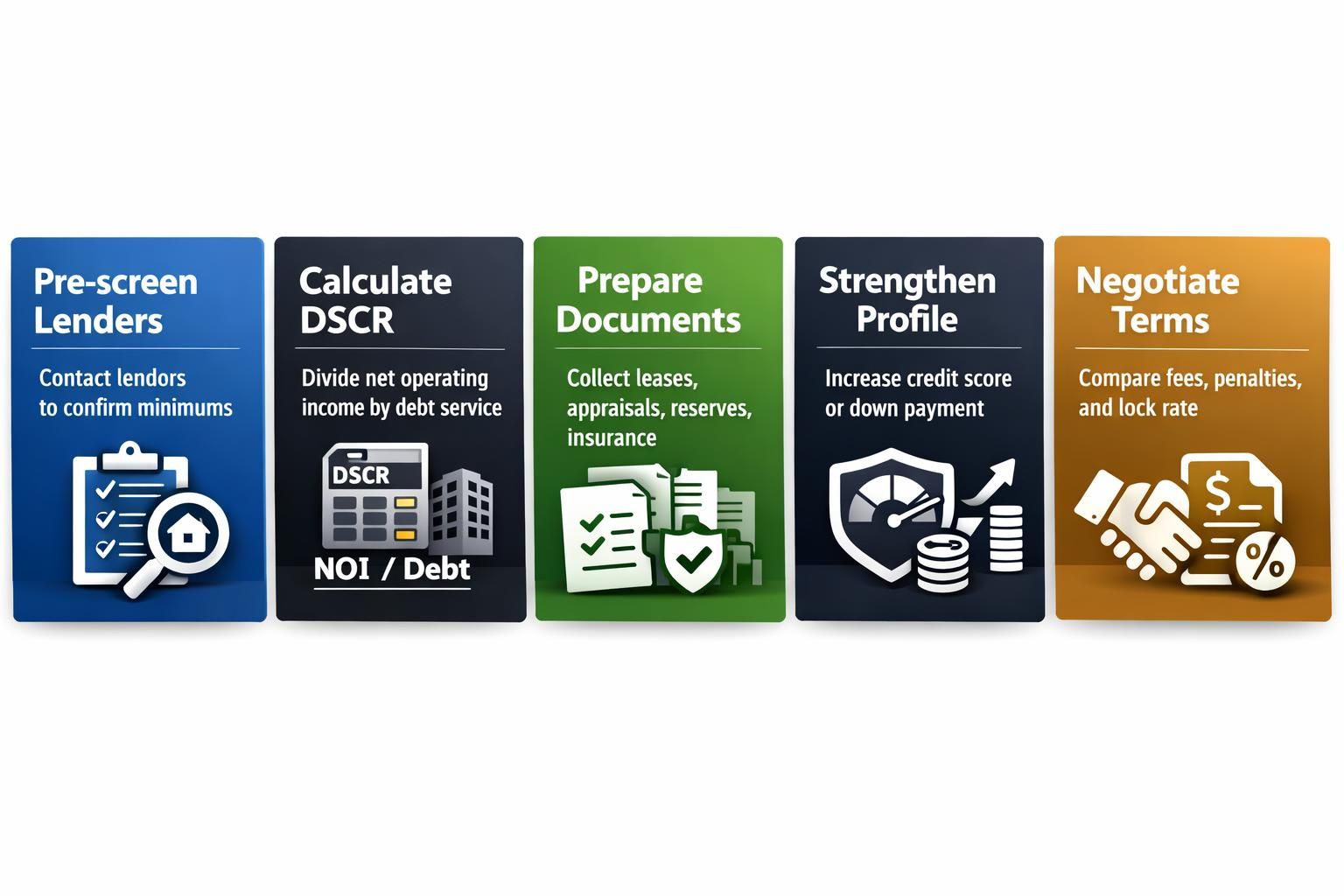
Pre-screen lenders for minimum loan policies: Before falling in love with a property, contact multiple DSCR lenders to confirm their minimum loan amounts, eligible property types, and geographic restrictions. Document these details in a spreadsheet so you can quickly match future deals to the right lender.
Calculate the property's DSCR accurately: DSCR is calculated by dividing the property's net operating income by the total monthly debt service. Lenders typically require a DSCR of at least 1.0, though many prefer 1.2 or higher for small balance loans. Use conservative rent estimates and include property taxes, insurance, and HOA fees in your expense calculations.
Gather documentation early: Even though DSCR loans don't require tax returns, you'll still need a lease agreement or rental appraisal, proof of reserves, credit reports, and property insurance quotes. Having these ready accelerates underwriting and demonstrates professionalism.
Strengthen your borrower profile: If your DSCR is borderline or the loan amount is at the lender's floor, a higher credit score, larger down payment, or proof of significant liquid reserves can tip the scales in your favor. Lenders have more flexibility when the overall risk profile is strong.
Negotiate terms and lock your rate: Once you receive loan estimates, compare not just the interest rate but also origination fees, prepayment penalties, and reserve requirements. Small balance loans sometimes carry higher fees, so scrutinize the total cost of borrowing. After selecting a lender, lock your rate to protect against market fluctuations during the closing period.
By treating small balance DSCR financing as a deliberate, methodical process rather than a last-minute scramble, you position yourself as a serious investor. Lenders respond positively to borrowers who understand the mechanics of DSCR underwriting and come prepared with clean documentation and realistic expectations.
Rate and Term Considerations for Smaller DSCR Loans
Interest rates and loan terms on small balance DSCR loans can differ from those offered on larger transactions. While you won't necessarily face punitive pricing just because your loan is at or near the minimum, certain factors unique to smaller deals can influence the cost of capital and the flexibility of your repayment structure.
Rate pricing adjustments: Lenders may apply rate adjustments based on loan amount tiers. A $100,000 loan might carry a slightly higher rate than a $250,000 loan, all else being equal, because the lender's profitability margin is tighter. Rates on DSCR loans typically range from 6.25% to 8.00%, depending on credit score, DSCR, and loan-to-value ratio.
Shorter term options: Some lenders offer shorter-term products, such as 5-year or 7-year adjustable-rate mortgages, which can start at the lower end of the rate spectrum. These products appeal to investors planning to refinance or sell once the property appreciates or rents increase.
Prepayment penalties: Small balance DSCR loans may carry prepayment penalties ranging from one to five years. If you anticipate selling or refinancing soon, negotiate for a shorter penalty period or a structure that allows partial paydowns without penalty.
Reserves and liquidity requirements: Lenders might require higher reserve balances, six to twelve months of payments, for smaller loans to cushion against potential cash flow disruptions. This is especially common when the DSCR is below 1.25 or the property is in a market the lender considers higher risk.
Investors should model multiple scenarios using different rate and term combinations to understand the true cost over the life of the loan. A slightly higher rate with no prepayment penalty might outperform a lower rate with a five-year lockout if your strategy involves repositioning properties within a shorter hold period. Always request a detailed loan estimate and compare the annual percentage rate alongside the note rate to capture the full picture of borrowing costs.
Strategies to Overcome Low Loan Amount Barriers
When the property you want falls below a lender's minimum loan threshold, creativity and strategic planning can open doors. Rather than walking away from a deal or settling for suboptimal financing, investors can employ several tactics to either increase the loan amount or find alternative pathways that accommodate smaller transactions.
Combine multiple properties into a blanket loan: If you're acquiring more than one property, ask lenders whether they'll write a single blanket loan secured by multiple assets. This approach raises the total loan amount above the minimum while streamlining closing costs and paperwork.
Include rehab or improvement costs: Some DSCR lenders offer renovation financing or allow borrowers to roll repair costs into the loan amount. By financing necessary upgrades alongside the purchase, you can push the total above the lender's floor and increase the property's income potential at the same time.
Partner with another investor: Co-borrowing or joint ventures can merge buying power and help you clear minimum thresholds while sharing risk. Ensure the lender allows multiple borrowers on DSCR loans and that your partnership agreement is documented clearly.
Target lenders specializing in your market: Regional lenders and community-focused institutions often have lower minimums than national players because they understand local rent dynamics and property values. Building relationships with these lenders can unlock access to deals that larger institutions won't touch.
Negotiate exceptions: If you have a strong track record, excellent credit, and a high DSCR on the property, some lenders will make exceptions to their published minimums. Don't hesitate to ask, especially if you're bringing multiple deals to the table or can demonstrate repeat business potential.
These strategies require proactive planning and sometimes a willingness to adjust your acquisition approach. The effort pays off when you secure financing that aligns with your investment thesis without forcing you into markets or property types that don't match your expertise or risk tolerance.
Navigating the minimum loan amount for small balance DSCR loans doesn't have to be a barrier to building a profitable rental portfolio. While lenders impose thresholds for valid economic reasons, the landscape is far from uniform. By understanding what drives these minimums, identifying lenders whose programs align with your deal size, and employing strategic tactics when you're near the floor, you can keep your pipeline flowing and your returns strong.
Lower priced rental properties offer compelling cash-on-cash returns, especially in markets where appreciation may lag but rents remain stable. The key is matching your financing strategy to your property selection criteria and establishing relationships with lenders who view small balance deals as opportunities rather than inconveniences. Whether you're buying in emerging neighborhoods, secondary cities, or simply focusing on affordable rentals that deliver consistent income, the right DSCR loan can provide the leverage you need without the income documentation hassles of traditional mortgages.
As you refine your acquisition strategy, remember that the lending environment evolves. Rate environments shift, lenders adjust their appetites, and new programs enter the market. Staying informed and maintaining a network of responsive loan officers ensures you're never caught off guard by changing minimums or tightening guidelines. If you're ready to explore flexible financing options tailored to your investment goals, get a personalized DSCR loan quote and see how the right loan structure can accelerate your portfolio growth.