Building a rental portfolio requires more than just finding the right properties. It demands smart financing strategies that let you scale without drowning in paperwork or stretching your capital too thin. For real estate investors managing multiple properties, traditional single-property mortgages can quickly become a logistical nightmare and a drain on resources.
The top loan options for multi property investors are designed specifically to address these challenges. They streamline the acquisition process, reduce administrative overhead, and often provide more favorable terms than securing separate loans for each property. Whether you're adding your third rental or your thirtieth, understanding portfolio loans, blanket financing, and other specialized products can make the difference between steady growth and stalled momentum.
In this guide, we'll break down the financing options that matter most to investors focused on scaling their portfolios. From government-backed multifamily loans to single-family rental portfolio products, you'll learn how each option works, when it makes sense, and how to leverage these tools to maximize your investment returns.
Why Portfolio Loans Matter for Multi Property Investors
Why portfolio loans matter for multi property investors comes down to flexibility and efficiency. When you're managing several rental properties, dealing with multiple loan applications, separate closing costs, and different payment schedules can eat away at both your time and your profits. Portfolio loans offer a streamlined alternative that aligns with the realities of scaling a rental business.
Portfolio loans are typically held by the originating lender rather than being sold to secondary market investors. This structure may provide more personalized loan terms that can be negotiated to fit your specific investment strategy. For investors with non-traditional income sources or unique property mixes, this flexibility can be invaluable.
Portfolio loans might offer more customizable repayment structures tailored to your cash flow needs
Lenders may be more willing to work with investors who have complex portfolios or unconventional income documentation
These loans can streamline the financing process by consolidating multiple properties under one loan architecture
Investors often find that portfolio loans reduce the administrative burden of managing separate mortgages for each property
The ability to negotiate terms directly with a lender who will hold your loan can be particularly advantageous when market conditions shift or when your investment strategy requires terms that don't fit conventional lending boxes. This customization potential makes portfolio loans one of the top loan options for multi property investors looking to expand strategically.
Single-Family Rental Portfolio Loans for Scaling Efficiently
Single-family rental portfolio loans for scaling efficiently address a common pain point: the cost and complexity of financing multiple properties individually. These specialized products allow you to bundle several single-family rentals under one loan, reducing the paperwork, closing costs, and time required to grow your portfolio.
SFR portfolio loans have gained traction as rental demand continues to rise. By consolidating properties, you can leverage economies of scale that may lower your overall financing costs and simplify property management. This approach is particularly useful for investors who've already accumulated a handful of rentals and are ready to accelerate their acquisition pace.
Bundling multiple properties under a single loan may reduce per-property closing costs significantly
Administrative efficiency improves when you manage one payment schedule instead of juggling multiple loan servicing accounts
These loans can facilitate faster portfolio expansion by streamlining the underwriting and approval process
The streamlined nature of SFR portfolio loans makes them attractive for investors focused on building rental income at scale. Instead of waiting weeks or months for individual property approvals, you might secure financing for several properties simultaneously. This efficiency can be crucial in competitive markets where timing matters and hesitation means losing deals to faster-moving competitors.
Have a property in mind?
Tell us about the property and we will find the financing that fits you best.
Blanket Loans: Financing Multiple Properties Under One Umbrella
Blanket loans: financing multiple properties under one umbrella represents another powerful scaling strategy for investors. Similar to portfolio loans, blanket loans cover multiple properties with a single mortgage, but they often include provisions that make them particularly useful for investors who buy and sell properties regularly as part of their strategy.
One key feature that may distinguish blanket loans is the release clause. This provision can allow you to sell individual properties from the blanket loan without paying off the entire mortgage, which provides flexibility as your portfolio evolves. For investors who flip properties or periodically rebalance their holdings, this feature can be particularly valuable.
Blanket loans typically cover multiple properties with one loan document, reducing legal and closing costs
Release clauses may permit selling individual properties without refinancing the entire loan balance
These loans can simplify cash flow management by consolidating multiple payments into one monthly obligation
Investors might find better leverage ratios when financing properties as a package rather than individually
The flexibility of blanket loans makes them one of the top loan options for multi property investors who need to move quickly and adapt their portfolios to market conditions. Whether you're consolidating existing properties or acquiring new ones, blanket financing can reduce friction in your investment operations and free up capital for your next opportunity.
Government-Backed Multifamily Financing Options
Government-backed multifamily financing options provide a stable source of capital for investors focused on larger rental properties. Programs backed by agencies offer competitive terms that can make multifamily investments more accessible, particularly for investors looking to enter or expand within this segment of the market.
These loan products are designed specifically for multifamily assets and often feature longer terms, fixed interest rates, and favorable loan-to-value ratios. The backing of government-sponsored entities typically results in lower risk for lenders, which can translate into better pricing and terms for borrowers.
Agency-backed loans may offer more competitive interest rates compared to conventional commercial financing, potentially improving cash flow on multifamily properties.
Loan terms can be structured with flexibility to match different investment strategies, from acquisition to refinancing existing assets.
These products typically provide access to larger loan amounts, making them suitable for investors ready to scale up from smaller rental properties to apartment buildings.
The stability of government-backed programs offers consistency even as market conditions fluctuate, allowing for strategic planning with more certainty.
For investors aiming to diversify beyond single-family rentals, government-backed multifamily loans represent a proven path. The combination of competitive pricing, flexible terms, and reliable access to capital makes these products particularly attractive for those looking to build long-term wealth through apartment investing. Understanding how to leverage these programs can be a game-changer when you're ready to take your portfolio to the next level.
Bridge Loans for Quick Acquisitions and Portfolio Transitions
Bridge loans for quick acquisitions and portfolio transitions serve a distinct purpose in the investor's financing toolkit. These short-term capital solutions provide the speed and flexibility needed to secure attractive deals in competitive markets, acting as a temporary funding source while you arrange longer-term financing or prepare a property for refinancing.
In fast-moving real estate markets, the ability to close quickly can be the difference between landing a profitable deal and watching it go to another investor. Bridge loans are designed for precisely these situations, offering expedited funding that lets you act decisively when opportunities arise.
Bridge loans typically close faster than traditional mortgages, often in weeks rather than months, enabling you to compete with cash buyers.
These loans can facilitate property acquisition while you work on improvements or stabilize occupancy before refinancing into permanent financing.
Investors may use bridge loans to consolidate multiple properties before transitioning to a portfolio or blanket loan structure.
The flexibility of bridge financing can help you seize time-sensitive opportunities, particularly for multifamily properties that require repositioning.
While bridge loans usually carry higher interest rates than permanent financing, their strategic value often justifies the cost. They function as a tactical tool that keeps your portfolio growth on track when timing is critical. For investors with a clear exit strategy, whether through refinancing, sale, or stabilization, bridge loans can unlock opportunities that would otherwise slip away while waiting for conventional financing approval.
DSCR Loans and Rental Income-Based Financing
DSCR loans and rental income-based financing offer a refreshing alternative for investors whose personal income doesn't tell the full story of their financial capacity. Debt Service Coverage Ratio loans focus on the property's income potential rather than your personal tax returns, making them particularly useful for investors with multiple properties or those who structure their income in tax-efficient ways.
DSCR loans qualify you based on the rental income a property generates, not your personal W-2 or tax returns, which can be advantageous for investors with complex income structures.
These loans may allow faster portfolio expansion because underwriting focuses on property performance rather than personal debt-to-income ratios.
Investors can often secure financing for multiple properties without hitting the conventional loan limits that restrict traditional mortgages.
The streamlined documentation requirements of DSCR loans might reduce approval time and paperwork compared to traditional investor mortgages.
For real estate investors building portfolios at scale, DSCR loans remove common bottlenecks that slow growth. When your personal income statement becomes less relevant than your properties' cash flow, you gain the freedom to expand based on deal quality rather than arbitrary lending restrictions. This makes DSCR products one of the top loan options for multi property investors focused on cash flow and long-term portfolio building.
Using Leverage to Scale a Rental Portfolio
Beyond choosing the right loan product, disciplined use of leverage is what actually lets you go from one rental to a full portfolio. The BRRRR method (Buy, Rehab, Rent, Refinance, Repeat) remains the core playbook: you acquire a property below market value, improve it, place a tenant, then refinance based on the stabilized value to pull your capital back out and redeploy it into the next acquisition.
Seasoning requirements: Most lenders want to see a property rented for at least six months before they'll approve a cash-out refinance based on the new, higher appraised value.
Conservative leverage: Keeping initial loan-to-value ratios in the 75% to 80% range on new acquisitions balances growth speed against the added risk of thinner equity cushions.
DSCR financing as the refinance engine: Because DSCR loans qualify you on the property's rental income rather than your personal debt-to-income ratio, they're well suited to the refinance step of the BRRRR cycle, especially once you own enough properties that a conventional lender's income documentation requirements become impractical.
Diversification as risk management: Spreading acquisitions across property types and, where practical, across markets reduces the impact of a single market downturn or a concentrated vacancy problem on your overall portfolio cash flow.
Each successful refinance cycle recycles your original capital, which is what allows leverage to compound your growth rate rather than requiring fresh savings for every new property.
Strategic Considerations When Choosing Portfolio Financing
Strategic considerations when choosing portfolio financing should drive your decision more than interest rate alone. While securing the lowest rate matters, the structure, flexibility, and alignment with your long-term investment strategy often have a bigger impact on your success as a multi-property investor.
Different loan products serve different purposes. A bridge loan might make sense for a quick acquisition that you plan to refinance, while a blanket loan could be ideal if you're consolidating existing properties to improve cash flow management. Portfolio loans might offer the customization you need if your investment strategy doesn't fit conventional lending boxes. Government-backed multifamily financing could provide the best terms if you're scaling your rental portfolio into larger apartment buildings. And DSCR loans might unlock growth if your personal income documentation creates barriers with traditional lenders.
The key is matching the financing tool to your specific situation and goals. Consider factors like your exit strategy, the types of properties you're targeting, your timeline for growth, and how much flexibility you need in loan terms. Also think about whether you'll be holding properties long-term or cycling through acquisitions and dispositions as part of your strategy. The right financing choice streamlines your operations, reduces costs, and positions you to move quickly when opportunities arise. By understanding the top loan options for multi property investors and how each fits different scenarios, you can build a financing strategy that supports sustainable portfolio growth and maximizes your return on investment.
How to Structure Financing Across Multiple Properties
How you structure ownership and financing across a growing portfolio matters as much as which loan product you choose. A few structural decisions come up repeatedly as investors scale past their first few properties.
Watch the conventional financed-property cap: Fannie Mae guidelines allow qualified borrowers to finance up to 10 residential one-to-four unit properties, and this limit is tracked per borrower across all lenders, not per lender. Borrowers with seven to ten financed properties also face a higher minimum credit score requirement under conventional guidelines. This cap is one of the main reasons investors transition to DSCR, portfolio, or blanket loans as they scale, since those products aren't subject to the same conventional financed-property limit.
Entity structure affects both liability and lending: Holding properties in an LLC or similar entity can provide liability protection and pass-through tax treatment, and many DSCR lenders are built to underwrite loans to entities based on the property's cash flow rather than the owner's personal financials.
Build relationships with multiple lenders: Working with three to five lenders who understand investor financing gives you options if one lender tightens guidelines, changes pricing, or hits an internal exposure limit on your portfolio.
Decide deliberately between consolidating and keeping loans separate: Consolidating properties under one blanket or portfolio loan can simplify servicing, but it also means an issue with one property, such as a lien or a prepayment penalty on refinance, can affect the entire loan. Keeping loans separate preserves flexibility to sell or refinance individual properties independently, which matters if your properties have different exit timelines.
Qualifying for Financing with Multiple Existing Rentals
Once you already own several rental properties, qualifying for the next loan looks different from your first purchase. Lenders want to see that your existing portfolio is performing and that you have the reserves to weather a rough patch across multiple properties at once.
Reserve requirements scale with your portfolio: Expect to show liquid reserves covering roughly two to six months of PITIA (principal, interest, taxes, insurance, and association dues) per property, with funds seasoned in your accounts for at least two to three months before application.
DSCR requirements: Most DSCR lenders require a ratio of at least 1.0, meaning the property's rental income covers its debt payment, though a ratio of 1.25 or higher typically qualifies you for better pricing.
Credit and down payment benchmarks: Investors with multiple rentals typically need credit scores in the 620 to 680 range and down payments of 20% to 25%, though exact requirements vary by lender and by how many properties you already have financed.
An alternative path for small multifamily: FHA and VA financing can work for 2-4 unit properties if you intend to occupy one unit, offering lower down payment options, though this path requires owner-occupancy and isn't available for pure investment purchases.
Get pre-approved before you shop: A straightforward pre-approval sequence (financial review, property evaluation, lender comparison, and a pre-approval letter in hand) lets you move quickly once you find the next deal and signals to sellers that your financing is real.
Common Portfolio-Scaling Mistakes to Avoid
Fast growth creates its own risks. These are the mistakes that most often derail investors who scale too quickly or without enough structure.
Overleveraging without stress-testing: Before adding another property, model how your portfolio holds up under a 10% vacancy increase, a rate hike on any variable-rate debt, and simultaneous repair costs across two or more properties. If that scenario breaks your cash flow, you're leveraged too thin.
Skipping market-selection diligence: Employment diversity, price-to-rent ratios, local landlord-tenant regulations, and the availability of reliable property management all affect how a market performs over a full ownership cycle, not just at purchase.
Growing without systems: Standardized tenant screening, centralized financial tracking, and a reliable vendor network become necessary, not optional, once you're managing more than a few properties. Without them, small problems compound faster than you can catch them.
Stacking debt maturities: If several loans come due for renewal or balloon payment around the same time, you're exposed to whatever rate and underwriting environment exists at that moment. Staggering maturity dates across your portfolio reduces the risk of being forced to refinance multiple properties simultaneously into unfavorable conditions.
Concentrating risk geographically: Heavy concentration in a single market or submarket means a local downturn, new regulation, or oversupply hits your entire portfolio at once rather than a single property.
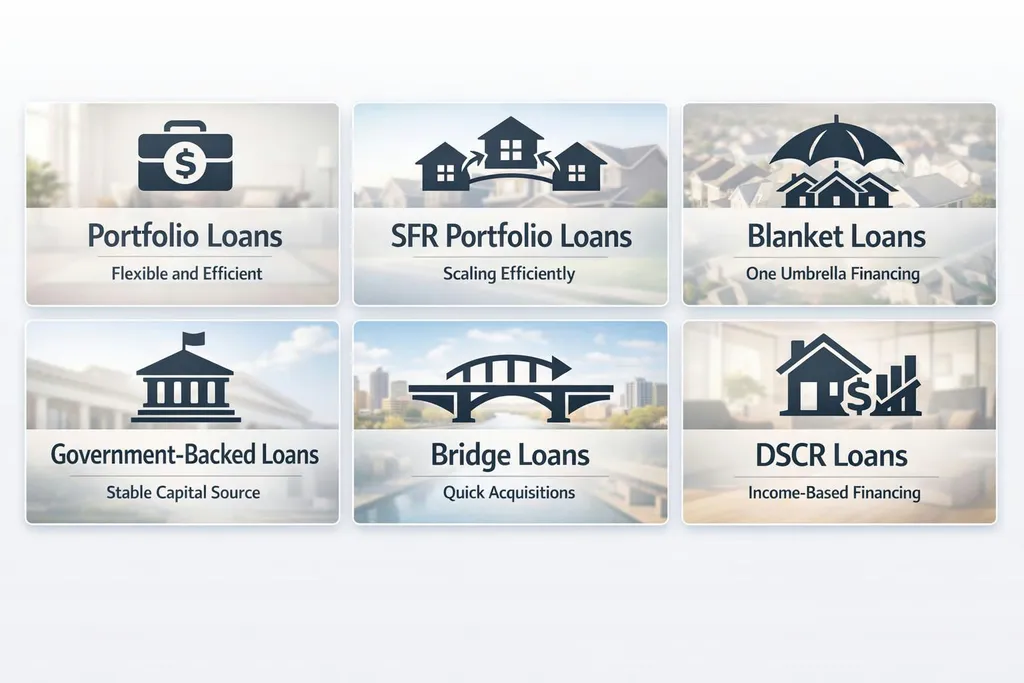
Scaling a rental property portfolio requires more than capital. It demands financing strategies that reduce complexity, lower costs, and align with your growth objectives. The top loan options for multi property investors offer exactly that: portfolio loans with customizable terms, blanket loans with release clauses, SFR portfolio products that bundle properties efficiently, government-backed multifamily programs with competitive rates, bridge loans for quick acquisitions, and DSCR loans that qualify based on property performance rather than personal income.
Each financing tool serves a specific purpose in your investment strategy. The investors who build substantial portfolios understand which product fits which situation and how to leverage these options strategically. Whether you're consolidating existing properties, accelerating acquisitions, or entering the multifamily space, choosing the right financing structure can dramatically impact your results.
At Trulo Mortgage, we specialize in investor-focused loan products designed for portfolio growth. From DSCR loans to rental property financing, we understand the unique needs of real estate investors building wealth through rental income. If you're ready to explore financing options that support your scaling strategies, reach out to discuss how the right loan structure can help you reach your portfolio goals faster and more efficiently.