Choosing the right DSCR lender isn't just about finding the lowest rate. For real estate investors, the lender you pick shapes your cash flow, your ability to scale, and ultimately, the profitability of every rental property or fix and flip project you take on. A misstep here can mean higher costs, restrictive terms, or financing that doesn't align with your investment strategy.
Understanding how to choose a DSCR lender means going beyond surface-level comparisons. It requires a clear-eyed evaluation of loan-to-value ratios, minimum DSCR thresholds, prepayment penalties, and how a lender's underwriting guidelines match your portfolio. With the right approach, you'll secure financing that supports your goals rather than limiting them.
This guide walks you through the essential criteria investors should consider when selecting a DSCR lender in 2026, helping you make informed decisions that protect your bottom line and position you for long-term success.
What to Look for in a DSCR Lender: Core Criteria Checklist
When evaluating what to look for in a DSCR lender, it helps to start with a checklist of the fundamentals. Not every lender structures their programs the same way, and the details can have a big impact on your deal economics. Here's what matters most.
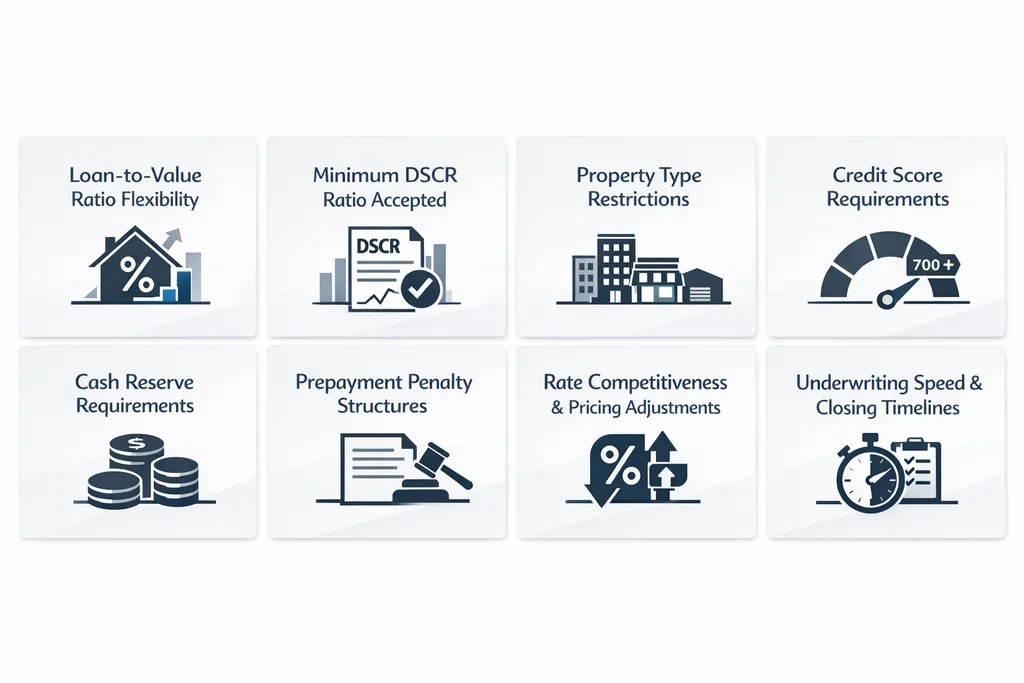
Loan-to-Value Ratio Flexibility: Some lenders cap LTV at 75%, while others may go higher depending on the property type and your credit profile. Higher LTV options can reduce the cash you need upfront, but they often come with stricter DSCR requirements or higher rates.
Minimum DSCR Ratio Accepted: Lenders set different floors for the debt service coverage ratio they'll accept. A lender requiring a 1.25 DSCR won't work for a property generating a 1.10 ratio, no matter how strong the rest of your profile looks. Matching your property's cash flow to the lender's minimum threshold is critical.
Property Type Restrictions: Not all lenders finance every property type. Some specialize in single-family rentals, while others handle multi-family units, condos, or even short-term vacation rentals. Confirming that a lender underwrites your specific property type saves time and avoids surprises during the application process.
Credit Score Requirements: FICO minimums vary by lender. Many require a 680 or higher, but some may work with investors in the 620 to 660 range, usually at a higher rate or with additional cash reserves required. Knowing where you stand helps you target lenders within reach.
Understanding DSCR Lending Criteria and Guidelines
DSCR lending criteria form the backbone of how lenders evaluate risk and structure their offers. Unlike conventional loans that lean heavily on personal income documentation, DSCR loans focus on the rental income the property produces relative to its debt obligations. This shift in underwriting opens doors for investors, but it also introduces new variables to track.
Cash Reserve Requirements: Lenders often require several months of reserves, PITI (principal, interest, taxes, insurance), to cushion against vacancies or repairs. The exact number of months varies, but having two to six months in reserves can strengthen your application and may even unlock better pricing.
Prepayment Penalty Structures: Many DSCR loans include prepayment penalties that can last three to five years. These penalties protect the lender's yield, but they also affect your flexibility if you plan to refinance or sell the property early. Understanding the terms upfront prevents costly surprises down the road.
Rate Competitiveness and Pricing Adjustments: DSCR loan rates typically sit above conventional mortgage rates, reflecting the higher risk lenders assume. However, pricing can vary significantly based on your DSCR ratio, LTV, credit score, and property type. Comparing rate sheets and understanding how pricing adjustments apply to your specific scenario is essential for securing competitive terms.
Underwriting Speed and Closing Timelines: Some lenders process applications faster than others, which can be crucial in competitive markets or time-sensitive deals. A lender with a streamlined underwriting process and clear communication can make the difference between closing on time and losing a property to another buyer.
How Property Type Shapes Your Lender Search
The type of property you're financing plays a major role in how to choose a DSCR lender. Different lenders specialize in different asset classes, and their comfort level with a given property type directly affects the terms they offer. Here's what investors need to consider.
Single-Family vs. Multi-Family Properties: Single-family rental properties are the most common asset class for DSCR loans, and most lenders have well-defined programs for them. Multi-family properties (two to four units) may require higher DSCR ratios or lower LTVs, depending on the lender's appetite for that segment.
Condos and Townhomes: Not all lenders finance condos or townhomes, especially if the HOA has financial issues or the property is in a non-warrantable project. If you're targeting these property types, confirming a lender's condo approval process early saves time and avoids dead ends.
Short-Term and Vacation Rentals: Properties used for short-term rentals (Airbnb, VRBO) often fall into a specialized category. Some lenders accept rental income from these properties, but they may apply stricter underwriting standards or require additional documentation to verify income consistency.
Mixed-Use and Commercial Properties: If your investment includes a commercial component, such as a retail storefront with residential units above, you'll need a lender experienced in mixed-use financing. These deals typically involve more complex underwriting and may not fit within standard DSCR loan parameters.
Step-by-Step: Comparing DSCR Lenders for Your Deal
Once you've identified a shortlist of potential lenders, the next step is a structured comparison. This process ensures you're not just chasing the lowest rate but finding the lender whose program best fits your investment strategy. Here's how to approach it methodically.
Gather Rate Quotes and Fee Schedules: Request detailed rate quotes that include all lender fees, origination charges, and third-party costs. Rates alone don't tell the full story. A slightly higher rate with lower upfront fees can sometimes be more cost-effective, especially if you plan to hold the property long-term.
Map Lender Requirements to Your Deal: Create a simple matrix that lists each lender's LTV cap, minimum DSCR, credit score requirement, and property type restrictions. Then, overlay your deal's specifics (your credit score, the property's DSCR, your target LTV) to see which lenders align without requiring you to stretch your profile or inject more capital.
Evaluate Loan Terms and Flexibility: Beyond rates and fees, examine the loan's structure. Does the lender offer fixed-rate or adjustable-rate options? What are the prepayment penalty terms? Are there any restrictions on future refinances or assumptions? These details can significantly impact your strategy, especially if you plan to refinance as rates shift or if you intend to sell the property within a few years.
Assess Customer Service and Communication: The lender's responsiveness and clarity during the initial inquiry phase often signals how they'll perform throughout the loan process. A lender who answers questions promptly, provides transparent guidance, and walks you through their underwriting criteria is more likely to close on time and handle issues smoothly.
Review Post-Closing Support and Servicing: Some lenders service their own loans, while others sell them to third-party servicers. Understanding who will manage your loan after closing and their track record for handling payments, escrow accounts, and borrower inquiries can save headaches down the road.
Aligning DSCR Loan Terms with Your Investment Strategy
Your investment strategy should drive your lender selection, not the other way around. Whether you're building a portfolio of long-term rentals, flipping properties, or pursuing a hybrid approach, the loan terms you accept today will shape your financial flexibility tomorrow. Here's how to match lender offerings to your goals.
Long-Term Buy-and-Hold Investors: If your plan is to hold properties for years or decades, prioritize fixed-rate loans with minimal prepayment penalties after the first few years. Locking in predictable debt service protects you from rate fluctuations and simplifies cash flow projections. Also, look for lenders that allow portfolio loans or blanket financing as you scale, which can streamline future acquisitions.
Investors Planning Near-Term Exits: For those who anticipate selling or refinancing within a few years, shorter prepayment penalty periods or lower penalty amounts become more important. An adjustable-rate mortgage (ARM) might also make sense if you're confident you'll exit before the rate adjusts. In this scenario, optimizing upfront costs and closing speed often outweighs locking in the absolute lowest long-term rate.
Scaling Investors with Multiple Properties: If you're rapidly acquiring properties, find a lender who can handle multiple loans efficiently and offers consistent underwriting across deals. Some lenders cap the number of financed properties per borrower, so confirming there's no ceiling on your portfolio growth prevents bottlenecks as you expand. Additionally, lenders who allow cross-collateralization or portfolio-based pricing can offer efficiencies as your holdings grow.
Investors Targeting Unique Property Types: If your strategy focuses on niche markets, like vacation rentals, mixed-use buildings, or properties in secondary markets, seek out lenders with specialized programs or a track record in those segments. Generic DSCR lenders may decline these deals outright, while specialized lenders can offer tailored terms that reflect the unique cash flow and risk profiles of these assets.
Key Investor Insight
At the end of the day, how to choose a DSCR lender comes down to matching the lender's strengths to your deal's realities. The best lender for one investor's single-family rental in a strong market might not be the right fit for another investor targeting a multi-family property with tighter cash flow. Taking the time to evaluate LTV caps, DSCR minimums, property type flexibility, prepayment penalties, and underwriting speed ensures you're not leaving money on the table or locking yourself into terms that constrain your strategy. The lender you choose shapes not just one deal, but the trajectory of your entire portfolio.
Selecting the right DSCR lender is one of the most important decisions you'll make as a real estate investor. It affects your upfront costs, your ongoing cash flow, and your ability to execute your investment strategy without unnecessary friction. By focusing on the criteria outlined in this guide, from LTV and DSCR thresholds to prepayment penalties and property type restrictions, you can narrow your options to lenders who truly understand your needs and offer terms that support your goals.
Remember, the cheapest rate isn't always the best deal. The right lender is one whose underwriting standards, loan structures, and service quality align with your investment approach. Take the time to compare, ask detailed questions, and don't be afraid to walk away from a lender whose terms don't fit. Your portfolio's success depends on these decisions.
Ready to find a lender that matches your investment strategy? Explore your DSCR loan options and see how the right financing can accelerate your real estate goals.