Understanding how to build a rental portfolio using leverage can transform a single property investment into a thriving real estate empire. For many investors, leverage represents the difference between slow, incremental growth and rapid portfolio expansion that generates substantial passive income.
Leverage in real estate investing means using borrowed capital to increase your purchasing power and potential returns. Instead of waiting years to save enough cash for each new property, savvy investors tap into financing options that allow them to acquire multiple rental properties while preserving their own capital for other opportunities.
This approach isn't without considerations, of course. Using debt to expand your holdings requires careful planning around cash flow management, loan terms, and market conditions. However, when executed thoughtfully, leverage strategies can help you scale your rental portfolio much faster than relying solely on saved capital.
In this guide, we'll walk through the specific steps and strategies that successful rental property investors use to build portfolios through smart financing. From understanding different loan products to implementing refinancing cycles that free up capital for your next deal, you'll discover how leverage can become your most powerful tool for portfolio growth.
Starting Your Leverage Strategy with the Right Foundation
Starting your leverage strategy with the right foundation means selecting properties and financing that set you up for sustainable growth. Before you can successfully scale using borrowed capital, you need to establish a solid base that generates positive cash flow and builds equity over time.
The properties you choose for your initial investments should typically demonstrate strong fundamentals. This means looking at rental demand in the area, property condition, and realistic projections for rental income versus all your expenses including mortgage payments, insurance, taxes, and maintenance reserves.
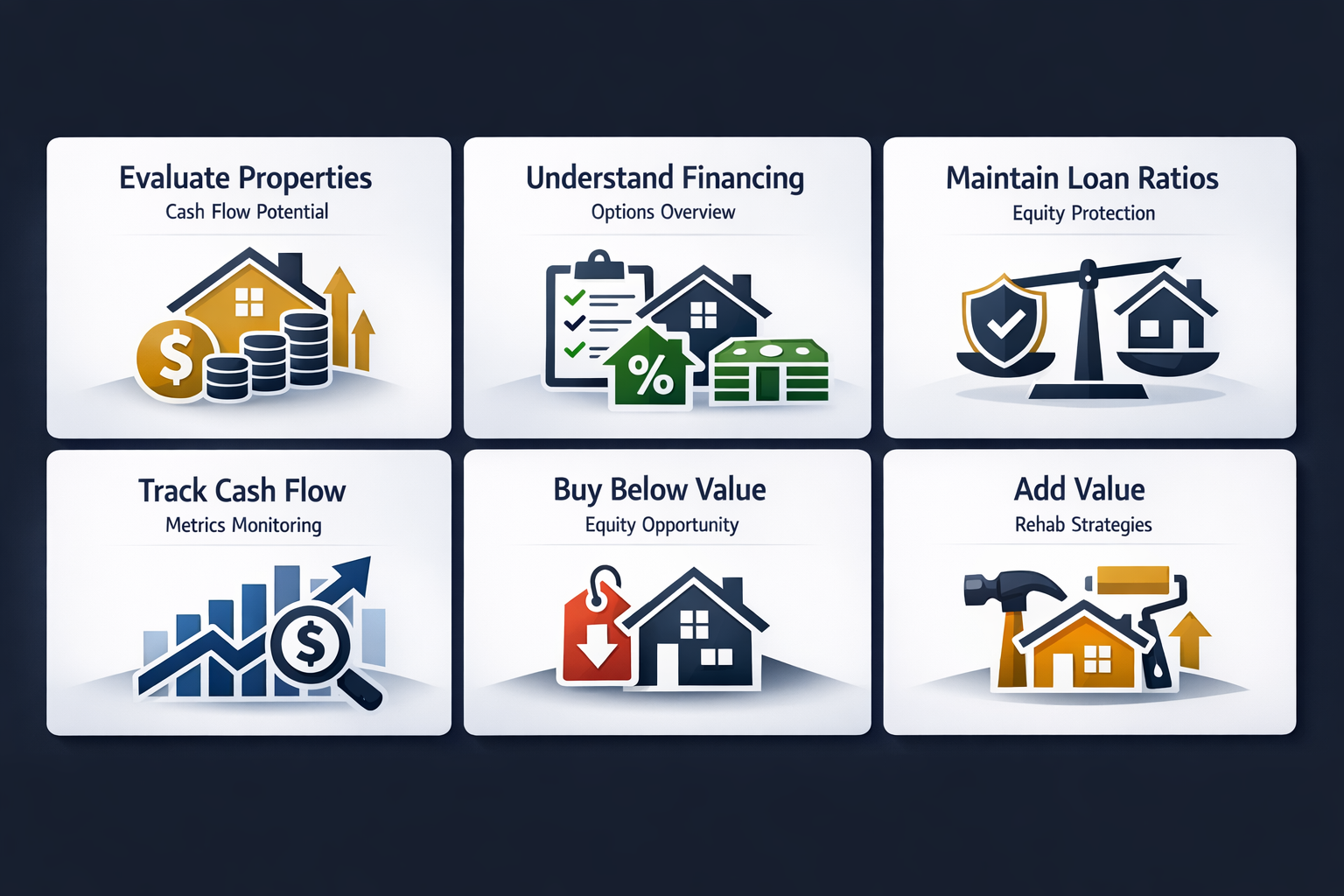
Evaluate properties based on cash flow potential. Your first rental properties should generate enough income to cover all expenses plus provide a cushion for vacancies and repairs. This positive cash flow becomes the foundation that supports additional borrowing as you scale.
Understand your financing options from the start. DSCR loans, which qualify investors based on the property's rental income rather than personal income, can be particularly useful for building a rental portfolio. These loans allow you to acquire properties based on the deal's merit rather than your W-2 earnings.
Maintain manageable loan-to-value ratios. While leverage amplifies returns, starting with properties where you have some equity cushion provides protection against market fluctuations. Many investors find that keeping initial LTV ratios around 75-80% balances growth potential with risk management.
Track your cash flow metrics carefully. From day one, monitor the debt service coverage ratio on each property. This metric, which compares rental income to debt obligations, becomes crucial when you're ready to refinance or acquire additional properties.
Building this foundation might feel slower than jumping straight into aggressive expansion, but it creates the stability needed for long-term portfolio growth. Properties that perform well financially give you options later, whether that's refinancing to pull out equity or using them as examples of your track record when approaching lenders for additional financing.
Implementing the BRRRR Method for Capital Reuse
Implementing the BRRRR method for capital reuse stands as one of the most effective scaling strategies available to rental property investors. BRRRR, which stands for Buy, Rehab, Rent, Refinance, Repeat, allows you to recycle the same capital across multiple property acquisitions.
The beauty of this approach lies in how it accelerates portfolio growth compared to traditional buy-and-hold strategies. Instead of leaving your initial investment tied up indefinitely in one property, you strategically pull that capital back out through refinancing, then deploy it toward your next acquisition.
Buy properties below market value. The BRRRR strategy typically works best when you acquire properties that need improvements but have strong bones. Purchasing below market value creates immediate equity opportunity once you complete renovations. Many investors look for distressed properties, estate sales, or motivated sellers willing to negotiate on price.
Add value through strategic rehabilitation. The rehab phase focuses on improvements that increase rental income and property value. This might include updating kitchens and bathrooms, improving curb appeal, or reconfiguring layouts to add bedrooms. The goal is to increase the after-repair value significantly above your total investment.
Stabilize the property with reliable tenants. Before refinancing, you'll typically need to demonstrate that the property generates consistent rental income. Most lenders want to see the property rented for at least six months before they'll refinance based on the new appraised value. This rental period proves the property's income potential.
Execute a cash-out refinance to recapture your capital. Once the property is stabilized and seasoned, you refinance based on the new, higher value. If you've added substantial value through your rehab, you might recover most or even all of your initial investment, which you can then use as a down payment on your next property.
Repeat the cycle to scale your portfolio. With your capital returned, you're ready to start the process again on another property. Each successful BRRRR cycle adds another cash-flowing property to your portfolio while allowing you to reuse the same initial capital.
This method of capital reuse can dramatically accelerate how quickly you build your rental portfolio. However, it requires careful execution at each phase, particularly accurate estimation of rehab costs and after-repair values.
Strategic Refinancing Cycles to Unlock Growth Capital
Strategic refinancing cycles to unlock growth capital give investors the ability to tap into accumulated equity without selling properties. As your rental properties appreciate and you pay down mortgage balances, you build equity that can fuel additional acquisitions through well-timed refinancing.
Cash-out refinancing allows you to access this equity by replacing your existing mortgage with a larger loan and pocketing the difference. This strategy works particularly well in markets experiencing appreciation or after you've implemented value-add improvements that boost property values.
Monitor equity accumulation across your portfolio. Keep track of current market values for each property and calculate how much equity you've built through appreciation and principal paydown. Properties with substantial equity become candidates for strategic refinancing when you're ready to expand.
Time refinances strategically with your acquisition plans. Rather than refinancing randomly, coordinate these transactions with your pipeline of new property opportunities. This ensures the capital you pull out gets deployed quickly into new income-generating assets rather than sitting idle.
Evaluate the impact on cash flow before refinancing. While pulling out equity provides growth capital, it also typically increases your monthly payment on that property. Run the numbers to ensure the property will still maintain positive cash flow after the refinance, leaving room for vacancies and maintenance.
Consider rate-and-term refinances alongside cash-out options. Sometimes the goal isn't pulling out equity but rather improving your loan terms. If interest rates have dropped since your original financing, a rate-and-term refinance might lower your payments across existing properties, improving overall portfolio cash flow and freeing up capital that way.
Refinancing cycles become particularly powerful when you've held properties for several years and experienced both appreciation and loan paydown. In some cases, investors might refinance the same property multiple times over their holding period, each time accessing newly accumulated equity to fund additional growth.
The key is maintaining discipline around cash flow. Each refinance should be evaluated not just for the capital it provides but for its impact on the property's ongoing financial performance. Properties that continue generating positive cash flow after refinancing support your overall portfolio stability even as you scale.
Leveraging DSCR Loans for Portfolio Expansion
Leveraging DSCR loans for portfolio expansion removes many of the traditional barriers that limit rental property investors. Debt Service Coverage Ratio loans qualify you based on the rental income the property generates rather than your personal income documentation, which becomes increasingly valuable as you scale.
For investors building sizable portfolios, DSCR loans offer several advantages over conventional financing. They don't require tax returns, W-2s, or income verification in the traditional sense. Instead, lenders evaluate whether the property's rental income adequately covers the mortgage payment, typically looking for a DSCR of 1.0 or higher.
DSCR loans allow unlimited property acquisitions. Unlike conventional loans, which often limit you to ten financed properties, DSCR loans typically don't impose such caps. This makes them particularly valuable for investors looking to scale beyond a handful of rentals into a substantial portfolio.
Qualification focuses on property performance rather than personal income. If you're a full-time investor without traditional employment income, or if your tax returns show significant write-offs that reduce your stated income, DSCR loans evaluate the deal itself rather than your personal financial picture.
Closing timelines often move faster than conventional options. With less documentation required and underwriting focused primarily on the property's income potential, DSCR loans might close more quickly than conventional mortgages, which can be important in competitive markets.
These loans work well with cash-out refinancing strategies. Many investors use DSCR loans not just for purchases but also for cash-out refinances on existing rentals, accessing equity to fund their next acquisition while maintaining their investment properties in a portfolio lending structure.
The rental income analysis for DSCR loans typically uses either current leases or market rent assessments. Lenders want to see that the property generates enough monthly income to cover the proposed mortgage payment with some cushion. Properties with strong rental demand and solid cash flow characteristics tend to qualify most easily.
As you build your rental portfolio using leverage, DSCR loans can become a cornerstone of your financing strategy. They scale with you, supporting continuous growth without the income documentation barriers that might otherwise slow your expansion.
Diversification and Risk Management in Leveraged Portfolios
Diversification and risk management in leveraged portfolios help protect your investments while you scale. Using debt to expand your holdings amplifies both potential returns and potential risks, making thoughtful diversification strategies important for long-term success.
Geographic diversification can protect your portfolio from localized economic downturns. If all your properties sit in one neighborhood or city, a local employer closing or regional economic shift could impact multiple properties simultaneously. Spreading investments across different markets may help cushion against concentrated risk.
Property type diversification balances your income streams. Mixing single-family rentals, small multifamily properties, and different property classes can provide stability. Different property types often perform differently under various economic conditions, with some proving more resilient during downturns.
Maintaining adequate cash reserves becomes critical with leverage. Many experienced investors keep reserves equal to at least six months of expenses across their portfolio. These reserves provide a buffer during vacancy periods or when unexpected repairs arise, preventing forced sales or defaults during temporary cash flow disruptions.
Regular portfolio performance reviews identify emerging issues early. Track metrics like occupancy rates, debt service coverage ratios, and cash-on-cash returns for each property. Declining performance in specific properties or markets might signal the need to adjust your strategy before small issues become major problems.
Strategic debt structuring spreads out refinancing risk. Avoid having all your mortgages mature or reset simultaneously. Staggering loan terms means you're not forced to refinance your entire portfolio during potentially unfavorable interest rate environments.
Building a rental portfolio using leverage requires balancing growth ambitions with prudent risk management. The same debt that accelerates your expansion can create challenges if markets shift or if too many properties experience issues simultaneously. Diversification strategies, adequate reserves, and ongoing monitoring help ensure that leverage works for you rather than against you as you scale.
Learning how to build a rental portfolio using leverage opens doors to portfolio growth that would take decades through cash-only purchases. The strategies we've covered, from DSCR loans and BRRRR methods to strategic refinancing cycles and smart diversification, provide a roadmap for scaling your real estate investments efficiently.
Success with leveraged real estate investing comes down to executing each strategy thoughtfully. Starting with properties that generate strong cash flow, understanding your financing options, and maintaining careful attention to the numbers helps ensure that debt works as a tool for growth rather than becoming a burden.
Capital reuse through refinancing cycles allows you to access equity you've built and deploy it toward new opportunities. DSCR loans remove many of the traditional barriers that limit portfolio size, letting you scale based on property performance rather than personal income documentation. Meanwhile, diversification strategies and adequate reserves protect your portfolio as it grows.
The rental property investors who build substantial portfolios typically share a common approach: they view leverage as a strategic tool that requires respect and careful management. They run the numbers on every deal, ensure adequate cash flow cushions, and maintain reserves for unexpected challenges.
If you're ready to accelerate your rental property portfolio growth, start by evaluating your current holdings and identifying opportunities to implement these leverage strategies. Whether you're adding your second rental property or your twentieth, understanding how to strategically use financing can help you reach your investment goals faster while building long-term wealth through real estate.