How Much Income Do You Need for a DSCR Loan? (Not Yours)
August 21, 2026
•
7 min read
DSCR Loan Income Requirements Explained
Understanding how much income is needed for a DSCR loan can make the difference between securing your next investment property or missing out on a profitable opportunity. Unlike traditional mortgages that scrutinize your personal income statements, DSCR loans focus primarily on the rental income generated by the property itself. This shift in evaluation criteria opens doors for investors who might struggle with conventional financing but have solid rental income streams from their investment properties.
Understanding DSCR Loan Income Fundamentals
When evaluating how much income is needed for a DSCR loan, lenders typically focus on the property's ability to generate sufficient rental income rather than your personal financial documentation. This approach can streamline the qualification process significantly for investors with multiple properties.
Property-based qualification: The rental income from the specific investment property becomes the primary factor in loan approval
Reduced documentation: Personal tax returns and employment verification may not be required in many cases
Portfolio leverage: Investors with existing rental properties can more easily expand their holdings using this financing method
Faster approval process: Simplified income verification can lead to quicker loan processing times
Rental Coverage Calculation Methods
The rental coverage calculations forms the backbone of DSCR loan approval logic. Lenders use specific formulas to determine whether the property's rental income can adequately service the debt obligations.
Monthly rental income: Lenders typically use market rent or existing lease agreements to establish income potential
Debt service calculation: This includes principal, interest, taxes, insurance, and sometimes HOA fees
DSCR ratio requirement: Most lenders require a minimum ratio, often ranging from 1.0 to 1.25 or higher
Market rent analysis: Professional appraisals may include rental comparisons to validate income projections
Income Thresholds and Minimum Requirements
Income requirements for DSCR loans vary among lenders, but understanding the general parameters can help investors prepare their applications more effectively.
Minimum DSCR ratios: Most lenders require ratios above 1.0, with many preferring 1.20 or higher for better rates
Property type considerations: Single-family rentals might have different thresholds than multi-unit properties
Geographic factors: Local rental markets can influence acceptable income levels and calculations
Loan-to-value impact: Higher down payments might offset lower DSCR ratios in some cases
Factors That Influence Approval Logic
The approval logic for DSCR loans extends beyond simple income calculations. Lenders consider multiple variables when determining how much income is needed for a DSCR loan eligibility approval.
Credit score requirements: Higher credit scores might allow for lower income thresholds or better loan terms
Property condition and location: Well-maintained properties in desirable areas typically strengthen applications
Borrower experience: Seasoned investors might receive more favorable consideration than first-time property buyers
Reserve requirements: Some lenders require cash reserves equal to several months of mortgage payments
Step-by-Step Income Qualification Process
The income qualification process for DSCR loans follows a structured approach that differs significantly from traditional mortgage underwriting.
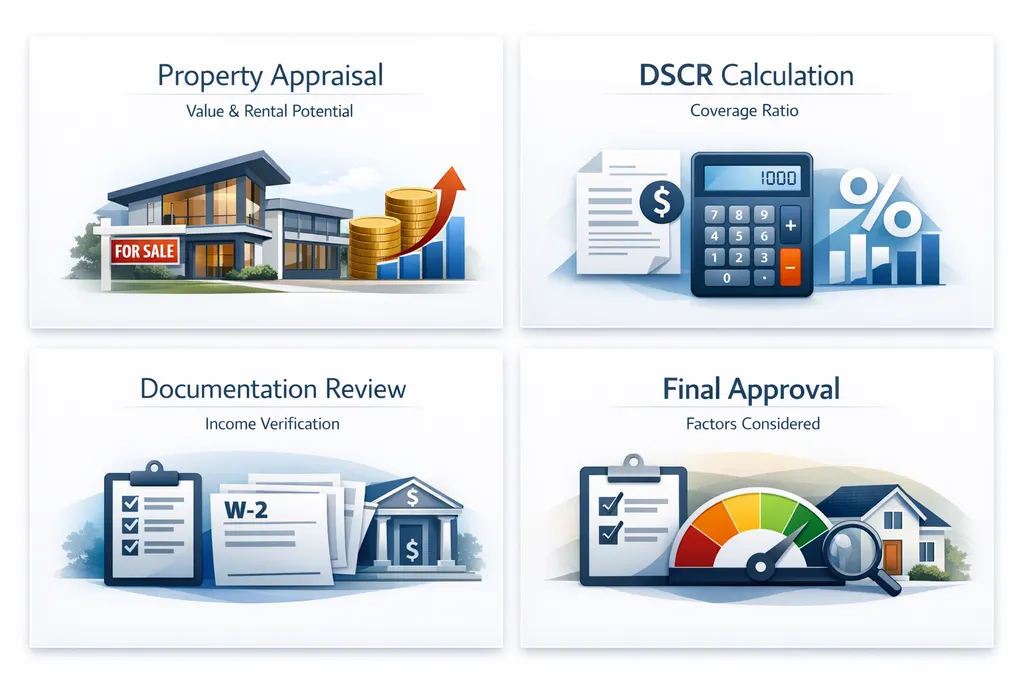
Property appraisal and rent analysis: Professional evaluation determines both property value and rental income potential through market comparisons
DSCR calculation: Lenders divide the monthly rental income by the total monthly debt service to establish the coverage ratio
Documentation review: Existing leases, rent rolls, or market rent studies provide income verification for the specific property
Final approval decision: Lenders weigh the DSCR ratio against other factors like credit score and down payment amount
Optimizing Your Income Position for Approval
Investors can take specific steps to improve their income position and increase the likelihood of DSCR loan approval.
Choose properties with strong rental potential: Focus on locations and property types that command higher market rents relative to purchase price
Increase down payment amounts: Larger down payments reduce monthly debt service, which can improve your DSCR ratio significantly
Improve property condition before application: Well-maintained properties often qualify for higher rental income estimates during appraisal
Gather comprehensive rental documentation: Existing leases, rent rolls, and market studies strengthen your income case with lenders
DSCR Loan Income FAQs
Do I need to show my personal income for a DSCR loan?
Generally no. DSCR loans are underwritten primarily on the property's rental income rather than your personal tax returns or pay stubs. Some lenders may still ask about your overall financial picture, but the core qualification metric is the DSCR ratio itself.
What DSCR ratio do I need to qualify?
Most lenders require a ratio at or above 1.0, meaning the property's rental income at least covers its debt payments. A stronger ratio, often 1.20 or higher, generally unlocks better pricing, though minimums vary by lender.
Can I qualify if my DSCR ratio is below 1.0?
Some lenders offer programs for properties with a DSCR below 1.0, though these typically come with a larger down payment requirement, a rate premium, or both, since the property does not fully cover its own debt service on paper.
Does my job or employment status matter for a DSCR loan?
Employment history is generally not a qualifying factor the way it is for a conventional mortgage. This is one of the main reasons self-employed investors and those with complex income situations use DSCR loans.
Understanding how much income is needed for a DSCR loan empowers real estate investors to make informed decisions about property acquisitions and financing strategies. The focus on rental income rather than personal financial documentation can simplify the qualification process while opening new opportunities for portfolio expansion. Success with DSCR loans often comes down to selecting properties with strong rental potential and understanding how lenders calculate and evaluate debt service coverage ratios. As you consider your next investment property, remember that the property's income-generating ability becomes your strongest qualification asset in the DSCR loan process.