Understanding How Fed Policy Affects Investment Property Loans
Federal Reserve policy decisions send ripples through every corner of the real estate investment landscape. When the Fed adjusts the federal funds rate or signals a shift in monetary policy, the effects reach far beyond Wall Street trading floors. For real estate investors seeking financing for rental properties or fix and flip projects, understanding how fed policy affects investment property loans can mean the difference between a profitable deal and a financial misstep.
The connection between Federal Reserve actions and your borrowing costs might not always be obvious, but it's definitely there. Changes in the federal funds rate typically influence the broader interest rate environment, which in turn affects mortgage pricing and lending standards. For investors relying on DSCR loans or bridge financing, these shifts can alter qualification requirements, debt service coverage calculations, and ultimately, your investment returns.
While traditional homebuyers might focus on monthly payment changes, investors need to think bigger. Rate volatility affects property valuations, rental yields, refinancing opportunities, and the overall feasibility of investment strategies. Let's break down exactly how federal monetary policy shapes the lending landscape for real estate investors and what you can do to stay ahead of the curve.
Common Questions About Federal Policy and Investment Financing
Many real estate investors wonder exactly how decisions made by Federal Reserve policymakers translate into real-world changes in their financing costs. The relationship between federal monetary policy and investment property loans is often more nuanced than it first appears.
Q: Does the federal funds rate directly determine my investment property mortgage rate?
Not exactly. The federal funds rate influences the cost of borrowing for banks and financial institutions, which may then adjust the rates they offer to borrowers. Investment property mortgages typically carry higher interest rates than owner-occupied home loans due to perceived risk factors. When the Fed raises the federal funds rate, lenders might increase borrowing costs across the board, but the relationship isn't always immediate or proportional. Treasury yields, economic conditions, and lender-specific policies all play a role in determining the final rate you'll receive on a DSCR loan or fix and flip financing.
Q: How quickly do Fed rate changes affect investment loan availability?
The timeline can vary. Some lenders adjust their rate sheets within days of a Federal Reserve announcement, while others might take weeks to fully incorporate policy changes into their underwriting guidelines. During periods of significant rate volatility, you might notice that loan programs become more or less accessible as lenders reassess risk and adjust qualification criteria.
How the Federal Funds Rate Influences Borrowing Costs
The federal funds rate serves as a baseline for many lending products across the financial system. When this rate changes, it creates a cascade of adjustments that eventually reach the investment property lending market. Understanding how the federal funds rate influences borrowing costs helps investors anticipate changes in their financing environment.
Bank funding costs rise with rate increases: When the Fed raises the federal funds rate, banks typically pay more to borrow money themselves. These increased costs often get passed along to borrowers in the form of higher mortgage rates, particularly for investment properties where lenders already price in additional risk premiums.
Lending standards may tighten: Higher rates can prompt lenders to become more selective about which deals they'll finance. DSCR requirements might increase, down payment expectations could shift upward, and qualification criteria may become stricter as lenders seek to mitigate risk in a higher-rate environment.
Investor returns face compression: As borrowing costs climb, the spread between your rental income and debt service narrows. This compression can reduce cash flow, lower overall returns, and make some deals that looked attractive at lower rates less appealing when financing costs increase.
Refinancing windows may close: Investors who planned to refinance existing debt might find opportunities disappear as rates rise. Properties acquired with bridge loans or short-term financing could face challenges when transitioning to permanent financing if rates have moved significantly higher.
Rate Volatility and Investment Strategy Adjustments
Rate volatility presents both challenges and opportunities for real estate investors. When mortgage pricing swings rapidly in response to Federal Reserve policy shifts or economic uncertainty, savvy investors adjust their strategies accordingly rather than sticking rigidly to outdated plans.
Acquisition timing becomes critical: During periods of rising rates, locking in financing quickly can save thousands over the life of a loan. Conversely, if rates appear likely to fall, investors might consider shorter-term bridge financing with plans to refinance later, though this approach carries its own risks if rate predictions prove incorrect.
Property selection criteria shift: Higher financing costs typically push investors toward properties with stronger cash flow fundamentals. When evaluating rental properties, higher debt service costs mean you'll need better rent coverage to maintain acceptable DSCR ratios and ensure positive cash flow.
Exit strategies require reconsideration: Fix and flip investors who planned to sell into a hot market might face headwinds if higher rates cool buyer demand. Rate volatility can extend holding periods and increase carrying costs, making it essential to build larger financial buffers into project budgets.
Treasury Yields and Mortgage Pricing Dynamics
While the federal funds rate grabs headlines, treasury yields often play an equally important role in determining investment property mortgage rates. Many lenders price their long-term loan products based on treasury benchmarks rather than the federal funds rate directly.
Ten-year Treasury as a mortgage benchmark: Investment property mortgages often track movements in the ten-year Treasury yield rather than short-term rates. When treasury yields rise, lenders typically increase mortgage rates to maintain their profit margins and account for opportunity costs of capital.
Yield curve signals matter: The relationship between short-term and long-term treasury yields can signal economic expectations. An inverted yield curve, where short-term rates exceed long-term rates, might indicate recession concerns and could affect both property values and lending appetite among financial institutions.
Spread widening during uncertainty: During periods of economic stress or Federal Reserve policy uncertainty, the spread between treasury yields and mortgage rates may widen. Lenders add extra cushion to protect against volatility, which can make investment property financing more expensive even if treasury rates themselves haven't moved dramatically.
Step-by-Step: Adapting Your Investment Approach to Fed Policy Changes
Real estate investors who actively monitor Federal Reserve policy and adjust their strategies accordingly tend to navigate rate environments more successfully than those who ignore macroeconomic factors. Here's a practical framework for incorporating Fed policy awareness into your investment process.
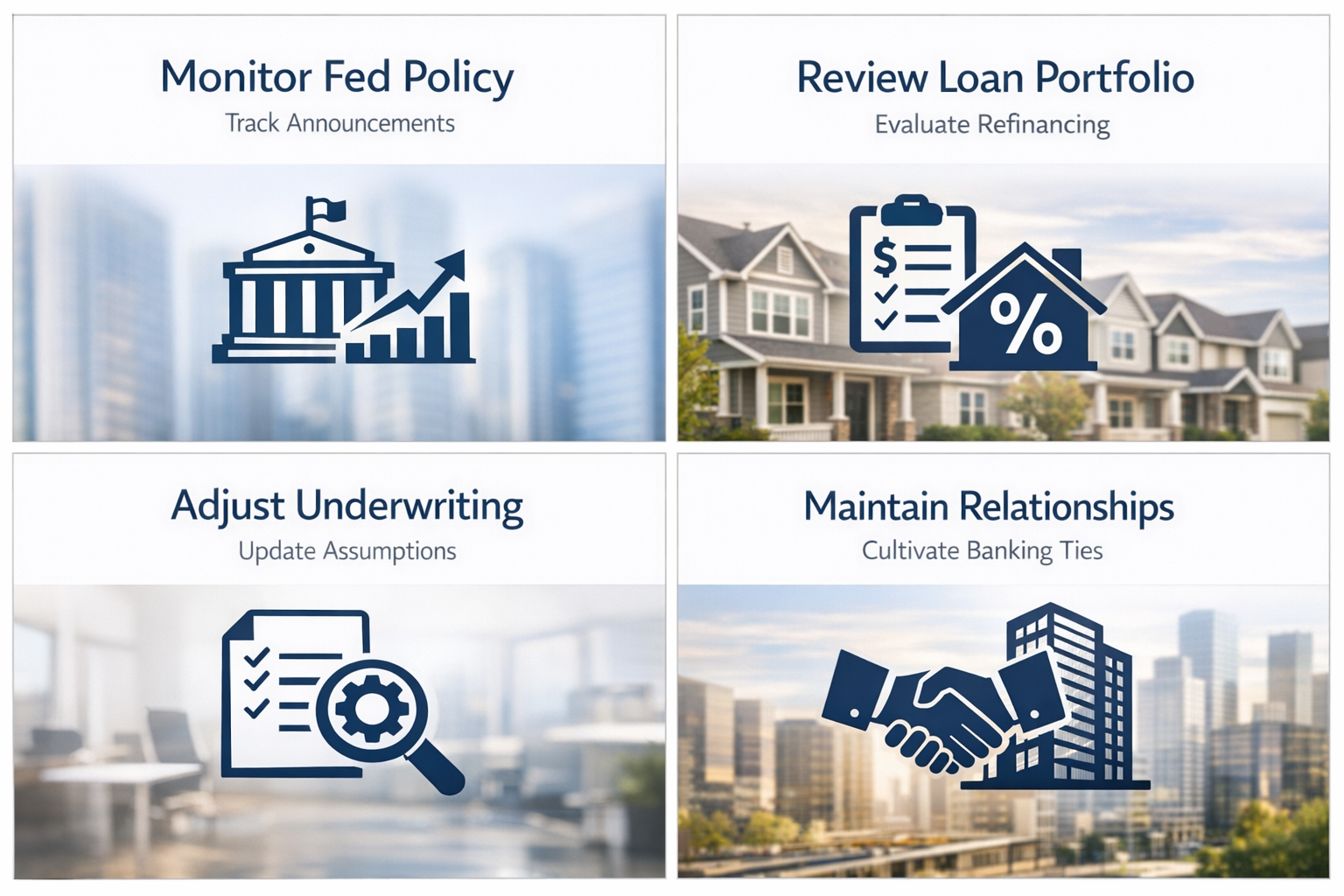
Monitor Federal Reserve announcements and forward guidance: Pay attention to Fed meeting outcomes, policy statements, and economic projections. While you don't need to become a monetary policy expert, understanding the Fed's current stance, whether it's tightening, easing, or holding steady, helps you anticipate potential rate movements that could affect your financing costs.
Review your existing loan portfolio regularly: When Fed policy shifts toward lower rates, evaluate refinancing opportunities for existing properties. Calculate potential savings, considering closing costs and any prepayment penalties. Conversely, if rates are rising, ensure your current financing is locked at favorable terms and consider whether adjustable-rate products might pose risks.
Adjust underwriting assumptions for new deals: Don't underwrite new acquisitions using outdated rate assumptions. When the Fed signals a tightening cycle, build higher interest rate scenarios into your financial models. Test whether deals still generate acceptable returns if rates rise another percentage point or two, ensuring you're not overleveraging based on temporarily favorable conditions.
Maintain relationship banking: During periods of rate volatility, lenders with whom you have established relationships may offer more favorable terms or greater flexibility than institutions seeing your application for the first time. Cultivate these relationships before you need them, as access to capital can tighten quickly when Fed policy shifts dramatically.
Build cash reserves and maintain flexibility: Rate volatility creates uncertainty around refinancing timelines and exit strategies. Maintaining larger cash reserves provides breathing room if rates move against you, allowing you to hold properties longer or weather temporary cash flow challenges without being forced into unfavorable sales or refinancing decisions.
DSCR Loan Qualification in Different Rate Environments
DSCR loans have become increasingly popular among real estate investors because they focus on property cash flow rather than personal income. However, how fed policy affects investment property loans becomes particularly evident in DSCR qualification requirements, which can shift noticeably as rates change.
Calculate how rate changes impact your DSCR ratio: Your debt service coverage ratio compares rental income to loan payments. When interest rates rise, your monthly debt service increases, which can push your DSCR below lender minimum thresholds even if rental income remains constant. Before rates move, calculate what your DSCR would be at various interest rate levels to understand your margin of safety.
Understand lender threshold adjustments: During rising rate periods, some lenders might increase their minimum DSCR requirements from, say, 1.0 to 1.2, seeking additional cushion against default risk. This means properties that previously qualified might no longer meet lending criteria without higher down payments or stronger rental income documentation.
Explore alternative property types or markets: If rising rates price you out of certain markets or property classes, consider whether different investment strategies might offer better DSCR metrics. Properties with stronger rent-to-price ratios or markets with higher rental yields might become more attractive when financing costs increase.
Consider larger down payments to improve qualification: Increasing your down payment reduces your loan amount and, consequently, your debt service. While this ties up more capital per property, it might be necessary to achieve acceptable DSCR ratios when rates climb. Run the numbers to determine whether reducing leverage in a higher-rate environment still produces acceptable overall returns on invested capital.
Recognizing Refinancing Windows Created by Fed Policy Shifts
One of the most tangible ways that Federal Reserve policy affects real estate investors is through refinancing opportunities. When rates decrease, refinancing existing debt can lower your debt service costs and boost cash flow significantly, but timing these windows requires attention to Fed policy signals.
Refinancing opportunities typically emerge when the Federal Reserve shifts from a tightening cycle to a neutral or easing stance. As rates begin to fall, investors who acquired properties or originated loans during higher-rate periods may find substantial savings available through refinancing. The challenge lies in recognizing these windows early enough to take advantage before rates potentially reverse course again.
Real estate investors should monitor not just current rates but also the Fed's forward guidance about future policy intentions. If the Federal Reserve signals that rate cuts may be coming due to economic concerns or inflation returning to target levels, it might be worth preparing your refinancing paperwork in advance. Having recent appraisals, updated rent rolls, and financial documentation ready allows you to move quickly when rates reach favorable levels.
That said, refinancing decisions shouldn't be based solely on rate movements. Calculate your break-even timeline by dividing closing costs by monthly savings. If you plan to hold a property for many years, even modest rate reductions might justify refinancing. For shorter hold periods or properties you're preparing to sell, the costs might outweigh the benefits unless rate improvements are substantial.
Additionally, consider that refinancing windows created by Fed policy shifts might be brief. Markets often anticipate Fed moves before they happen, meaning rates sometimes fall in advance of actual policy changes and then stabilize or even rise once the expected cuts materialize. This forward-looking behavior means waiting for the perfect bottom in rates can backfire, and securing refinancing when rates reach acceptable levels, rather than trying to time absolute lows, often proves to be the wiser strategy.
Understanding how fed policy affects investment property loans isn't just about tracking rate changes. It's about recognizing the broader implications for your investment strategy, from initial acquisitions through refinancing and eventual exits. Federal Reserve policy creates the backdrop against which all real estate investment decisions play out, influencing everything from DSCR qualification standards to property valuations and investor returns.
The relationship between Fed policy and investment property financing operates through multiple channels. Direct effects include changes in borrowing costs as the federal funds rate influences bank funding expenses. Indirect effects emerge through treasury yields, economic growth expectations, and lender risk appetite, all of which shape the mortgage pricing and underwriting landscape investors navigate daily.
Rate volatility, while sometimes uncomfortable, doesn't have to derail your investment plans. Investors who stay informed about Federal Reserve policy direction, build flexibility into their strategies, and maintain strong lender relationships can adapt successfully regardless of whether rates are rising, falling, or holding steady. The key lies in recognizing that financing conditions will change over time and building your investment approach with that reality in mind.
For real estate investors working with DSCR loans, fix and flip financing, or rental property mortgages, monitoring Fed policy provides valuable context for timing decisions and adjusting expectations. You don't need to predict exactly where rates will go, but understanding the current policy direction and potential trajectory helps you make more informed choices about leverage, property selection, and portfolio management.
Ultimately, successful real estate investors treat Federal Reserve policy as one important factor among many in their decision-making process. Property fundamentals, local market conditions, and individual deal characteristics matter tremendously, but ignoring the macroeconomic environment shaped by Fed policy would be shortsighted. By staying aware of how policy shifts might affect your financing costs and qualification requirements, you position yourself to seize opportunities and avoid pitfalls that catch less-informed investors off guard.