DSCR Refinance Rates vs Purchase Rates: What Every Investor Should Know
Real estate investors who rely on rental income to qualify for financing face a common question: does refinancing cost more than buying? When you're building a portfolio with DSCR loans, understanding how dscr refinance rates vs purchase rates compare can shape every strategic move you make. Many investors assume refinancing always carries a premium, but recent pricing data tells a more nuanced story.
The good news is that well-qualified investors often encounter minimal rate differences between purchasing new rental properties and refinancing existing ones. This parity opens the door to flexible portfolio management, whether you're consolidating debt, pulling equity for your next deal, or simply locking in better terms. The key lies in knowing what drives pricing for each loan type and how your borrower profile influences the final numbers.
In this guide, we'll break down exactly how DSCR loan rates differ between purchases and refinances, what factors influence those spreads, and how you can use this knowledge to optimize your investment strategy. From rate/term refinances to cash-out scenarios, you'll learn when refinancing makes financial sense and how to position yourself for the best possible pricing.
How DSCR Loan Pricing Works for Purchases and Refinances
DSCR loans use the property's cash flow, not your personal income, to determine eligibility. The debt service coverage ratio itself is straightforward: you divide the property's monthly rental income by its monthly debt obligation. A ratio of 1.25, for example, means the property generates 25% more income than needed to cover the mortgage payment. Lenders use this metric alongside credit score, loan-to-value ratio, and property type to price both purchase and refinance loans.
Purchase loans for investment properties typically receive baseline pricing because lenders view them as fresh transactions with complete appraisals and updated property valuations. Refinances follow a similar underwriting model but add one layer: the reason for refinancing. Rate/term refinances, where you're simply adjusting your loan structure or interest rate without taking cash out, generally price closest to purchase loans. Cash-out refinances, which let you tap equity, tend to carry a modest premium because they increase lender risk.
According to recent pricing reports, high-credit borrowers with strong property performance might see purchase rates starting around 6.125% with a 780 FICO score, 75% LTV, and a 1.25 DSCR. Rate/term refinances for the same borrower profile often match that pricing. Cash-out refinances, meanwhile, might begin closer to 6.490% under premium scenarios, representing a spread of roughly 0.365% over purchase rates. These figures illustrate that the difference between dscr refinance rates vs purchase rates is often smaller than many investors anticipate, especially for those with solid credit and strong rental performance.
The pricing mechanism itself hinges on risk layering. Each factor, whether it's a lower credit score, higher LTV, or weaker DSCR, adds incremental cost. But the loan purpose alone, purchase versus refinance, doesn't automatically trigger a large penalty. Instead, the overall risk profile determines your final rate, which is why a well-positioned investor can refinance with minimal cost difference compared to buying a new property.
Do's: Smart Strategies for Comparing Refinance and Purchase Rates
Navigating DSCR loan pricing requires a methodical approach. Here's how to position yourself for the most competitive rates, whether you're purchasing or refinancing.
Do maintain a FICO score of 740 or higher. Lenders reward strong credit with their best pricing tiers. Even a 20-point score improvement can unlock a lower rate bracket and save thousands over the loan term.
Do target a DSCR of 1.25 or above. Properties that generate healthy cash flow relative to their debt service receive preferential pricing. If your rental income falls short, consider adjusting rents or paying down other property expenses before applying.
Do keep your LTV at or below 75%. Lower leverage reduces lender risk and directly translates to better rates. If you're refinancing, waiting until you've built more equity can pay off in the form of a lower rate.
Do compare rate/term refinance pricing before pursuing cash-out. If you don't immediately need liquidity, a rate/term refinance might match purchase loan pricing and still improve your loan structure or reduce your payment.
Don'ts: Common Mistakes When Evaluating DSCR Loan Rates
Avoiding these pitfalls will help you secure better pricing and make smarter financing decisions across your portfolio.
Don't assume refinancing always costs more. Many investors delay refinancing because they believe rates will be significantly higher, but recent data shows minimal spreads for well-qualified borrowers. Evaluate current pricing rather than relying on outdated assumptions.
Don't ignore the total cost of borrowing. A slightly higher rate on a cash-out refinance might still be worthwhile if the equity you extract funds a higher-return investment. Focus on the net benefit, not just the rate itself.
Don't apply with weak rental documentation. DSCR loans hinge on demonstrable cash flow. Missing lease agreements, incomplete rent rolls, or unrealistic income projections can hurt your pricing or even lead to a denial.
Don't overlook prepayment penalties on your existing loan. If you're refinancing out of a loan with a steep penalty, calculate whether the rate improvement justifies the exit cost. Sometimes waiting a few months to clear a penalty period makes more financial sense.
Key Factors That Influence DSCR Refinance Rates vs Purchase Rates
Several variables determine whether your refinance pricing aligns with or diverges from purchase loan rates. Understanding these levers helps you anticipate costs and structure deals accordingly.
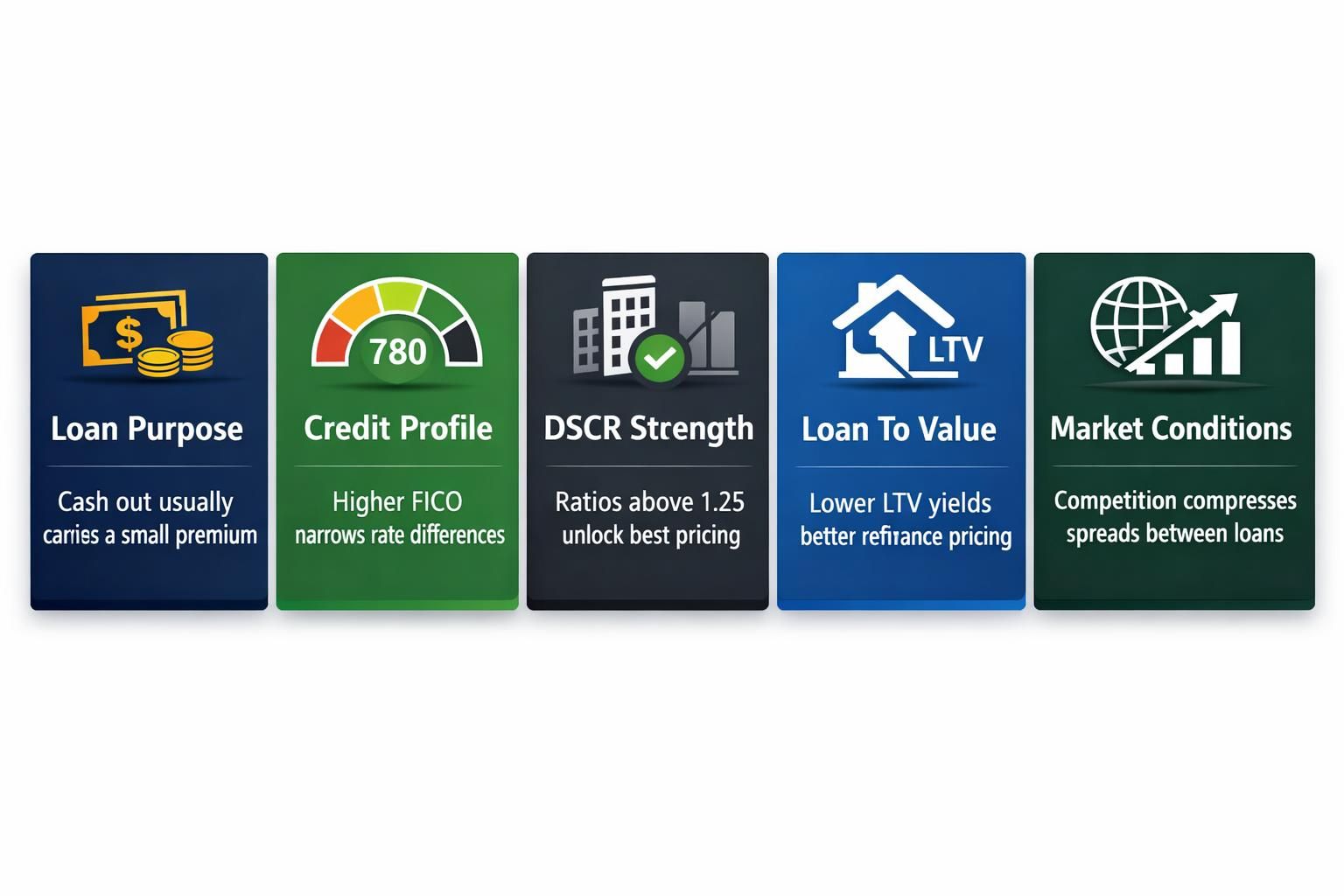
Loan purpose and equity extraction. Rate/term refinances typically price closest to purchase loans because they don't increase the lender's exposure. Cash-out refinances carry a premium, though the spread might be less than half a percentage point for borrowers with strong profiles. The amount of cash you take out also matters; larger draws relative to property value can widen the rate gap.
Credit score and borrower profile. High-credit investors often see the smallest difference between purchase and refinance rates. Recent pricing data shows that borrowers with 780+ FICO scores and strong debt service coverage ratios can access rates starting in the low-6% range for both loan types. Lower scores, by contrast, may see larger spreads and higher floors on refinance pricing.
Property performance and DSCR. A property generating robust rental income relative to its debt service sends a strong signal to lenders. DSCR ratios of 1.25 or higher tend to unlock the best pricing, while ratios below 1.0 might push rates higher or require reserves and compensating factors. This dynamic applies equally to purchases and refinances, but refinances benefit from a track record of actual rental performance rather than projected income.
Loan-to-value ratio and equity position. Lower LTV ratios reduce lender risk and improve pricing. Purchase loans are often capped at 80% to 85% LTV, depending on the lender and property type. Refinances follow similar limits, but your equity position at the time of refinancing determines how much flexibility you have. A property you've owned for years with significant equity might qualify for a lower rate than a recent purchase with minimal down payment.
Market conditions and lender appetite. DSCR loan pricing fluctuates with broader interest rate trends and investor demand for mortgage-backed securities. When lender competition is high, the spread between purchase and refinance rates tends to compress. In tighter markets, refinances, particularly cash-out transactions, might see slightly wider spreads as lenders adjust for perceived risk.
When Refinancing Makes More Sense Than Purchasing New Properties
Deciding between refinancing an existing asset and acquiring a new one depends on your portfolio goals, available capital, and current market opportunities. Here's when refinancing often delivers better returns.
You need capital for another investment without selling.Cash-out refinancing lets you tap accumulated equity to fund down payments on additional properties. If you're facing a competitive acquisition opportunity and don't want to liquidate a performing asset, refinancing can unlock liquidity without triggering capital gains taxes or losing rental income.
Your existing loan carries unfavorable terms. If you financed a property years ago with a higher rate or restrictive loan structure, a rate/term refinance can reduce monthly payments and improve cash flow. Even a modest rate improvement, when spread over a 30-year term, can add up to substantial savings and increase your property's net operating income.
Property values have appreciated significantly. Rising property values increase your equity position and might allow you to refinance at a lower LTV, which can improve your rate. If your property has gained 20% or more in value since purchase, refinancing could offer better pricing than when you originally financed.
You want to consolidate multiple loans. Investors with several properties might benefit from refinancing multiple loans into a single blanket loan or replacing scattered high-rate debt with a streamlined DSCR refinance. This strategy can simplify portfolio management and reduce overall interest costs.
Is Refinancing More Expensive Than Buying With a DSCR Loan?
The question of whether is refinancing more expensive than buying with a dscr loan depends heavily on your borrower profile and the type of refinance you pursue. For investors with strong credit, healthy DSCR ratios, and moderate LTV, rate/term refinances often price at parity with purchase loans. Recent data suggests that both loan types might start around 6.125% for well-qualified borrowers, meaning the cost difference can be negligible.
Cash-out refinances do tend to carry a premium, reflecting the increased lender risk when you extract equity. Pricing for these transactions might begin closer to 6.490% under premium conditions, representing a spread of roughly 0.365% over comparable purchase loans. While this is a measurable difference, it's far from prohibitive, especially when you consider the strategic value of accessing equity for additional investments or property improvements.
Closing costs also play a role in the total expense comparison. Refinances typically involve appraisal fees, title insurance, and lender charges similar to purchase loans, though you avoid some buyer-side costs like transfer taxes in many jurisdictions. When evaluating total cost, calculate both the rate differential and the upfront fees to determine your break-even point and overall return on the refinance.
Another consideration is the opportunity cost. If refinancing frees up capital that you deploy into a property with stronger cash flow or appreciation potential, the slightly higher rate might be a worthwhile trade-off. Conversely, if purchase loan rates are competitive and you have sufficient capital for a down payment, buying a new property might offer better risk-adjusted returns without adding leverage to an existing asset.
Ultimately, the expense comparison isn't just about rate spreads. It's about how the financing aligns with your broader portfolio strategy, cash flow needs, and growth trajectory. For many investors, the ability to refinance at rates that closely match purchase pricing provides valuable flexibility to adapt as market conditions and personal goals evolve.
How to Secure the Best DSCR Loan Rates for Any Transaction
Getting the lowest possible rate, whether you're purchasing or refinancing, requires preparation and strategic positioning. Here's how to maximize your chances of securing competitive DSCR loan pricing.
Optimize your credit profile before applying. Pay down credit card balances, correct any errors on your credit report, and avoid opening new accounts in the months leading up to your application. Even small score improvements can shift you into a better pricing tier and save thousands over the loan term.
Document rental income meticulously. Lenders calculate DSCR based on verifiable rental income, so gather current lease agreements, rent rolls, and bank statements showing consistent deposits. If you're purchasing, provide a market rent analysis or appraisal that supports your projected income figures. Strong documentation reduces lender uncertainty and supports better pricing.
Compare multiple lenders and loan structures. DSCR loan pricing varies across lenders based on their risk appetite, investor relationships, and portfolio needs. Request quotes from several sources and compare not just rates but also fees, prepayment penalties, and loan terms. Some lenders offer better pricing for specific property types or geographic markets, so casting a wide net pays off.
Consider timing your transaction strategically. Interest rates fluctuate with economic conditions and Federal Reserve policy. While you can't perfectly time the market, monitoring trends and locking a rate when conditions are favorable can make a meaningful difference. If rates are rising, locking early protects you from further increases. If they're falling, delaying a refinance by a few months might improve your pricing.
Leverage your track record and relationships. Investors with multiple properties and a history of timely payments often receive preferential pricing from lenders who value repeat business. If you've worked with a lender before and maintained a strong relationship, don't hesitate to ask for competitive pricing or to match a quote from another source.
Understanding how dscr refinance rates vs purchase rates compare gives you the insight to make smarter financing decisions across your portfolio. For well-qualified investors, the cost difference is often minimal, especially for rate/term refinances that don't involve cash-out. Even when you do extract equity, the premium might be just a fraction of a percent, making it a worthwhile trade-off when the capital fuels additional growth.
The key takeaway is that refinancing shouldn't be dismissed as inherently more expensive. Instead, evaluate each opportunity based on your borrower profile, property performance, and strategic goals. Whether you're consolidating debt, pulling equity for your next acquisition, or simply improving loan terms, competitive DSCR pricing is accessible when you prepare thoroughly and compare your options.
As you plan your next move, focus on the factors you can control: credit score, rental documentation, LTV ratio, and lender selection. These elements drive pricing far more than the simple distinction between purchase and refinance. Ready to explore your options? Get a personalized DSCR loan quote and see how competitive rates can support your investment strategy today.