DSCR Loan Underwriting Guidelines for Warrantable Condos
August 11, 2026
•
9 min read
Understanding DSCR Loan Underwriting for Warrantable Condos
Financing condo investment properties presents unique challenges that go far beyond typical single-family rental loans. When you're evaluating a condo deal, understanding the underwriting process becomes critical to your success. DSCR loan underwriting guidelines for warrantable condos offer a path forward that focuses on property cash flow rather than your personal income, making them particularly attractive for investors building or scaling a rental portfolio.
Unlike conventional mortgages that scrutinize your W-2s and tax returns, DSCR loans evaluate whether the rental income from the property can cover the mortgage payment. This shift in focus opens doors for investors who might have complex tax situations or multiple properties already generating income. However, condos add another layer of complexity because lenders must evaluate not just the unit itself, but the entire condo project's financial health and legal structure.
For warrantable condos, those that meet standard agency guidelines, the underwriting process tends to be more straightforward than their non-warrantable counterparts. Yet even warrantable projects require careful review of HOA financials, owner-occupancy ratios, and project insurance. Getting a handle on these requirements early in your deal evaluation process can save you time, money, and potential heartache down the road.
Core DSCR Loan Requirements for Condo Investments
Core DSCR loan requirements for condo investments establish the foundation for your financing approval. Before you can close on that promising condo unit in a high-demand rental market, you'll need to satisfy several key criteria that lenders use to assess risk and determine loan terms.
Minimum debt service coverage ratio: Most lenders require a DSCR of at least 1.0, meaning the property's rental income must equal or exceed the monthly mortgage payment, including principal, interest, taxes, insurance, and HOA fees. Higher ratios often unlock better rates and terms.
Credit score thresholds: While DSCR loans are more flexible than conventional mortgages, lenders typically still expect minimum credit scores. Investors with stronger credit profiles may access lower rates and higher loan-to-value ratios.
Loan-to-value caps: Maximum LTV ratios determine how much you'll need for a down payment. These caps vary based on the DSCR, credit profile, and whether the condo is warrantable or non-warrantable, with warrantable condos generally receiving more favorable treatment.
Property performance focus: The core principle of DSCR lending shifts attention from your personal income to the asset's ability to generate sufficient rental revenue, making these loans particularly useful when your tax returns don't reflect your true borrowing capacity.
These baseline requirements form the starting point for your underwriting journey. Each lender may layer on additional criteria based on their risk appetite and portfolio strategy, but these fundamentals remain consistent across most DSCR programs. Understanding where your investment property stands relative to these benchmarks helps you anticipate potential obstacles and structure deals accordingly.
What Makes a Condo Warrantable
What makes a condo warrantable comes down to meeting specific criteria established by major mortgage agencies. For investors, warrantability significantly impacts both loan availability and terms, so knowing these distinctions before you make an offer can protect your investment strategy.
Owner-occupancy requirements: Warrantable condos typically need a certain percentage of units to be owner-occupied rather than investor-owned or rented out. This ratio demonstrates project stability and reduces concentration risk from the lender's perspective.
HOA financial health: The homeowners association must maintain adequate reserves and keep delinquency rates below specific thresholds. High delinquency rates signal financial instability and can trigger non-warrantable status, even if other criteria are met.
Single-entity ownership limits: Projects where one person or entity owns too many units may not qualify as warrantable. This protects against concentration risk and ensures diverse ownership throughout the building.
Commercial space restrictions: The percentage of space dedicated to commercial use versus residential units affects warrantability. Too much commercial footage can disqualify a project from agency guidelines.
Litigation and legal standing: Active lawsuits against the HOA or significant pending legal issues can impact warrantable status and create financing roadblocks for individual units.
These warrantability factors exist outside your control as an investor purchasing a single unit. That's why due diligence on the condo project itself becomes just as important as evaluating the individual unit's rental potential. A great condo in a problematic project can sink your financing options faster than any issue with the unit itself.
Project Review and Documentation Process
The project review and documentation process for financing condo investment properties with cash flow loans involves more paperwork and scrutiny than single-family transactions. Lenders need to verify that the entire condo project meets their underwriting standards, not just the individual unit you're purchasing.
HOA documentation requirements: Expect to provide the condo association's master insurance policy, budget documents, reserve study, and recent financial statements. These documents reveal the project's financial stability and proper insurance coverage.
Project questionnaires: Many lenders require detailed questionnaires completed by the HOA management company, covering everything from owner-occupancy percentages to pending special assessments and litigation status.
Budget and reserve analysis: Underwriters examine whether the HOA maintains sufficient reserves for future capital improvements and whether the monthly fees adequately cover ongoing expenses without excessive special assessments.
Insurance verification: The project must carry adequate hazard and liability coverage, with proper flood insurance if applicable. Gaps in coverage can delay or derail financing entirely.
This documentation gathering often takes longer than investors anticipate. Working with an HOA management company that's familiar with lender requirements can streamline the process considerably. Some condos in popular investor markets have pre-packaged documentation ready to go, while others might require multiple follow-up requests that extend your timeline.
Getting ahead of this process early, even before you make an offer, gives you a realistic picture of the financing landscape. If the HOA is unresponsive or the project documentation reveals red flags, you'll want to know that before you're under contract with earnest money at risk.
How to Calculate DSCR for Condos
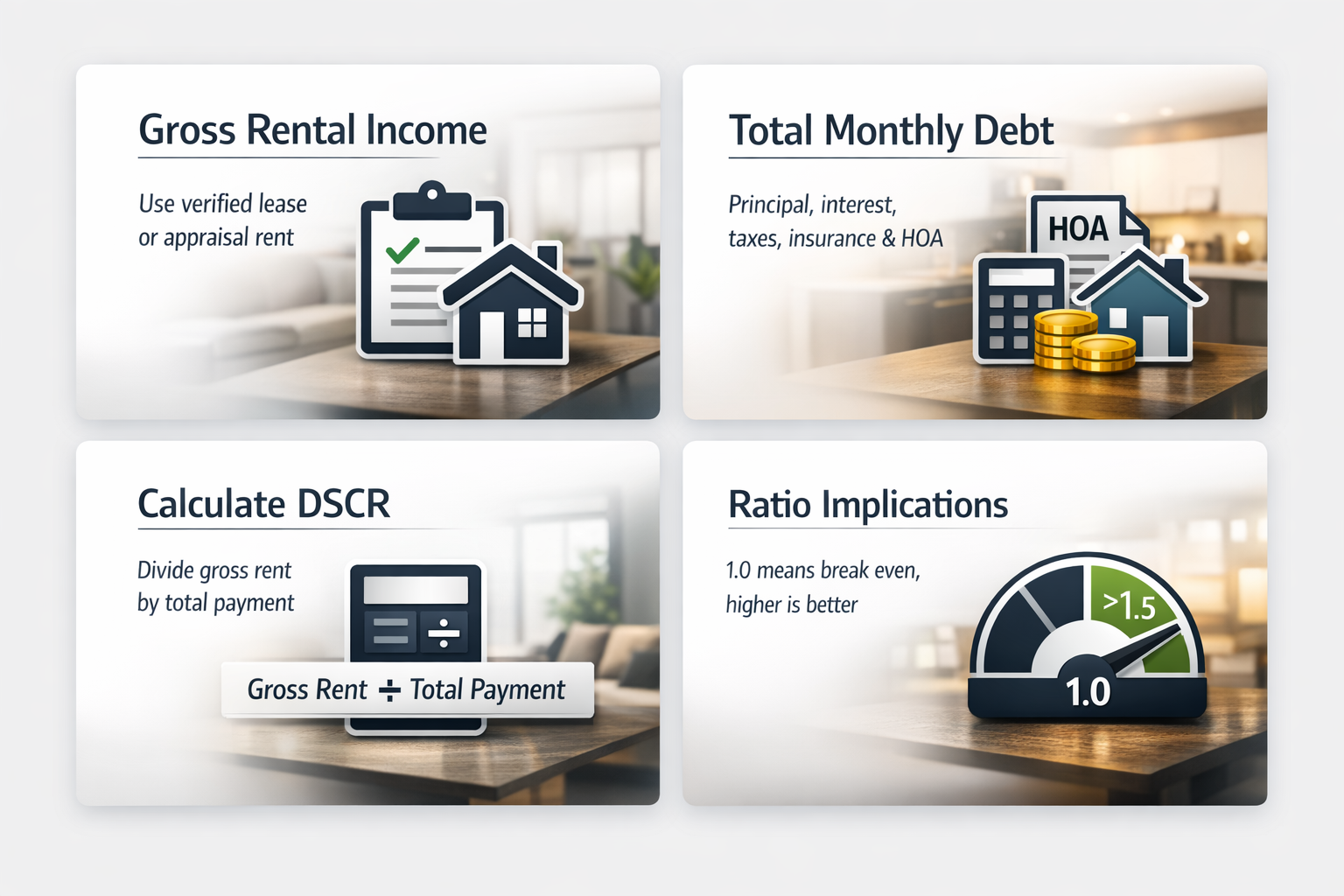
How to calculate DSCR for condos follows a straightforward formula, but applying it correctly requires understanding which income and expenses to include. The debt service coverage ratio divides the property's rental income by its total monthly housing expense.
Determine gross rental income: Start with the monthly rent the property can realistically command. Most lenders use either the actual lease in place or an appraisal rent schedule to establish this figure. They typically don't allow you to use aspirational rents that haven't been verified by market data.
Calculate total monthly debt service: Add together your principal and interest payment, property taxes, insurance premium, HOA fees, and any other recurring property-specific costs. For condos, HOA fees can represent a significant portion of this total, sometimes more than the principal and interest combined in luxury buildings.
Divide income by expenses: Take your gross monthly rent and divide it by the total monthly housing expense. If your condo rents for $3,000 per month and your total payment including HOA fees is $2,500, your DSCR is 1.2. This ratio tells the lender the property generates 120% of what's needed to cover the debt.
Understand ratio implications: A DSCR of 1.0 means the income exactly covers expenses with no cushion. Ratios below 1.0 indicate negative cash flow, which some lenders may still finance but at higher rates and lower LTVs. Ratios above 1.25 typically receive the most favorable terms.
The DSCR calculation is mechanical, but the inputs require judgment and verification. Lenders won't simply accept your estimate of market rent. They'll want third-party validation through an appraisal or rent schedule. Similarly, all expense components must be documented and reasonable.
For condo investors, HOA fees deserve special attention in your DSCR planning. These fees vary dramatically between properties and directly impact your debt service coverage. A building with high HOA fees might require higher rents to achieve the same DSCR as a comparable unit with lower fees, affecting your target property selection.
Common Underwriting Challenges and Solutions
Common underwriting challenges for DSCR loans on warrantable condos can derail deals if you're not prepared with solutions. Knowing where friction typically occurs allows you to address issues proactively rather than scrambling when problems surface during underwriting.
HOA delinquency spikes: If too many owners fall behind on HOA fees, the entire project may fail warrantability standards. Solution: request recent delinquency reports during your due diligence period, and if rates are borderline, consider whether the investment risk justifies potential financing complications.
Insufficient HOA reserves: Projects without adequate reserve funds for future repairs and replacements raise red flags for lenders who worry about special assessments hitting owners. Solution: review the reserve study carefully and factor potential special assessments into your long-term cash flow projections.
Rental income documentation gaps: New construction or recently renovated units may lack rental history, making it harder to establish market rent. Solution: work with your appraiser to provide comparable rental data from similar units in the building or nearby projects with similar amenities and finishes.
Project insurance lapses or gaps: Missing coverage components or approaching renewal dates can stall underwriting. Solution: verify current insurance status early and ensure the HOA maintains continuous coverage without gaps that might delay your closing.
These challenges occur frequently enough that experienced investors build time buffers into their purchase timelines. A 45-day closing might sound reasonable for a single-family rental, but condos often benefit from 60-day or longer timelines that accommodate the additional project review requirements.
Communication with the HOA management company becomes critical when challenges arise. Having a responsive management team that quickly provides requested documentation or clarification can mean the difference between a smooth closing and a terminated contract. Some investors specifically target condo projects with professional management known for efficient lender cooperation.
Warrantable vs Non-Warrantable: Key Distinctions
Warrantable versus non-warrantable distinctions affect everything from interest rates to down payment requirements. While both property types can work for DSCR financing, understanding the differences helps you evaluate deals accurately and set proper expectations for loan terms.
Warrantable condos meet standard agency guidelines and typically offer more favorable financing terms. These projects have passed scrutiny for owner-occupancy ratios, HOA financial health, commercial space limitations, and other criteria. Lenders view them as lower risk, which translates to better rates and higher maximum LTV ratios for investors.
Non-warrantable condos fail to meet one or more agency standards. Common triggers include high investor concentration, significant commercial space, new construction that hasn't reached completion thresholds, condotel properties, or projects with pending litigation. These characteristics don't necessarily indicate poor investments, but they do signal higher lending risk.
From a DSCR loan perspective, both categories remain financeable, but non-warrantable condos typically face additional requirements. Lenders might require higher DSCR minimums, such as 1.1 or 1.2 instead of 1.0. Maximum LTV ratios often decrease, requiring larger down payments. Interest rates may carry premiums to compensate for the additional perceived risk.
The underwriting process for non-warrantable condos also tends to involve more detailed project review and additional documentation requests. Lenders want to understand exactly why the project is non-warrantable and assess whether that factor creates meaningful default risk for their loan.
For investors, the key is running your numbers with realistic loan assumptions based on the project's warrantable status. A seemingly profitable deal on a non-warrantable condo might look less attractive once you account for a higher down payment requirement and elevated interest rate. Conversely, strong rental demand and cash flow might more than compensate for slightly less favorable financing terms.
Optimizing Your DSCR Loan Application
Optimizing your DSCR loan application positions you for the best possible terms and smoothest transaction. While you can't control condo project characteristics, you can control how you structure your deal and present your application to lenders.
Start by shopping your deal to multiple DSCR lenders rather than accepting the first quote you receive. Terms vary significantly between lenders based on their portfolio needs, risk appetite, and geographic focus. One lender might specialize in condo financing and offer better terms, while another focuses primarily on single-family rentals and prices condos less competitively.
Consider structuring your purchase to maximize your DSCR. If your ratio sits close to a threshold like 1.0 or 1.25 where terms improve, evaluate whether a slightly larger down payment could reduce your monthly debt service enough to cross into better pricing. Sometimes an extra five or ten thousand dollars down unlocks rate improvements that pay for themselves within months.
Prepare your documentation package thoroughly before submitting your application. Have your operating agreement or trust documents ready if you're purchasing under an entity. Provide clear rent comparables if the property lacks rental history. Anticipate lender questions about the condo project and gather HOA documents proactively rather than waiting for requests.
Timing matters too. Submit your application with enough buffer time before your closing date to accommodate the condo project review process. Rushed underwriting on compressed timelines increases stress and may force you to accept less favorable terms to meet your contract deadline.
Work with professionals experienced in investor condo financing. A knowledgeable loan officer who regularly handles DSCR condo transactions can navigate underwriting more efficiently than someone who primarily works with owner-occupied conventional loans. Similarly, your real estate agent should understand the financing complexities and help structure realistic timelines and contingencies.
Finally, maintain realistic expectations about the process. Condo financing involves more complexity than single-family properties, period. Projects that appeared warrantable during your initial research might reveal issues during deeper underwriting review. Having backup options and flexibility in your investment strategy prevents you from feeling cornered if your first-choice financing path encounters obstacles.
Navigating DSCR loan underwriting guidelines for warrantable condos requires attention to detail, patience with the documentation process, and realistic expectations about timelines. The cash flow-focused nature of DSCR lending makes it an excellent tool for condo investors who want to scale their portfolios without the income verification requirements of conventional mortgages.
Success in condo investing starts with thorough due diligence on both the individual unit and the broader project. Understanding warrantability criteria, HOA financial health, and project documentation requirements before you make offers saves time and protects your earnest money. The most successful investors treat the condo project review as seriously as they treat the unit's rental potential.
While warrantable condos generally offer more straightforward financing paths, even these properties require careful underwriting navigation. Building relationships with lenders who specialize in investor condo financing and maintaining organized documentation practices streamlines the process and positions you for favorable terms.
Remember that DSCR lending focuses on the property's ability to generate income relative to its debt obligations. Keep that principle front and center as you evaluate deals, structure offers, and work through underwriting. Properties with strong cash flow characteristics ultimately receive the best financing terms, regardless of your personal financial situation.
If you're ready to explore financing options for your next condo investment property, get a personalized DSCR loan quote tailored to your specific investment goals and property characteristics.