DSCR Loans for Student Housing: Investor's Guide (2026)
August 31, 2026
•
8 min read
Student housing presents a compelling opportunity for real estate investors seeking consistent rental income near college campuses. A DSCR loan for student housing rentals offers unique advantages by focusing on the property's income potential rather than personal financial documentation. This financing approach has become increasingly popular among investors targeting single-family homes with 3-5 bedrooms in college towns, where demand for off-campus housing continues to grow.
Unlike traditional mortgage products, DSCR loans evaluate your investment based on the property's debt service coverage ratio, making them particularly suitable for student rental properties that generate reliable income through academic leases. Understanding how to leverage this financing tool effectively can help you build a profitable portfolio in university markets while managing the unique challenges of student housing investments.
Essential Property Selection Criteria
Selecting the right property configuration is crucial when pursuing a DSCR loan for student housing rentals. Lenders typically favor specific property types that demonstrate strong income potential and manageable risk profiles in college markets.
Target single-family homes with 3-5 bedrooms: These configurations are often preferred by lenders and can accommodate multiple students while maintaining a residential feel that appeals to both tenants and neighbors.
Focus on proximity to campus locations: Properties within walking distance or easy commuting access to universities tend to have lower vacancy rates and command higher rents per room.
Evaluate neighborhood safety and amenities: Well-maintained areas with good lighting, parking availability, and nearby conveniences like grocery stores and restaurants attract quality tenants and support rental stability.
Consider property age and maintenance requirements: Newer or recently renovated properties may require less immediate capital investment and appeal more to students who prioritize modern amenities and reliable utilities.
Advanced Income Modeling Techniques
Proper income modeling is fundamental to securing favorable DSCR loan terms and maximizing returns from student housing investments. The unique rental patterns in college markets require specialized approaches that account for academic calendars and student preferences.
Implement room-by-room rental strategies: Renting individual rooms rather than the entire property can enhance income predictability and reduce risks associated with full-property vacancies during student turnovers.
Structure leases around academic schedules: Academic leases that align with school years help stabilize occupancy rates and allow for predictable income forecasting when presenting your investment to lenders.
Account for seasonal vacancy patterns: Include summer months and semester breaks in your financial projections to demonstrate realistic income expectations and proper cash flow management.
Document comparable rental rates: Research per-room and per-property rental rates in your target area to support your income projections and justify your investment thesis to DSCR loan providers.
Turnover Risk Management Strategies
Student housing investments face unique turnover challenges that require proactive management to maintain consistent cash flow and satisfy DSCR loan requirements. Effective risk management strategies help minimize vacancy periods and protect your investment returns.
Build relationships with university housing offices: Establishing connections with campus housing coordinators can provide referrals and early notice of students seeking off-campus accommodations.
Implement flexible lease structures: Offering options like semester-only leases or early renewal incentives can help maintain occupancy during typical transition periods.
Create comprehensive tenant screening processes: Thorough background checks, academic standing verification, and co-signer requirements help identify reliable tenants who are likely to fulfill their lease obligations.
Plan for turnover expenses: Budget for cleaning, minor repairs, and marketing costs between tenants to ensure these expenses don't negatively impact your debt service coverage ratio.
DSCR Loan Qualification Requirements
Understanding the specific qualification criteria for DSCR loans in student housing helps investors prepare stronger loan applications and secure better financing terms. DSCR loans can finance investment properties based primarily on property income rather than personal financial history.
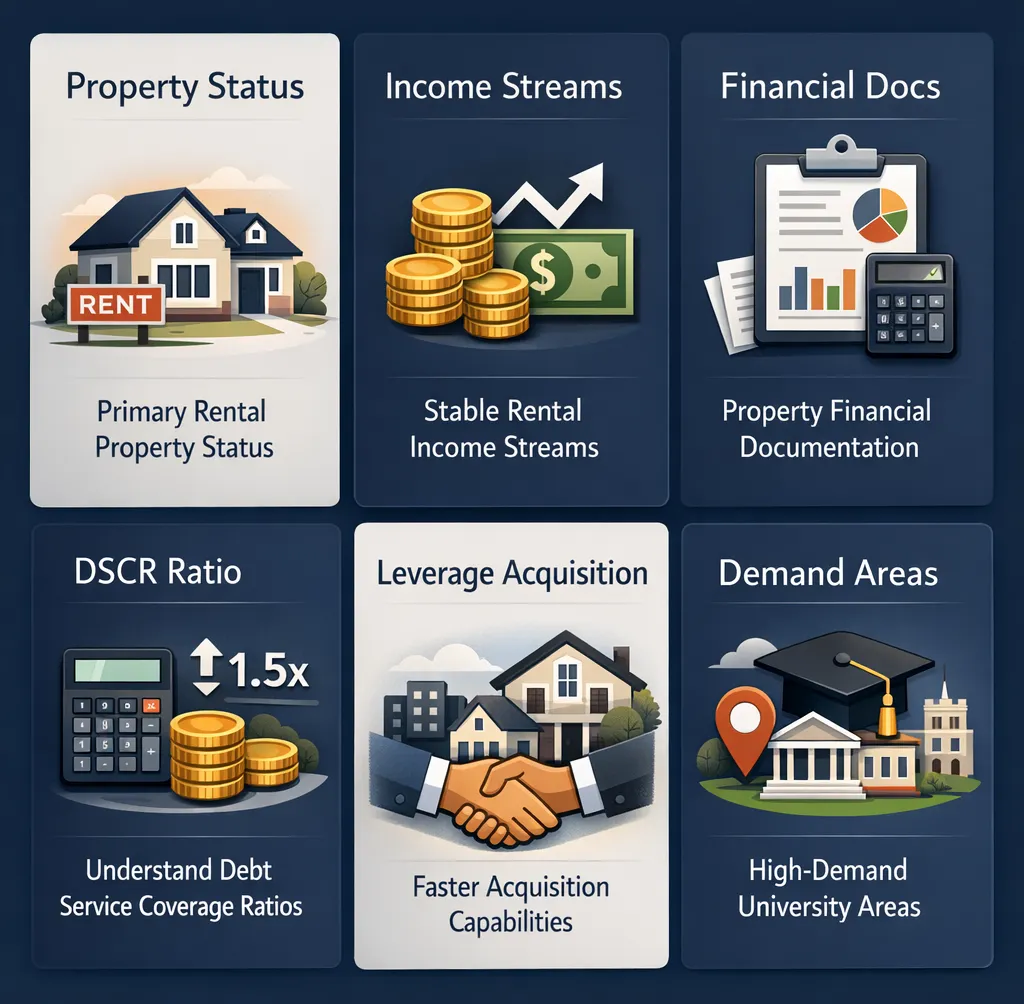
Maintain primary rental property status: Ensure your student housing operates primarily as a rental property to meet basic DSCR loan eligibility requirements and avoid complications during underwriting.
Demonstrate stable rental income streams: Provide documentation of consistent rental income through lease agreements, rental histories, and market analysis to support your debt service coverage calculations.
Prepare property financial documentation: Compile rent rolls, operating expenses, and property management costs to present a clear picture of the investment's financial performance.
Understand debt service coverage ratios: Most lenders require DSCR ratios above 1.0, meaning rental income must exceed debt service payments by a comfortable margin to qualify for favorable loan terms.
Maximizing Investment Returns
Optimizing returns from student housing investments requires strategic approaches that leverage the benefits of DSCR financing while addressing the unique aspects of college rental markets. Smart investors focus on both immediate cash flow and long-term appreciation potential.
Leverage faster acquisition capabilities: DSCR loans typically require less complex documentation than traditional mortgages, allowing you to move quickly on attractive student housing opportunities in competitive markets.
Focus on high-demand university areas: Target markets with growing student populations, limited campus housing, or expanding academic programs to ensure sustained rental demand for your properties.
Implement value-add improvements: Strategic upgrades like updated kitchens, reliable internet infrastructure, or improved parking can justify higher rents and improve your property's debt service coverage ratio.
Consider portfolio expansion opportunities: Use successful student housing investments as stepping stones to acquire additional properties, building a diversified rental portfolio across multiple college markets.
What Lenders Look at Specifically for Student Housing
Proximity to campus: Properties within reasonable walking or shuttle distance to a university typically support stronger, more predictable rental demand.
Lease structure: Individual per-bedroom leases versus a single master lease can affect how a lender calculates income and assesses vacancy risk.
Seasonal vacancy: Summer months often bring higher vacancy in college markets, and some lenders apply a conservative income adjustment to account for this.
University enrollment trends: Stable or growing enrollment at the nearby institution generally supports a stronger long-term income case than a school with declining enrollment.
Student Housing DSCR Loan FAQs
Do lenders require parental co-signers for student tenant leases?
That's a landlord-tenant leasing decision rather than a DSCR loan requirement. The loan qualifies on the property's income potential, though a strong, well-documented leasing history can support your income case.
Is off-campus student housing riskier to finance than standard rentals?
Lenders often view it as carrying somewhat higher turnover and seasonal vacancy risk, which can show up as more conservative income assumptions or slightly different pricing rather than outright disqualification.
Can I convert a single-family home to a student rental and still use a DSCR loan?
Generally yes, provided the property meets the lender's standard property type and condition requirements. The intended tenant profile does not usually change the core DSCR qualification process.
Does the DSCR ratio requirement differ for student housing?
The baseline requirement is often similar to standard rental DSCR loans, though some lenders apply more conservative income assumptions upfront, which can effectively make the ratio harder to hit on a marginal deal.
A DSCR loan for student housing rentals offers real estate investors a powerful tool for building wealth in college markets. By focusing on proper property selection, implementing effective income modeling techniques, and managing turnover risks proactively, you can create a profitable student housing portfolio that generates consistent returns.
The key to success lies in understanding both the opportunities and challenges unique to student rental markets. From academic leases that provide predictable income patterns to turnover risk management strategies that maintain occupancy rates, every aspect of your investment approach should align with the realities of college town real estate.
As you consider expanding into student housing investments, remember that DSCR loans reward properties with strong income potential and proper financial management. With the right strategy and financing in place, student housing can become a cornerstone of your real estate investment portfolio.