Self-employed real estate investors face unique challenges when seeking traditional mortgage financing. Banks typically require extensive documentation including W-2s, tax returns, and employment verification that many business owners simply can't provide in the standard format. However, a DSCR loan for self employed investors offers a revolutionary approach to rental property financing that sidesteps these conventional requirements entirely.
Rather than scrutinizing personal income documentation, DSCR loans evaluate investment properties based on their rental income potential. This shift in underwriting criteria opens doors for self-employed investors who've been locked out of traditional lending channels, allowing them to build and expand their rental portfolios based on property performance rather than personal financial paperwork.
Smart Strategies Self Employed Investors Should Follow
Smart strategies for self employed investors using DSCR loans can significantly improve approval odds and investment outcomes. These proven approaches help maximize the benefits of property-income-based financing while building a stronger investment portfolio.
Focus on properties with strong rental history: Target investment properties that demonstrate consistent rental income through lease agreements and rent rolls, as lenders heavily weigh this documentation in their approval process.
Maintain higher down payment reserves: Self-employed investors might benefit from offering larger down payments, which can improve loan terms and demonstrate financial commitment to lenders evaluating DSCR applications.
Document all property income sources: Compile comprehensive rental income documentation including current leases, market rent analyses, and property management agreements to strengthen your loan application.
Work with experienced DSCR lenders: Partner with mortgage companies that specialize in investor financing and understand the unique needs of self-employed real estate investors seeking property-based loans.
Critical Mistakes That Derail DSCR Applications
Critical mistakes can derail DSCR applications for self-employed investors, potentially costing time and investment opportunities. Avoiding these common pitfalls helps ensure a smoother approval process and better loan terms.
Don't ignore property condition issues: Failing to address significant property repairs or maintenance issues before applying can negatively impact property valuations and rental income projections that DSCR lenders rely upon.
Don't overlook market rental rates: Avoid unrealistic rental income projections that don't align with local market conditions, as lenders will verify these figures through independent appraisals and market analysis.
Don't rush the application process: Self-employed investors shouldn't submit incomplete applications or inadequate property documentation, as this can lead to delays or rejections in the approval process.
Don't neglect credit score maintenance: While DSCR loans focus on property income, personal credit history still matters in the approval process and affects interest rates and loan terms offered.
Essential DSCR Qualification Requirements for Business Owners
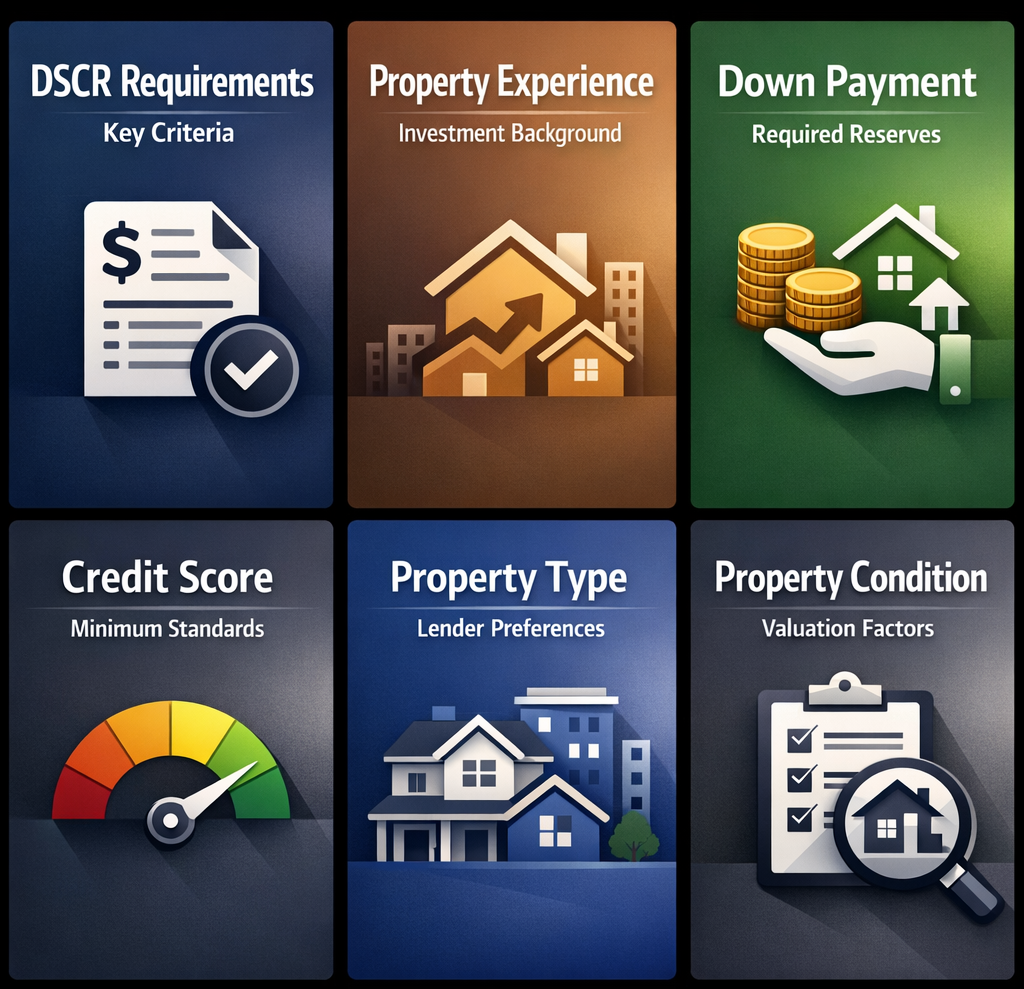
Essential DSCR qualification requirements for business owners differ significantly from traditional mortgage criteria, focusing on property performance rather than personal income verification. Understanding these requirements helps self-employed investors prepare stronger applications.
Property debt service coverage ratio: The rental property must generate sufficient income to cover mortgage payments, typically requiring a DSCR of 1.0 or higher, though many lenders prefer ratios of 1.20 to 1.25 for optimal terms.
Investment property experience: Many DSCR lenders prefer working with investors who have some real estate investment experience, though first-time investors may still qualify with strong property fundamentals.
Down payment and reserves: Self-employed investors typically need down payments ranging from 20% to 25%, plus adequate cash reserves to cover several months of property expenses and mortgage payments.
Credit score benchmarks: While not as stringent as traditional mortgages, DSCR loans still require decent credit scores, often with minimum requirements around 620 to 640 depending on the specific lender.
Property type and condition: The investment property must meet lender guidelines for condition, location, and rental potential, with single-family homes and small multifamily properties typically preferred by most DSCR lenders.
Step by Step DSCR Approval Process Navigation
Step by step DSCR approval process navigation helps self-employed investors understand what to expect during their loan application journey. This streamlined approach typically moves faster than traditional mortgage approvals since it eliminates extensive income verification steps.
Initial application and property identification: Submit your DSCR loan application along with basic personal information and details about the investment property you're purchasing or refinancing, including address and intended use.
Property income analysis and documentation: Provide rental income documentation such as existing leases, rent rolls, or market rent estimates that demonstrate the property's ability to generate sufficient property cash flow for debt service.
Property appraisal and inspection coordination: Schedule the required property appraisal and any necessary inspections, which help lenders verify property value and rental income potential for their underwriting analysis.
Underwriting review and approval decision: The lender's underwriting team reviews your application, property documentation, and appraisal to make a final approval decision based primarily on the property's debt service coverage ratio.
Closing preparation and funding: Once approved, coordinate with your lender, title company, and other parties to prepare closing documents and schedule funding for your investment property purchase or refinance.
Key Advantages of No Tax Return Financing Options
Key advantages of no tax return financing options make DSCR loans particularly attractive for self-employed investors who struggle with traditional mortgage requirements. These benefits extend beyond simple documentation convenience to offer strategic advantages for portfolio growth.
Simplified documentation process: Self-employed investors can qualify without providing W-2s, tax returns, or employment verification, eliminating the complexity of documenting irregular business income patterns that often complicate traditional mortgage applications.
Faster approval timelines: Without the need for extensive income verification and tax document analysis, DSCR loans may process more quickly than conventional mortgages, helping investors close deals faster in competitive markets.
Privacy protection for business finances: Business owners can keep their complex tax situations and business financial details private, as DSCR lenders focus solely on the investment property's income potential rather than personal financial information.
Scalable portfolio growth opportunities: The streamlined qualification process allows successful investors to potentially acquire multiple properties more efficiently, as each deal is evaluated based on individual property merit rather than cumulative personal income impact.
Reduced seasonal income fluctuation concerns: Self-employed investors with seasonal or cyclical business income don't need to worry about timing their loan applications around their most favorable tax filing periods or business cycles.
DSCR loans represent a game-changing opportunity for self-employed investors seeking to build or expand their rental property portfolios. By focusing on property income rather than personal financial documentation, these loans eliminate traditional barriers that have long frustrated business owners and independent contractors in the real estate investment space.
The no tax return option provides unprecedented access to investment capital while maintaining privacy and simplifying the approval process. Self-employed investors who understand the qualification requirements and follow proven strategies can leverage DSCR loans to accelerate their portfolio growth and capitalize on rental property opportunities that might otherwise remain out of reach.
As the investment lending landscape continues to evolve, DSCR loans offer a practical solution that aligns with the realities of modern self-employment and property investment. For investors ready to move beyond the constraints of traditional mortgage requirements, these property-focused loans provide the financial flexibility needed to build lasting wealth through real estate investment.