Real estate investors using debt service coverage ratio financing often encounter prepayment penalties when paying off loans early. These fees can significantly impact your bottom line, turning what looks like a profitable exit into a costly mistake. Understanding how the DSCR loan prepayment penalty explained becomes essential when you're planning to sell a rental property, refinance for better terms, or simply pay down debt ahead of schedule.
For investors managing rental portfolios, these penalties aren't just fine print. They're strategic considerations that affect when you exit deals, how you structure acquisitions, and ultimately what returns you actually pocket. The good news? With proper planning and knowledge of penalty structures, you can navigate these costs effectively and make smarter financing decisions.
Understanding the Structure of Prepayment Penalties
Understanding the structure of prepayment penalties starts with recognizing why lenders impose them in the first place. When a lender provides financing for your rental property, they anticipate earning interest over the full loan term. If you pay off the loan early, the lender loses that anticipated interest income. Prepayment penalties exist to compensate lenders for this potential lost revenue.
The penalty structure typically follows one of several formats. Here's what you need to know about how these penalties work:
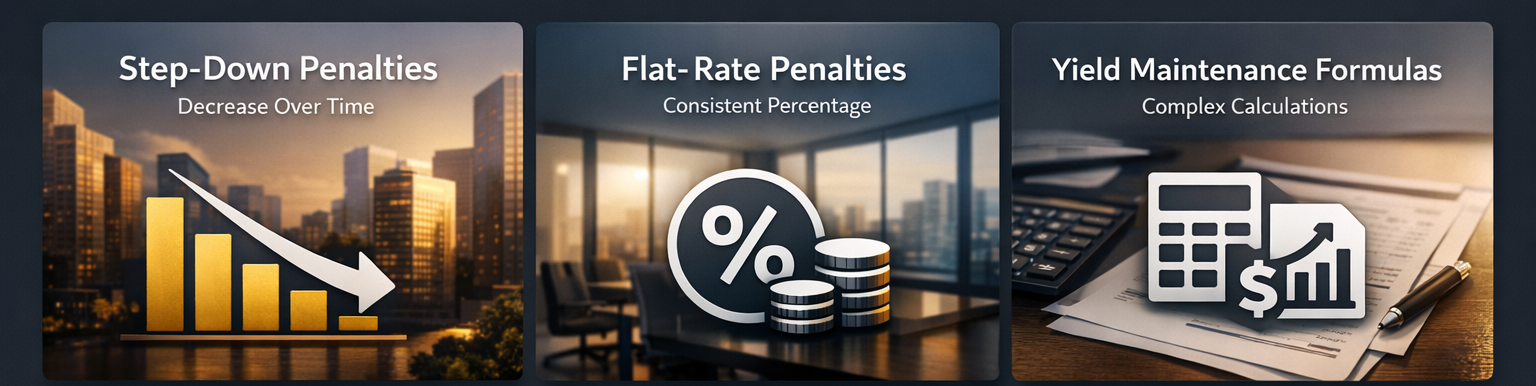
Step-down penalties: These decrease over time, often starting at 5% in year one and declining by 1% annually. By year five or later, the penalty may disappear entirely, giving investors a clear timeline for cost-effective exits.
Flat-rate penalties: Some loans maintain a consistent penalty percentage throughout a specified period, regardless of when you prepay. This structure offers predictability but less flexibility for early exits.
Yield maintenance formulas: These more complex calculations aim to make the lender whole by considering current interest rates versus your loan rate. If rates have dropped, the penalty might be higher to compensate for the lender's reinvestment challenge.
The duration of these penalties varies considerably based on your borrower profile and the specific loan product. Some DSCR rental property loans carry no prepayment penalties at all, while others enforce them for up to five years. Investors with stronger credit profiles or those willing to accept slightly higher interest rates may be able to negotiate shorter penalty periods or reduced fees.
Each lender structures these penalties differently, so reading your loan documents carefully is critical. The penalty clause should clearly state the percentage, duration, and calculation method. If anything seems unclear, don't hesitate to ask your lender to explain in plain terms before you sign.
Calculating the True Cost of Early Payoff
Calculating the true cost of early payoff requires more than just looking at the penalty percentage. When investors consider paying off a DSCR loan ahead of schedule, a comprehensive cost analysis reveals whether the move makes financial sense.
Start by determining your exact penalty amount. If your loan carries a 3% prepayment penalty and your remaining balance is $400,000, you're looking at a $12,000 fee. However, that's just the beginning of your analysis. You'll also need to factor in the opportunity cost of the capital you're using to pay off the loan.
Consider these steps when evaluating the cost:
Calculate your penalty fee: Multiply your loan balance by the penalty percentage stated in your loan agreement. Be sure you're using the correct percentage for your current year in the loan term if you have a step-down structure.
Assess your opportunity cost: Determine what return you could earn by deploying that capital elsewhere. If you can earn 10% on another investment but you're only saving 6% in interest by paying off the loan, the penalty becomes even more expensive.
Factor in tax implications: Prepayment penalties may be tax-deductible as a business expense, potentially softening the blow. Consult with your tax advisor to understand how this affects your specific situation.
Some investors discover that waiting just a few more months can dramatically reduce their penalty exposure, especially with step-down structures. If you're three months away from moving into a lower penalty tier, delaying your sale or refinance might save thousands of dollars.
Also consider the reason you're prepaying. If you're refinancing to capture a significantly lower interest rate, the long-term savings might justify paying the penalty. However, if you're simply paying off debt because you prefer being debt-free, the penalty cost might outweigh the psychological benefit, especially if the loan carries favorable terms.
Strategic Timing for Property Exits
Strategic timing for property exits can make the difference between a profitable transaction and one that erodes your returns. When you're holding rental properties financed with DSCR loans, your prepayment penalty schedule should factor into every exit decision.
Investors who plan ahead typically fare better than those who react to market opportunities without considering penalty implications. If you're approaching the end of a penalty period, waiting a few additional months might be worth it. For example, if you're eleven months into year three of a five-year step-down penalty, holding the property three more months to enter year four could reduce your penalty by a full percentage point.
Follow these timing strategies to minimize penalty impact:
Align exits with penalty reductions: Map out when your penalty decreases or expires, and target those windows for sales or refinancing. Build this timeline into your investment strategy from day one so you're not caught off guard.
Monitor market conditions relative to penalties: Sometimes market timing trumps penalty avoidance. If you're in a seller's market with rapidly appreciating values, the extra profit might more than offset the penalty cost.
Negotiate with buyers on timing: If a buyer approaches you but you're facing a steep penalty, consider negotiating a closing date that pushes into a lower penalty period. Many buyers will accommodate a reasonable delay if it helps the deal work for both parties.
Exit timing also depends on your portfolio strategy. Some investors accept higher penalties as a cost of doing business when they identify significantly better deployment opportunities for their capital. If you can extract equity from one property and deploy it into another with substantially better cash flow or appreciation potential, paying a 2% or 3% penalty might be justified by the improved returns on your next investment.
The key is running the numbers before making emotional decisions. Create a simple spreadsheet that compares your net proceeds after penalties versus waiting for a penalty-free window. Factor in the carrying costs of holding the property longer, including mortgage payments, property taxes, insurance, and maintenance. This analysis often reveals whether immediate action or strategic patience serves your financial interests better.
Common Scenarios Where Penalties Apply
Common scenarios where penalties apply extend beyond simply deciding to pay off your loan early. Real estate investors encounter prepayment penalties in several situations, and understanding each context helps you avoid surprise costs.
The most obvious trigger is a full loan payoff when selling a rental property. When you close on a sale, the buyer's funds pay off your existing loan, and if you're within the penalty period, the lender deducts the penalty from your proceeds before sending you the remaining equity. This can create an unpleasant surprise if you didn't account for it in your net proceeds calculation.
Key situations that typically trigger penalties include:
Refinancing transactions: When you refinance your DSCR loan to capture better terms or pull out equity, you're paying off the original loan early. Even if you're refinancing with the same lender, the penalty may still apply unless specifically waived in your loan documents.
Property sales: Whether you're selling to another investor, converting to a primary residence sale, or executing a 1031 exchange, paying off the loan at closing usually triggers any applicable penalty.
Significant principal reduction: Some loan agreements include penalties not just for full payoff but also for paying down principal beyond a certain threshold in a single year. Review your loan terms to understand if this applies to your situation.
Loan assumption transfers: In some cases, transferring your loan to a new buyer through assumption might avoid penalties, but this depends on whether your loan is assumable and whether the lender approves the transfer.
Less common but still important are situations involving portfolio restructuring. If you're consolidating multiple properties under a single blanket loan or moving properties between legal entities, these transactions might require paying off existing loans and could trigger penalties.
Some investors mistakenly believe that certain transaction types automatically avoid penalties. For instance, they might assume that a 1031 exchange or a sale due to financial hardship exempts them from fees. In reality, most loan agreements don't distinguish between reasons for early payoff. The penalty applies regardless of why you're paying off the loan ahead of schedule.
When Prepayment Penalties Might Not Apply
When prepayment penalties might not apply, investors find opportunities to exit or restructure loans without incurring substantial fees. Not all situations result in penalty charges, and understanding these exceptions can save significant money.
Some DSCR loans are structured without any prepayment penalties from the outset. Investors who prioritize flexibility during loan shopping might accept a slightly higher interest rate in exchange for the freedom to prepay without consequences. This structure works particularly well if you anticipate selling or refinancing within a few years.
Circumstances where penalties may not apply include:
After the penalty period expires: The most straightforward scenario is simply outlasting the penalty period. Once you move beyond the specified penalty years, you can prepay freely without any financial consequence.
Loans structured as penalty-free: Some lenders offer DSCR loan products with no prepayment penalties as a competitive advantage. These loans might carry slightly higher rates but provide maximum flexibility for active investors.
Partial prepayments within allowed limits: Many loans permit you to pay down a certain percentage of principal annually without penalty, often around 20%. If you're making extra payments within this threshold, penalties typically don't apply.
When contractual changes occur: In some cases, if the lender modifies your loan terms or certain contract conditions change, the enforceability of prepayment penalties might be affected. This is a complex legal area where consulting an attorney could prove valuable.
Transfer to certain qualified parties: Depending on your loan agreement, transferring the property to a spouse, family member, or into a trust for estate planning might not trigger penalties, though this varies considerably by lender.
The legal enforceability of prepayment penalties can also come into question under specific circumstances. Changes in applicable laws or regulations might impact whether a lender can enforce a penalty clause. Additionally, if a lender has materially breached the loan agreement or failed to fulfill their obligations, this might affect their ability to enforce penalties, though such situations typically require legal counsel to navigate.
Before assuming a penalty applies, review your loan documents carefully or consult with your lender. Sometimes simple communication reveals flexibility you didn't know existed. Some lenders may be willing to waive or reduce penalties to maintain a good relationship with investors who bring them repeat business, though this is never guaranteed and shouldn't be counted on without explicit agreement.
The DSCR loan prepayment penalty explained throughout this article represents more than just another cost of doing business. It's a strategic factor that should influence your acquisition decisions, hold periods, and exit planning from the very beginning of each investment.
Smart investors incorporate penalty analysis into their underwriting process, calculating multiple exit scenarios that account for different penalty structures and timing. They recognize that a loan with a three-year step-down penalty might align perfectly with a value-add strategy that requires holding for thirty-six months anyway, while a five-year penalty might not suit a fix-and-flip approach converted to rental.
The best approach is treating prepayment penalties as negotiable terms during loan origination. Don't simply accept the standard offering. Ask about penalty-free options, negotiate for shorter penalty periods, or request step-down structures that align with your investment timeline. Lenders often have more flexibility than they initially present, especially for experienced investors with strong portfolios.
Finally, remember that prepayment penalties serve a purpose in the lending ecosystem. They allow lenders to offer competitive rates by ensuring a minimum return period. Understanding this dynamic helps you approach these fees not as unfair obstacles but as trade-offs in your financing structure that you can evaluate, negotiate, and plan around effectively.