Real estate investors often explore creative financing strategies when building their rental property portfolios. One question that surfaces regularly is whether you can use gift funds from family members for your down payment on an investment property secured with a DSCR loan. The answer isn't as straightforward as it is with traditional owner-occupied mortgages, and understanding the guidelines can save you time and frustration during the application process.
DSCR loans are structured specifically for investors who want to qualify based on the rental income a property generates rather than personal income documentation. This fundamental difference changes how lenders approach down payment sources, including gifts. While conventional mortgages for primary residences typically allow gift funds under specific conditions, investment property loans operate under a different set of rules that prioritize the asset's performance over the borrower's personal financial relationships.
For investors considering whether an investment property down payment can come from a family gift, the guidelines vary significantly by lender and loan program. This article breaks down what you need to know about using gift funds with DSCR loans, alternative down payment strategies, and how to position your financing for approval.
Understanding DSCR Loan Down Payment Requirements
Understanding DSCR loan down payment requirements is the first step before exploring gift fund options. DSCR loans are designed for investors purchasing or refinancing rental properties, and the underwriting process focuses primarily on the property's ability to cover its own debt service.
Minimum down payment thresholds: Most DSCR loan programs require a minimum down payment ranging from 20% to 25% of the purchase price. The exact requirement depends on factors such as the property type, your credit score, the debt service coverage ratio itself, and whether the property is already generating rental income or will be a new acquisition.
Down payment impact on rates: The size of your down payment directly influences your interest rate and loan terms. Larger down payments typically result in better rates because they reduce the lender's risk exposure. With rates for DSCR loans ranging from 6.25% to 8.00%, a borrower putting down 25% or more might secure terms on the lower end of that spectrum, while minimum down payments could push rates higher within the range.
Source of funds documentation: Lenders require documentation proving where your down payment originates, typically through bank statements showing seasoned funds that have been in your account for at least two to three months. This seasoning requirement exists to verify the funds are legitimately yours and not borrowed, which would increase your overall debt burden and potentially affect the investment's viability.
Reserves beyond down payment: Beyond the down payment itself, DSCR lenders often require you to hold reserves equal to several months of the property's PITIA payments, typically two to six months for standard long-term rentals and six to twelve months for short-term rental properties, depending on your experience level and the number of financed properties you already own. These reserves must also be documented and cannot simply be gift funds deposited immediately before closing.
The debt service coverage ratio itself is calculated by dividing the property's monthly rental income by its monthly debt obligations, including principal, interest, taxes, insurance, and HOA fees if applicable. A DSCR of 1.0 means the property's income exactly covers its expenses, while a ratio above 1.0 indicates positive cash flow. Most lenders require a minimum DSCR between 1.0 and 1.25. A limited number of lenders offer specialty exception programs that accept ratios as low as 0.75, typically requiring compensating factors such as larger reserves or a lower loan-to-value ratio.
When it comes to down payment sources, DSCR lenders take a stricter approach than conventional mortgage programs for owner-occupied homes. The fundamental reason is that investment properties carry higher risk profiles, and lenders want assurance that borrowers have genuine financial capacity and skin in the game rather than leveraging entirely gifted or borrowed capital.
Can Investment Property Down Payment Come from Family Gift
Can investment property down payment come from family gift? This is one of the most common questions from investors exploring DSCR financing options, and the answer requires understanding how investment loans differ from residential mortgages.
General industry stance on gift funds: The vast majority of DSCR loan programs do not allow gift funds to be used for down payments. Unlike FHA or conventional loans for primary residences, where documented gifts from family members are commonly accepted with proper gift letters, investment property loans are underwritten with the expectation that the borrower is deploying their own verified capital. This policy reflects the investment nature of the transaction and the lender's need to ensure the borrower has genuine financial commitment to the property's success.
Why the restriction exists: Lenders impose this limitation because gift funds don't demonstrate the borrower's own financial strength or ability to manage investment risk. When you use your own seasoned funds, it shows you've successfully saved or generated capital, managed your finances responsibly, and have reserves to weather potential vacancy or repair costs. Gift funds bypass this verification entirely, leaving lenders uncertain about your true financial capacity and commitment level.
Exceptions and workarounds: While direct gift funds are typically prohibited at closing, there are scenarios where gifted money might eventually become acceptable. If a family member gifts you funds well in advance of your loan application, and those funds season in your bank account for several months, they may be treated as your own assets by the time you apply. The key is that the funds must be fully seasoned, and you must be able to document a consistent account balance history without recent large deposits that would trigger sourcing questions.
Alternative family assistance structures: Some investors structure family financial assistance differently to comply with lending guidelines. For example, a family member might provide funds as an equity partnership or loan documented through proper legal channels, or they might help you build reserves over time rather than providing a last-minute down payment gift. These approaches require advance planning and proper documentation but can achieve similar outcomes while meeting underwriting standards.
The restriction on gift funds reflects a broader principle in investment property lending: lenders want to see that you have genuine financial capacity independent of others. This doesn't mean family can never assist with your investment goals, but it does mean that assistance needs to be structured thoughtfully and with appropriate lead time.
If you're counting on gift funds for a DSCR loan down payment, it's essential to discuss this with your lender early in the process. Some portfolio lenders or private money sources might have more flexibility than traditional DSCR programs, though they may offset that flexibility with higher rates or additional requirements elsewhere in the loan structure.
Have a property in mind?
Tell us about the property and we will find the financing that fits you best.
Acceptable down payment sources for DSCR loans include several options that demonstrate your financial strength and commitment as an investor. Understanding what lenders will accept helps you plan your financing strategy effectively.
Seasoned bank account funds: The most straightforward and universally accepted source is money that has been sitting in your bank account for at least 60 to 90 days. Lenders will review two to three months of bank statements to verify these funds are stable, legitimate, and represent your own assets. Large deposits during this seasoning period will trigger questions and require documentation proving the source was acceptable, such as the sale of another asset, a business profit distribution, or a tax refund.
Sale proceeds from other real estate: If you're selling another investment property or even a primary residence, the net proceeds can typically be used for your down payment. You'll need to provide the settlement statement from that sale showing the funds you received, along with bank statements showing the deposit of those proceeds into your account. This source is particularly common among active investors who are repositioning their portfolios or conducting 1031 exchanges, though DSCR loans themselves cannot typically be part of a 1031 exchange structure.
Retirement account funds: Some investors tap into retirement accounts like IRAs or 401(k)s for investment property down payments, either through withdrawals or loans against the account balance. While this is generally permitted, you'll need documentation from the retirement account custodian, and you should carefully consider the tax implications and penalties that might apply depending on your age and account type. Self-directed IRA investments in real estate follow different rules entirely and typically can't be combined with personal mortgage financing.
Business account assets: If you operate your real estate investing through a business entity, funds from that business account can typically be used for down payments, provided you can document the business ownership and the legitimate source of those business funds. This often applies to experienced investors with established LLCs or S-corporations who maintain separate business banking for their rental operations.
Lines of credit or liquidated investments: In some cases, investors use proceeds from stock sales, bond redemptions, or other liquidated investment accounts as down payment sources. These are generally acceptable provided you can document the account ownership and the liquidation transaction. However, using a line of credit or HELOC from another property may be scrutinized carefully, as it represents additional debt that could impact your overall financial profile and ability to manage the new investment.
Regardless of which acceptable source you use, documentation is critical. Lenders will require clear paper trails showing where funds originated, how long they've been in your control, and that they represent legitimate, legal assets. Unexplained deposits, cash transactions, or funds that suddenly appear shortly before your loan application will create delays and potentially disqualify your financing.
The best practice is to consolidate your down payment funds into a single account well before you start your property search, allowing them to season properly and creating a clean documentation trail. This advance planning eliminates last-minute sourcing headaches and streamlines your closing process once you find the right investment opportunity.
How to Structure Your DSCR Loan Application for Success
How to structure your DSCR loan application for success involves more than just assembling the required documents. Strategic preparation can significantly improve your approval odds and help you secure better terms.
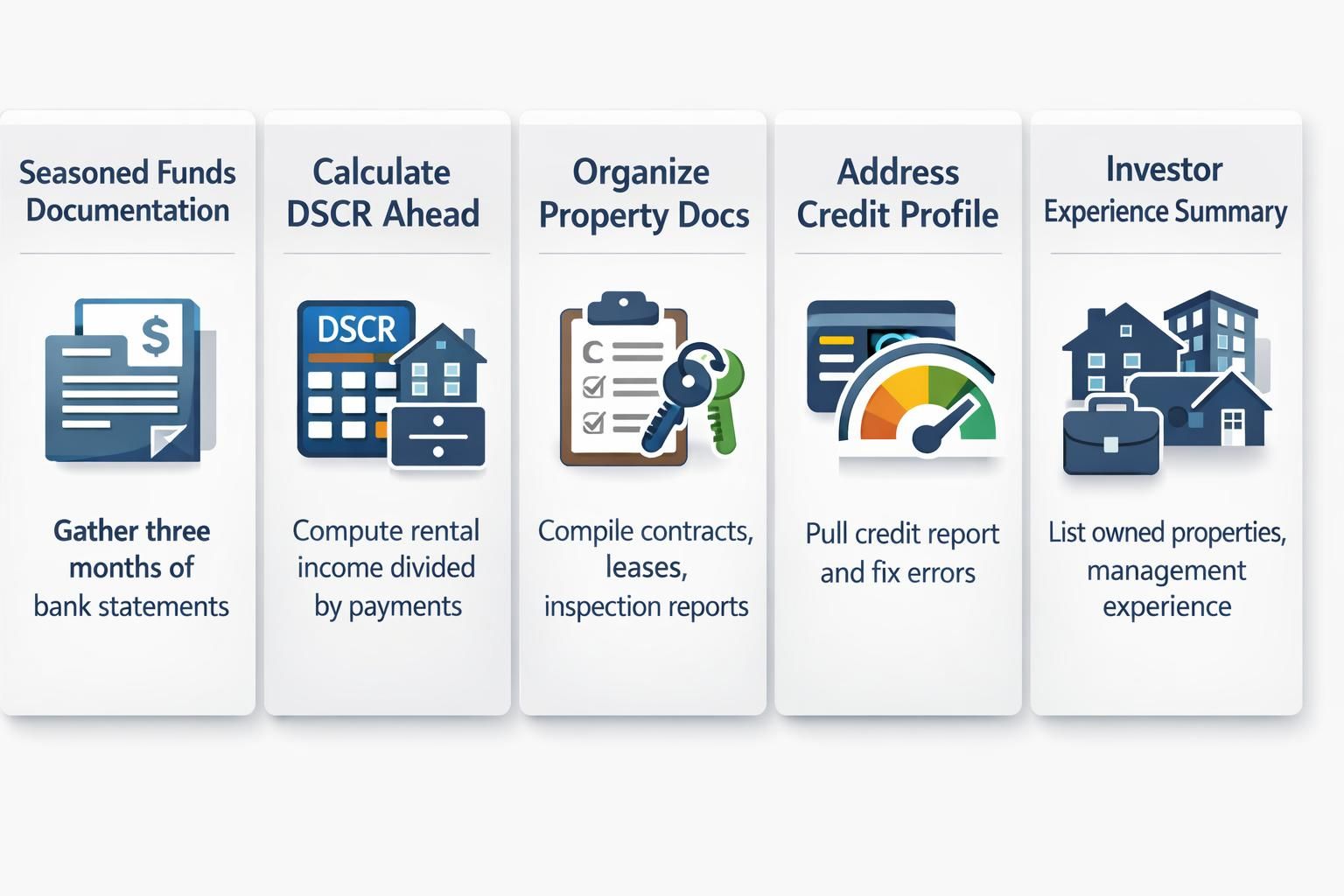
Begin with seasoned funds documentation: Start by gathering at least three months of bank statements for all accounts where your down payment and reserves are held. Review these statements yourself first, identifying any large deposits or unusual transactions that will require explanation. Prepare supporting documentation for these items in advance, such as transfer records between your own accounts, sale proceeds documentation, or business distribution statements. The cleaner your account history, the smoother your underwriting process will be.
Calculate your DSCR accurately before applying: Don't wait for the lender to tell you whether your property qualifies. Calculate the debt service coverage ratio yourself using the property's current or projected rental income divided by the total monthly payment including principal, interest, taxes, insurance, and any HOA fees. If you're purchasing a property that isn't currently rented, research comparable rental rates in the area using rental listing sites, property management company estimates, or recent lease agreements on similar properties. Present this research to your lender as supporting documentation.
Organize property documentation early: Compile all property-related documents including the purchase contract, property inspection reports, current lease agreements if the property is already rented, rent rolls, and any correspondence with property management companies. If you're refinancing, gather your current mortgage statement, property tax records, and insurance declarations. This preparation demonstrates professionalism and helps underwriters move quickly through your file.
Address credit and financial profile proactively: Before applying, pull your own credit report and address any errors, outstanding collections, or issues that might raise questions. While DSCR loans are more forgiving of personal income fluctuations than traditional mortgages, your credit score still matters significantly for rate pricing and approval. Most DSCR lenders require minimum credit scores ranging from 620 to 680, with better scores unlocking better rates within the 6.25% to 8.00% range.
Prepare your investor resume and experience summary: Even though DSCR loans don't require personal income verification, lenders still want to understand your experience level as an investor. Create a simple summary document listing other rental properties you own, your experience with property management, any relevant real estate education or licensing, and your overall investment strategy. This context helps underwriters assess your capability to manage the investment successfully.
Timing is another critical element of structuring your application effectively. Don't wait until you've found the perfect property and are under contract to start the loan process. Instead, get pre-qualified well in advance so you understand your buying power, rate expectations, and any documentation issues that need to be resolved. This preparation allows you to move quickly and confidently when you identify an attractive investment opportunity.
Communication with your lender throughout the process also matters significantly. Be responsive to document requests, proactive about explaining any unusual aspects of your financial profile, and honest about your experience level and investment plans. Lenders appreciate borrowers who are organized, communicative, and realistic about their financing needs.
Alternative Financing Strategies When Gift Funds Are Your Only Option
Alternative financing strategies when gift funds are your only option can help you still move forward with your investment goals, even if traditional DSCR guidelines don't accommodate direct gift usage at closing.
Delay your purchase to season the funds: The most straightforward approach is to accept the gifted funds now but delay your investment property purchase for several months while the money seasons in your account. Most lenders consider funds seasoned after 60 to 90 days of consistent account history. During this waiting period, continue building your account balance through regular deposits if possible, creating a pattern of financial stability that underwriters will view favorably. This approach requires patience but converts gift funds into fully acceptable down payment sources.
Partner with the gift provider as an equity investor: Instead of structuring the assistance as a gift, consider formalizing it as an investment partnership. The family member who wants to help you could become a co-borrower or equity partner in the property, with clearly documented ownership percentages, profit-sharing arrangements, and exit strategies. This structure requires proper legal documentation through an LLC operating agreement or partnership agreement, but it aligns with how DSCR lenders view investment transactions and may actually strengthen your application by showing additional financial backing.
Use family assistance to build reserves while funding down payment separately: If you have some capital of your own but not quite enough for both the down payment and the required reserves, structure the family assistance to cover your reserve requirements while you deploy your own funds for the down payment. Since reserves can sometimes be held in retirement accounts or other investments rather than liquid cash, this approach may offer more flexibility. However, verify with your specific lender what forms of reserves they accept and whether gifted funds are acceptable for this purpose even if not for the down payment itself.
Explore seller financing or creative acquisition structures: Some investment properties are available with seller financing, where the property owner acts as the lender for a portion of the purchase price. If you can secure seller financing for part of the deal, you might reduce the cash down payment needed to a level you can cover with your own seasoned funds. Alternatively, consider lease-option arrangements where you control and rent the property while building up your own capital to eventually complete the purchase outright.
Consider portfolio lenders with more flexible policies: While most DSCR loan programs follow similar guidelines regarding gift funds, some portfolio lenders who hold loans on their own books rather than selling them may have more flexibility. These lenders might accept gift funds under specific circumstances, though they may offset this flexibility with higher interest rates, larger down payment requirements, or additional compensating factors like stronger credit scores or more extensive real estate experience. Research local community banks, credit unions, and private lenders who maintain portfolio lending programs.
Each of these alternative approaches involves trade-offs, whether in timing, complexity, cost, or control over the investment. The right strategy depends on your specific situation, the strength of your relationship with the family member providing assistance, your timeline for acquiring the property, and your long-term investment goals.
What's most important is being realistic about the guidelines and planning accordingly rather than assuming gift funds will be accepted and finding out otherwise when you're already under contract on a property. Advance planning and open conversations with potential lenders will help you identify the path that works best for your circumstances.
DSCR loan gift funds for down payment guidelines come down to one core principle: most lenders want to see that your down payment reflects your own seasoned financial capacity, not funds gifted immediately before closing. While direct gift funds are rarely accepted the way they are on owner-occupied FHA or conventional loans, that doesn't mean family support is off the table. Seasoning the funds, structuring assistance as a documented partnership, or using family help to cover reserves instead of the down payment can all keep your financing on track.
The investors who navigate this most smoothly are the ones who plan ahead. Understanding your lender's specific documentation requirements, seasoning timelines, and acceptable fund sources well before you're under contract removes the risk of a last-minute financing surprise. If gift funds are part of your plan, start the conversation with your lender early so you can structure your timeline and paperwork accordingly.
Ready to explore your DSCR loan options and understand exactly what down payment sources will work for your situation? Get a personalized DSCR loan quote and start your financing with clarity.