Real estate investors often look for creative ways to fund their next acquisition, especially when purchasing rental properties from family members. One financing strategy that's gaining traction involves combining gift equity from relatives with DSCR loan gift equity rules for buying property from family. This approach can reduce the cash you need upfront while still qualifying based on the property's rental income rather than your personal tax returns.
DSCR loans are designed specifically for investors who want to qualify based on a property's ability to generate income. Unlike conventional mortgages that scrutinize your W-2s and personal debt-to-income ratio, these loans focus on whether the rent covers the mortgage payment. When you're buying from a family member who's willing to contribute equity as a gift, understanding how lenders handle that contribution becomes critical to structuring a deal that works.
This guide breaks down exactly how gift equity works within DSCR loan parameters, what lenders require from you as the borrower, and how to navigate the documentation process when family members are involved in your investment property purchase.
What Gift Equity Means for Investment Property Buyers
Gift equity represents the difference between a property's fair market value and the actual sale price when a family member sells you real estate below market rate. That difference functions as an instant equity stake in the property without requiring you to bring additional cash to closing.
Immediate equity position: If your aunt sells you a property worth $400,000 for $320,000, that $80,000 difference becomes your gift equity and can often be applied toward your down payment requirement.
Reduces cash outlay: Instead of scraping together a full down payment from liquid savings, you can leverage the generosity of family members to preserve capital for renovations, reserves, or your next deal.
Appraisal requirement: Lenders will require an independent appraisal to establish the true market value, ensuring the gift equity calculation is based on accurate data rather than inflated family estimates.
Documentation standards: Even though it's family, you'll need a formal gift letter stating the funds are a gift with no expectation of repayment, along with proof of the relationship and the property's appraised value.
This strategy works particularly well when you're acquiring a property that's already generating rental income or has strong rent potential. The challenge is finding a lender who understands how to blend gift equity with investor-focused loan products.
How DSCR Loan Gift Equity Rules Differ From Conventional Programs
DSCR loans operate under a different underwriting framework than traditional mortgages, which affects how gift funds and gift equity are treated. The core distinction lies in what the lender is actually evaluating during the approval process.
Income verification shift: Conventional loans require proof of personal income through tax returns, pay stubs, and employment verification. DSCR loans skip that entirely and focus on the property's rental income divided by the proposed mortgage payment, a ratio that must typically exceed 1.0 to demonstrate the investment can carry itself.
Borrower contribution mandate: While conventional programs may allow 100% gift funds in some scenarios, DSCR loan gift equity rules for buying property from family require at least a 10% contribution from the borrower's own funds, ensuring you have skin in the game beyond what family provides.
No occupancy requirement: These loans are built for non-owner-occupied investment properties, so you won't face the residency restrictions that come with many conventional gift fund programs designed for primary residences.
Flexible documentation: Because DSCR lenders already operate in the non-QM space, they tend to have more streamlined processes for unusual funding sources, including gift equity, as long as you meet the minimum borrower contribution threshold.
Understanding these differences helps you position your deal correctly from the start. If you're buying a duplex from your parents and planning to use gift equity for most of the down payment, you'll still need to demonstrate that 10% is coming from your own verified funds.
Using Gift Equity for Investment Property Purchase Down Payment
When you're using gift equity for investment property purchase down payment, the mechanics require coordination between you, the selling family member, and your lender. The process involves more than just agreeing on a discounted sale price.
Appraisal establishes value: The lender orders an independent appraisal to determine fair market value. If the appraiser concludes the property is worth $500,000 and your uncle agrees to sell it to you for $425,000, that $75,000 spread becomes your gift equity.
Gift letter documentation: Your family member must provide a signed letter confirming the equity is a gift with no repayment obligation, including the relationship between you, the property address, and the dollar amount of the gift.
Your 10% contribution: You must still provide at least 10% of the purchase price from your own documented funds. These can be savings, proceeds from another property sale, or business account funds, as long as they're properly sourced and seasoned according to lender guidelines.
Closing statement clarity: The settlement statement will reflect both the gift equity and your cash contribution, showing the lender exactly how the down payment requirement was satisfied and verifying compliance with the 10% rule.
This structure gives you the flexibility to acquire properties without depleting your entire cash position while still meeting lender requirements. It's particularly useful when you're scaling a portfolio and need to preserve liquidity for operating reserves and future acquisitions.
Step-by-Step Process to Close With Family Gift Equity
Executing a transaction that combines family gift equity with a DSCR loan requires careful sequencing to satisfy both lender requirements and family dynamics. Here's how to structure the deal from initial conversation to closing table.
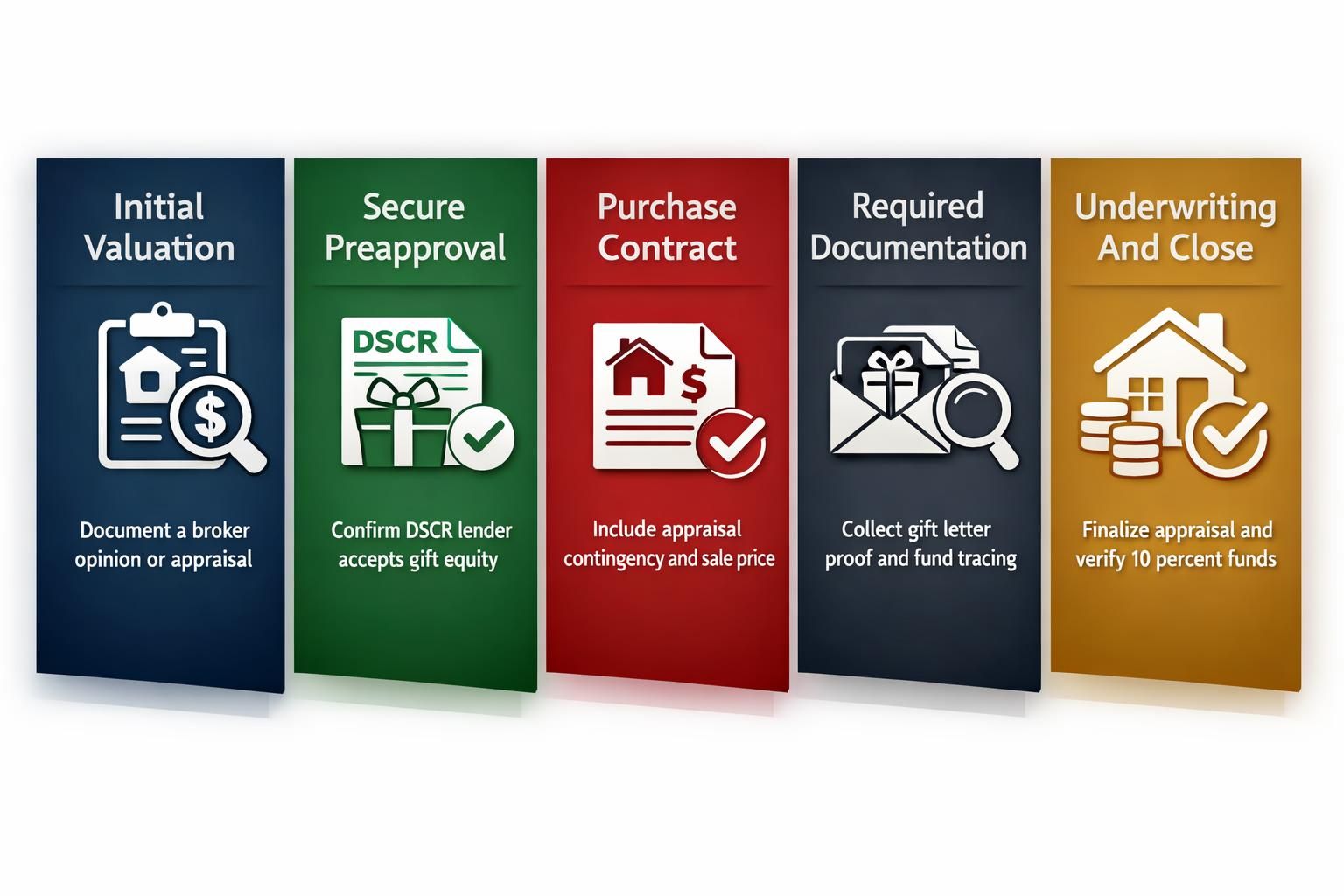
Initial valuation and agreement: Before approaching a lender, get a realistic estimate of the property's market value through a broker price opinion or preliminary appraisal. Agree with your family member on a sale price that creates meaningful gift equity while still feeling fair to both parties. Document this agreement in writing even before formal contract stage.
Secure lender pre-approval: Approach a DSCR lender early in the process and disclose your intention to use gift equity from a family member. Confirm they accept this structure and understand the 10% borrower contribution requirement. Get clarity on what documentation they'll need from both you and the selling family member so there are no surprises later.
Execute purchase contract: Draft a standard real estate purchase agreement between you and your family member showing the agreed-upon sale price. This becomes the foundation for the lender's file. Include all standard contingencies, particularly the appraisal contingency, since the lender's appraised value must support your gift equity calculation.
Gather required documentation: Collect the gift letter from your family member, proof of your relationship (could be as simple as matching last names or a brief affidavit), and evidence of your 10% contribution funds. Ensure your contribution is properly sourced, meaning the lender can trace where those funds came from through bank statements or other financial records.
Complete underwriting and close: Once the appraisal confirms the property value supports your gift equity amount and underwriting verifies your 10% contribution, the loan moves to closing. The final settlement statement will show the purchase price, your cash investment, and the gift equity component, satisfying all parties that the transaction was structured correctly.
Walking through these steps methodically prevents last-minute scrambling when the title company or lender raises questions about fund sources. Transparency from the beginning makes the whole process smoother for everyone involved.
Common Mistakes When Structuring Gift Equity Transactions
Even experienced investors stumble when mixing family transactions with institutional lending requirements. Avoiding these pitfalls will save you time, stress, and potentially the entire deal.
Assuming 100% gift equity works: The biggest misconception is thinking you can use gift equity to cover the entire down payment on a DSCR loan. Remember that 10% borrower contribution is mandatory. If you don't have that 10% in verified funds, the loan won't close regardless of how generous your family member is being.
Skipping the formal appraisal: Some investors try to move forward based on an automated valuation model or a family member's opinion of value. Lenders require an independent appraisal performed by a licensed appraiser with no relationship to either party. Without it, there's no defensible basis for the gift equity calculation.
Inadequate gift documentation: A casual email or verbal agreement isn't sufficient. The lender needs a formal gift letter with specific language confirming no repayment is expected, the exact dollar amount, the property address, and signatures from the donor. Missing any of these elements can stall your closing.
Ignoring seasoning requirements: Your 10% contribution typically needs to be seasoned, meaning it's been in your account for a minimum period (often 60 days). Last-minute transfers from other accounts or sudden deposits can trigger additional documentation requests or underwriting delays.
Misunderstanding relationship limitations: Not all lenders accept gift equity from any family member. Some restrict it to immediate family like parents or siblings, while others allow extended family. Clarify these boundaries with your lender before you get too far into negotiations with a cousin or aunt.
Taking shortcuts on any of these elements can derail a transaction that otherwise makes perfect financial sense. Treat the documentation and verification process with the same rigor you'd apply to any arm's-length investment deal.
Combining family generosity with investor-focused financing creates opportunities that might otherwise remain out of reach. DSCR loan gift equity rules for buying property from family give you a path to acquire rental properties with less cash outlay while still qualifying based on the property's income rather than your personal financials. The mandatory 10% borrower contribution ensures lenders see your commitment to the investment, but the remaining down payment can come from gift equity when a family member sells below market value.
Success with this strategy depends on understanding the documentation requirements, communicating clearly with all parties, and working with a lender experienced in non-QM investor products. When structured properly, you preserve capital for renovations and reserves while expanding your portfolio through properties that already have rental income or strong rent potential.
If you're considering using gift equity for your next investment property purchase, explore your DSCR loan options to see how this financing structure can work for your specific situation. With the right preparation and documentation, buying rental property from family becomes a viable path to portfolio growth without depleting your entire cash position.