Real estate investors eyeing properties in tourist destinations or seasonal markets face a unique challenge: income fluctuation. When your rental property sits vacant for three or four months a year, traditional lenders might slam the door in your face. But here's the thing, a DSCR loan for properties with seasonal vacancy could be your ticket to financing these potentially lucrative investments.
Unlike conventional mortgages that scrutinize your personal income and employment history, DSCR loans focus on what the property itself can generate. That's a game changer when you're dealing with tourism cycles and off-peak periods. The key is understanding how lenders evaluate these properties and what adjustments they might make to accommodate the ebb and flow of seasonal rental income.
In this article, we'll walk through the strategies investors use to secure financing for seasonal properties, the flexibility some lenders offer, and practical ways to stabilize cash flow year-round. Whether you're looking at a ski resort condo or a beach house, knowing how to position your investment can make all the difference.
How DSCR Loans Handle Seasonal Income Patterns
How DSCR loans handle seasonal income patterns is critical for investors targeting markets with pronounced tourism cycles. The debt service coverage ratio measures whether a property's rental income can cover its mortgage payments, but what happens when that income swings wildly between summer and winter?
Traditional lenders typically want to see stable, predictable cash flow. Seasonal properties don't fit that mold. However, DSCR loans offer more breathing room because they're designed for investment properties where income may vary. Some lenders will look at your property's annualized rental income rather than requiring every single month to meet a specific threshold.
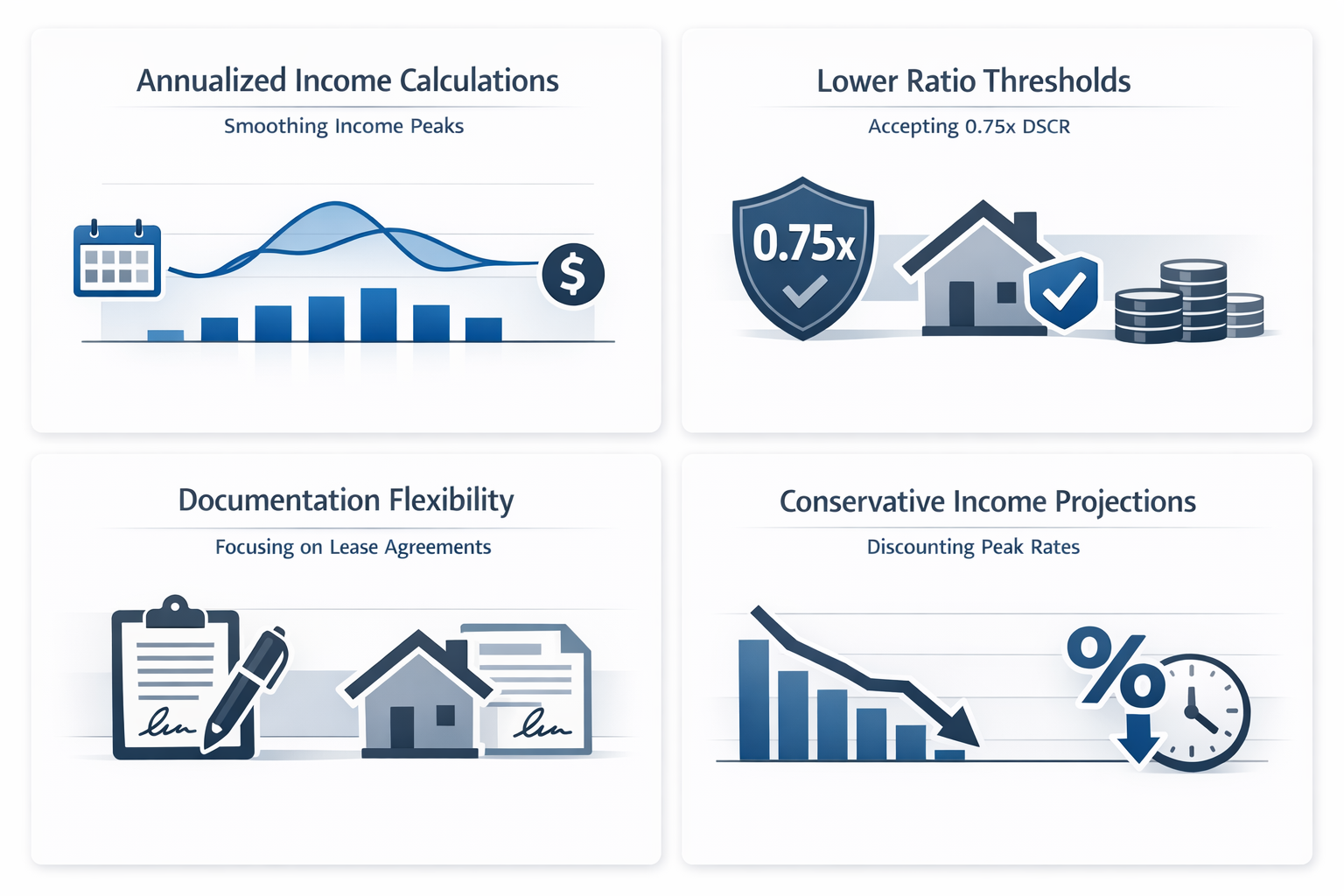
Annualized income calculations: Lenders may average your rental income across the entire year, smoothing out the peaks and valleys that come with tourism cycles.
Lower ratio thresholds: Some lenders accept DSCR ratios as low as 0.75x, which can be helpful when properties in developing or seasonal markets don't generate enough income to hit traditional 1.0x or 1.25x benchmarks.
Documentation flexibility: Instead of requiring W-2s or tax returns, lenders focus on lease agreements, booking histories, or market rental analysis to project income potential.
This approach means you're not automatically disqualified just because your mountain cabin sits empty from May through September. The lender is betting on the property's overall performance, not month-to-month consistency. That said, you'll still need to demonstrate that the numbers work when averaged out, and that's where your underwriting strategy becomes essential.
Key Lender Adjustments for Vacancy Risk
Key lender adjustments for vacancy risk can make or break your financing deal. Because seasonal properties inherently carry higher vacancy rates, lenders often bake in protective measures. Understanding these adjustments helps you negotiate better terms and set realistic expectations.
When evaluating a DSCR loan for properties with seasonal vacancy, lenders might increase their projected vacancy rate beyond what you'd see for a traditional long-term rental. If a standard rental might assume 5% vacancy, a seasonal property could see projections of 20% to 40% or more, depending on the market and tourism cycles.
Conservative income projections: Lenders may discount your peak-season rental rates or require multiple years of booking data to validate income claims.
Higher interest rates or points: The additional risk of income fluctuation might translate into slightly higher borrowing costs compared to stable, year-round rentals.
Larger down payment requirements: Some lenders ask for 25% to 30% down on seasonal properties to offset the higher default risk during prolonged vacancies.
Reserve requirements: You might be required to maintain cash reserves equivalent to six months of mortgage payments to demonstrate you can weather the off-season.
These adjustments aren't necessarily deal breakers. In fact, they can work in your favor if you've got a solid plan to minimize vacancy and maximize income during peak periods. The goal is to show lenders you understand the risks and have strategies in place to mitigate them.
Strategies to Stabilize Cash Flow Year-Round
Strategies to stabilize cash flow year-round are what separate successful seasonal property investors from those who struggle to meet their loan obligations. The research points to one particularly effective approach: targeting long-stay travelers instead of relying solely on short-term vacation bookings.
Remote workers, traveling nurses, and temporary residents are increasingly looking for furnished rentals they can occupy for months at a time. By marketing your property to this audience during the off-season, you can fill gaps that would otherwise leave you with zero income. This strategy helps maintain the consistent cash flow that makes lenders more comfortable with your DSCR loan.
Market to extended-stay guests: Position your property as ideal for remote workers or professionals on temporary assignments who need housing outside peak tourist season.
Adjust pricing strategically: Offer discounted monthly rates during slow periods to attract longer bookings rather than leaving the property vacant.
Diversify your booking channels: Use platforms that cater to both short-term vacationers and mid-term renters to maximize occupancy across all seasons.
Consider hybrid rental models: Some investors rent their properties traditionally during off-peak months and switch to short-term rentals during high season.
The key insight here is flexibility. Tourism cycles don't have to dictate your income if you're willing to adapt your rental strategy. Properties in ski towns can attract summer hikers and fall leaf-peepers. Beach houses might appeal to winter remote workers seeking a quiet workspace. By thinking beyond the obvious peak season, you can demonstrate to lenders that your property's income potential extends year-round.
Using Interest-Only DSCR Loans for Seasonal Properties
Using interest-only DSCR loans for seasonal properties represents a powerful cash flow management tool. This financing structure allows investors to make lower monthly payments during lean periods by paying only the interest portion of the loan, at least for an initial period.
Here's how this works in practice. Let's say you own a rental property near a ski resort that generates substantial income from December through March but sits mostly vacant the rest of the year. An interest-only payment option means your carrying costs drop significantly during those quiet months, preserving your cash reserves.
Calculate your payment advantage: Interest-only payments might be 30% to 50% lower than principal-and-interest payments, depending on the loan amount and rate. This reduction can be critical when you're not generating rental income.
Plan for the transition: Interest-only periods typically last three to ten years. You'll need a strategy for when payments increase, whether that's refinancing, selling, or having built up sufficient reserves from peak-season profits.
Use savings strategically: The money you save during the interest-only period should be reinvested into property improvements, marketing, or reserves, not spent on lifestyle expenses.
This loan structure isn't right for every investor or every property. It requires discipline to manage income fluctuation and to resist the temptation to overleverage. However, for investors in markets with distinct tourism cycles, the flexibility of interest-only payments can mean the difference between profitability and financial strain during off-peak months.
Planning for Regulatory and Vacancy Challenges
Planning for regulatory and vacancy challenges is non-negotiable when you're financing seasonal rental properties. The short-term rental landscape has become increasingly complex, with municipalities implementing new restrictions that can dramatically affect your income stream and, consequently, your ability to service your DSCR loan.
Jurisdictions across the country have introduced caps on rental days, licensing requirements, occupancy taxes, and even outright bans in certain neighborhoods. These regulatory shifts can turn a profitable seasonal rental into a money pit overnight if you're not prepared.
Research local regulations thoroughly: Before securing financing, verify current short-term rental rules and any pending legislation that might affect your property. Some lenders may refuse to finance properties in jurisdictions with uncertain regulatory futures.
Build vacancy assumptions into your projections: High vacancy rates are a documented challenge in short-term rentals. Factor in realistic occupancy rates based on market data, not best-case scenarios, when calculating whether your DSCR will meet lender requirements.
Maintain compliance documentation: Keep meticulous records of licenses, permits, tax payments, and insurance coverage. Lenders doing annual reviews or refinancing will want to see you're operating legally.
Create contingency plans: What happens if your city suddenly limits short-term rentals to 90 days per year? Having a backup strategy, such as converting to mid-term or traditional rentals, protects both your investment and your lender relationship.
The regulatory environment for seasonal rentals tends to evolve quickly, particularly in popular tourist destinations where residents push back against over-tourism. Investors who monitor these changes and adapt accordingly will maintain their DSCR loan viability, while those who ignore regulatory risk may find themselves unable to refinance or forced to sell at unfavorable times.
Securing a DSCR loan for properties with seasonal vacancy requires a different approach than financing traditional rental properties. The income fluctuation inherent in tourism-driven markets means you'll need to demonstrate stronger cash flow management, realistic vacancy projections, and often a willingness to accept adjusted terms.
The good news? Lenders are increasingly recognizing the investment potential of seasonal properties. Lower DSCR thresholds, annualized income calculations, and interest-only payment options give investors the flexibility to succeed in markets that traditional financing simply can't accommodate.
Your success ultimately depends on how well you understand the tourism cycles affecting your property, how effectively you market to fill off-season gaps, and how proactively you manage regulatory risks. Investors who treat seasonal vacancy as a challenge to solve rather than an insurmountable obstacle will find that DSCR loans open doors to profitable markets others avoid.
Whether you're eyeing a mountain cabin, a beach condo, or a property in any tourism-dependent area, the financing is available. The question is whether you're prepared to structure your investment and operations in a way that makes lenders confident in your property's ability to cover its debt, season after season.