Real estate investors managing compound properties or multi-building investments face unique financing challenges that traditional mortgages simply weren't designed to handle. When you're dealing with a DSCR loan for properties with multiple buildings, the underwriting complexity can feel overwhelming if you're stuck with conventional lending requirements. The good news? DSCR loans offer a practical solution that shifts the focus from your personal income to what really matters: the cash flow generated by each property.
These specialized loan products have become increasingly popular among investors who need flexibility and scalability. Instead of pulling together mountains of tax returns, W-2s, and employment verification, you can qualify based on the rental income your properties generate. For investors with diverse portfolios that include compound properties, multi-family units, or mixed-use buildings, this approach removes traditional barriers and opens doors to faster portfolio expansion.
In this guide, we'll walk through exactly how DSCR loans work for properties with multiple buildings, what makes income allocation across these assets unique, and how you can leverage this financing tool to grow your real estate holdings without the usual documentation headaches.
What Makes DSCR Loans Ideal for Multiple Building Properties
What makes DSCR loans ideal for multiple building properties comes down to their fundamental underwriting approach. A DSCR loan for properties with multiple buildings evaluates each asset based on its ability to generate income rather than your personal financial situation. This distinction becomes critical when you're managing compound properties that might include several rental units, commercial spaces, or mixed-use configurations.
No loan count restrictions: Unlike conventional mortgages that typically cap investors at four to ten financed properties, DSCR loans do not impose loan count limits. This flexibility allows you to continue expanding your portfolio without hitting arbitrary walls that force you into commercial lending territory.
Cash flow-based qualification: Each property qualifies on its own merit using the debt service coverage ratio, which compares the property's rental income to its mortgage payment. If the income covers the debt service adequately, you may qualify regardless of your personal income level or employment status.
Simplified documentation process: You won't need to provide W-2s, pay stubs, or tax returns for personal income verification. Instead, lenders focus on lease agreements, rental income statements, and property appraisals to determine eligibility.
Portfolio scalability: Because each property is evaluated independently, you can stack multiple DSCR loans across your holdings. This approach lets you leverage the cash flow from existing properties to secure financing for new acquisitions without complicating the underwriting process.
The structure of DSCR loans naturally aligns with how experienced investors think about their portfolios. You're not borrowing against your salary or business income; you're borrowing against the economic value each property produces. For compound properties where income allocation might vary across multiple buildings or units, this method simplifies what could otherwise become a tangled underwriting challenge.
Understanding Income Allocation Across Multiple Buildings
Understanding income allocation across multiple buildings is essential when you're pursuing a DSCR loan for properties with multiple buildings. Lenders need to see clear documentation of how rental income flows from each structure and how that income supports the proposed debt service. The process can vary depending on whether you're financing a single parcel with several buildings or separate properties under one loan application.
Individual building income tracking: Each building or unit should have separately documented rental income, typically verified through current leases or rental agreements. This transparency helps lenders assess the debt service coverage ratio for the entire property or for each building individually, depending on the loan structure.
Consolidated cash flow analysis: When using a blanket loan structure to finance multiple buildings under one mortgage, lenders may evaluate the combined cash flow across all structures. This consolidated approach can help smooth out fluctuations if one building has temporary vacancies while others remain fully occupied.
Expense allocation considerations: Operating expenses, maintenance costs, property taxes, and insurance must be allocated accurately across buildings to calculate net operating income. Clear accounting practices make underwriting more straightforward and can improve your chances of favorable loan terms.
Market rent assessments: If a building isn't fully leased, lenders may use market rent analysis to estimate potential income. This approach allows you to qualify for financing even if you're planning renovations or repositioning strategies that will increase rental income over time.
Income allocation becomes particularly important for compound properties that include mixed-use elements, such as ground-floor retail with residential units above. Each income stream might have different lease terms, tenant profiles, and risk characteristics, so lenders typically require detailed rent rolls and financial statements to understand the complete picture. Taking the time to organize this information upfront can streamline the approval process and reduce underwriting delays.
Navigating Underwriting Complexity for Compound Properties
Navigating underwriting complexity for compound properties requires a clear understanding of how lenders evaluate multi-building investments. While DSCR loans simplify many aspects of the qualification process, properties with multiple structures still present unique considerations that can affect loan terms, interest rates, and approval timelines.
Property type classifications: Lenders classify properties differently based on their use and configuration. A compound with separate single-family rentals may be underwritten differently than a multi-family building or a mixed-use property combining residential and commercial space. Understanding how your property will be categorized helps you set realistic expectations.
Appraisal requirements: Properties with multiple buildings often require more detailed appraisals that assess each structure individually as well as the property's overall value. Appraisers may use the income approach, comparing your property to similar multi-building investments in the area to establish fair market value.
Debt service coverage thresholds: Most DSCR lenders look for a minimum ratio, often around 1.0 to 1.25, meaning the property's net operating income should equal or exceed the monthly mortgage payment by at least that factor. Properties with multiple buildings might need to demonstrate this coverage across all structures combined or meet the threshold for each building separately.
Occupancy and tenant stability: Lenders evaluate tenant quality, lease duration, and occupancy rates to assess risk. A compound property with long-term tenants and low turnover typically presents less risk than one with month-to-month leases or recent vacancies, which could affect loan approval or pricing.
The complexity increases when you're dealing with properties that have different zoning classifications or mixed-use elements. Some lenders specialize in these scenarios and have underwriting teams experienced with the nuances of compound properties, while others may shy away from anything outside standard residential rentals. Working with a lender who understands the investor landscape can make a significant difference in how smoothly the process unfolds.
Strategic Advantages of Blanket DSCR Loans for Multiple Properties
Strategic advantages of blanket DSCR loans for multiple properties can transform how you manage and grow your real estate portfolio. When you're financing several buildings or properties at once, a blanket loan consolidates them under a single mortgage, reducing administrative overhead and potentially improving your overall financing terms.
Simplified cash flow management: Instead of juggling multiple loan payments, due dates, and lender relationships, you make one consolidated payment. This streamlined approach makes budgeting easier and reduces the risk of missed payments that could affect your credit or lender relationships.
Flexible payment structures: Blanket loans may offer more adaptable payment arrangements that reflect the cash flow patterns across your portfolio. If one property experiences seasonal variations or temporary vacancies, the combined income from other buildings can help maintain consistent debt service.
Potential for better terms: Consolidating multiple properties under one loan might give you more negotiating leverage with lenders. Larger loan amounts can sometimes secure lower interest rates or reduced fees compared to financing each property individually.
Release clauses for future flexibility: Many blanket loans include release clauses that allow you to sell individual properties and remove them from the blanket mortgage by paying down a portion of the principal. This feature preserves your ability to adjust your portfolio without refinancing the entire loan.
For investors managing compound properties or geographically dispersed holdings, blanket DSCR loans reduce the complexity that comes with maintaining multiple separate mortgages. You'll spend less time coordinating with different lenders and more time focusing on property performance and acquisition opportunities. However, it's worth noting that if one property underperforms, it could affect the overall loan since all properties serve as collateral. Understanding this risk-reward balance is essential before choosing a blanket loan structure.
Step-by-Step Process for Securing DSCR Financing on Multi-Building Properties
Securing DSCR financing on multi-building properties follows a logical sequence that emphasizes property performance over personal income documentation. Understanding this step-by-step process helps you prepare the right materials and move through underwriting efficiently when seeking a DSCR loan for properties with multiple buildings.
Organize property financials and documentation: Gather current rent rolls, lease agreements, operating expense statements, property tax records, and insurance documentation for each building. Clear, well-organized financials demonstrate professionalism and help lenders assess income allocation and expense patterns quickly.
Calculate your debt service coverage ratio: Before approaching lenders, calculate the DSCR for your property or properties by dividing the net operating income by the proposed mortgage payment. Knowing where you stand helps you gauge whether you'll meet lender thresholds and whether adjustments might be needed.
Order appraisals and property valuations: Lenders will require professional appraisals for properties with multiple buildings. Be prepared for more detailed assessments that evaluate each structure and the overall property value using income-based and comparative market approaches.
Submit your loan application with supporting documents: Complete the lender's application and provide all requested documentation. Since DSCR loans don't require personal income verification, the focus remains on property performance, ownership structure, and your experience as an investor.
Navigate underwriting and address lender questions: During underwriting, lenders may request clarification on income allocation, tenant profiles, or maintenance histories. Respond promptly and provide additional documentation as needed to keep the process moving forward and demonstrate the property's stability and income potential.
The timeline for DSCR loan approval can vary based on property complexity and lender workload, but it often moves faster than traditional mortgage processes because there's no need for employment verification or extensive personal financial analysis. Staying organized and proactive throughout each step helps ensure a smoother experience and positions you for successful financing approval.
Common Pitfalls When Financing Properties with Multiple Buildings
Common pitfalls when financing properties with multiple buildings can delay approvals, increase costs, or even derail deals if you're not prepared. Being aware of these challenges ahead of time allows you to structure your approach in ways that minimize risk and demonstrate to lenders that you're a capable, organized investor.
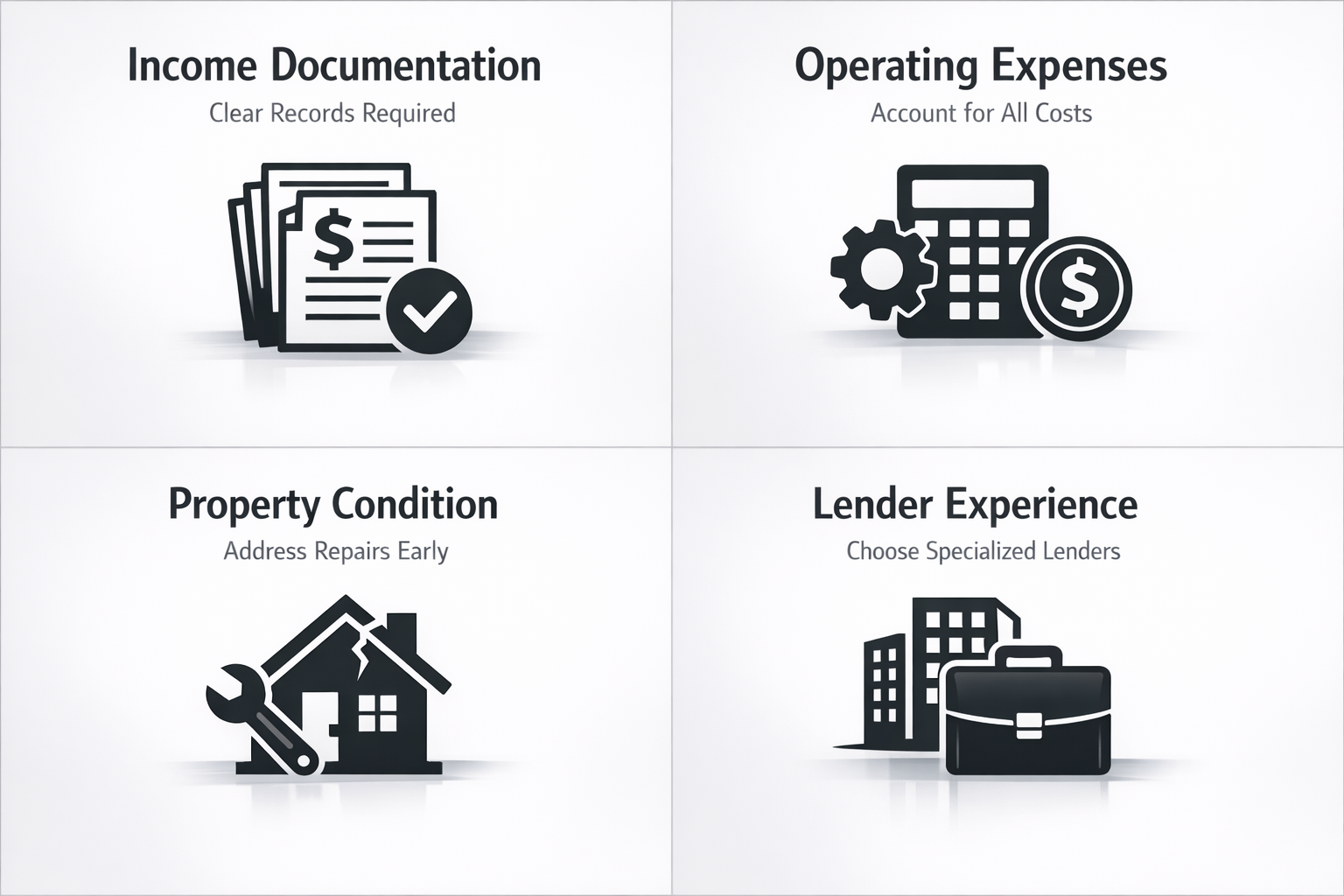
Inadequate income documentation across buildings: Failing to provide clear, separate income records for each building creates confusion during underwriting. Lenders need to see exactly how much rent each structure generates and whether that income is stable and verifiable through leases or rental agreements.
Underestimating operating expenses: Some investors focus heavily on gross rental income but overlook the full scope of operating expenses, including maintenance, utilities, property management fees, and reserves for capital improvements. Accurately accounting for these costs is essential for calculating a realistic DSCR.
Ignoring property condition and deferred maintenance: Properties with multiple buildings may have varying conditions, and lenders will assess whether deferred maintenance could affect rental income or property value. Addressing necessary repairs before applying for financing can improve appraisal results and lender confidence.
Choosing the wrong loan structure: Not every DSCR loan is structured the same way. Some investors benefit from individual loans on each property, while others find blanket loans more efficient. Evaluate your portfolio goals, exit strategies, and cash flow management preferences before committing to a particular structure.
Overlooking lender specialization and experience: Not all lenders are equally experienced with compound properties or multi-building investments. Working with a lender who understands the nuances of income allocation and underwriting complexity for these asset types can make the difference between a smooth process and a frustrating one.
Taking time to avoid these pitfalls sets you up for success and positions your application favorably. Lenders appreciate investors who demonstrate attention to detail, realistic financial projections, and a solid understanding of their properties' income-generating potential. By addressing these common issues proactively, you reduce friction in the underwriting process and increase your chances of securing favorable loan terms.
A DSCR loan for properties with multiple buildings opens up financing pathways that traditional mortgages simply can't match. By focusing on cash flow rather than personal income, these loans eliminate documentation barriers and allow you to scale your portfolio based on the economic performance of each asset. Whether you're managing compound properties, mixed-use buildings, or a diverse collection of rental units, DSCR loans offer the flexibility and simplicity that seasoned investors need.
Understanding how income allocation works across multiple buildings, navigating the underwriting complexity with organized documentation, and choosing the right loan structure are all critical steps in maximizing the benefits of DSCR financing. Blanket loans can streamline cash flow management and reduce administrative overhead, while stacking individual DSCR loans gives you the freedom to expand without hitting loan count limits.
As you move forward with your investment strategy, remember that preparation and clarity make all the difference. Lenders want to see stable income, well-maintained properties, and investors who understand their numbers. By presenting a clear picture of your property's performance and avoiding common pitfalls, you position yourself to secure financing efficiently and continue building wealth through real estate.
If you're ready to explore how DSCR loans can support your multi-building properties and help you reach your portfolio goals, the time to start organizing your financials and connecting with experienced lenders is now. The right financing strategy can turn complex properties into profitable, scalable investments that fuel long-term growth.