Breaking into real estate investing can feel overwhelming, especially when you're navigating financing options for the first time. DSCR loan eligibility for first time investors offers a unique pathway that focuses on property cash flow rather than traditional employment verification. These investor-focused loans evaluate your investment property's ability to generate sufficient rental income to cover debt payments, making them particularly attractive for new investors who might not have extensive W-2 income documentation.
Understanding the specific requirements and preparing your financial profile accordingly can make the difference between approval and rejection. While DSCR loans offer more flexibility than conventional mortgages, they still require meeting certain thresholds that every first-time investor should know before applying.
Common Questions About First Time DSCR Loan Requirements
First time investors often have similar concerns when exploring DSCR loan eligibility. Understanding these fundamental questions can help clarify the pathway to approval.
Q: What's the minimum credit score needed for DSCR loan approval?
Most lenders typically require a minimum credit score of 650 for DSCR loans, though some may consider scores as low as 620. Higher credit scores often result in better interest rates and more favorable loan terms.
Q: How much money do I need for a down payment on my first DSCR loan?
Down payment requirements generally range from 20-25% of the property's purchase price. This represents a significant upfront investment that first-time investors should plan for when building their initial capital.
Q: Do I need real estate investing experience to qualify?
DSCR loans focus primarily on the property's cash flow potential rather than your personal investing history. This makes them accessible for first-time investors who can demonstrate the property will generate sufficient rental income.
Essential Financial Requirements for New Investors
Essential financial requirements form the foundation of DSCR loan eligibility for first time investors. Meeting these benchmarks demonstrates your readiness to handle investment property financing.
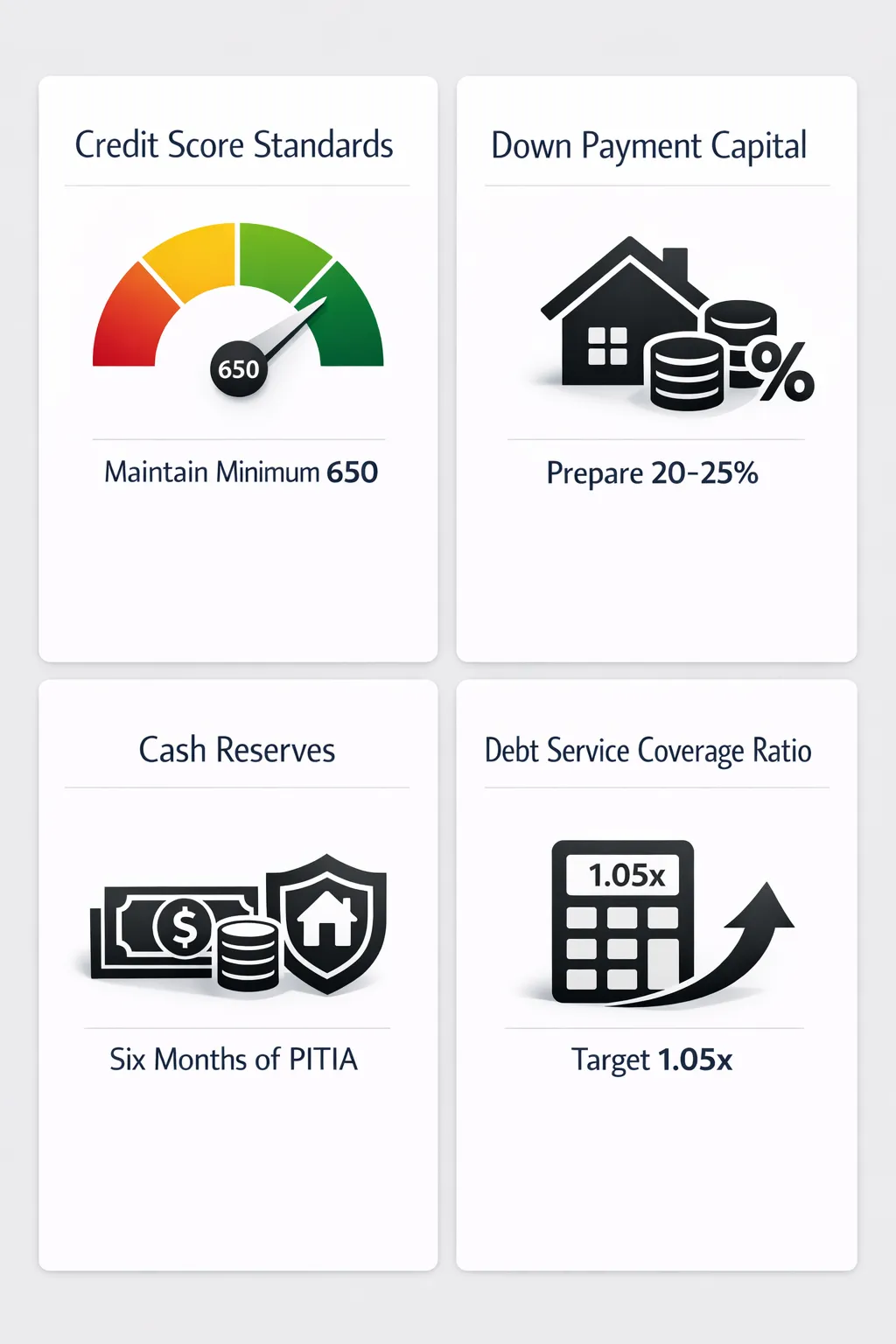
Credit Score Standards: Maintain a credit score of at least 650, with higher scores potentially qualifying for better interest rates and loan terms from various lenders
Down Payment Capital: Prepare 20-25% of the property's purchase price as a down payment, representing a substantial upfront investment that lenders require for risk mitigation
Cash Reserves: Accumulate reserves equivalent to six months of PITIA (Principal, Interest, Taxes, Insurance, and Association fees) to demonstrate financial stability
Debt Service Coverage Ratio: Target properties that generate a DSCR of at least 1.05x, meaning rental income should exceed debt payments by at least 5%
Property Cash Flow Analysis Requirements
Property cash flow analysis requirements determine whether your investment property qualifies for DSCR loan approval. Lenders evaluate the property's income-generating potential rather than your personal employment history.
Rental Income Documentation: Provide current lease agreements, rental market analysis, or professional rent estimates to establish the property's monthly income potential
Operating Expense Calculations: Account for property taxes, insurance, maintenance costs, and property management fees when determining net operating income
DSCR Ratio Compliance: Ensure the property's net operating income divided by total debt service meets or exceeds the lender's minimum ratio requirements
Market Rent Verification: Demonstrate that projected rental rates align with comparable properties in the same market area through professional appraisals or market studies
Documentation Standards for DSCR Applications
Documentation standards for DSCR applications require thorough preparation to streamline the approval process. First-time investors should gather comprehensive financial records that support their loan application.
Asset Verification: Bank statements showing sufficient funds for down payment, closing costs, and required reserves over the past two to three months
Property Documentation: Purchase agreement, property appraisal, rent roll or lease agreements, and any existing property management contracts
Credit History Records: Recent credit reports and explanations for any negative items that might impact loan approval decisions
Insurance Requirements: Proof of adequate property insurance coverage and flood insurance if the property is located in designated flood zones
Step-by-Step DSCR Loan Application Process
The step-by-step DSCR loan application process helps first-time investors navigate each phase systematically. Following these sequential steps can improve your chances of approval and reduce processing delays.
Pre-qualification Assessment: Contact DSCR lenders to review your credit profile, available capital, and investment goals to determine preliminary loan parameters and interest rates
Property Identification and Analysis: Locate investment properties that meet DSCR requirements, obtain professional appraisals, and conduct thorough cash flow analysis to ensure positive debt coverage ratios
Formal Application Submission: Complete detailed loan applications with all required documentation, including financial statements, property information, and projected rental income calculations
Underwriting and Approval: Work with lenders during the underwriting process to provide additional documentation if requested and address any concerns that may arise during property evaluation
Closing Preparation: Review final loan terms, coordinate with title companies, arrange property insurance, and prepare for closing with all necessary funds and documentation
Strategies for Improving Your Approval Odds
Implementing specific strategies for improving your approval odds can significantly enhance your DSCR loan eligibility prospects. These proactive approaches help first-time investors present stronger applications to lenders.
Credit Score Enhancement: Pay down existing debts, correct credit report errors, and avoid new credit inquiries for several months before applying to maximize your credit score potential
Capital Accumulation: Build larger down payment reserves beyond minimum requirements to demonstrate financial strength and potentially secure better loan terms from lenders
Property Selection Optimization: Focus on properties in stable rental markets with strong cash flow ratios potential that clearly exceed minimum DSCR ratio requirements
Professional Team Assembly: Work with experienced real estate agents, property managers, and accountants who understand investment property analysis and can support your application process
Lender Relationship Building: Research and connect with multiple DSCR loan specialists to compare terms and find lenders who specifically work with first-time investors
Qualifying for a DSCR Loan After a Recent Purchase
Some first-time investors want to refinance or pull equity shortly after buying a property, and the timing depends on the lender's seasoning requirements. Seasoning refers to how long you must hold a property before a DSCR refinance is available.
Seasoning ranges vary by lender: Requirements typically range from zero to six months of ownership, with some lenders eliminating seasoning entirely while more traditional lenders may still require three to six months.
Underlying qualification criteria still apply: Even with flexible seasoning, lenders still evaluate credit score (generally 620-680), DSCR (typically 1.0 to 1.25), and property cash flow verification through rent rolls or lease agreements.
Planning ahead helps: Identifying seasoning-flexible lenders and preparing rental documentation and cash flow projections before closing on your first property can streamline a future refinance.
Understanding these seasoning nuances alongside the core eligibility requirements gives first-time investors a clearer picture of when, and how, they can access equity from a recently purchased rental property.
Successfully navigating DSCR loan eligibility for first time investors requires careful preparation and understanding of lender expectations. The combination of meeting credit score thresholds, accumulating sufficient capital reserves, and selecting properties with strong cash flow potential creates a foundation for approval success.
Remember that DSCR loans offer unique advantages for new investors by focusing on property performance rather than personal income verification. This approach opens doors for investors who might not qualify for traditional investment property financing but can demonstrate their chosen property's ability to generate positive cash flow.
Taking time to strengthen your financial profile, gather comprehensive documentation, and work with experienced DSCR loan specialists will position you for success in your first investment property purchase. The initial effort invested in meeting these requirements can lead to long-term wealth building through real estate investing.