Understanding DSCR Loan Underwriting for Investment Success
Real estate investors seeking financing for rental properties often encounter common DSCR underwriting conditions that can significantly impact their loan approval chances. The Debt Service Coverage Ratio has become a cornerstone metric for investment property financing, offering a streamlined path to funding without the traditional income verification requirements that bog down conventional mortgages.
Unlike traditional mortgage products designed for owner-occupied properties, DSCR loans focus primarily on the property's ability to generate sufficient rental income to cover its debt obligations. This approach typically allows investors to close deals faster while building portfolios more efficiently. However, understanding the specific underwriting conditions that lenders evaluate remains crucial for structuring successful investment deals and avoiding costly delays or rejections.
Essential DSCR Ratio Requirements for Loan Approval
Essential DSCR ratio requirements form the foundation of every underwriting decision, determining whether your investment property generates adequate cash flow to support the proposed financing. Most DSCR lenders require a minimum DSCR of 1.0x, meaning the property's net operating income must at least cover its debt service, with ratios of 1.25x or higher typically unlocking the best pricing and terms.
Calculate your ratio accurately: Lenders divide the property's annual net operating income by its total annual debt service to determine qualification. Properties with higher ratios often qualify for better terms and lower interest rates.
Account for market variations: Different property types and geographic markets may have varying DSCR requirements. Lenders might accept lower ratios for stabilized assets in prime locations while demanding higher coverage for riskier investments.
Plan for ratio fluctuations: Seasonal rental markets or vacancy periods can impact your DSCR calculations. Smart investors typically target ratios well above minimum requirements to provide cushion for market changes.
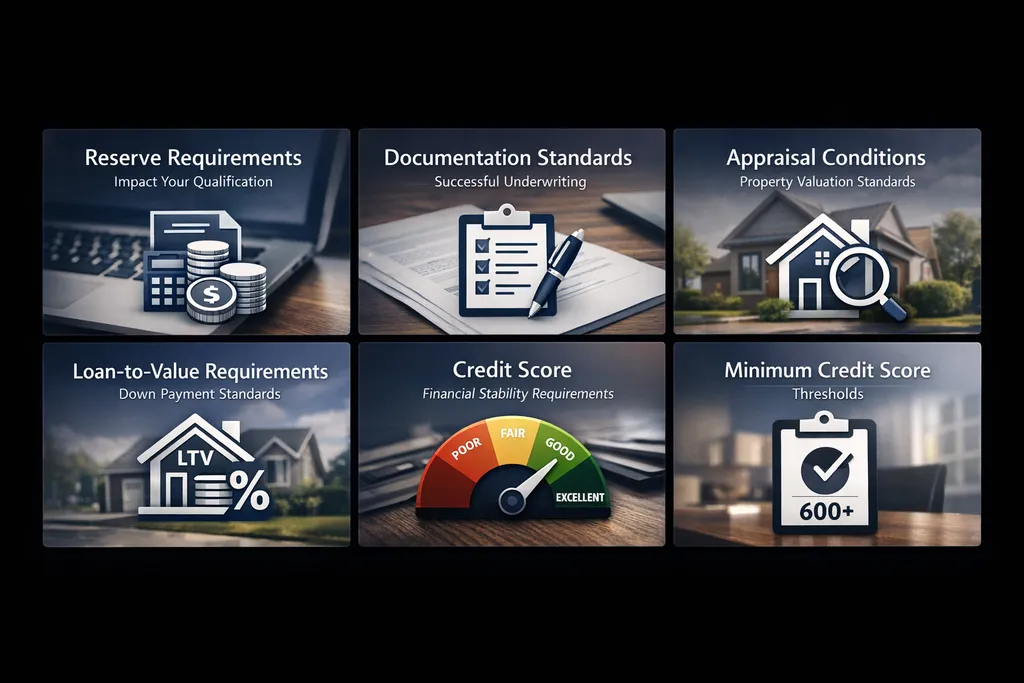
Reserve Requirements That Impact Your Qualification
Reserve requirements represent one of the most common DSCR underwriting conditions that investors must satisfy to secure financing approval. These liquid asset requirements ensure borrowers can handle unexpected expenses, vacancy periods, or market downturns without defaulting on their loan obligations.
Maintain adequate liquid reserves: Most lenders require investors to hold reserves equivalent to several months of mortgage payments in readily accessible accounts. These funds cannot be tied up in retirement accounts or other investment properties.
Document reserve sources properly: Bank statements, money market accounts, and other liquid assets must be thoroughly documented during the underwriting process. Some lenders may accept stocks or bonds as qualifying reserves with appropriate discounts applied.
Consider portfolio-wide requirements: Investors with multiple properties might face aggregate reserve requirements that increase with each additional property in their portfolio. This scaling requirement can impact your ability to rapidly expand your investment holdings.
Documentation Standards for Successful Underwriting
Documentation standards in DSCR underwriting differ significantly from conventional mortgage requirements, focusing on property performance rather than personal income verification. However, investors must still provide comprehensive documentation to satisfy common DSCR underwriting conditions and demonstrate their ability to manage investment properties effectively.
Prepare property-specific documents: Lease agreements, rent rolls, and operating expense records provide lenders with clear pictures of property performance. Properties with established rental history typically move through underwriting more smoothly than vacant or newly acquired assets.
Organize financial documentation: While DSCR loans don't require traditional income verification, lenders still need bank statements, tax returns, and asset documentation to verify reserves and overall financial stability. Complete documentation packages help expedite the approval process.
Include property management details: Some lenders prefer properties managed by professional management companies, while others accept self-managed properties. Having proper management agreements and maintenance records can strengthen your application significantly.
Key Appraisal Conditions and Property Valuation Standards
Key appraisal conditions represent critical elements in DSCR underwriting that determine both loan approval and maximum financing amounts. Property valuation standards for investment properties often differ from owner-occupied appraisals, incorporating income-generating potential alongside traditional comparable sales analysis.
Income approach methodology: Appraisers typically emphasize the income approach for rental properties, analyzing current and potential rental rates alongside operating expenses to determine market value. This approach aligns with DSCR loan principles that prioritize cash flow over personal borrower income.
Property condition requirements: Investment properties must meet specific habitability and safety standards to qualify for DSCR financing. Lenders might require repairs or improvements before closing, particularly for properties with deferred maintenance or code violations.
Market rent analysis: Appraisers conduct detailed market rent surveys to verify that current lease rates align with local market conditions. Properties with below-market rents might qualify for higher valuations based on potential income increases.
Comparable sales verification: Despite the income focus, appraisers still analyze recent sales of similar investment properties to support their valuation conclusions and ensure the property value supports the requested loan amount.
Loan-to-Value Requirements and Down Payment Standards
Loan-to-value requirements in DSCR underwriting typically demand higher down payments compared to owner-occupied financing, reflecting the increased risk associated with investment property lending. Understanding these requirements helps investors plan their capital allocation and evaluate deal feasibility more accurately.
Standard LTV limitations: Most DSCR lenders cap loan-to-value ratios between 75% and 80% for single-family rental properties, requiring investors to contribute 20% to 25% down payments. Multi-unit properties might face even more conservative LTV requirements.
Property type variations: Different property types often have varying LTV standards, with condominiums potentially facing lower maximum ratios compared to single-family homes. Commercial properties typically require even larger down payments to satisfy lender risk parameters.
Geographic considerations: Lenders might adjust LTV requirements based on local market conditions, property appreciation trends, and regional economic factors. Markets with volatile property values often face more conservative lending standards.
Seasoning requirements: Some lenders impose seasoning periods for recently acquired properties, potentially limiting cash-out refinancing options or requiring additional equity contributions for quick refinance transactions.
Credit Score and Financial Stability Requirements
Credit score and financial stability requirements remain important common DSCR underwriting conditions, even though these loans focus primarily on property cash flow rather than borrower income. Lenders use these metrics to assess overall borrower reliability and property management capability.
Minimum credit score thresholds: Most DSCR lenders require credit scores of at least 620 to 640, though better rates and terms typically become available at 700 or higher. Investors with lower scores might face higher interest rates or additional reserve requirements.
Debt-to-income considerations: While not as restrictive as conventional mortgages, DSCR lenders still evaluate existing debt obligations to ensure borrowers aren't overextended. High personal debt loads might trigger additional scrutiny or higher reserve requirements.
Financial capacity verification: Lenders assess overall financial stability through bank statements, asset documentation, and existing real estate portfolios. Borrowers must demonstrate sufficient liquidity and experience to handle investment property ownership responsibilities.
Previous real estate experience: Some lenders prefer borrowers with existing rental property experience, though first-time investors can still qualify with adequate financial strength and professional property management arrangements.
DSCR Underwriting Conditions Checklist
DSCR ratio: 1.0x minimum to qualify; 1.25x or higher for the most competitive pricing.
Credit score: Most programs set a floor between 620 and 680, with better pricing above 680.
Down payment: Typically 20% to 25% of the purchase price.
Cash reserves: Usually 2 to 6 months of PITIA for standard rentals; short-term rental properties often require 6 to 12 months.
Interest rate: DSCR rates in 2026 generally range from 6.25% to 8.00%, depending on credit, DSCR, and loan-to-value.
Closing costs: Budget 2% to 5% of the loan amount for lender fees, title, and escrow setup.
Meeting or exceeding these benchmarks before you apply is the fastest way to move a DSCR file through underwriting without conditions or delays.
Successfully navigating common DSCR underwriting conditions requires thorough preparation and understanding of lender expectations across multiple evaluation criteria. From maintaining adequate DSCR ratios and reserve requirements to satisfying documentation requests and appraisal conditions, each element plays a crucial role in securing investment property financing.
The streamlined nature of DSCR loans offers significant advantages for real estate investors, typically enabling faster closings compared to traditional mortgage products. However, this efficiency depends heavily on meeting the specific underwriting standards that lenders have established to manage their risk exposure while supporting investor growth.
Investors who master these underwriting conditions position themselves for greater success in building and expanding their rental property portfolios. By understanding what lenders evaluate and preparing accordingly, you can move through the financing process more smoothly while securing the capital needed to capitalize on profitable investment opportunities.