Rental property renovations can unlock tremendous value for real estate investors, but only when you've got the right financing strategy in place. Whether you're planning a light refresh or a complete gut rehab, the way you fund your project directly impacts your bottom line, timeline, and overall return on investment. The best ways to finance rental property renovations depend on your specific situation, including your existing equity, credit profile, project scope, and exit strategy.
Understanding the full spectrum of rehab funding options helps you match the right capital source to your investment goals. Some methods offer speed and flexibility at a higher cost, while others provide lower rates but require more time and documentation. As the real estate market continues to evolve, investors who master these financing strategies position themselves to capitalize on value add investing opportunities that others might miss.
This guide walks through proven financing methods used by experienced rental property investors, examining the strengths and considerations of each approach so you can make informed decisions that align with your portfolio strategy.
Common Questions About Renovation Financing
Before diving into specific financing options, it helps to address some foundational questions that many investors ask when planning rental property upgrades. Understanding these basics can clarify your approach and help you avoid common pitfalls.
Q: What types of loans are specifically designed for rental property renovations?
Renovation-specific loans, also known as rehab loans, are designed to finance both the acquisition and refurbishment of investment properties. These products typically allow investors to roll renovation costs into a single loan package, which may simplify the funding process and improve cash flow management during the project. Hard money rehab loans and private lender options often fall into this category, offering tailored terms for investors focused on adding value through property improvements.
Q: How do I decide between using cash reserves versus financing?
This decision often comes down to your overall investment strategy and liquidity needs. While paying cash eliminates interest costs and simplifies the transaction, it also ties up capital that could be deployed across multiple properties or held for contingencies. Financing allows you to maintain liquidity and potentially leverage your capital more effectively, though it does add carrying costs that must be factored into your project budget and return calculations.
Q: When is the best time to refinance after completing renovations?
Refinance timing typically depends on how much value you've added and current market conditions. Many investors aim to refinance once renovations are complete and the property has been stabilized with tenants in place, which can demonstrate improved cash flow and support a higher valuation. However, some lenders may require a seasoning period, so it's worth checking requirements early in your planning process to align your timeline accordingly.
Hard Money and Private Lender Rehab Loans
Hard money and private lender rehab loans represent one of the most popular financing methods among active real estate investors. These non-conventional options often provide quicker access to capital with flexible loan terms, making them particularly attractive for investors who need to move fast on value add investing opportunities.
Speed and flexibility: Hard money loans typically close much faster than traditional financing, often within days or a couple of weeks. This speed can be crucial when competing for properties or when renovation timelines are tight, allowing investors to capitalize on time-sensitive opportunities that might otherwise slip away.
Asset-based underwriting: Private lenders generally focus more on the property's potential value after renovations rather than solely on the borrower's credit history or income documentation. This approach may open doors for investors whose financial profile doesn't fit conventional lending boxes but who have solid renovation experience and a strong project plan.
Higher cost structure: The trade-off for speed and flexibility comes in the form of higher interest rates and points. These loans typically carry significantly higher financing costs than conventional products, which must be carefully factored into your project budget and return calculations to ensure the deal still makes financial sense.
Short-term structure: Most hard money rehab loans are designed as bridge financing with terms ranging from six months to two years. This structure works well for investors planning to renovate quickly and either sell or refinance into permanent financing, but it does create pressure to execute on schedule.
When evaluating hard money and private lender options, investors should compare multiple sources and pay close attention to all fees, including origination points, exit fees, and any prepayment penalties. The total cost of capital, not just the interest rate, determines whether this financing method supports your investment strategy.
Cash-Out Refinancing Strategies
Cash-out refinancing allows investors to tap into existing equity in their rental properties to fund renovation projects. This approach can be particularly effective for investors who have built substantial equity through appreciation or principal paydown and want to reinvest that value into property improvements.
Lower interest rates: Compared to hard money or other short-term rehab funding options, cash-out refinancing typically offers more favorable interest rates since it's structured as a long-term mortgage product. This lower cost of capital can improve overall project returns, especially for renovations that will be held for several years.
Longer timeline: The refinancing process generally takes longer than alternative financing methods, often requiring 30 to 45 days or more to close. Investors need to plan accordingly and may not find this option suitable for time-sensitive projects or when quick execution is necessary to capture market opportunities.
Income and credit requirements: Traditional refinancing typically involves more stringent underwriting standards, including verification of income, employment history, and credit scores. Investors with multiple properties or complex financial situations may find the documentation requirements more burdensome than with private lending options.
Equity preservation: While cash-out refinancing does tap into your equity, it maintains your ownership position completely. This differs from equity partnerships or joint ventures where you might give up a portion of ownership in exchange for capital, making it attractive for investors who want to retain full control.
This financing method works especially well when you're planning extensive renovations on a property you intend to hold long-term. The lower carrying costs make the numbers work better over extended holding periods, and you can amortize the financing cost across years of improved rental income.
Home Equity Lines of Credit for Property Upgrades
Home equity lines of credit represent another avenue for investors looking to leverage existing property equity to fund renovations. These revolving credit facilities offer unique advantages that can complement an investor's broader financing strategy.
Flexible draw structure: Unlike a lump-sum loan, a line of credit allows you to draw funds as needed throughout your renovation project. This flexibility can help manage cash flow more efficiently, as you only pay interest on the amount actually drawn rather than on the entire approved credit line from day one.
Revolving availability: As you pay down the balance, that credit becomes available again for future projects. This revolving nature makes equity lines particularly useful for investors managing multiple renovation projects or those who want to maintain ready access to capital for unexpected opportunities or cost overruns.
Competitive rates: Equity lines often carry interest rates that are more favorable than hard money loans but may be variable rather than fixed. Investors should understand how rate adjustments could impact their project costs and overall returns, particularly if renovations take longer than anticipated.
Qualification considerations: Securing a home equity line typically requires demonstrable income and solid credit, similar to cash-out refinancing. Lenders may also limit the total loan-to-value ratio across all your properties, which could constrain how much capital you can access depending on your existing debt structure.
Many experienced investors use home equity lines as a strategic tool within a layered financing approach, drawing on these facilities for initial project costs and then refinancing into permanent financing once renovations are complete and the property is stabilized.
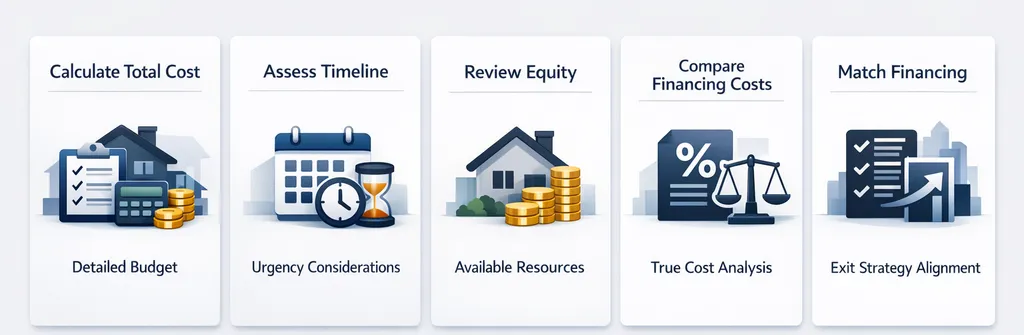
Step-by-Step: Evaluating Your Renovation Financing Options
Choosing among the various best ways to finance rental property renovations requires a systematic evaluation process. Walking through these steps can help you identify the financing method that best aligns with your specific project and investment goals.
Calculate your total project cost: Start by developing a detailed budget that includes not just renovation expenses but also financing costs, holding costs, property taxes, insurance, and a contingency reserve. Understanding your true all-in cost helps you evaluate which financing methods can deliver the returns you need while maintaining an adequate safety margin.
Assess your timeline and urgency: Determine how quickly you need to close on financing and complete the project. If you're competing in a hot market or need to start work immediately to capture seasonal advantages, speed may justify higher financing costs. Conversely, if your timeline is flexible, you might save substantially by pursuing options with longer approval processes but lower rates.
Review your existing equity and liquidity: Take stock of available equity across your portfolio and your cash reserves. Properties with substantial equity may support cash-out refinancing or equity lines, while limited equity might push you toward private lenders who focus more on after-repair value. Your liquidity position also influences whether you can afford to tie up cash or need to preserve reserves for other opportunities.
Compare total financing costs: Look beyond just interest rates to calculate the true cost of each option, including all fees, points, and ongoing expenses. Some financing methods that appear expensive on a rate basis might actually cost less when all factors are considered, especially if faster execution allows you to generate rental income sooner or avoid carrying costs on vacant property.
Match financing to your exit strategy: Consider whether you plan to hold the property long-term, sell after renovations, or refinance into permanent financing. Your exit strategy should influence your financing choice, as short-term bridge loans work well for quick flips or refinances, while lower-rate longer-term options suit buy-and-hold strategies better.
By working through this evaluation process methodically, you can move beyond gut feelings and make financing decisions grounded in the specific economics of your project and the realities of your investment strategy.
Alternative Financing: Joint Ventures and Equity Partnerships
Beyond traditional debt financing, joint venture agreements and equity partnerships offer profitable alternatives that can enable investors to undertake extensive renovations without over-leveraging. These collaborative financing structures involve shared risk and resource pooling, creating opportunities that might not be feasible for individual investors working alone.
Identify complementary partners: Successful joint ventures typically pair investors with different strengths. You might contribute renovation expertise and project management capabilities while a partner provides capital, or vice versa. The key is finding partners whose skills and resources complement your own, creating a combination that's stronger than either party operating independently.
Structure clear agreements upfront: Before beginning any project, establish detailed partnership agreements that specify each party's contributions, responsibilities, decision-making authority, and profit-sharing arrangements. Clear documentation helps prevent disputes and ensures everyone understands expectations, particularly around renovation budgets, timelines, and exit strategies.
Balance control and capital needs: Equity partnerships typically require you to give up some ownership stake and decision-making control in exchange for capital. Consider how much autonomy you're willing to trade for access to funding, and structure deals that preserve your ability to execute the renovation strategy while fairly compensating partners for their capital contribution and risk.
Plan the exit from the beginning: Establish clear terms for how and when partners can exit the investment, whether through refinancing, sale, or buyout provisions. Understanding the exit mechanics before you start helps prevent conflicts later and ensures all parties can realize their returns according to their individual investment timelines and goals.
Joint ventures and equity partnerships can be particularly valuable for larger-scale renovation projects where the capital requirements exceed what you can comfortably finance through debt. These arrangements also allow you to maintain liquidity for other investments and spread risk across multiple parties, though they do require strong communication skills and partnership management.
Specialized Renovation Loan Programs
Several specialized loan programs are designed specifically to finance property acquisition and renovation together in a single package. While some of these programs target owner-occupants, certain versions can work for investors, and understanding the landscape helps you identify all available options for your rehab funding strategy.
Renovation loan programs that combine purchase and rehabilitation financing can streamline the funding process by eliminating the need to secure separate acquisition and construction capital. These products typically involve a single closing, which may reduce transaction costs and simplify your project management by consolidating all financing with one lender.
The underwriting for these specialized programs often considers the property's after-repair value rather than just its current condition, which can increase your purchasing power and allow you to take on properties that might not qualify for conventional financing in their current state. This approach aligns well with proven financing strategies where the opportunity lies in properties requiring significant improvements.
However, these programs typically come with specific requirements around renovation timelines, approved contractor lists, draw schedules, and property standards. Investors need to evaluate whether these requirements align with their project plans and whether any restrictions might constrain their renovation strategy or timeline in ways that reduce overall returns.
Some programs also have limitations on the types of properties that qualify or the scope of work that can be financed. For example, certain programs may exclude properties with structural issues or those requiring more than a specified dollar amount in repairs. Understanding these boundaries helps you determine when specialized renovation programs fit your project and when alternative financing methods might serve you better.
When evaluating specialized renovation loan programs, pay particular attention to interest rates, loan terms, maximum loan-to-value ratios, and any ongoing compliance requirements. Compare these factors against other rehab funding options to determine which approach offers the best combination of cost, flexibility, and alignment with your specific investment strategy and property type.
Selecting the best ways to finance rental property renovations requires understanding your options, honestly assessing your situation, and matching financing methods to your specific project and investment goals. Whether you choose hard money loans for speed, cash-out refinancing for lower costs, equity lines for flexibility, or partnership structures for shared risk, each approach offers distinct advantages depending on your circumstances.
Successful investors typically develop relationships with multiple capital sources and remain flexible in their financing approach, recognizing that different projects may call for different solutions. The financing method that works perfectly for one renovation might be entirely inappropriate for another, even within the same investor's portfolio.
As you build experience with various financing options, you'll develop a clearer sense of which methods align best with your investment style, risk tolerance, and return requirements. This knowledge becomes a competitive advantage, allowing you to structure deals that others might pass on and to execute renovation strategies that maximize returns while managing costs effectively.
The key is to start with a solid understanding of total project costs, maintain realistic timelines, and choose financing that supports rather than constrains your investment strategy. When your rehab funding aligns with your goals, rental property renovations become powerful tools for building wealth and growing your real estate portfolio.